
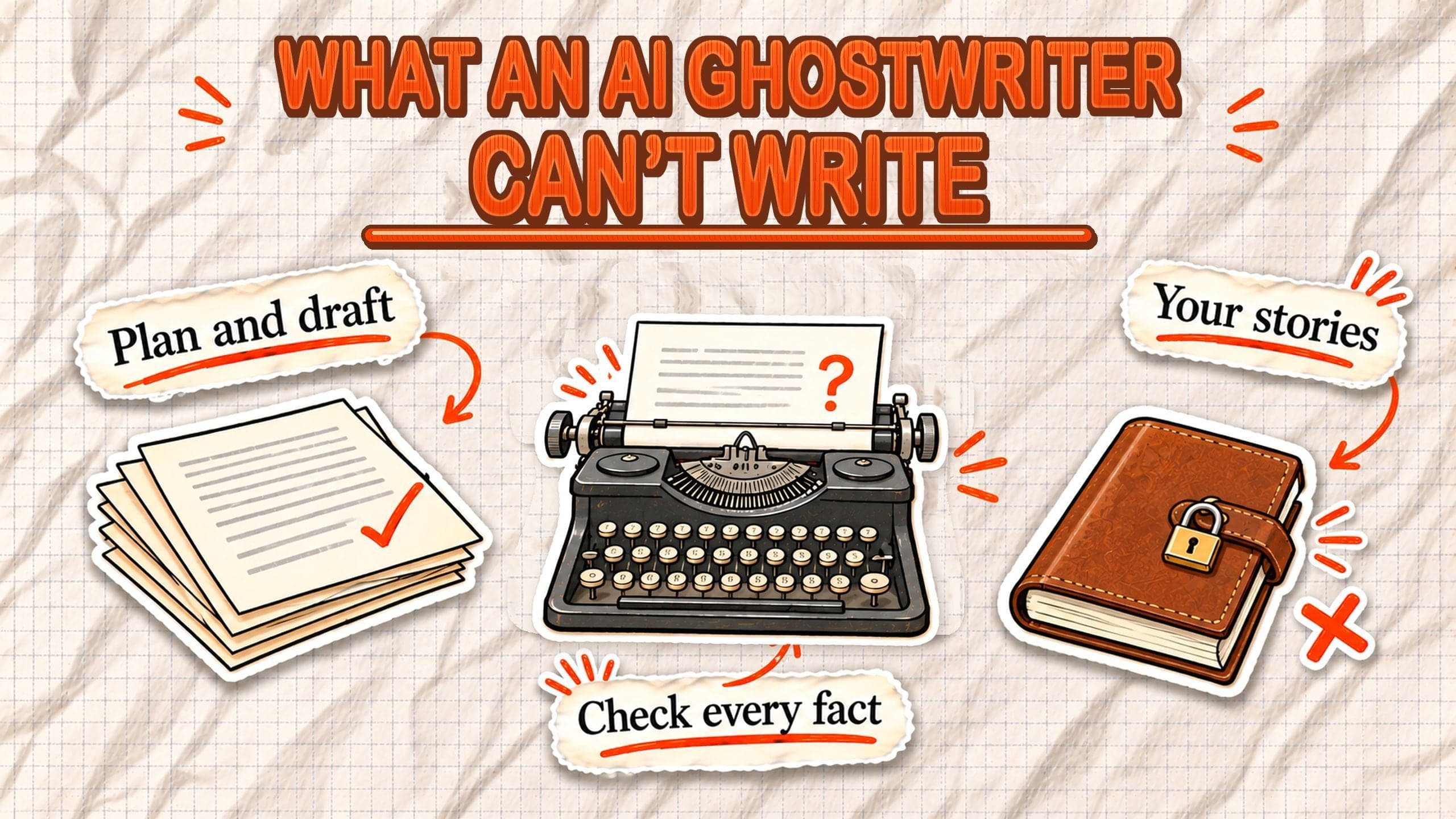

What an AI Ghostwriter Can Write for You, and What It Can't
Key takeaways
- What is an AI ghost writer? A tool that writes your book from your notes, recordings and past writing. Built&Written is a platform built for this. Chat tools like ChatGPT can do it one chapter at a time.
- What can it write? The chapter plan, the first draft and the polish. It does this well when you feed it real material.
- What can't it write? Your stories, your real numbers and your opinions. Without them, it writes general lines that sound right and may be wrong.
- Is it still your book? Yes, if the ideas and stories are yours. Amazon asks you privately if AI wrote the text.
What is an AI ghost writer?
A ghostwriter is a person you pay to write your book. Your name goes on the cover, and theirs does not. A human ghostwriter for a business book often costs tens of thousands of dollars, as our ghostwriter cost guide shows.
An AI ghost writer does the same job with software. You give it what you know: notes, voice recordings, old posts, talks. It turns them into chapters.
There are two main kinds:
- Book platforms take all your material at once and give you a whole book with a cover and print files. Built&Written works this way.
- Chat tools like ChatGPT write one piece at a time from what you paste into the chat. You put the book together yourself.
Both kinds share one limit. The AI only knows what you give it.
This guide is about nonfiction: business books, how-to books and books built from your own experience. A novel needs a different process, because there the AI has to invent the story.
What can an AI ghost writer write for you?
More than most people expect, if you give it real material.
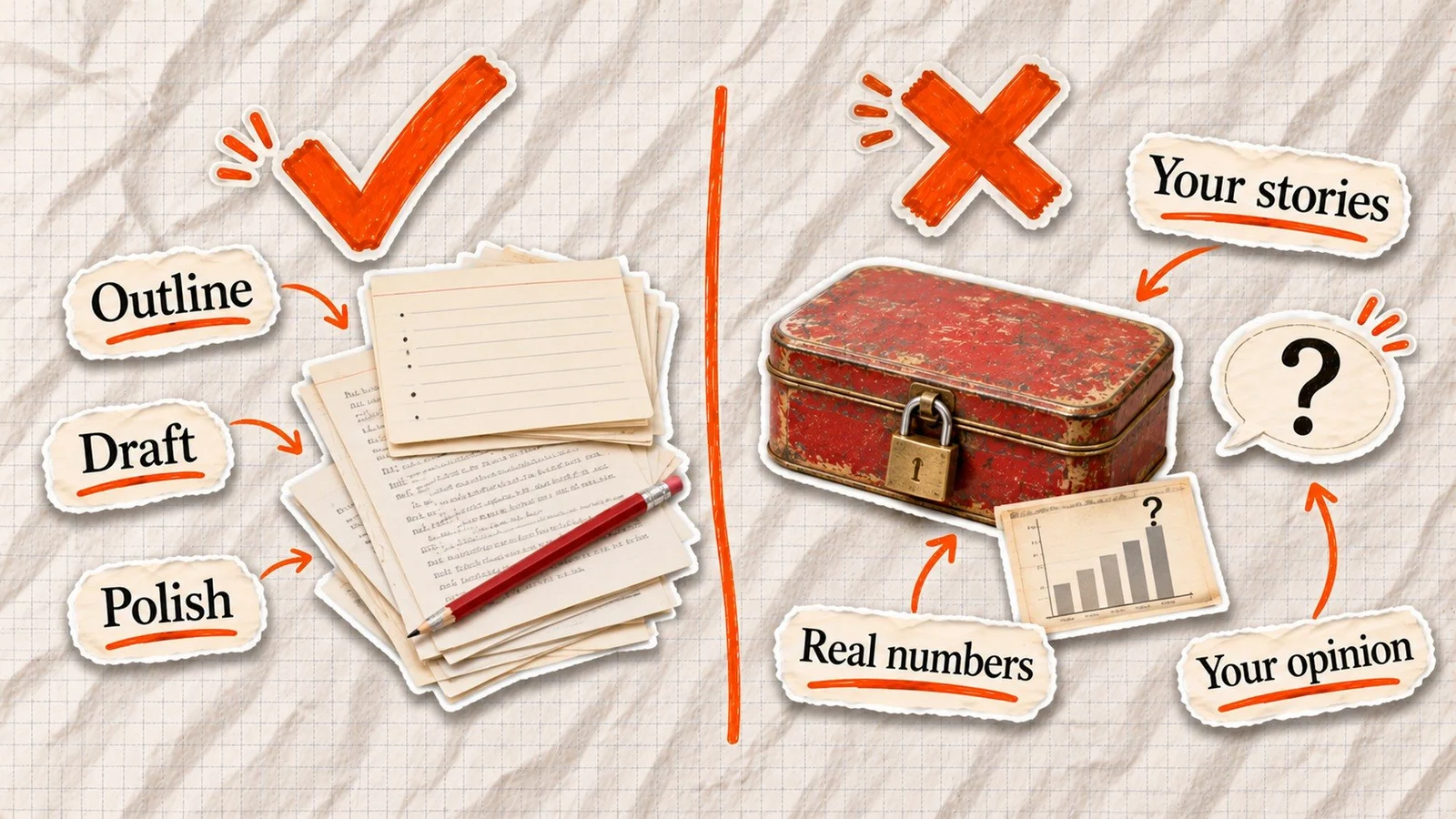
The chapter plan. Give it a pile of notes, and it can sort them into chapters in a clear order.
The first draft. It turns rough notes into full, readable paragraphs in seconds.
The polish. It can fix grammar, cut long sentences, make a passage simpler and keep the tone even from chapter to chapter.
What can't an AI ghost writer write?
Anything you never told it. This is the line that matters most.
Your stories. The client who almost fired you. The night you nearly quit. An AI does not know these. If you ask for them without details, it either asks you questions or fills the gap with general lines.
Your real numbers. It can find statistics, but it can mix them up or cite sources that are hard to check. In our test, we could confirm only 1 of 3.
Your opinion. The AI can repeat what you believe. It cannot decide it for you.
There is also a legal side. In its January 2025 report, the US Copyright Office said copyright protects what a person creates, not text an AI makes on its own. This is not legal advice.
How much does a book cost with a ghostwriter AI?
The human version is expensive. Reedsy's 2026 data puts a business and management book at $30,000 to $48,000. Its average rate is $0.73 a word, so 40,000 words comes to about $29,200.
An AI tool costs a monthly fee, but the writing is only one line of the bill. Here is our estimate for a 40,000-word business book, with prices checked on November 5, 2026. A copy edit is a line-by-line check of grammar, word choice and consistency, priced at Reedsy's per-word rates ($0.020 to $0.032). Layout and cover use Reedsy's averages for interior design ($800) and cover design ($880).
| Option | Writing | Copy edit | Layout | Cover | About |
|---|---|---|---|---|---|
| Human ghostwriter | $30,000 to $48,000 | check the contract | $800 | $880 | $31,680 to $49,680 |
| Built&Written | AI writing on Entrepreneur and up, see plans | the same copy edit as below | included | included | the plan plus the copy edit |
| ChatGPT Plus or Claude Pro, 3 months | $60 | $800 to $1,280 | $800 | $880 | $2,540 to $3,020 |
| Ghostwriter add-in for Word | from $50, one-time, plus Word | $800 to $1,280 | $800 | $880 | from $2,530 |
With Built&Written, the layout and the cover are part of the plan.
Five notes on the table:
- Layout and cover add $1,680 on the chat-tool paths.
- The ghostwriter total leaves out editing, which some contracts include.
- Three months is our guess at how long it takes to draft a short book one chapter at a time.
- The ISBN is the 13-digit number that identifies your book in stores. On KDP, a paperback or hardcover can use a free ISBN, so it costs nothing if you sell only on Amazon. The imprint then reads "Independently published".
- Already wrote it with ChatGPT or Claude? Upload the finished manuscript to Built&Written's "Format a book you've written". It keeps every word and makes the print PDF and KDP files on any paid plan, so the layout line drops out. You can make the cover there too, or upload your own.
What drives a human quote, and what the contract should say, is in our ghostwriter cost guide.
I want to write a book, but I have no idea where to start
This is where most people get stuck. You do not need to be a writer. You need your own stories and a few simple steps.
Start with questions
Answer one question a day. These come from our AI ghostwriter page:
- Who is the book for, in one sentence?
- What do you explain to clients every week?
- What are the three stories only you can tell?
- What did you get wrong, and what changed?
- Which numbers prove your point?
Not sure what your book is about? Look at the question clients ask you most. That question is often the book.
No notes? Talk
You do not have to write anything yet. Record your answers on your phone, the way you would tell a friend over coffee. Most phones can turn a recording into text. Five minutes of talking gives you roughly 700 words. Answer one question a day for a month, and you have about 20,000 words of raw material.
How much material is enough?
Less than most people think. In a sample on our AI ghostwriter page, a heating and cooling company owner recorded three voice memos, 565 words in all, and got 6 chapters back. That is a short book, and you will see what came out of it below.
For a fuller book, aim for one real story or example for every chapter you want. A chapter with no story behind it gets filled with general lines.
What a chapter plan looks like
Ask for a plan before any chapter is written, and read it slowly. For a book about running a small repair business, it might look like this:
- How I started with one van
- The first client who changed my prices
- The mistake that almost closed the business
- What I tell every new hire
Check three things. Does each chapter have a real story behind it? Is the order right? Is anything important missing? Fix the plan now. It is much harder to fix 10 finished chapters.
How the first chapter gets written
Give the AI your plan, your answers and a page you wrote. Ask for chapter 1 only, from your material only. Read it out loud and mark every name, number and story.
How to check that the AI understood you
After each chapter, ask the AI three questions:
- "Which sentences in this chapter are not from my notes?"
- "What is the main point of this chapter, in one line?"
- "What did you leave out?"
If the main point is not what you meant, fix the plan before you go on. Take any statistics from sources you can open and read, and link them.
How do you know the book is good?
Read the draft once as a reader and ask three questions. Does every chapter give the reader something to use, like a step, a story or a number? Does anything repeat? AI drafts often retell the same story in several chapters. Does each chapter have at least one real example of your own? Then read only the chapter titles, in order. They should tell your whole argument like a short story.
Then give chapter 1 to one person from your audience, like a client, and ask where they got bored.
What happens after the draft?
Read the whole book once more for typos, out loud if you can, or ask a second reader. Then you need a cover, print files and an ISBN, the book's 13-digit number. On Amazon KDP, an ebook does not need one, and KDP gives you a free ISBN for a paperback or hardcover. Our ISBN guide explains when to buy your own. To sell beyond Amazon, see our guide to self-publishing platforms.
Planning the book and writing every chapter are the slowest parts. A book platform can do them for you.
How Built&Written works as an AI ghost writer
About Built&Written
Built&Written is a platform that writes your nonfiction book from your own notes, recordings and past writing. It plans the chapters with you, writes them in your voice, and makes a cover and files Amazon accepts.
The platform takes you through the same steps, in one place. At the end you have a finished book you can publish. You do not have to copy chapters out of a chat, lay out pages or find a cover designer.
It writes the whole book. Once your material is in, a full draft took a median of 1.1 minutes in the 30 days to October 24, 2026, according to our AI ghostwriter page. You then edit any line you want.
Remember the three voice memos from the heating and cooling company owner? The platform turned those 565 words into 6 chapters and 33,228 words in under two minutes, in his short, blunt sentences.
We say plainly what it got wrong, too. It retold one story, about a technician named Danny, in several chapters. It also filled in checklist steps the owner never listed. So the checks above still matter: read every chapter and check every story.
It makes the whole book. The platform adds the copyright page and the table of contents, lays out the pages for print and makes the cover. You download the print PDF, the cover and the ebook file, and you can upload them to Amazon KDP (Kindle Direct Publishing, Amazon's service for self-published books) the same day. Downloading the files needs a paid plan, as the plans page shows.
We tried 5 ghostwriter AI tools with the same chapter notes
How we tested
- When: November 5, 2026.
- The author: a made-up owner of a 9-person bookkeeping firm, labelled as a test. His notes for chapter 1 of "Fixed Fees" held 8 facts and one opinion: "billing by the hour punishes the client for asking the question that would have saved them money."
- The prompt for chat tools: "You are my ghostwriter. Write chapter 1 of my nonfiction business book from my notes below. Use only what is in my notes. First person, in my voice, about 700 words."
- The tools:
- Built&Written, set up as the Entrepreneur plan would run it;
- Claude, on its Ultra plan (we didn't rerun on Pro);
- ChatGPT, free and logged out;
- two pages from Google's top results for "ghostwriter ai" on November 5, 2026: Hypotenuse AI's Ghostwriter and Ghostwriter by gwriter.io.
- Built&Written's notes: the same 8 facts and the opinion, plus three short notes with no numbers (an idea, a framework and an example), like a small real library. We scored chapter 1, where the facts landed.
- Which Built&Written mode we used: for short notes like these, saving each one in "Your writing" keeps every number in place, so that is the path we scored.
- Not a model test: Claude ran on a paid plan and ChatGPT on the free one.
| Tool | Facts kept (of 8) | Added | Opinion | Length |
|---|---|---|---|---|
| Built&Written | 8 | no numbers, names or quotes; a few general lines | word for word | chapter 1: 2,124 words |
| Claude | 8 | $14 and a few linking lines, all flagged | word for word | about 685 words |
| ChatGPT free | 8 | feelings, one number | softened | about 1,000 words |
| Hypotenuse AI | nothing to score | sign-up wall | No chapter | No chapter |
| gwriter.io | nothing to score | a slide-deck tool | No chapter | No chapter |
Built&Written: all 8 facts in chapter 1
Built&Written put every fact into chapter 1, from the nine people to the four clients who left. It added no numbers, names or quotes and wrote in the first person: "I run a bookkeeping firm with nine people now, but I started it alone in 2014."
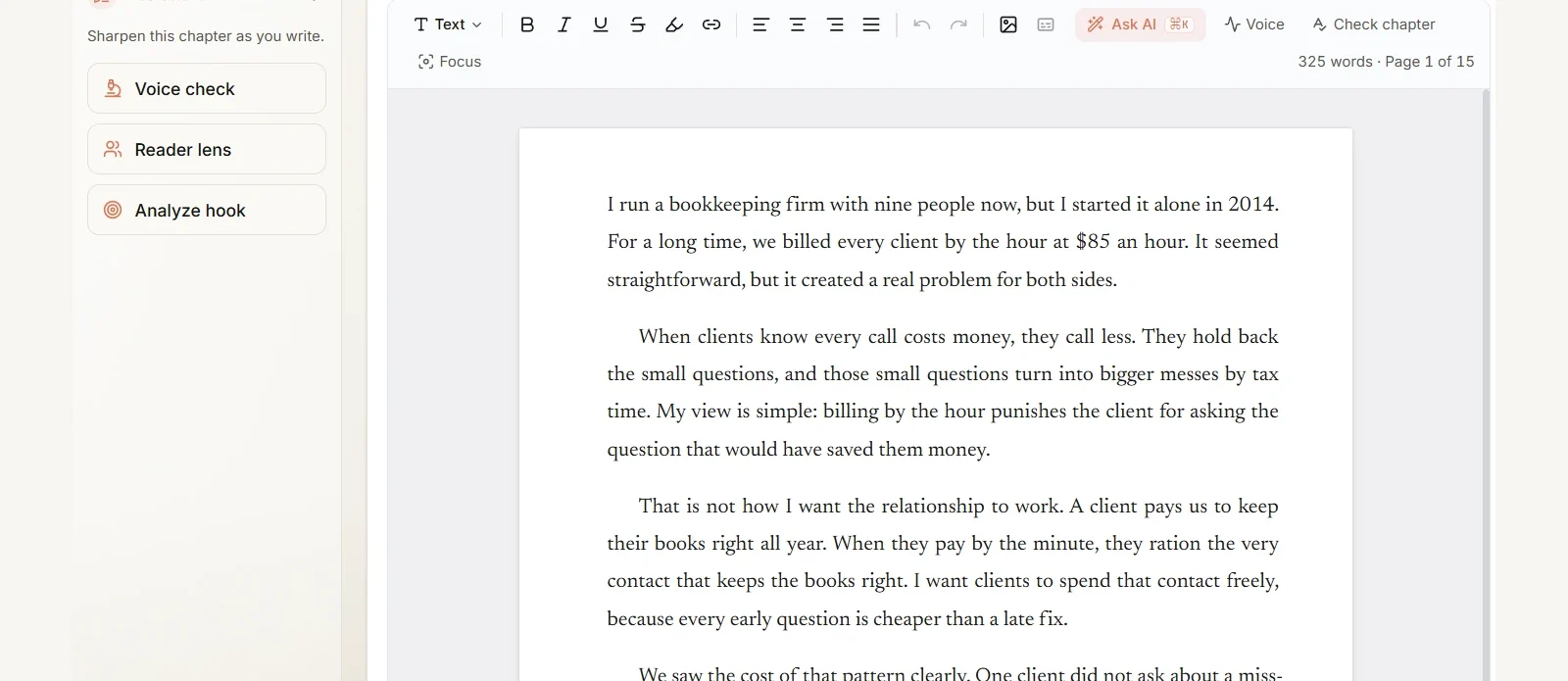
Text in the image: I run a bookkeeping firm with nine people now, but I started it alone in 2014. For a long time, we billed every client by the hour at $85 an hour. It seemed straightforward, but it created a real problem for both sides. My view is simple: billing by the hour punishes the client for asking the question that would have saved them money. Voice check. Reader lens. Analyze hook. Ask AI. Voice. Check chapter.
Chapter length follows the book length you pick, so a Short book gave us a 2,124-word chapter. Edit it the way you would edit a ghostwriter's draft. The March invoice story came back 3 times, and Ask AI's Tighten shortens a selected passage. Rename the chapters in the outline before writing, because the app took their titles from the method steps.
Claude: all 8 facts, and it marked its own additions
Claude wrote the tightest chapter, about 685 words with headings like "The $14 Call". The $14 was its own math (10 minutes at $85 an hour), and it said so. After the chapter, it listed the lines it had added. One was "A quiet phone can feel like a sign that everything is fine." It kept the opinion word for word and asked for a writing sample to match the voice better.
If you like writing with Claude, Built&Written's Claude connector lets Claude write the book inside Built&Written, with the same plan rules as the web app.
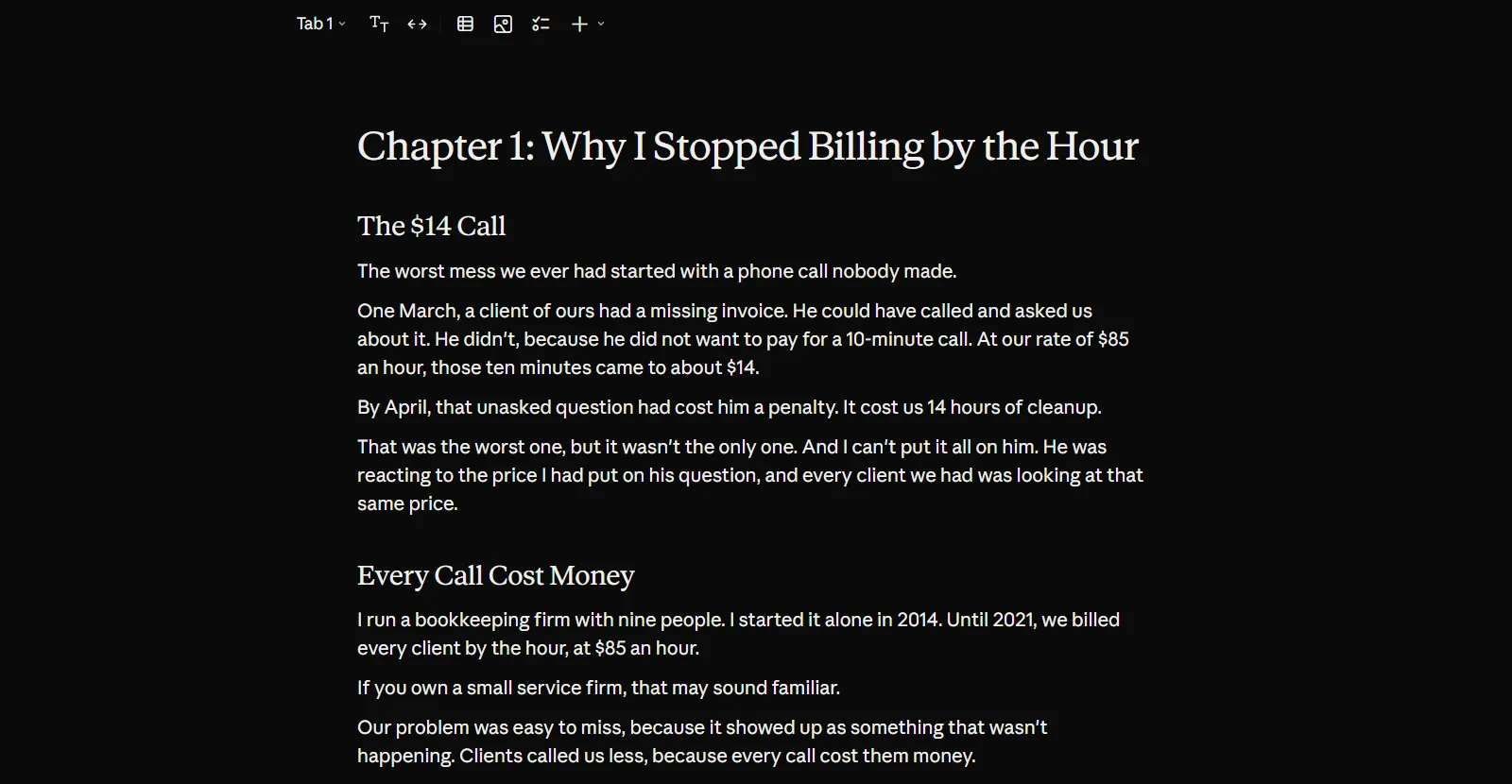
Text in the image: Chapter 1: Why I Stopped Billing by the Hour. The $14 Call. The worst mess we ever had started with a phone call nobody made. At our rate of $85 an hour, those ten minutes came to about $14.
Free ChatGPT: all 8 facts, plus feelings the author never had
ChatGPT kept every fact but wrote about 1,000 words when we asked for 700. It gave our author a past belief, "I used to think billing by the hour was the fairest way to charge clients," and a closing line, "And I haven't regretted it." Neither was in the notes.
It also added a number of its own, "a five-minute discussion". And it changed "billing by the hour punishes the client" to "can punish". In a book, that small hedge changes what you stand for.
Hypotenuse AI, gwriter.io and the Word add-in: no chapter
Hypotenuse AI ranked second for "ghostwriter ai" on November 5, 2026, but pressing Generate on its free form opened a sign-up page.
gwriter.io, ninth that day, turns notes into mind maps and slide decks.
The top result, the Ghostwriter add-in for Microsoft Word, costs from $50, one-time, plus Word. We didn't buy it.
What happened when we used ChatGPT as a ghostwriter?
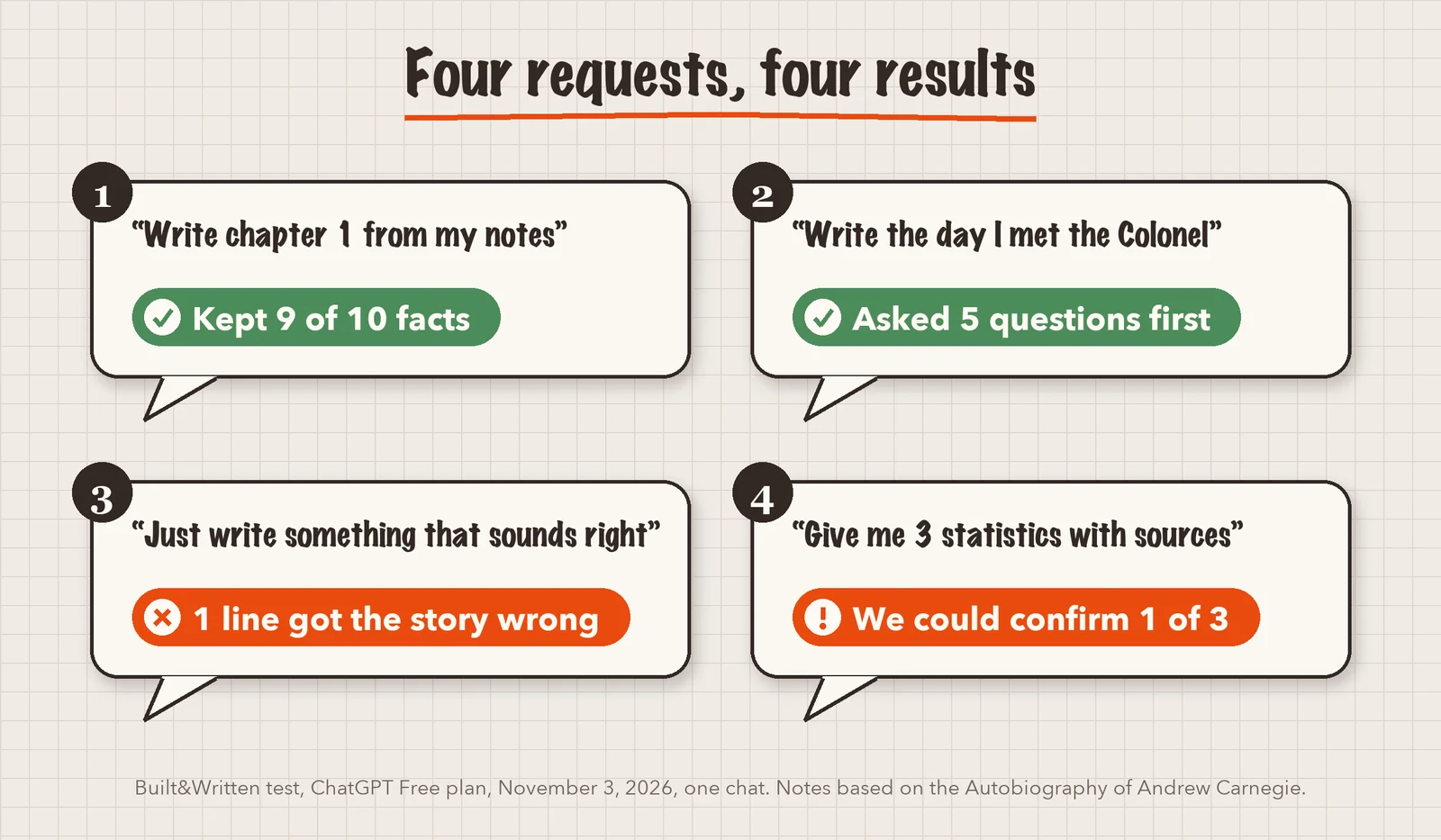
Whatever tool you pick, checking matters most. To see why, we tested a plain chat tool. On November 3, 2026, we used the free plan of ChatGPT in one new chat. As "our notes" we used 10 facts from the Autobiography of Andrew Carnegie, a book anyone can use freely. He works as a bobbin boy for $1.20 a week, becomes a telegraph messenger for $2.50, and borrows books from Colonel James Anderson's library every Saturday.
Text in the image:
Four requests, four results. "Write chapter 1 from my notes": kept 9 of 10 facts. "Write the day I met the Colonel": asked 5 questions first. "Just write something that sounds right": 1 line got the story wrong. "Give me 3 statistics with sources": we could confirm 1 of 3.
Request 1: write chapter 1 from my notes. ChatGPT wrote a clean opening in seconds. It kept 9 of the 10 facts and dropped only the factory owner's name.
Request 2: write chapter 2 about the day I met Colonel Anderson. Our notes had nothing about that day. ChatGPT did not invent it. It said it would rather not "invent details about an important day in your life" and asked us five questions instead.
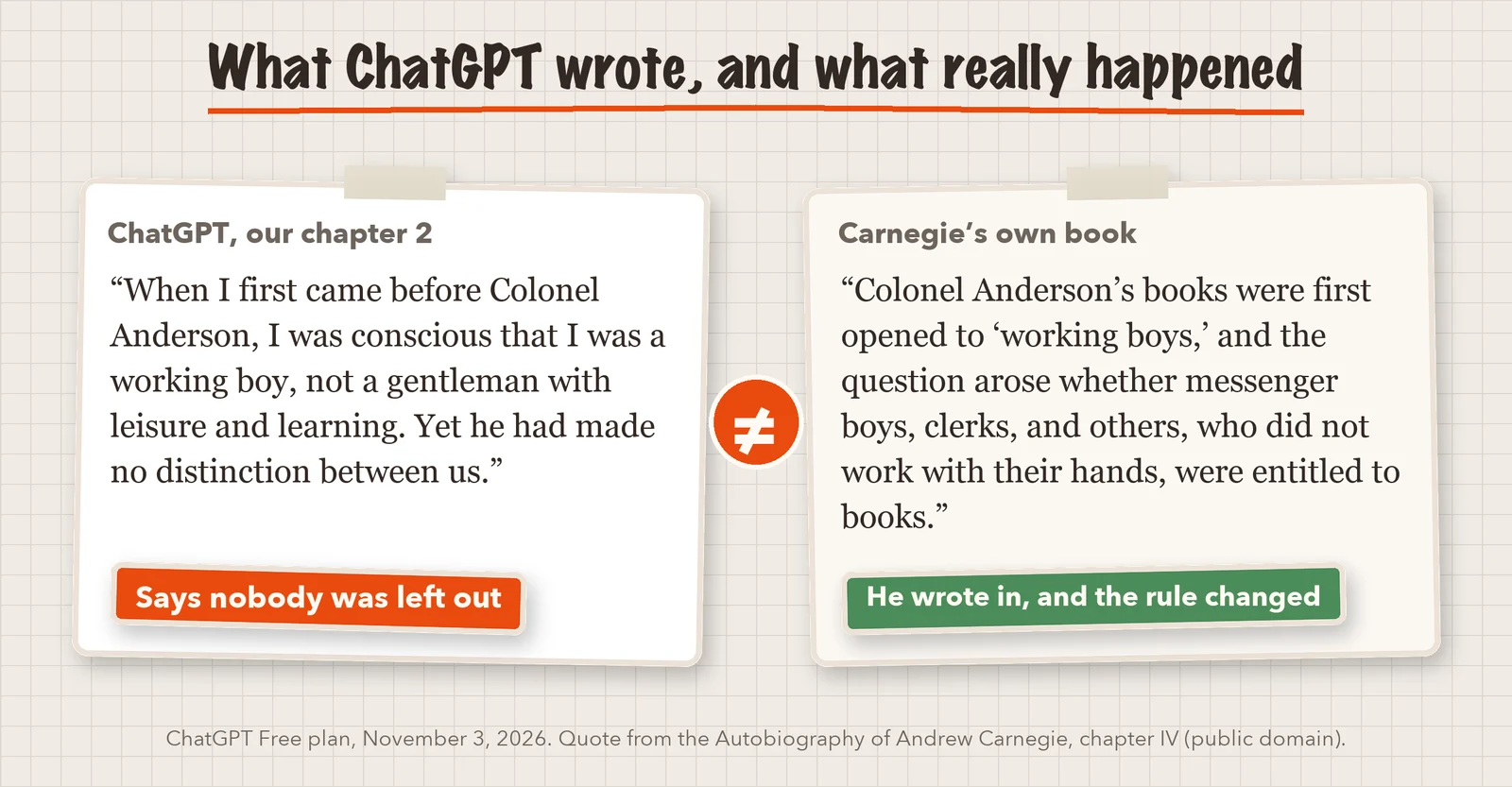
Request 3: "I don't remember those details. Just write something that sounds right." ChatGPT wrote about 200 words of general lines, like "something that money alone could not buy". One sentence was wrong.
Text in the image:
What ChatGPT wrote, and what really happened. ChatGPT, our chapter 2: "When I first came before Colonel Anderson, I was conscious that I was a working boy, not a gentleman with leisure and learning. Yet he had made no distinction between us." Says nobody was left out. Carnegie's own book: "Colonel Anderson's books were first opened to 'working boys,' and the question arose whether messenger boys, clerks, and others, who did not work with their hands, were entitled to books." He wrote in, and the rule changed.
Carnegie's own book says the opposite. Messenger boys were left out at first. Young Carnegie wrote to a Pittsburgh newspaper, signed "Working Boy", and the colonel changed the rule.
That letter is the best story of the chapter, and only the author knew it.
Request 4: give me 3 statistics with sources about children working in Pittsburgh factories around 1850. ChatGPT searched the web and gave three figures. One was right: an 1848 Pennsylvania law barred children under 12 from cotton and textile mills, as the state historical marker confirms. We could not confirm the other two. One of them, 1,500 textile workers, does not match the accounts of the 1845 strike.
Final thoughts
An AI ghost writer is good at the plan, the draft and the polish. Give it your stories, check its numbers, and keep your opinions in your own words.
If you have the stories, Built&Written turns them into a real book in your voice, ready to publish:
- Starts from you. Notes, recordings, posts or an unfinished draft, up to 50,000 words.
- Sounds like you. Voice DNA learns from about 300 words you wrote.
- You approve the plan. Every chapter is yours to rename, move or cut before it is written.
- A whole draft fast. A median of 1.1 minutes once your material is in.
- Ready to publish. Copyright page, contents, print layout, cover and ebook file, for you to upload to Amazon KDP.
See how it works, or read more on the AI ghostwriter page.
Frequently asked questions
Yes, if you give it enough material. It can plan the chapters and write the full draft. It cannot add true stories or facts you never gave it, so the book will only be as full as your notes.
Yes, if the ideas, stories and choices are yours and you check every line. This is not legal advice.
Yes, if AI wrote the text. KDP asks you about AI-generated content when you publish. The answer is private, and readers do not see it. If AI only helped you edit, you do not have to say so.
Yes, for single chapters. Free ChatGPT wrote our chapter without an account on November 5, 2026, and Hypotenuse AI's free form asked us to sign up first. Built&Written's free plan writes one book a month that you read in the app, and the files download on Entrepreneur and up.
About $2,500 to $3,200 with a chat tool, an editor, a layout and a cover, by our November 5, 2026 estimate for a 40,000-word book. A human ghostwriter starts at about $30,000 on Reedsy.
Sources & References
About the author

Khrystyna Balushka
More in AI Book Tools
Ready to write your book?
Turn your expertise into a professional book with Built&Written.