

How to Turn Years of Journaling Into a Book With AI
If you've kept a journal for five, ten, or twenty years, you may already have the raw material for a book. The challenge isn't finding something to write about. It's turning hundreds of personal entries into a story or collection of ideas that makes sense to someone else.
Your journals capture experiences, observations, and lessons, but a book needs a clear direction and structure. AI can help identify recurring themes, organize scattered entries, build chapters, and refine your writing. What it shouldn't do is invent memories or replace your perspective.
Can you turn years of journal entries into a book?
Yes. Years of journal entries can become the foundation of a memoir, personal-growth book, or reflective nonfiction. You've already documented experiences, decisions, mistakes, and lessons that would be difficult to reconstruct from memory alone.
But having enough material for a book isn't the same as having a book.
Journals usually follow the order in which things happened. A book needs a central theme that connects those experiences and gives readers a reason to keep turning the pages. That often means rearranging entries, cutting repetitive details, and adding context that wasn't necessary when you were writing only for yourself.
For example, imagine you've spent ten years journaling about difficult jobs, career changes, and moments of self-doubt. Instead of publishing those entries chronologically, you could turn them into a book about professional reinvention, using specific experiences to illustrate what you learned.
AI can help you find those connections and organize the material. The experiences and conclusions, however, should remain yours.
What kind of book can you write from your journals?
The right format depends on what your journals contain and what you want readers to take away. You don't have to tell your entire life story. Sometimes, a decade of entries about one recurring challenge is enough to build a focused nonfiction book.
Here are four formats worth considering:
| Book format | What to extract from journals |
|---|---|
| Memoir | Important experiences, turning points, and personal transformation |
| Personal-growth book | Lessons, recurring challenges, and reflections on how you've changed |
| Experience-based nonfiction | Practical insights and advice developed through lived experience |
| Thematic essay collection | Individual reflections connected by a shared subject, such as relationships, work, or identity |
To choose, think about your intended reader. Are they interested in your personal journey, or are they looking for guidance they can apply to their own lives?
A memoir might follow how you rebuilt your life after a major change. A personal-growth book could use those same journal entries to explore resilience, decision-making, or developing confidence.
You can ask AI to suggest possible formats based on recurring themes in your entries. But the final choice should reflect the book you want to write, not simply the format that accommodates the most material.
How to turn your journals into a book with AI step by step
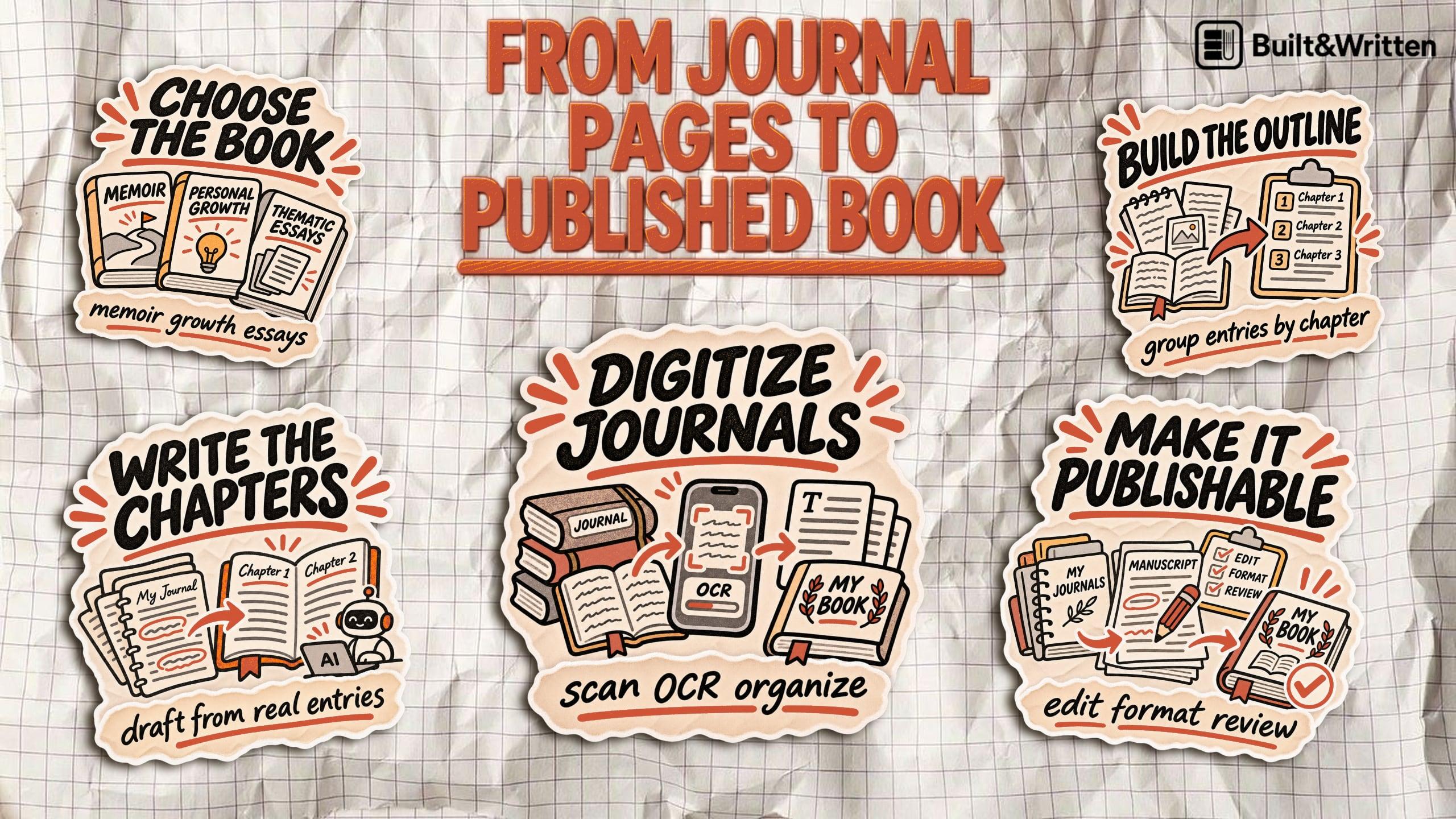
You don't need to feed twenty years of journals into an AI tool and ask it to write a book. A better approach is to work in stages: prepare your entries, find the strongest material, build a structure, and develop chapters while keeping control over the story.
Step 1. Collect and digitize your old journals
Start by gathering everything you've written: handwritten notebooks, digital diaries, phone notes, and reflections saved in documents. Don't worry about deciding what belongs in the book yet.
For handwritten journals, scan or photograph the pages and use optical character recognition (OCR) to convert them into editable text. You can also transcribe important passages manually, especially if your handwriting is difficult to recognize.
Check the converted text before using it with AI. OCR can misread dates, names, punctuation, and entire sentences, potentially changing what an entry means.
Save the entries as text documents, ideally organized by year or subject. Keep the original dates and preserve a separate copy of the unedited material.
This gives you a searchable collection without losing the context of your original writing.
Step 2. Use AI to identify recurring themes and meaningful stories
Reading hundreds of journal entries to find patterns can be exhausting. AI can help by examining batches of entries and identifying subjects you returned to repeatedly.
Look for recurring challenges, significant decisions, relationships, personal achievements, and moments when your perspective changed.
For example, you might discover that entries written years apart repeatedly discuss the same struggle with work-life balance.
Try this prompt:
Analyze these journal entries and identify five recurring themes, significant experiences, and changes in perspective. Use only the information provided. For each finding, reference the original entry date or document name. Do not invent experiences or assume emotions that aren't explicitly described.
Review the results against your journals. AI might identify a recurring theme that you hadn't noticed, but you still need to decide whether it's meaningful enough to build a book around.
You can repeat the process with different batches before comparing the findings.
Step 3. Decide what your book is really about
Once you've identified recurring themes, choose the one that can support a complete book.
Ask yourself three questions:
Who would benefit from reading about these experiences?
What central lesson, question, or transformation connects the entries?
What should readers understand by the final chapter?
Suppose your journals cover fifteen years of relationships, work, travel, and family life. You could write about all of them, but the result might lack direction.
Instead, you might focus on how your relationship with work changed over those years, using relevant experiences to support that story.
A useful book premise could be: A memoir about learning to separate personal identity from professional success.
Not every meaningful journal entry belongs in that manuscript. Some memories matter deeply to you without contributing to the reader's understanding of the central theme.
Step 4. Organize journal entries into a book outline
With a clear premise, you can start organizing your material into chapters.
There are three common approaches:
Chronological: Follow events in the order they happened, particularly useful for memoirs.
Thematic: Group experiences around subjects or lessons, often suitable for personal-growth books.
Narrative: Structure the book around a central conflict, turning points, and eventual change.
AI can suggest chapter structures based on the entries you've selected.
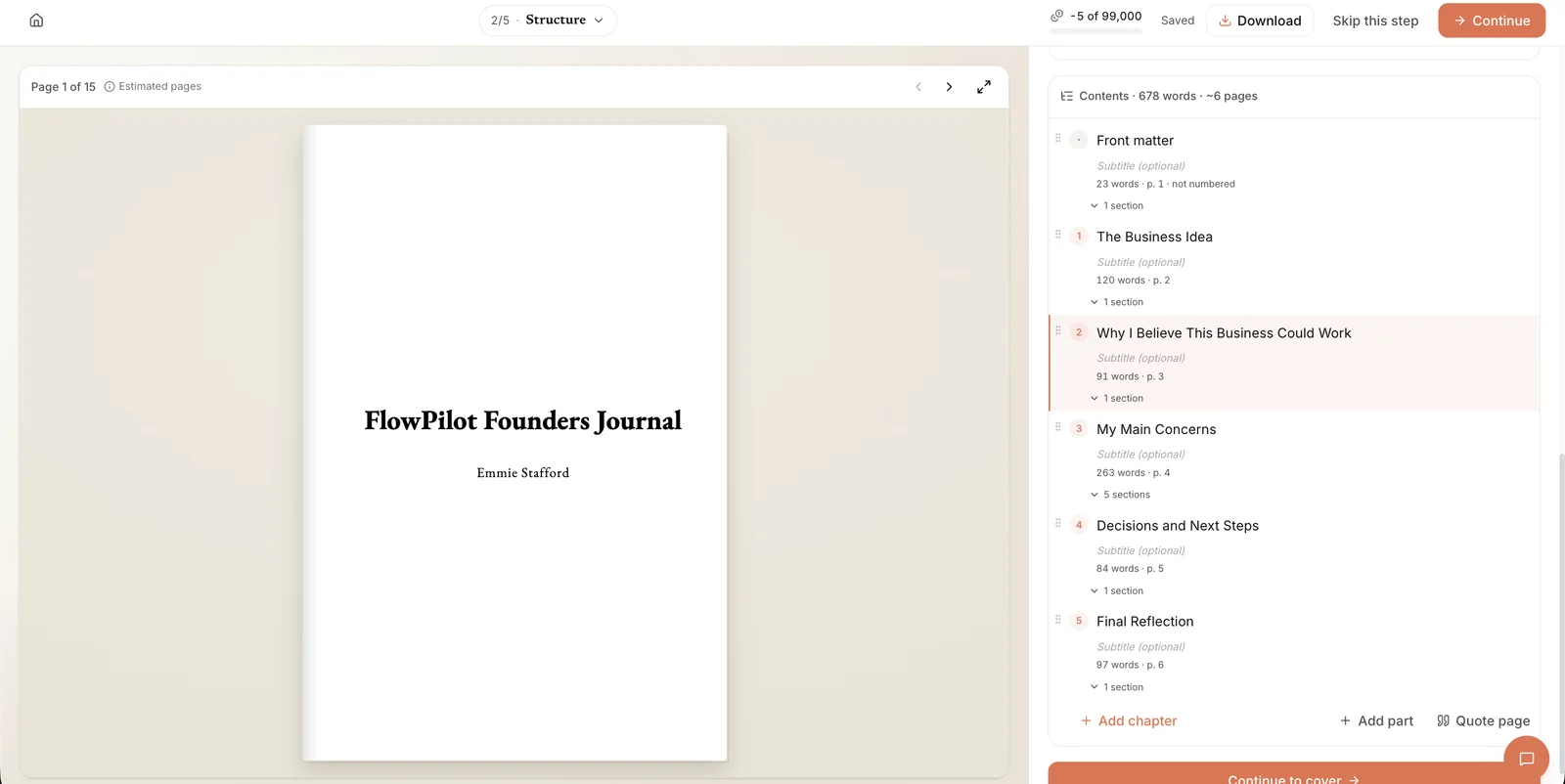
For example, imagine your journals contain scattered reflections about burnout in 2017, changing careers in 2020, and rebuilding confidence in 2023.
Instead of treating these as unrelated entries, you could develop this outline:
When Success Started Feeling Exhausting
Recognizing the Need for Change
Leaving a Familiar Career Behind
Learning to Start Again
Redefining What Success Means
Each chapter would draw from relevant journal entries, even when those entries were written years apart.
Review the proposed outline yourself. Check whether the chapters follow a logical progression and whether you have enough firsthand material to support each one.
Step 5. Turn journal entries into chapters with AI
Now you can begin transforming selected entries into connected prose.
Rather than asking AI to write an entire memoir at once, work chapter by chapter. Supply the relevant entries, your chapter outline, and a clear explanation of what the chapter should accomplish.
AI can help organize scenes, improve transitions, remove repetition, and explain connections between experiences. However, it should never fill gaps in your memories with invented details.
Use a prompt like this:
Turn these journal entries into a nonfiction book chapter following the supplied outline. Preserve my perspective and distinctive wording where possible. Improve the structure and transitions, but don't invent dialogue, events, dates, emotions, or missing details. Flag anything that needs clarification rather than making assumptions.
Some entries may already contain powerful descriptions worth keeping almost unchanged. Others might need rewriting because they rely on private references, fragmented thoughts, or context a reader wouldn't understand.
Compare every draft with its source material before moving to the next chapter.
Step 6. Edit the manuscript without losing your personal voice
A book built from personal journals should still sound like the person who wrote them.
Your original entries may contain distinctive expressions, humor, sentence rhythms, and emotional honesty that generic AI writing tends to smooth out.
Before editing, select representative samples that capture how you naturally express yourself. Use them to guide AI-assisted revisions, and compare the results with your original language.
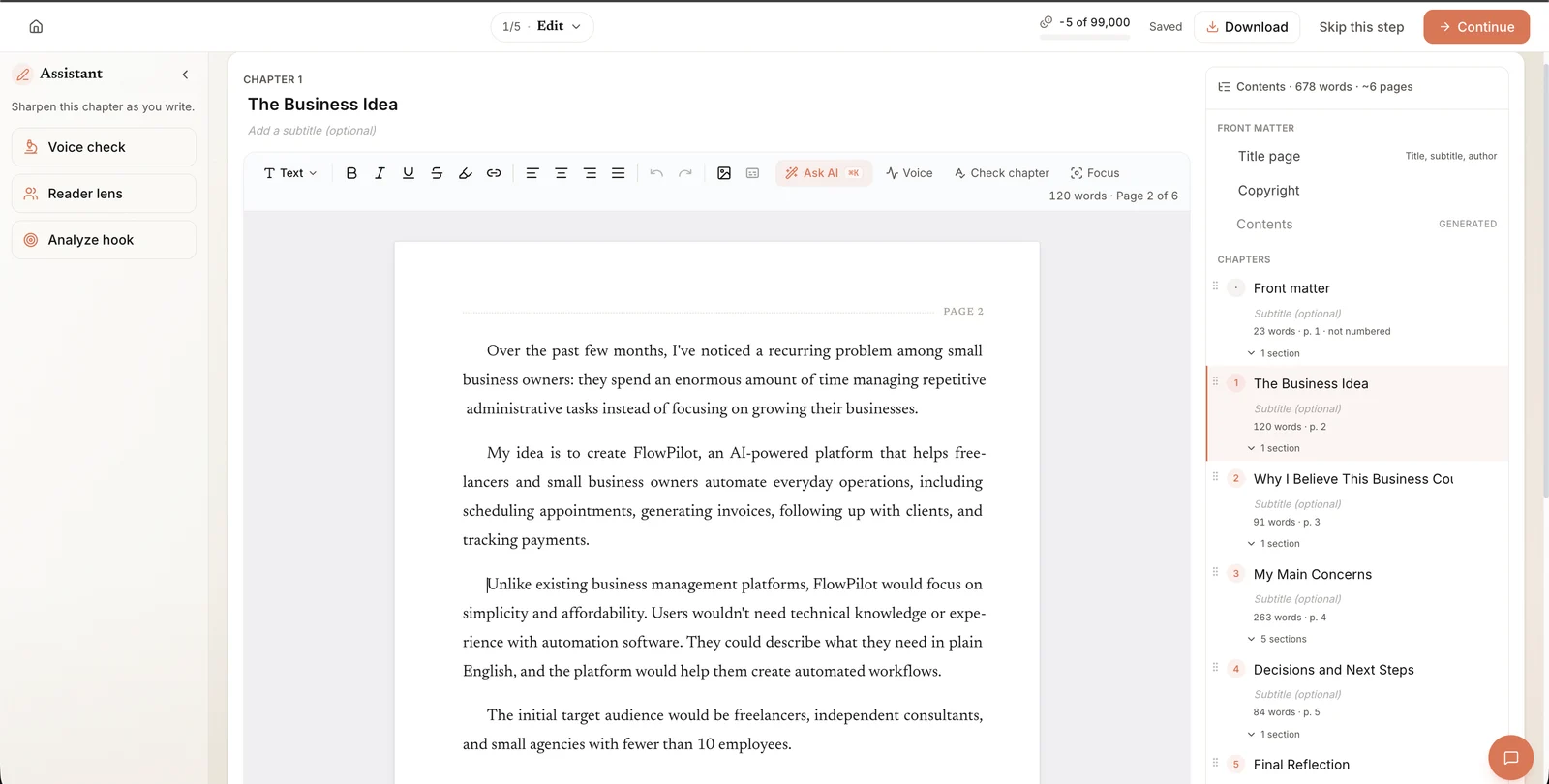
Built&Written's Voice DNA is designed for this purpose. It uses samples of your existing writing to help maintain a consistent authorial voice across an AI-assisted manuscript. You can also develop chapters and revise the text in Built&Written's editor.
Still, no tool can decide which memories deserve emphasis or whether a passage genuinely reflects your experience.
Read the manuscript aloud, restore expressions that sound like you, and remove polished sentences that feel emotionally inaccurate. The goal is a book with the clarity of an edited manuscript and the personality of your original journals.
How to use AI without changing or inventing your memories
When AI turns journal entries into polished prose, it can introduce details that were never in your original writing. A brief note about an argument might become a dramatic conversation, complete with dialogue you don't remember. An uncertain timeline might turn into a sequence of events that sounds convincing but isn't accurate.
AI can also exaggerate emotions, suggesting that you felt devastated, inspired, or relieved when your journal never said so.
The distinction is between what you recorded and what AI interprets. An entry describing a difficult workday is evidence of what you wrote about that experience. It doesn't automatically prove that you were unhappy with your entire career.
To keep your manuscript accurate, compare AI-generated chapters with the original entries. Check:
Dates, locations, and the order of events.
Dialogue and descriptions attributed to real people.
Emotional conclusions and lessons you supposedly learned.
Details that appear in the chapter but have no identifiable source.
When memories are incomplete, acknowledge the uncertainty. Phrases like "I don't remember exactly what happened next" are better than invented scenes presented as fact.
Your book can be engaging without reconstructing every missing detail. Accuracy matters more than a perfectly polished narrative.
What should you leave out of a book based on your journals?
Your journal was written for you. A published book is written for readers, which means some entries should remain private, even if they're meaningful.
Start by removing repetitive reflections, unrelated experiences, and everyday details that don't contribute to the book's central theme. You don't need to include every argument, difficult week, or personal breakthrough to tell an honest story.
Be especially careful with entries involving other people. Your journals might contain private conversations, sensitive family information, or descriptions of events from someone else's perspective.
Before including those details, consider whether you should:
Ask permission before sharing particularly sensitive stories.
Change names and identifying details where appropriate, without misleading readers.
Remove intimate information that adds little to the narrative.
Review potentially damaging claims about identifiable people for accuracy and legal risks.
Anonymizing someone doesn't always make them unrecognizable, and permission may not resolve every concern.
Leaving something out doesn't mean hiding the truth. It means choosing which experiences serve the story while respecting the privacy of the people involved.
How to turn your journal-based manuscript into a publishable book
Once you've turned your journal entries into chapters, you have a working manuscript. Before publishing, it needs another round of editing, organization, and formatting.
Start with structural editing. Check whether the chapters follow a logical progression, the central theme remains clear, and each section contributes something meaningful. Remove repetition, strengthen transitions, and add context wherever readers might struggle to follow your experiences.
Next, proofread the manuscript for grammar, punctuation, and consistency. Prepare the front matter, including the title page and copyright page, and any necessary back matter, such as acknowledgments or an author's note.
Then format the interior for your chosen book size and prepare a cover that meets your publishing platform's requirements.
Built&Written can help you develop and edit the manuscript, format its interior, and create a print cover. It also exports KDP-ready PDF files and EPUB ebooks, depending on your plan.
You'll still need to review the final files, check the formatting, and upload everything to Amazon KDP yourself. AI can simplify production, but the publishing decisions remain yours.
Common mistakes when turning journals into a book
Having years of personal writing doesn't automatically mean you have a compelling book. Some of the biggest mistakes happen when authors forget that their journals were originally written for themselves, not an audience.
Here are five mistakes to avoid:
Including everything you've written. A complete personal record can overwhelm readers. Select entries that support your book's central theme.
Trying to cover every major life event. Too many unrelated stories make the book feel unfocused. Choose experiences that contribute to the narrative.
Assuming readers know the context. People, places, and conflicts familiar to you may confuse someone else. Introduce essential background information.
Writing only for emotional release. Personal reflection can be valuable, but readers also need a reason to care. Consider what they can learn or understand from each chapter.
Trusting AI-generated interpretations. AI might assign meaning to experiences you never interpreted that way. Check its conclusions against your original entries.
The goal isn't to document your entire life. It's to create a book readers can follow, understand, and remember.
Frequently asked questions
Yes. AI can help transform diary entries into a structured manuscript by identifying useful material, suggesting chapters, and improving transitions. However, it can't independently determine which memories are accurate or meaningful. You'll need to make those decisions and review the resulting text.
There's no minimum number. A few detailed entries covering significant experiences might provide more useful material than hundreds of repetitive notes. What matters is whether you have enough relevant content to develop your book's central idea. You can also write new material to connect or explain existing entries.
Yes. You can digitize handwritten journals using scanning and OCR tools or transcribe them manually. Once converted into text, the entries can become source material for a memoir. Keep the original notebooks so you can verify dates, wording, and details during editing.
No. Memoirs often move between different periods to develop themes or provide context. You can organize your entries around important experiences rather than dates, provided readers can understand when events occurred.
Yes. You generally own the [copyright in your original diary writing](https://www.copyright.gov/engage/writers/) and can adapt it into a book. However, publishing private conversations, identifiable information, or sensitive claims about other people can create legal or privacy concerns. Review these details carefully before publication.
Sources & References
- Library of Congress, The Signal: Volunteers Leverage OCR to Transcribe Library of Congress Digital Collections (May 19, 2025)
- Amazon KDP Help: Paperback Submission Guidelines
- U.S. Copyright Office: What Writers Should Know about Copyright
- The Authors Guild: Writing About Real People, Libel, Defamation, and Rights of Privacy and Publicity (August 7, 2025)
About the author

Polina Karlashchuk
More in Writing
Ready to write your book?
Turn your expertise into a professional book with Built&Written.