

Books Acknowledgments Examples: From Funny to Professional + Template
Book acknowledgments are the section where an author thanks the people who helped bring the book to life, including editors, agents, researchers, colleagues, friends, and family. They can appear in the front matter or at the end of the book, and there is no fixed format they have to follow. Some authors keep them brief and professional, while others make them personal, emotional, or funny. Below, you'll find 19 real book acknowledgments examples across four different styles, plus a practical template you can adapt for your own book.
That freedom is what makes acknowledgments interesting. Looking at real examples, from heartfelt notes to funny acknowledgements in books, can help you decide what fits your own voice. Below, we'll break down different styles, who to thank, where the page goes, and give you a template you can adapt for your own book.
What Are Acknowledgments in a Book?
A book acknowledgments page is the section where the author thanks the people who contributed to the book or supported them while they were writing it. That can include editors, agents, researchers, interviewees, colleagues, friends, family members, or anyone else who played a meaningful role in the process.
The purpose is simple: to recognize those contributions and give readers a little context about the people behind the finished book. There is no required structure or tone. An acknowledgments section can be a few lines or several pages, formal or personal, carefully organized or conversational. What matters most is that it feels appropriate for the author and the book.
In fiction, acknowledgments often focus on editors, agents, early readers, and personal support. In memoir, they can carry more emotional weight because the people being thanked may also be connected to the experiences described in the book. Business and professional books tend to include a wider network of contributors, such as researchers, colleagues, clients, interviewees, subject-matter experts, and teams whose knowledge helped shape the author's ideas. Nonfiction acknowledgments often sit somewhere between the two, combining professional credit with more personal thanks.
Where Does the Acknowledgments Page Go?
An acknowledgments page can appear in either the front matter or the back matter of a book. The choice depends on the book's structure, the length of the section, and how quickly the author wants readers to reach the main text.
In the front matter, acknowledgments usually appear before the main body of the book, alongside sections such as the title page, copyright page, dedication, table of contents, preface, or introduction. This placement works best when the acknowledgments are short and closely connected to the setup of the book.
In the back matter, acknowledgments appear after the main text, often following the final chapter or conclusion. This is especially common when the section is longer or includes detailed thanks to editors, researchers, interviewees, colleagues, clients, or family members. Putting it at the end keeps the opening pages focused and lets readers move into the book without several pages of acknowledgments first. If you are preparing the finished manuscript for Amazon, this is also where book formatting for Kindle and KDP becomes important, since front matter, chapters, and back matter need a clear structure.
Who Should You Thank in Your Book Acknowledgments?
A good acknowledgments section usually starts with the people who had the most direct impact on the book, then moves outward to broader professional and personal support. You do not need to follow a strict formula, but a clear framework can help you decide who to include in your book acknowledgments and how prominently to thank them.
- People directly involved in the book
- Editors, agents, publishers, designers, and researchers
- Experts, interviewees, colleagues, and organizations
- Friends and writing communities
- Family and partners
- Anyone whose contribution was especially personal
You do not need to thank everyone you know. Acknowledgments are more meaningful when they focus on people who genuinely contributed to the book or supported the process in a significant way. A shorter, specific list usually feels more sincere than several pages of names with little explanation.
Funny Acknowledgments in Books: Real Examples
Book acknowledgments do not have to sound formal. Some authors use the page to make a joke, tease themselves, or acknowledge how strange and exhausting the writing process can be. The best funny acknowledgements in books still express genuine gratitude, but they do it in a voice that feels unmistakably like the author.
1. Caroline Bassett, The Arc and the Machine
"As is usual in these cases, none of them are to blame."
Caroline Bassett, The Arc and the Machine
Bassett follows a conventional opening about the people who offered advice, support, and friendship with this dry disclaimer. The joke works because it turns the usual acknowledgment formula on its head without distracting from the people she goes on to thank.
2. Terrence T. Tucker, Furiously Funny: Comic Rage from Ralph Ellison to Chris Rock
"I thought about listing everyone from my pre-K teachers to the customers at a gas station where I used to work."
Terrence T. Tucker, Furiously Funny: Comic Rage from Ralph Ellison to Chris Rock
Tucker makes the acknowledgments themselves part of the joke. The deliberately excessive list he imagines is funny because it exaggerates how far an author could go when trying to remember everyone who contributed to a long project.
3. Joseph McCormack, Brief: Make a Bigger Impact by Saying Less
"My friends and extended family followed suit saying the book should be only 10 pages long. Funny...I'm still laughing."
Joseph McCormack, Brief: Make a Bigger Impact by Saying Less
For a book entirely about brevity, McCormack could hardly avoid jokes about its length. The acknowledgment uses the book's own premise as the punchline, giving the section some personality while staying connected to the subject of the book.
4. Matthew J. Salganik, Bit by Bit: Social Research in the Digital Age
"Eli and Theo, you have asked me so many times when my book will finally be finished. Well, it is finally finished."
Matthew J. Salganik, Bit by Bit: Social Research in the Digital Age
Salganik uses a small family moment to acknowledge just how long the project took. It is playful rather than joke-heavy, and it shows how humor can make a thank-you feel more personal and specific.
5. Adam Tarnow, The Fog of Work
"You should probably be listed as co-author, but since we share a checking account, I guess it all evens out."
Adam Tarnow, The Fog of Work
Tarnow uses a joke while thanking his wife for listening, challenging, encouraging, and celebrating with him throughout the project. The humor feels natural because it comes after a specific explanation of what she contributed, rather than replacing the actual thank-you.
Humor can be dry, self-aware, playful, or built around an inside joke. What makes it work is that the joke still leaves room for the actual purpose of the page: recognizing the people who helped make the book possible.
Heartfelt Book Acknowledgments: Real Examples
A heartfelt acknowledgment does not need to become a long personal essay. Often, the most emotional examples work because the author identifies exactly what someone contributed, whether that was encouragement, patience, guidance, friendship, or simply being present during a difficult writing process.
1. Halifu Osumare, Dancing in Blackness: A Memoir
"My husband Gene Howell deserves special thanks for his unconditional love and support."
Halifu Osumare, Dancing in Blackness: A Memoir
Osumare also thanks her mother, father, and stepfather for the values they gave her. The acknowledgment feels personal because she connects each person to a specific role in her life and in the writing of the memoir, rather than relying on a general statement of gratitude.
2. Vanessa Christina Wills, Marx's Ethical Vision
"They were my first teachers, my first audience, and my first constructive critics."
Vanessa Christina Wills, Marx's Ethical Vision
Wills uses these words to thank her parents, Andrea Beaumonte and Walton Wills. She then expands the acknowledgment to the wider community of friends, mentors, colleagues, and comrades who supported her. It is emotional without being vague because she explains what her parents and community actually provided.
3. Alix Beeston, In and Out of Sight
"A model of intellectual and interpersonal generosity whom I hope to spend my life emulating."
Alix Beeston, In and Out of Sight
Beeston uses this line to describe her mentor, friend, and doctoral supervisor Sarah Gleeson-White. Instead of simply thanking a mentor for "support," she identifies the quality that made that relationship meaningful. That specificity gives a short sentence considerably more emotional weight.
4. Nina Kenwood, Unnecessary Drama
"Forever my first and best readers, cheerleaders, book recommenders, and dearest of friends."
Nina Kenwood, Unnecessary Drama
Kenwood thanks fellow writers Emily Gale and Bronte Coates after describing how their writing group helped her through doubt, lockdowns, early motherhood, and the challenges of completing a second book. The acknowledgment works because the emotion is supported by concrete shared experiences.
5. Augusten Burroughs, Running with Scissors
"Taking me into their home and accepting me as one of their own."
Augusten Burroughs, Running with Scissors
In the acknowledgments to his memoir, Burroughs thanks the real-life family members portrayed in the book and recognizes that their memories of events may differ from his. The result is brief but meaningful. It acknowledges both their place in his life and the complicated reality of writing about people you know.
Heartfelt book acknowledgments do not have to rely on dramatic language. Specific details usually make the emotion stronger. Saying how someone helped, what they taught you, or what you went through together gives the reader a much clearer sense of why that person deserves a place on the page.
Short Acknowledgments in Books: Real Examples
An acknowledgments page does not need to run for several pages. Some authors keep the whole section compact, while others use a few carefully chosen sentences for their most important thanks. These examples show how much can be communicated without turning the acknowledgments into a long list.
1. Joshua Lospinoso, C++ Crash Course
"Above all, I thank my family for giving me creative space."
Joshua Lospinoso, C++ Crash Course
Lospinoso keeps his acknowledgments to just a few short paragraphs. He thanks his family, the people who helped shape the book, and the relative who first sparked his interest in programming. Each group gets a specific reason for being mentioned, so the section feels complete without becoming long.
2. Marc Gregoire, Professional C++, 5th Edition
"Finally, I thank you, the reader, for trying this approach to professional C++ software development."
Marc Gregoire, Professional C++, 5th Edition
Gregoire uses several brief paragraphs to cover his publishing team, technical editors, family, employer, and finally the reader. The structure is straightforward and proves that professional acknowledgments can recognize several groups without explaining every relationship at length.
3. Oisín Deery, Naturally Free Action
"Thanks, both first and last, to Katherine, for everything."
Oisín Deery, Naturally Free Action
This is a particularly minimalist personal thank-you. Deery's acknowledgments continue with professional contributors and colleagues, but this opening shows that an important relationship does not always require a full paragraph of explanation. Sometimes a short sentence carries more weight because the author does not try to over-explain it.
4. Joseph Heath, Following the Rules
"My thanks to those who have helped me with this book over the years."
Joseph Heath, Following the Rules
Heath begins simply, then names the people who read, commented on, and supported the project. Rather than building a personal story around every name, he groups related contributors together and explains their role in a sentence or two. This approach works especially well for academic, nonfiction, and professional books where clarity matters more than length.
Short book acknowledgments still need to feel intentional. The easiest way to keep them concise is to group people by contribution, mention specific help where it matters, and resist the urge to write a separate story about every person. A few thoughtful paragraphs can be enough.
Professional and Business-Book Acknowledgments: Real Examples
Business and nonfiction books often depend on more people than the author alone. Research, interviews, client experiences, expert feedback, and editorial work can all shape the finished manuscript. Strong professional acknowledgments recognize those contributions without reading like a corporate credits page. The key is to explain how people helped, instead of simply listing names.
1. Richard Owen and Laura L. Brooks, Answering the Ultimate Question
"We start by thanking all the organizations that have contributed their time and thought leadership toward examples and case studies."
Richard Owen and Laura L. Brooks, Answering the Ultimate Question
Owen and Brooks begin with the companies that supplied the real-world material behind their book, including LEGO, IBM, Intuit, Dell, and other organizations. The acknowledgment works because the authors connect those companies directly to the case studies readers encounter in the book, rather than presenting a list of corporate names without context.
2. Eric Herrenkohl, How to Hire A-Players
"I wouldn't have anything to say if I didn't have the privilege of working with great clients who lead terrific businesses."
Eric Herrenkohl, How to Hire A-Players
Herrenkohl puts his clients first and immediately explains why. Their businesses and experiences gave him many of the stories and lessons used in the book. He then moves naturally to his agent, mentors, editor, and publishing team. This makes the section feel connected to the book's origins instead of turning it into a directory of professional contacts.
3. Troy Waugh, Leading an Accounting Firm
"This work would have been impossible without the contributions of approximately 100 leaders of our profession."
Troy Waugh, Leading an Accounting Firm
Waugh's book relied heavily on professional expertise. More than 40 industry leaders gave extensive interviews, and some also reviewed and corrected chapter drafts. By explaining what these contributors actually did, Waugh gives meaningful credit to the professional community that helped build the book's authority.
4. Kate O'Neill, What Matters Next
"Thank you to all my keynote clients and advisory clients for sharing stories, questions, and what keeps you awake at night."
Kate O'Neill, What Matters Next
O'Neill thanks clients, podcast guests, researchers, editors, producers, and other collaborators, but she rarely stops at the person's name. She explains that client questions helped shape her thinking and that research support helped organize the material behind her work. Those small details make a long professional network feel personal and relevant.
5. Sharon Gai, How to Do More with Less
"I want to thank my interviewees, Aris, Jessica, Fatih, Michael, and countless others."
Sharon Gai, How to Do More with Less
Gai's acknowledgments reflect the different sources that informed a contemporary business book about AI. She recognizes interviewees, the Centre for AI Safety, GovTech, previous clients, conference audiences, agents, and the Wiley team. Each group is tied to a specific part of her professional experience or the development of the book.
Professional book acknowledgments work best when they show the relationship between the contributor and the finished book. Instead of writing "Thanks to my clients, colleagues, and research team," explain what they provided. A client may have shared a case study, an interviewee may have challenged an idea, a researcher may have verified the evidence, and an editor may have helped turn a complicated argument into a clearer one. That context keeps the section appreciative and human, even when dozens of professional contributors were involved.
What the Best Book Acknowledgments Have in Common
The strongest examples tend to follow the same basic principles. They do not simply name people. They give readers a reason to understand why those people mattered.
Good acknowledgments are usually:
- Specific. They explain what someone actually did, whether that was reading an early draft, providing research, sharing expertise, or offering support during the writing process.
- Personal. Even professional acknowledgments feel warmer when the author adds a detail about the relationship or contribution.
- Appropriate to the author's voice. A funny writer can be funny. A business author can stay polished. A memoirist may choose something more emotional. The acknowledgments should still sound like the person who wrote the rest of the book.
- Selective. You do not need to include everyone you have ever worked with or known. Giving space to the people who genuinely influenced the book makes each thank-you more meaningful.
- Clear about contribution. Readers should be able to understand why a person or organization appears on the page.
For example, compare these two versions:
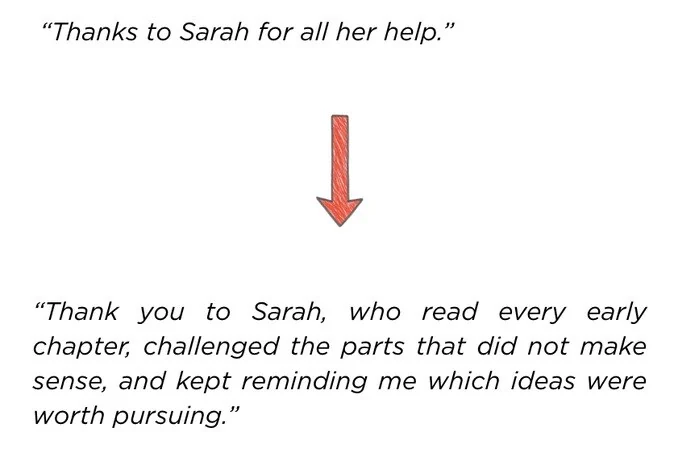
The second version is only slightly longer, but it tells us why Sarah mattered. That specificity is often what separates a memorable acknowledgment from a list of names.
The same principle applies to professional contributors. Instead of writing "Thanks to my research team," an author might mention that the team verified data, tracked down original sources, or reviewed technical sections. Small details make the gratitude feel earned and give the acknowledgments a stronger connection to the book itself. Accuracy also includes knowing what you have permission to publish. If your acknowledgments refer to confidential projects, reproduce quotations, or include material supplied by someone else, review the basics of copyright and permissions for self-published books before the manuscript is finalized.
Book Acknowledgments Template: How to Write One Without Sounding Generic
A useful acknowledgments template should give you structure without making the final page sound copied. The easiest approach is to work in blocks, then keep only the sections that fit your book. Fiction authors may focus more on editors, early readers, friends, and family, while nonfiction authors may also need to include researchers, interviewees, experts, clients, or professional organizations.
Opening
Start with one or two sentences that set the tone.
This book would not exist without the people who helped shape it, question it, and keep it moving forward.
Or:
I am grateful to everyone who gave their time, expertise, encouragement, and patience while this book came together.
Publishing and professional team
My thanks to [editor's name] for [specific contribution], to [agent's name] for [specific contribution], and to the team at [publisher/company] for helping bring this book into its final form. I am also grateful to [designer/researcher/producer's name] for [specific contribution].
This section works best when you mention what each person actually did. "For helping improve the structure" is more meaningful than simply adding another name to the list.
Contributors, experts, or interviewees
I am grateful to [name or group] for sharing [expertise, experience, research, interviews, data, feedback]. Their contribution helped shape [specific chapter, argument, case study, or part of the book].
For nonfiction and business books, this is a good place to acknowledge clients, researchers, subject-matter experts, interviewees, or organizations that provided access or information.
Friends and community
Thank you to [friend/writing group/community] for reading early drafts, asking difficult questions, and keeping me going when the work slowed down.
You do not need to thank every person you know. Focus on the people who actually influenced the manuscript or supported the writing process in a meaningful way.
Family and partner
To [partner's name], thank you for [specific support]. And to [family member's name or family], thank you for [specific contribution, patience, encouragement, or sacrifice].
This is often the most personal part of the acknowledgments, so it can be simpler and more direct than the professional sections.
Closing
End with the person or group you most want readers to remember.
Finally, to [name], thank you for [specific reason]. This book is better because you were part of it.
How to make the template sound like you
Do not copy every sentence exactly. Use the template as a framework, then replace general phrases with details that could only belong to your book.
Instead of:
Thank you to [editor's name] for all your help.
Try:
Thank you to [editor's name] for cutting the chapters that wandered, pushing me to explain the difficult parts more clearly, and knowing when an argument still needed another round of work.
A few practical rules help:
- Name the contribution.
- Be specific.
- Write in your normal voice.
- Vary your wording.
- Be selective.
- Check names, titles, and organizations carefully.
The template should give you a starting point, not a finished acknowledgments page. The strongest version will still sound specific to your book, your relationships, and your voice.
Final thoughts
There is no perfect acknowledgments page. Some authors need three paragraphs, while others need three pages. Some keep it professional, and others make it funny or deeply personal.
What matters is that the section reflects your book, your voice, and the people who genuinely helped create it. Be specific about what they contributed, leave out names you are including only from obligation, and write the section in the same voice readers have already come to know.
For a step-by-step walkthrough of drafting the section itself, see our guide on how to write a book acknowledgements section.
Frequently asked questions
Acknowledgments are where an author thanks the people and organizations that helped create or support the book.
They can appear in the front matter or back matter. Longer acknowledgments are often placed at the end.
There is no set length. They can be a few paragraphs or several pages, depending on how many people contributed.
Include people who genuinely helped with the book, such as editors, researchers, interviewees, colleagues, friends, and family.
Yes. Humor can work well if it feels natural to the author's voice and still expresses genuine appreciation.
A dedication says who the book is devoted to. Acknowledgments thank the people who helped create or support it.
Usually not for a simple thank-you. However, it is safer to ask when mentioning confidential work, clients, private information, or anything that could imply endorsement.
About the author

Polina Karlashchuk
More in Writing
Ready to write your book?
Turn your expertise into a professional book with Built&Written.