

What is creative nonfiction and how do you write it?
Creative nonfiction is true writing told like a story. The writer uses scenes, dialogue and a clear voice, and every fact stays real.
On November 13, 2026, we compared what Creative Nonfiction magazine, a university library guide, Dabble's guide and Wikipedia say about the form. Each claim below names its source. Our own advice is marked.
Key takeaways
- What it is: a literary genre of true stories told with fiction's tools, such as scenes and dialogue.
- Where to start: choose a form (memoir, personal essay, narrative history and others), because the form sets what your reader expects.
- The one rule: the facts stay true. You may reconstruct what you cannot know, and you should say so on the page.
What is creative nonfiction?
Creative nonfiction is a literary genre and an umbrella term, Lee Gutkind says. The magazine Creative Nonfiction sums it up in four words: "true stories, well told." Gutkind, its founder and editor, says the writers in this genre share one thing. They write true stories that inform the reader about a subject, enriched by ideas, personal insight and intimacy.
Some people call it the "fourth genre", next to poetry, fiction and drama, according to Duquesne University's library guide. It is also written "creative non fiction". Wikipedia uses "literary nonfiction" as another name for it, and says book-length works with a story-like arc are sometimes called narrative nonfiction.
That is the short creative nonfiction definition. Unlike news or textbooks, the author's point of view is part of the writing, as Dabble's guide puts it.
What makes nonfiction creative?
The creative part is the technique. Gutkind says these writers borrow from fiction and poetry: dialogue, setting, description and inner point of view. Inner point of view means showing what a person saw, thought and felt in that moment.
Dabble, a writing software company, publishes a guide to the form. It adds a clear narrative voice and figurative language such as metaphor. Figurative language means comparisons and word pictures that help the reader imagine the moment. It also says the structure is open: you do not have to tell events in order, and you can build the story the way that works best for your book. The magazine agrees that the form is flexible in voice, style, subject matter and structure.
How does a plain fact become a scene?
This is an invented example to show how a scene works. The plain fact: I was nervous at my first book signing. The same fact as a scene: I checked my watch three times. Eleven people sat in the folding chairs. My hands left damp marks on the pen. The details are illustrative, not a record of a real event. In your own book, use only details you remember or can verify. If you reconstruct something you cannot fully know, make that clear to the reader.
What are the types of creative nonfiction, with examples?
Gutkind lists memoir, personal essay, biography, narrative history and long-form reportage under the umbrella. The table below follows the Duquesne University library guide, which gives creative nonfiction examples, as books, for each form. It adds the lyric essay. It leaves out biography, which Dabble describes as a record of someone else's life.
| Form | What it is | Books in Duquesne's guide |
|---|---|---|
| Memoir | A long work about the author's own experience with a specific event, theme or topic | The Glass Castle; A Moveable Feast |
| Personal essay | Memoir-like, but essay length | Me Talk Pretty One Day |
| Narrative history | Real history, told as a story | The Radical and the Republican; Johnstown Flood |
| Long-form reportage (Duquesne calls it New Journalism) | Real events or social issues, reported with literary elements, and the author's viewpoint can show | In Cold Blood; Hiroshima |
| Lyric essay | A personal essay with enough figurative language | Men Explain Things to Me; Plainwater |
Which type of creative nonfiction fits your book?
If you plan to publish a book, the form decides what your reader expects. Start from what the book is about. The pairing below is our own advice, built on the definitions above.
| Your book is about | The form that fits |
|---|---|
| One event or theme from your own life, at book length | Memoir |
| One moment or one idea, in a few pages | Personal essay |
| A real event from the past, rebuilt from records | Narrative history |
| A current event or social issue you reported on | Long-form reportage |
| A method, with stories from your work | None of the above |
The last row needs a note. Gutkind, the Duquesne guide and Dabble's guide list no how-to or business book as a form of creative nonfiction. You can still borrow the tools. If your book teaches a method, read our guide to nonfiction book structure first. If you doubt you can write a book at all, start with can you write a book if you're not a writer.
How much can you make up in creative nonfiction?
The main rule: events, names, dates and quotes stay true. If you rebuild a detail from a guess, mark it on the page. The sources differ on how much room you have.
- The magazine says you can't make things up.
- Wikipedia says the text must be factually accurate.
- Gutkind allows more room. A writer can speculate about the past or imagine what someone was thinking, as long as the writer does not break the reader's trust or their own credibility. He says the legal, ethical and moral limits are hard to define.
- Dabble's guide is direct about real people. Do not invent traits or actions to make a person more interesting, and check details such as street names and times against sources.
The first line is our own advice. For more on keeping facts clean, see how to write a nonfiction book with AI without making up facts.
How do you write creative nonfiction?
Dabble names four techniques for writing the form. Here they are as steps.
- Do your research. Nonfiction is true, so check what you can. Old news clippings and interviews both help.
- Tell a story. Pick scenes, people and a place. Let the reader see them.
- Find a clear voice and point of view. Say how you saw the events. You may explain your view, but you may not make up what happened.
- Observe and interpret. Look closely at what happened, then say what it meant.
How do you turn your notes into a creative nonfiction book?
Knowing the form is the easy part. The hard part is the pile you already have: notes, posts, voice memos, half a draft. The pile is not yet a book, and it is easy to stall between the pile and chapter one.
This is where Built&Written fits. It does not choose your story. You choose the story and the form. The platform helps you get from your material to a finished book you can sell through KDP (Kindle Direct Publishing, Amazon's free service for selling your own book). The table puts the two routes side by side.
| Step | With Built&Written | On your own |
|---|---|---|
| Gather material | Paste notes, posts or a rough draft, or drop in a file | Collect everything in one document |
| Outline | The platform proposes chapters, and you edit them | You plan the chapters yourself |
| Write | Chapters are drafted from your material, shaped by your writing samples | You write every chapter |
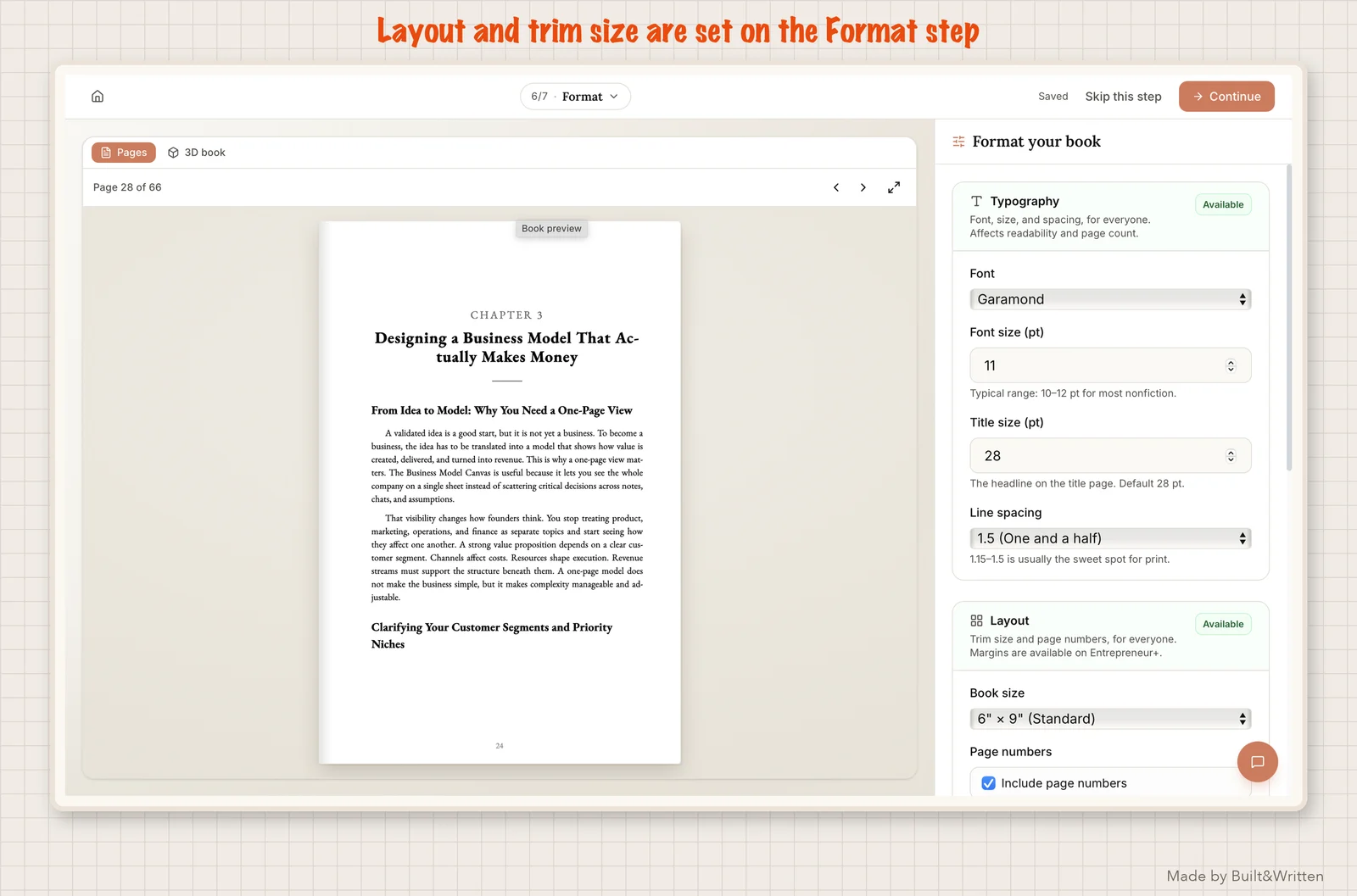
| Layout | Trim size (the final size of the printed book), margins and page layout are set for KDP | You build the print layout in a word processor |
| Cover | A built-in cover editor, with the spine width worked out from your page count | You design the cover yourself or hire a designer |
| Files | KDP-ready files to download | You export and check the files yourself |
What if you only have loose material?
Say you have notes about your childhood, a blog series or a rough draft. A typical run looks like this:
- You paste the material in or drop a file. The platform reads up to 50,000 words of source material. That limit covers the source material, not the length of your finished book. It gives you room to work with a large collection of notes, posts and drafts.
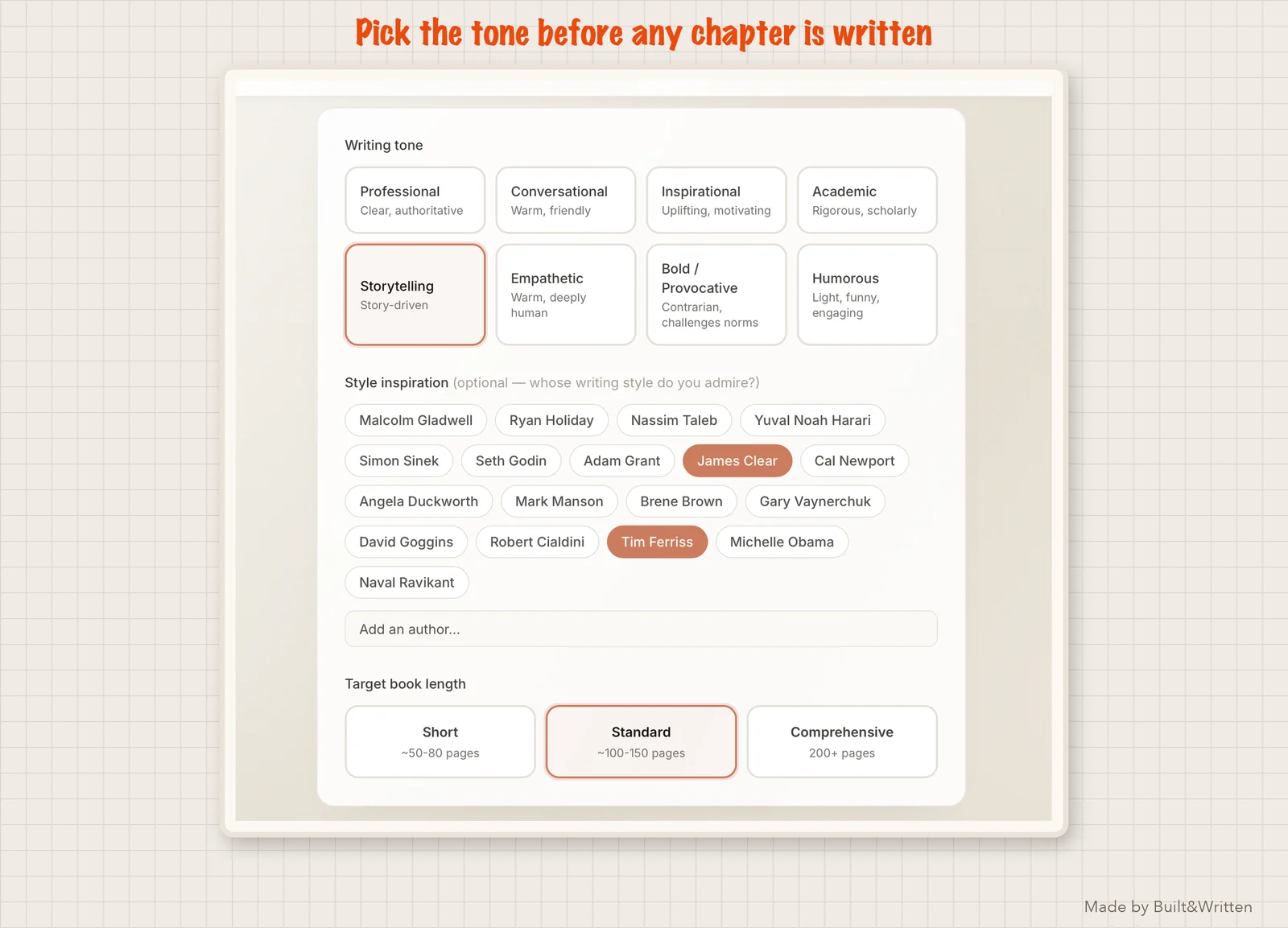
- You pick the title, the audience and a writing tone. One tone is Storytelling, which suits a memoir or a personal story.
- You add a few pages of your best writing. Voice DNA analyzes these samples to help the chapters reflect your usual writing style.
- The platform proposes an outline. You review it, edit it and approve it.
- The platform drafts the chapters from your material, and you edit them.
What if you already wrote the book?
Suppose you finished a memoir in Word. Upload it as a .docx file. The words stay exactly as you wrote them. The platform finds your chapters and rebuilds the layout for print. Fonts and margins come from its templates, so your own formatting is not kept.
What do you get at the end?
You get a formatted book and the files KDP asks for, with checks on title, author, page count, margins and cover. Which files you can download depends on your plan, so look at the pricing page first. You upload the files to KDP in your own account. Built&Written does not upload for you.
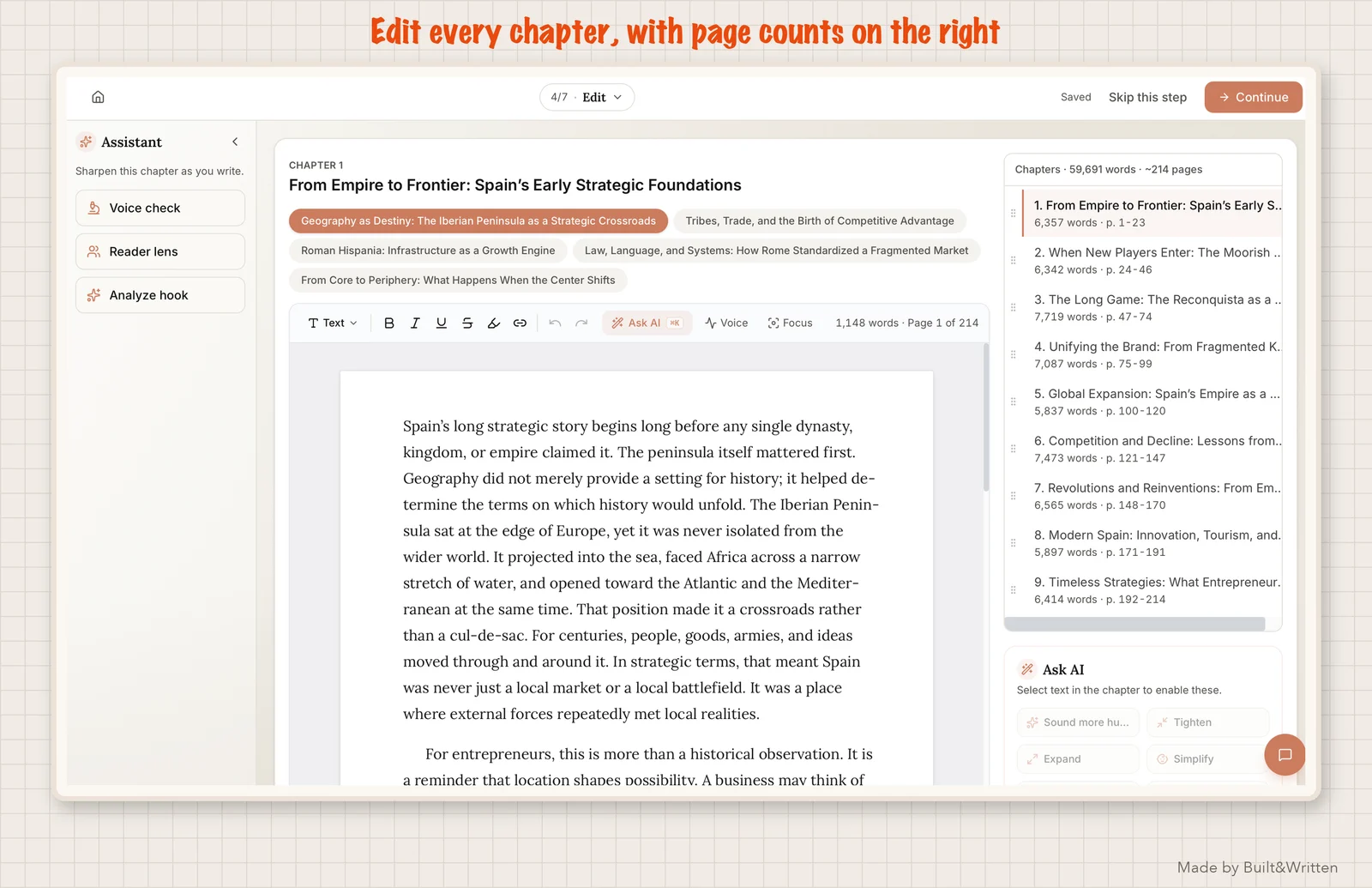
Before you download, you can edit any chapter, change the cover or adjust the layout.
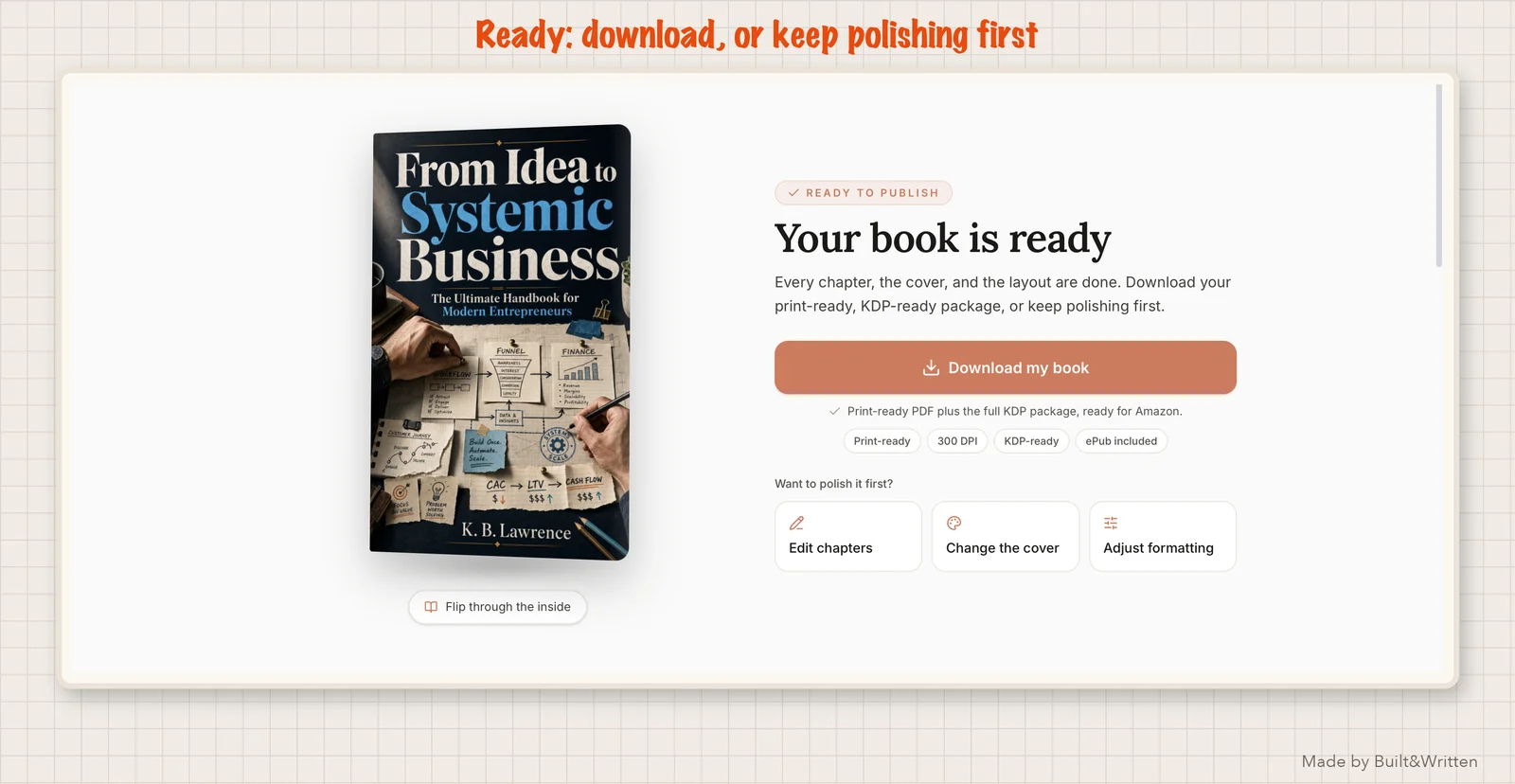
Here are the limits. The platform writes from the material you give it. The real events, names and dates are yours to supply and to check against your records. It does not replace a human editor, and it does not offer ghostwriting by a person. If your book is a life story, our guide to writing your life story with an AI biography generator shows the full path.
Which free tools help before you start?
These tools need no account:
- The book title generator gives title ideas.
- The word count to pages tool shows how many printed pages a draft will run.
- The book description scorer checks a book description.
- The KDP keywords generator suggests search words.
Final thoughts
Creative nonfiction is a true story told well. Choose the form first. Then research, write in scenes, find your voice and keep every fact true. Where you must reconstruct, say so.
Most people who search for this have a story and some material, not yet a book. Built&Written turns what you have into a finished book, so your time goes into the story. Here is what you get:
- A start from your own posts, notes, transcripts or a finished manuscript.
- An outline you approve before any chapter is written.
- Chapters that reflect your style, because Voice DNA analyzes your writing samples.
- Layout, cover and KDP checks done for you: title, author, page count, margins and cover.
- KDP-ready files to download, and EPUB (the ebook file format) and DOCX files on the higher plans.
- One-click edits to chapters, the cover or the formatting.
Frequently asked questions
They overlap. Both rest on accurate facts. Wikipedia says journalistic writing is not written to entertain through prose style, while creative nonfiction leans on figurative technique. Dabble notes that literary journalism reports real events with literary elements, so some journalism sits in both camps.
Wikipedia says the origin of the name is unknown. It notes that the flagship magazine and the first MFA program in the genre both used the name. Lee Gutkind founded the magazine Creative Nonfiction, and the page we read does not credit him with coining the term.
The two names overlap. Wikipedia says book-length works of creative nonfiction that follow a story-like arc are sometimes called narrative nonfiction. So a memoir or a narrative history built on a clear storyline can carry either name.
Creative Nonfiction magazine says it publishes between five and ten new works of creative nonfiction in each issue and reads unsolicited submissions. Check its submission page for current rules, because the page we read shows no date.
Dabble describes a memoir as a long work about the author's experience with a specific event, theme or topic. An autobiography is the author's own life story. A biography is a record of someone else's life.
You can use it to draft from your own material, but the facts stay your job. Built&Written writes from the notes you give it, so the events, names and dates must come from you. Read our post on whether it is ethical to use AI to write a book before you decide.
Sources & References
- Lee Gutkind, "What Is Creative Nonfiction?", Creative Nonfiction (read 2026-11-13; no page date shown)
- "Why Creative Nonfiction Matters", Creative Nonfiction (read 2026-11-13; no page date shown)
- Gumberg Library, Duquesne University, "Creative Nonfiction" research guide (last updated 2026-08-19)
- Abi Wurdeman, "Examples of Creative Nonfiction for the Slightly Confused", Dabble (2024-04-23)
- "Creative nonfiction", Wikipedia (read 2026-11-13)
About the author
Khrystyna Balushka
More in Writing
Ready to write your book?
Turn your expertise into a professional book with Built&Written.