

How to Rank an AI Generated Book on Amazon
You wrote a book with the help of AI, and now you want Amazon to show it to more people. Here is the short answer on how to rank an AI generated book on Amazon: Amazon's own help pages give no separate ranking rule for books written with AI.
We read four help pages of KDP (Kindle Direct Publishing, Amazon's service for self-published books) on November 13, 2026: the content guidelines, the metadata guidelines, the keywords page and the sales ranking page. We also reuse a test from November 9, when we asked three AI helpers to choose keywords and categories for one made-up book. In the text below, "KDP says" marks Amazon's own words. "We checked" marks our own test.
Key takeaways
- Do AI books rank differently? KDP's pages do not say so. The rank page talks about buying activity and never about how the book was written.
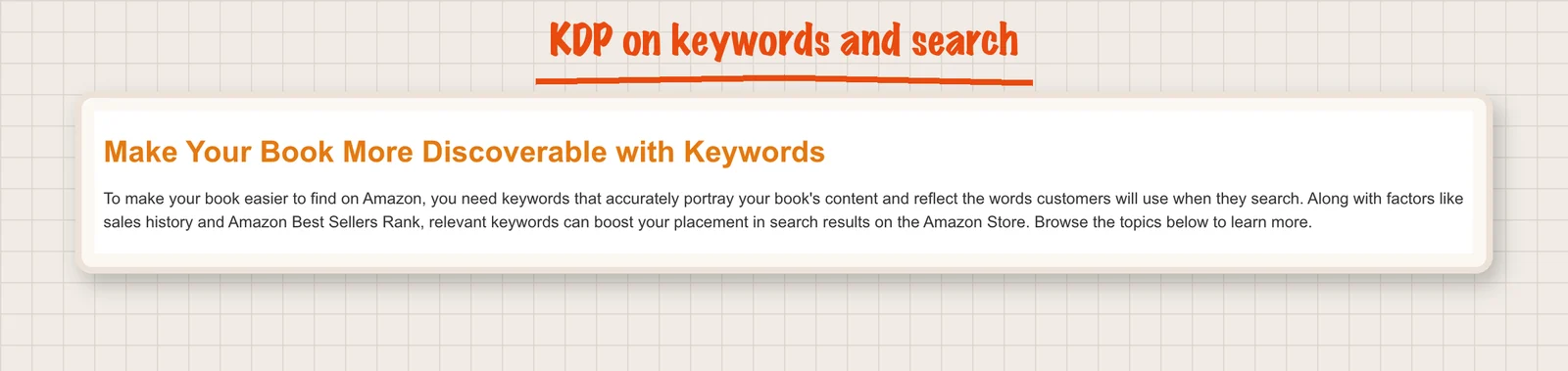
- Do keywords decide the rank? Keywords help Amazon show your book to the right searchers. The sales rank itself follows sales.
- Can an AI tool pick keywords for you? It can give a first draft. In our test, you still had to check every phrase and every category.
Does Amazon rank AI generated books lower?
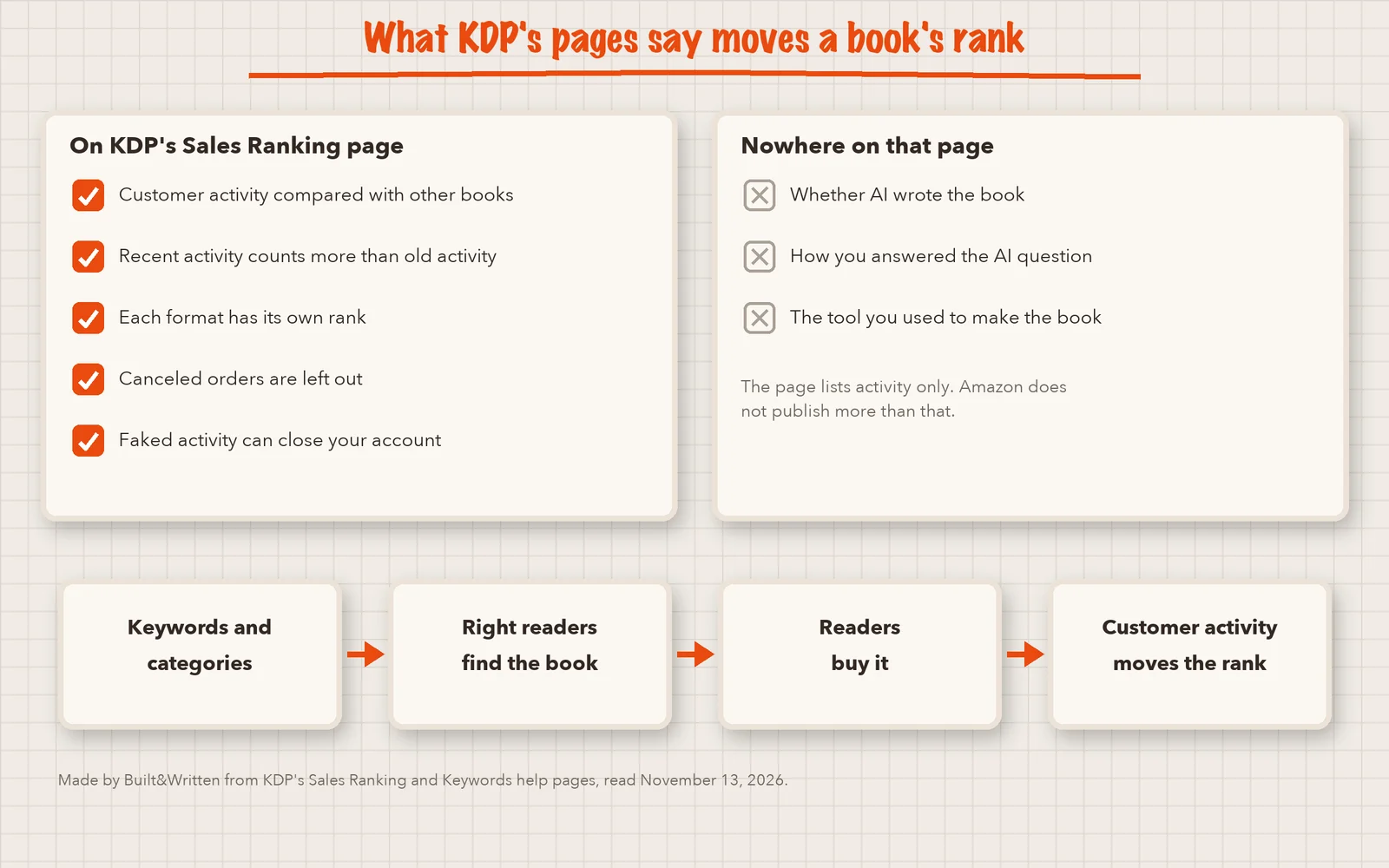
KDP says nothing of the kind. We read the content guidelines, the rules for listing details (title, description, keywords and categories), the keyword page and the sales ranking page. None of them says AI books rank lower or higher.
What KDP does say about AI is a disclosure rule. You must tell KDP about AI-generated text, images or translations when you publish a new book. A text made by AI counts as AI-generated "even if you applied substantial edits afterwards".
That rule is about what you tell Amazon. Rank is a separate matter. Our guides on telling Amazon about AI and on selling AI books as a beginner cover the form.
One limit applies to this whole article. Amazon does not publish how its systems work inside. We can only report what its pages say and what we checked.
What is the difference between search position and sales rank?
These are two different things, and many first-time authors mix them up.
| Search position | Sales rank | |
|---|---|---|
| What it is | The order of books Amazon shows when someone types a phrase | A number on the book's page that compares your sales with other books |
| Where you see it | In the search results | In the Product Details section of the book's page |
| What shapes it (KDP says) | Keywords, together with sales history and sales rank | Customer activity (buying and borrowing) compared with other books |
Here is an example. You wrote a guide for first-time managers and used the keyword "first time manager guide". Now Amazon can show your book when someone types that phrase. That is search position.
If only a few people buy the book, your sales rank (Amazon calls it the Best Sellers Rank) stays weak. Keywords bring people to the shelf. Sales build the rank.
What decides how you rank an AI generated book on Amazon?
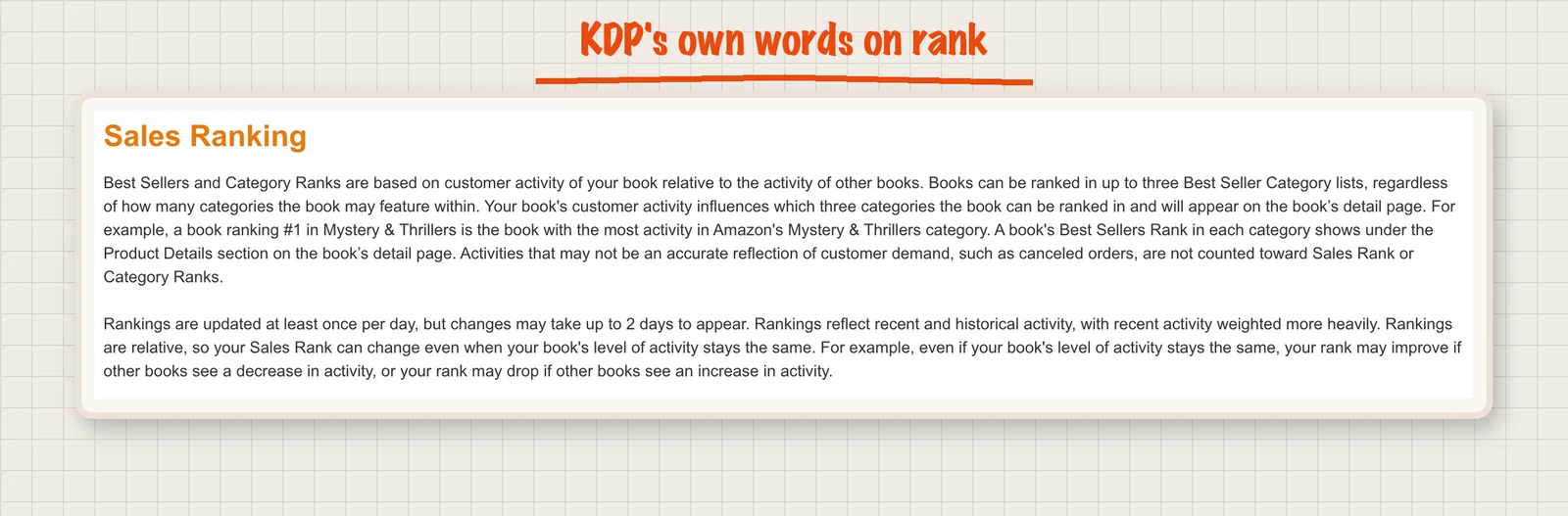
Customer activity decides the sales rank. KDP says the rank is "based on customer activity of your book relative to the activity of other books."
The same page gives six facts you can use:
- Your rank is relative. It can change even when your own sales stay the same, because other books sold more or less.
- Recent sales count more. Ranks update at least once a day, and a change can take up to 2 days to show.
- Each format has its own rank. Your ebook, paperback and hardcover are ranked separately.
- Canceled orders do not count. Activity that does not show real demand is left out.
- A small book can move fast. One sale of a lower volume book "may significantly improve that book's rank."
- Faking it is risky. If activity comes from accounts that try to manipulate the service, KDP may close your account and withhold your royalties (the money you earn from sales).
So the whole path is a loop. Good keywords and categories bring the right readers. Readers who buy move the rank. A better rank makes the book easier to find.
Which mistakes can get an AI generated book removed?
KDP says it does not allow descriptions "meant to mislead customers or that doesn't accurately represent the content of the book". It may also remove a book from sale if it creates a poor customer experience. These rules cover the title, the cover and the description.
KDP is specific about the title. Its page lists what you may not put there.
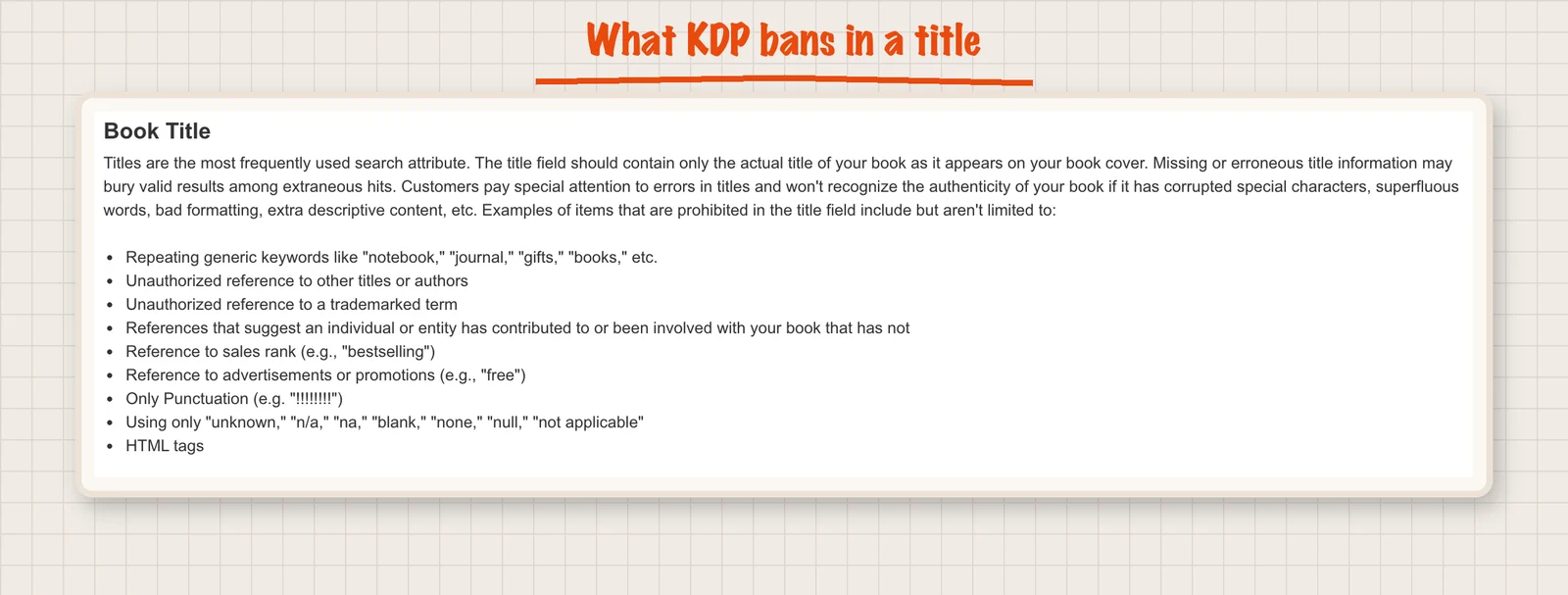
The list covers generic words like "journal", other authors' names, trademarks you do not own, sales rank words such as "bestselling", and promotion words such as "free". Your title and subtitle together must stay under 200 characters.
An AI helper writes confident, glossy copy. It may call your book "the bestselling guide" or promise things the chapters do not deliver. Read every line as a stranger would. If the page says it, the book must do it.
What about KDP keywords and categories?
KDP says to use up to seven keywords or short phrases and to pick up to three categories. A category is the shelf where Amazon files your book. KDP may remove or change a category that does not fit. You can change keywords and descriptions as often as you like, and a new category can take up to 72 hours to show. The steps and the full list of keywords to avoid are in our guide to KDP categories and keywords.
What did our test of AI keyword helpers show?
What we did. On November 9, 2026, we invented one book, a 60 page guide for new team leaders. ChatGPT, Gemini and the free keyword generator on our own site each gave seven keywords and three category shelves. We counted the characters against the 50 character limit in KDP's real form, searched every phrase on Amazon, and clicked through Amazon's category list.
What we found.
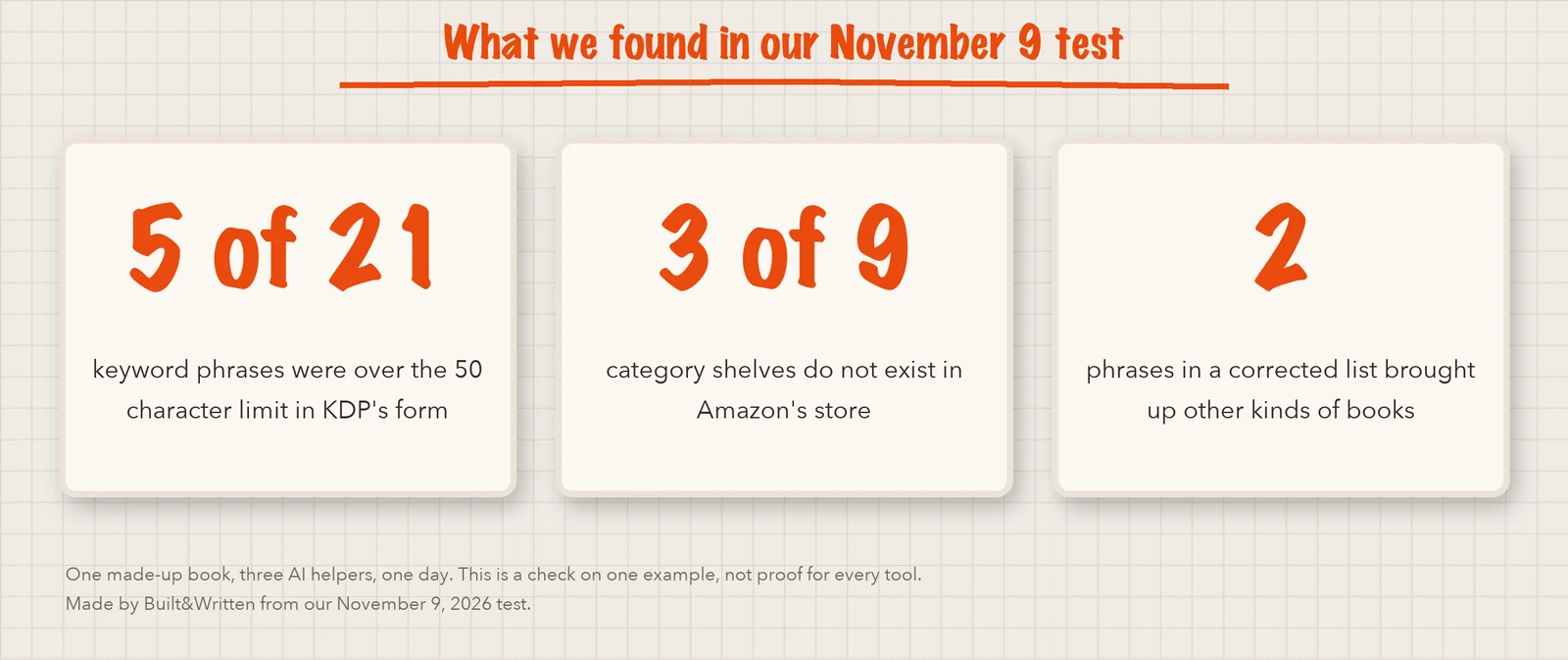
- 5 of the 21 phrases were over 50 characters. They all came from one helper, which had said they fit.
- 3 of the 9 category shelves do not exist in Amazon's store.
- 2 phrases in a second, corrected list brought up other kinds of books. "performance discussion prompts" returned 13 results, mostly classroom books.
What it means for you. An AI helper gives a good first draft in seconds. Count the characters, search every phrase and click through every shelf before you paste anything into KDP.
What this does not show. It was one book, one day and three helpers. Another book or another day could give different results, and we do not say one tool is better than another. The full run is in our post on AI keyword generators.
How does Built&Written prepare the book and the files?
A good listing only helps a good book. Many authors reach this step with plenty of material and no finished book. Others have a finished text, but the layout and the files are not ready for KDP.
Built&Written is a platform for writing nonfiction books and preparing them for KDP. It helps in two situations.
You have loose material. You have posts, notes, talk transcripts (the typed text of a talk) or a rough draft. Starting from a blank page is the hard part.
- You paste or upload your material.
- The platform proposes an outline. You change it and approve it.
- Its AI writes the chapters from your material, in your voice. Voice DNA reads a few pages of your own writing to match your style.
- You read every chapter, edit it, and change the cover or the layout with one click.
The platform's AI wrote the text, so you answer Yes to KDP's AI question.
You have a finished manuscript (your finished book text). You upload it, and the platform sets the pages for print. Your words stay as they are, and no AI touches the text. It rebuilds the layout from its own templates, using KDP's page sizes and margins, so you do not set up margins by hand. See how the formatter works.
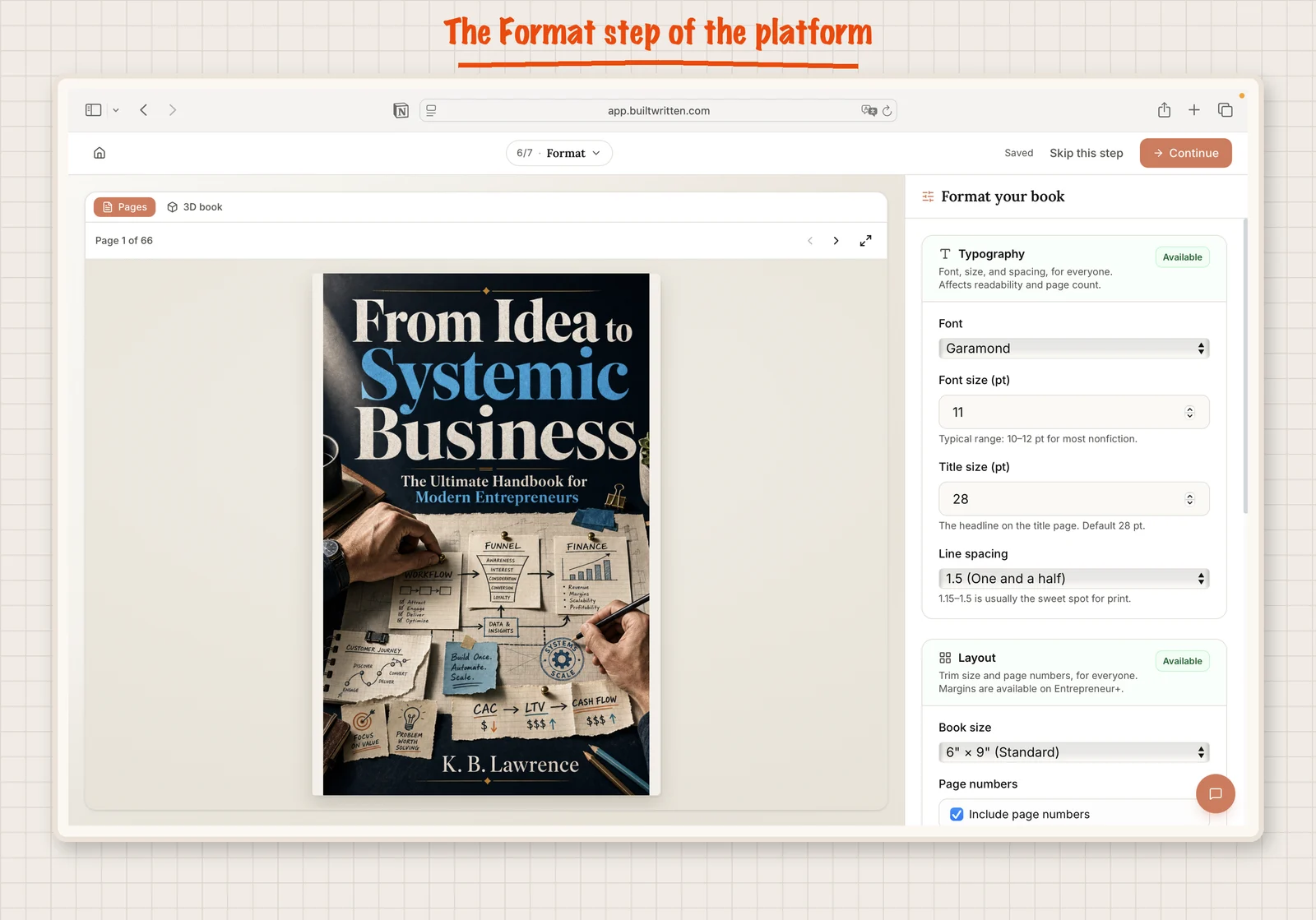
What you get. You get files made to follow KDP's rules: a print PDF with the inside pages, and a cover with front, spine and back. An EPUB (the ebook file) and a DOCX (a Word file) come with the Entrepreneur plan and up, and downloading an AI-written book also needs that plan. See the plans.
What it cannot do. Built&Written does not promise sales, a high rank or approval from Amazon. It does not publish the book for you. You upload the files to KDP in your own account. You also read every page, because you answer for what is printed. How long all this takes depends on how much material you have and how much you edit.
For the listing, the platform's KDP helper (Author plan and up) drafts a description, seven keywords and two categories from your finished book. It does not write the title. Check its draft with the test above. Free tools from Built&Written also help: the KDP keywords generator, the book description scorer and the KDP cover validator.
What should you check before you press Publish?
Each check comes from KDP's own pages.
| Check | What KDP says |
|---|---|
| Title and subtitle | Only the real title. No "bestselling", no "free". Under 200 characters together. |
| Description | Must match the book. No reviews or testimonials. No prices or time-sensitive claims. |
| Keywords and categories | Up to seven keywords and three categories, and all must fit the book. |
| AI question | If AI created the text, images or translations, tell KDP. |
| Files and cover | The book must not disappoint readers. The title and author on the cover must match what you typed. |
Rank follows readers, so plan how they will find the book. Our post on Amazon ads for AI books shows a small budget start.
Final thoughts
An AI generated book ranks on Amazon the way any book does. Sales set the sales rank. Honest keywords and shelves help the right readers find the book. The AI part is a disclosure, and an honest listing keeps the book on sale.
Use an AI helper for the first draft of your keywords, then check every phrase yourself. If you already have a manuscript or material for a book, you can look at how Built&Written prepares it for KDP.
Frequently asked questions
It can give you a first draft. In our November 9, 2026 test, three AI helpers gave seven phrases each. Some were too long, and some shelves did not exist. Count the characters, search each phrase on Amazon and check each shelf yourself.
No. Search position shows where your book appears when someone types a phrase. Sales rank compares your sales with other books. A book can show up for a small phrase and still have a weak sales rank if few people buy it.
Amazon's pages do not say it does. The rule asks you to tell KDP when AI created the text, images or translations. We found no statement about rank, or about whether readers see your answer, so we do not claim either.
KDP says ranks update at least once a day, and a change can take up to 2 days to show. Recent sales count more than old ones. The rank is also relative, so it can move when other books sell more or less.
KDP's Sales Ranking page does not list reviews as a factor. It lists customer activity compared with other books. Reviews may still help readers decide to buy, but we cannot show that they change the rank.
No. KDP says that if buying or borrowing activity comes from accounts that try to manipulate its services, it may close your account and withhold royalties. Use honest ways to reach readers, such as ads and your own audience.
Sources & References
About the author

Khrystyna Balushka
More in KDP Publishing
Ready to write your book?
Turn your expertise into a professional book with Built&Written.