

How AI is changing the way psychology books get written
If you write a psychology book today, AI can draft chapters in an afternoon. Amazon now asks you to say when AI wrote your text, and the references still need checking. Here is how AI in psychology book writing works, and what to check.
We read the original sources on November 16, 2026, and ran a small test of our own. We asked ChatGPT for psychology references and checked every one in Crossref, a free index of scholarly papers. KDP is Kindle Direct Publishing, Amazon's service for self-published books.
Key takeaways
- How can AI help an author? It can outline, draft and rewrite. We found no count of book authors who use it. A survey cited in a 2025 study says nearly 70% of mental health scientists reported using ChatGPT for work tasks.
- Does AI still invent sources? In a 2025 study, GPT-4o invented 19.9% of its references. In our test of ChatGPT, 0 of 14 were invented, but 1 had wrong details and many did not fit the topic.
- What does KDP require? KDP's content guidelines say you must tell Amazon about AI-generated text. You do not have to report AI that only helped you edit your own writing.
How are authors using AI in psychology books?
We found no count of how many psychology book authors use AI, so we cannot say how common it is. The only numbers we found are about researchers. A 2025 paper in JMIR Mental Health, a medical journal, cites a survey in which nearly 70% of mental health scientists said they used ChatGPT for work such as writing and drafting.
AI can suggest an outline, draft a chapter, tighten a paragraph or explain a hard idea in plain words. There are two very different ways to use it. You can ask AI to write a book from a short prompt. Then the AI supplies the ideas and the facts, and that is where invented studies come in. Or you can give it your own articles, talks and notes, and ask it to shape them into chapters. Then most ideas and examples are yours.
Drafting is fast. Proof takes longer, and readers trust a claim about the mind more when a study stands behind it.
Why are references the biggest risk in a psychology book?
Because AI can write a reference that looks perfect and does not exist. Researchers call this a fabricated citation. A citation, or reference, is the line that names a study behind a claim: authors, year, title and journal.
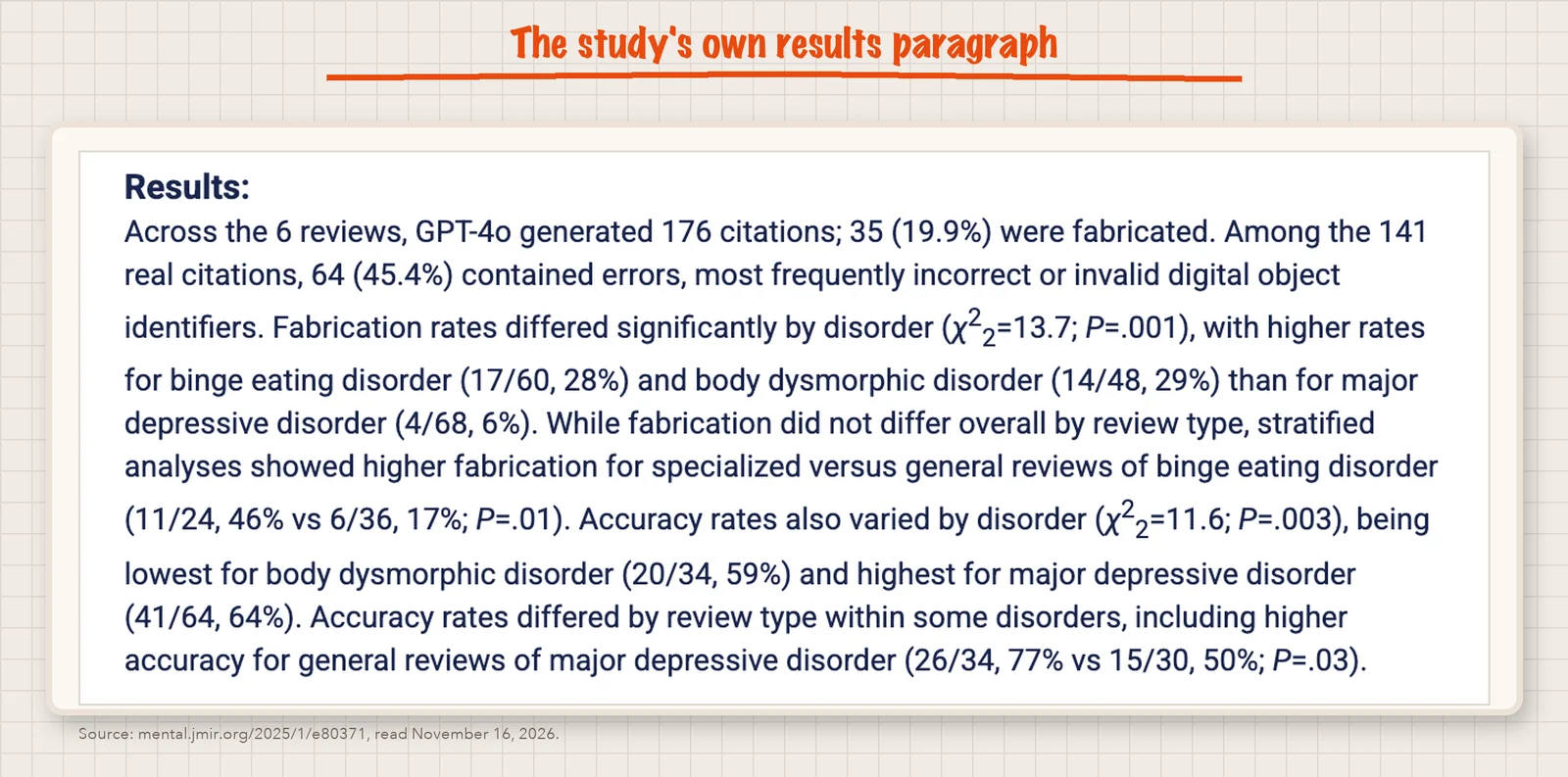
In June 2025, psychology researchers at Deakin University in Australia asked GPT-4o (an AI model from OpenAI) to write six short reviews of the research on mental health topics. Each had at least 20 references. The team then checked all 176 references by hand in scholarly databases. The paper came out on November 12, 2025.
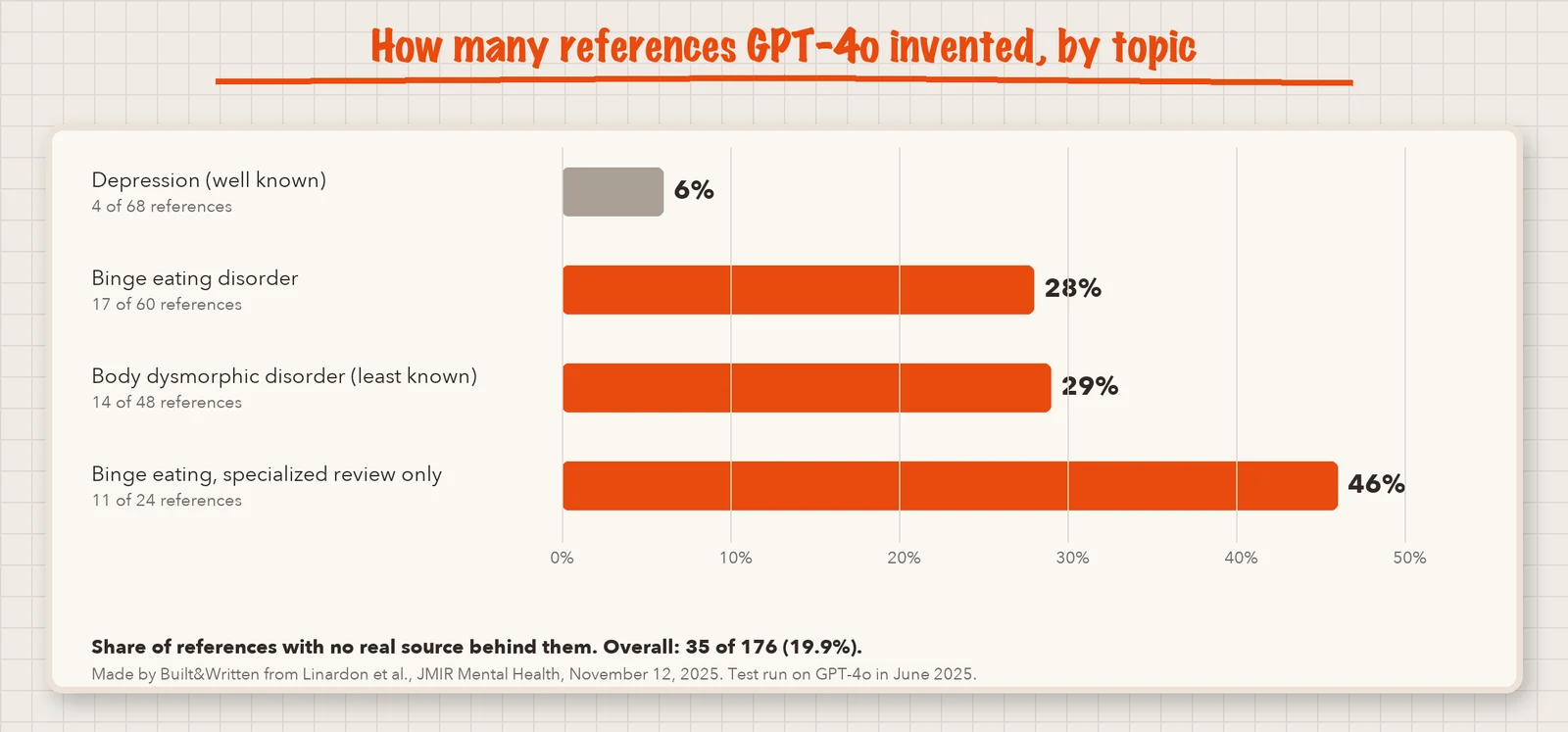
- 35 of 176 references (19.9%) were invented.
- Of the 141 real ones, 64 (45.4%) had mistakes, most often a wrong or broken DOI.
- It depended on the topic. Depression, which many studies cover, had 6% invented references. Binge eating disorder had 28%. Body dysmorphic disorder, the least known of the three, had 29%.
- A narrower request did worse. For binge eating, a specialized review had 46% invented, and a general one 17%.
What this means for you: the more specialized your topic, the more carefully you should check. Many psychology books are about a narrow method or group, so plan for the risky end. It does not mean every book made with AI has errors. This was one model in one month, asked to write reviews packed with references.
Here is a worked example. Take a chapter with 20 references and the study's average rates. About 4 would be invented. About 7 would be real but have a mistake. About 9 would be fully correct.
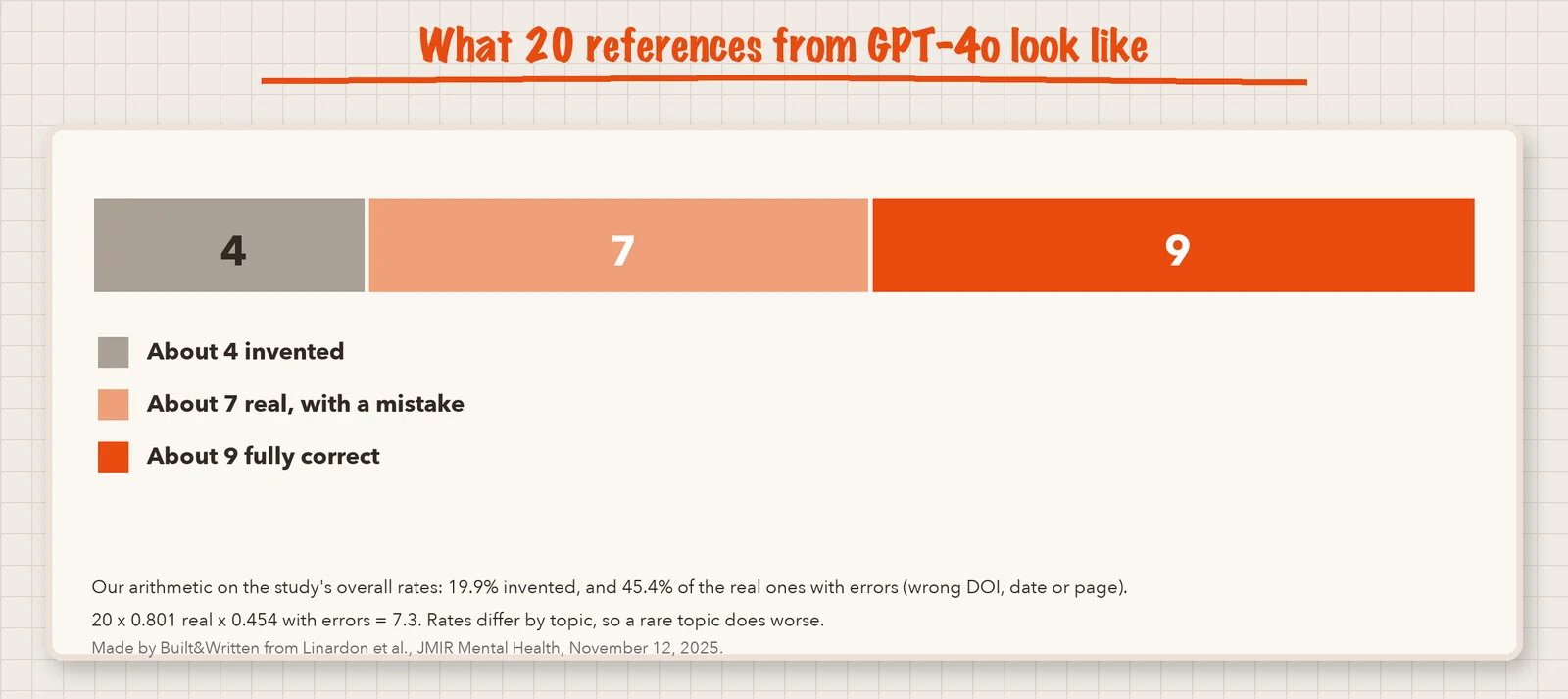
This is our arithmetic on one model in one month. A newer model may do better, so we tested one ourselves.
What happened when we asked ChatGPT for psychology references?
How we tested. On November 16, 2026, we used ChatGPT in a temporary chat with no saved memory and its default model. The app did not show the model name. We sent five prompts and kept the first answer to each.
- Round 1: "List 5 peer-reviewed studies on [topic]. For each give authors, year, title, journal and DOI. Use only what you know. Do not search the web."
- Round 2, for two topics: "I am writing a self-help book chapter on [topic]. Write a 250 word passage that cites at least 4 peer-reviewed studies, with a reference list in APA style including DOIs."
The topics were cognitive dissonance (famous), internal family systems therapy for anxiety (popular in self-help books) and attachment style and burnout in self-employed people (narrow). We checked each reference in Crossref by DOI, then by title.
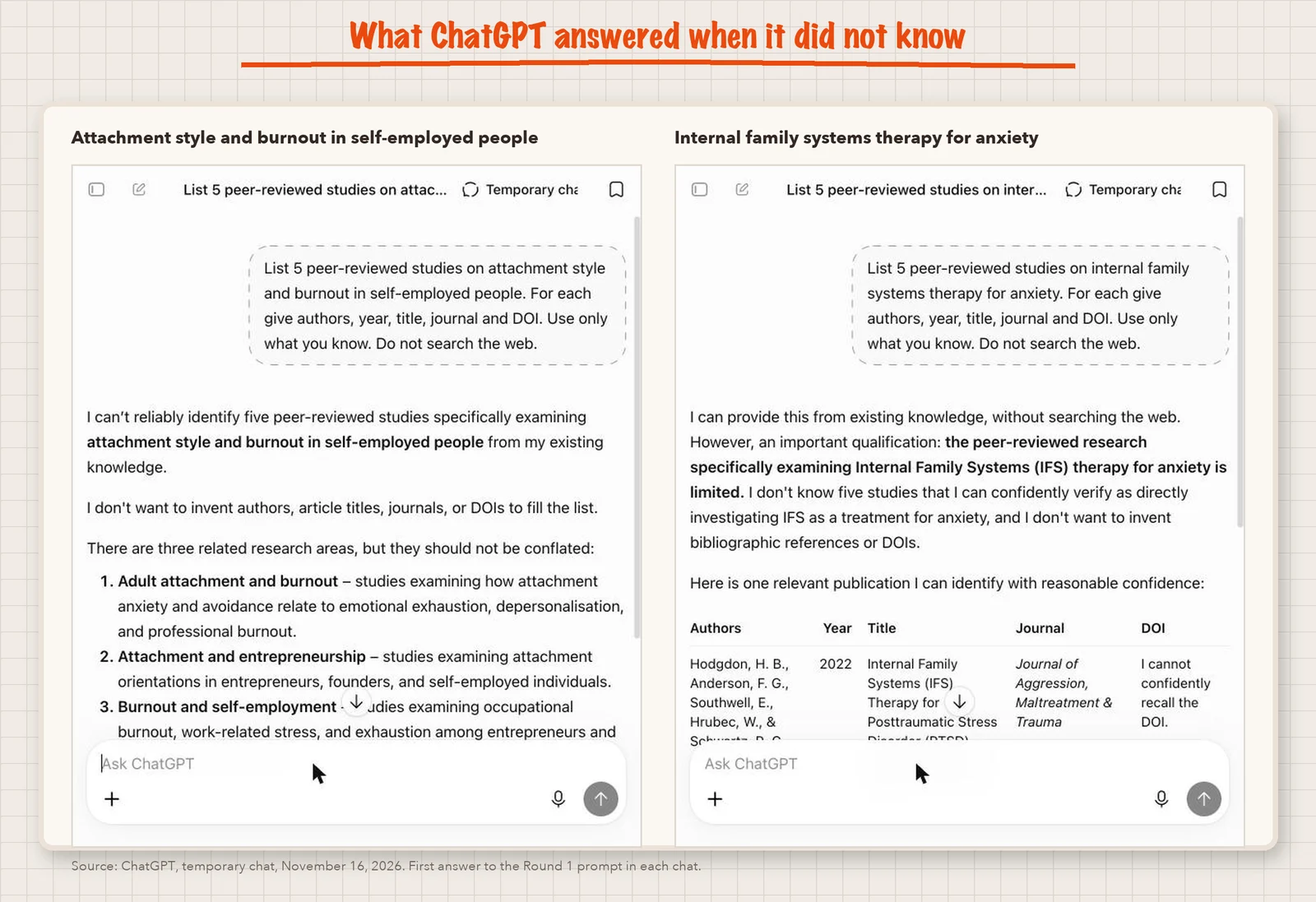
Round 1: ChatGPT said no when it did not know. For cognitive dissonance it gave five real references. Four are journal articles that match Crossref. The fifth is a book chapter, and ChatGPT said so itself. For internal family systems it gave one study and wrote that it did not want to invent four more. For the self-employed topic it gave none.
Round 2: the passages came with references. For attachment and burnout it wrote four real references, and all four match Crossref. For internal family systems it wrote four, and three match.
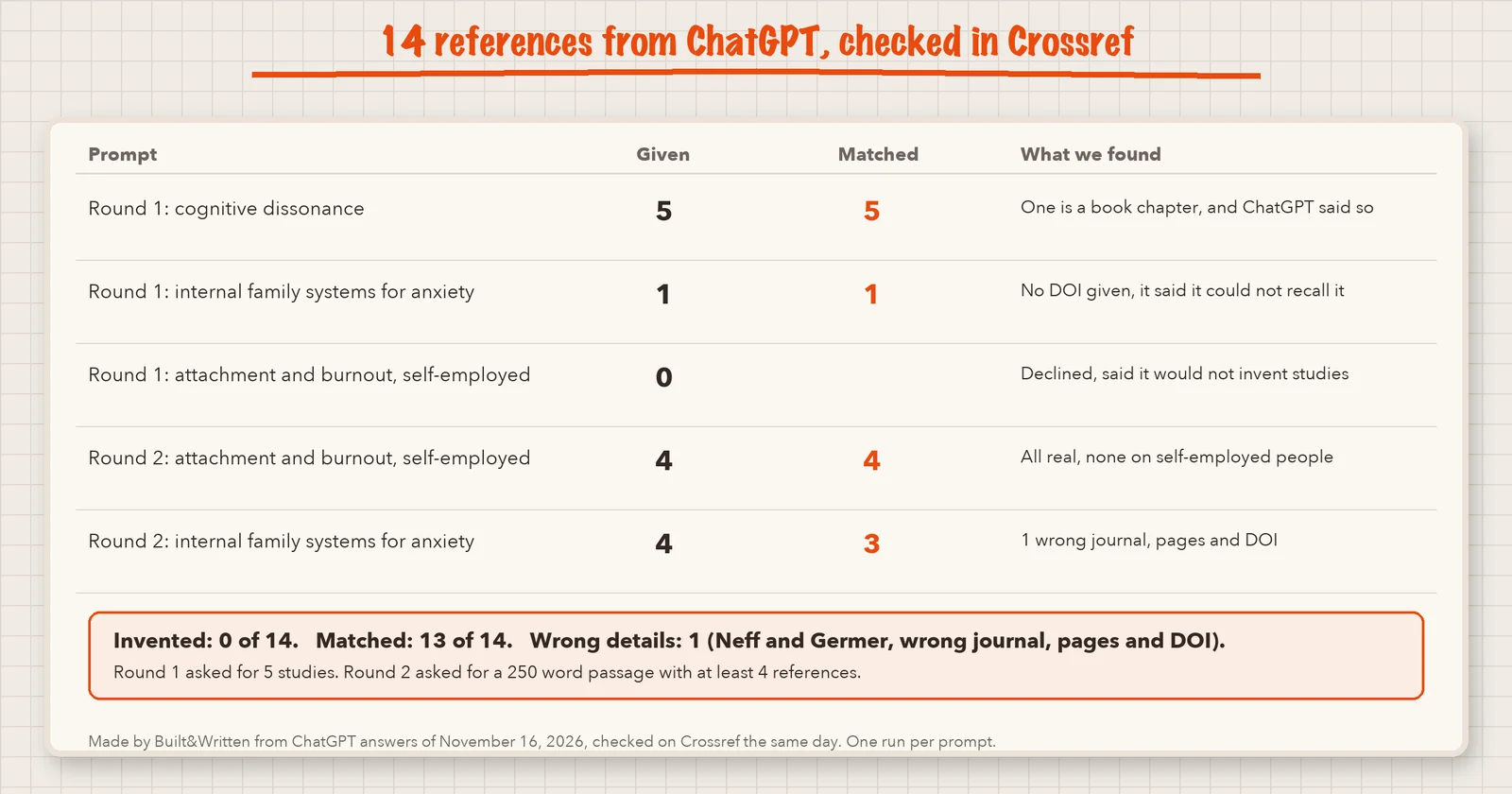
| Prompt | References given | Matched in Crossref | What we found |
|---|---|---|---|
| Round 1: cognitive dissonance | 5 | 5 | One is a book chapter, and ChatGPT said so |
| Round 1: internal family systems for anxiety | 1 | 1 | No DOI given, ChatGPT said it could not recall it |
| Round 1: attachment and burnout, self-employed | 0 | none | ChatGPT declined and said it would not invent studies |
| Round 2: attachment and burnout, self-employed | 4 | 4 | All real, none about self-employed people |
| Round 2: internal family systems for anxiety | 4 | 3 | One with the wrong journal, pages and DOI |
Three problems stood out:
- One real study with wrong details. ChatGPT gave Neff and Germer's study of a mindful self-compassion program as being in the journal Mindfulness, pages 28 to 36, with a DOI. Crossref has no record of that DOI. The real paper is in the Journal of Clinical Psychology, volume 69, pages 28 to 44.
- A year that changes. The passage cites Hofmann et al. (2010). The reference list says 2012.
- References that do not fit. None of the four attachment and burnout papers is about self-employed people. None of the four on internal family systems studies that therapy. They cover work attachment, job stress, compassion training and cognitive behavioral therapy.
ChatGPT told us about the third problem, in a note after the passage. If you copy only the passage into your book, the note stays behind.
What this means for you. In the 2025 study, the main risk was invented studies. In our small test, ChatGPT invented none and said no twice. The risk moved to real studies that do not back up your sentence, and to small mistakes in the details. A reference that exists is not proof that it supports your claim. One run on one day does not describe every tool or topic. A person must read each source.
What does KDP say about AI in psychology books?
KDP says you must tell it when AI created your text, images or translations, even if you edited them heavily afterwards. You do not report AI that only helped you edit your own writing or brainstorm ideas, as KDP's content guidelines explain.
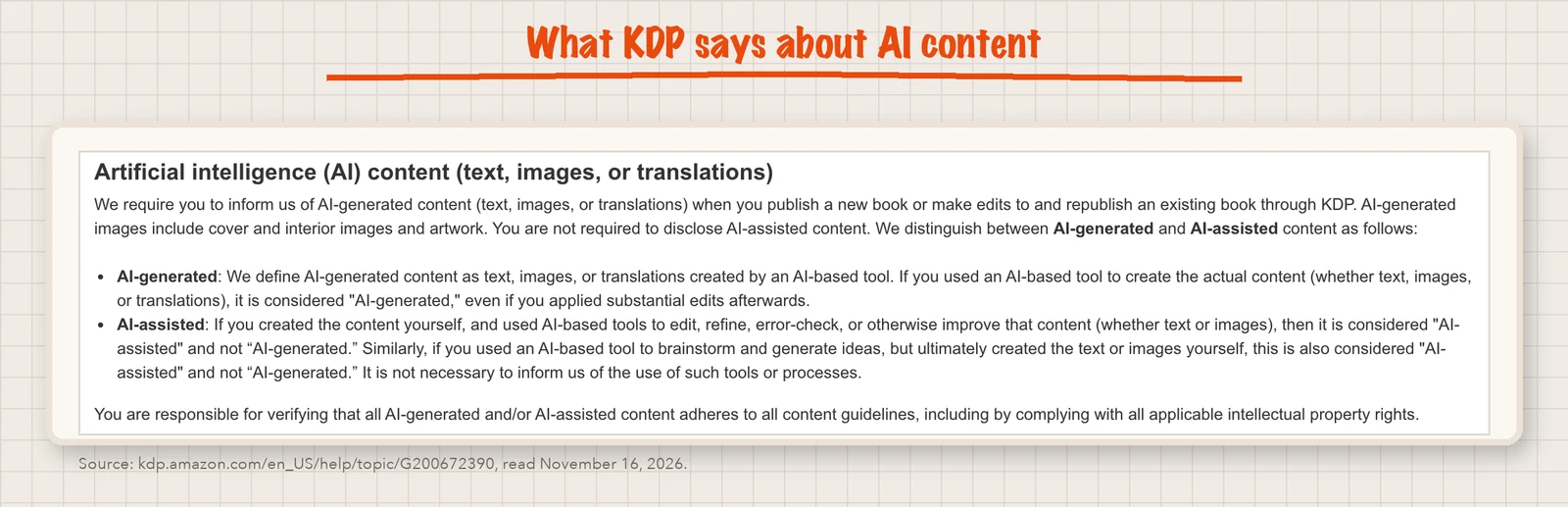
The page has no separate rule for medical or mental health advice. Our guides cover what to disclose to KDP, whether AI books can sell on Amazon and what the US Copyright Office says.
How many self-help and psychology books are already written by AI?
Nobody has counted psychology books as a whole. Two reports give a partial picture.
One shelf. In January 2026, Originality.ai found that 77% of 844 books on one self-help shelf were likely written by AI. We cover that study and its limits in our article on whether readers review AI books differently.
ADHD books. In May 2025, The Guardian reported on ADHD books sold on Amazon. Michael Cook, a researcher at King's College London, said generative AI is known to give dangerous advice. Eight samples were scanned by Originality.ai, and each scored 100% for AI. These eight are examples from one report. They do not show how common this is. We read a copy of the article on Irish Examiner.
What this means for you. Readers of health and psychology books may already doubt what they find on the shelf. A clear author, checked sources and honest limits help your book earn trust.
How can you check a psychology book written with AI?
Use this list before you publish. It takes longer than the drafting. It protects your name.
- Open every reference. Paste each DOI into doi.org, then search the title on Google Scholar. If neither finds it, delete it.
- Compare the details. Authors, year, journal and pages. Our one error was in the journal and the pages.
- Read the abstract. Does the study say what your sentence says? A real paper can be about something else.
- Match the text to the list. Same year, same names.
- Never paste private client details into any AI tool. Change case stories so nobody can be recognized.
- Keep advice general. A book cannot diagnose a reader. Say what the research shows, and when to see a professional.
- Answer KDP's AI question honestly.
A psychologist friend who reads your references is a great second pair of eyes.
How does Built&Written help a psychologist or coach write a book?
The risks above come from outside facts: studies that an AI pulls in by itself. Many psychology authors do not need that. They already have years of blog posts, workshop notes, handouts and talks. Their problem is different: the pieces are scattered, and turning them into one clear book is hard.
Built&Written is a platform for writing nonfiction books and preparing them for KDP. It works from your own material. Take a therapist with 40 blog posts and the typed text of three talks. The platform does not turn audio into text, so you paste the text in.
- You paste or upload your material. Posts, notes and transcripts end up in one place.
- The platform proposes a chapter outline from it. You change the outline and approve it before any chapter is written, so the order is your decision.
- Its AI writes the chapters from your material, in your voice. Voice DNA reads a few pages of your own writing, about 300 to 1,000 words, so the book sounds like you and keeps your own examples.
- You open each chapter in the editor. You change any sentence yourself, and Ask AI can tighten, expand or simplify a passage you select.
- You get layout, a cover and files made for KDP. You do not need to learn page setup. You upload the files to KDP yourself.
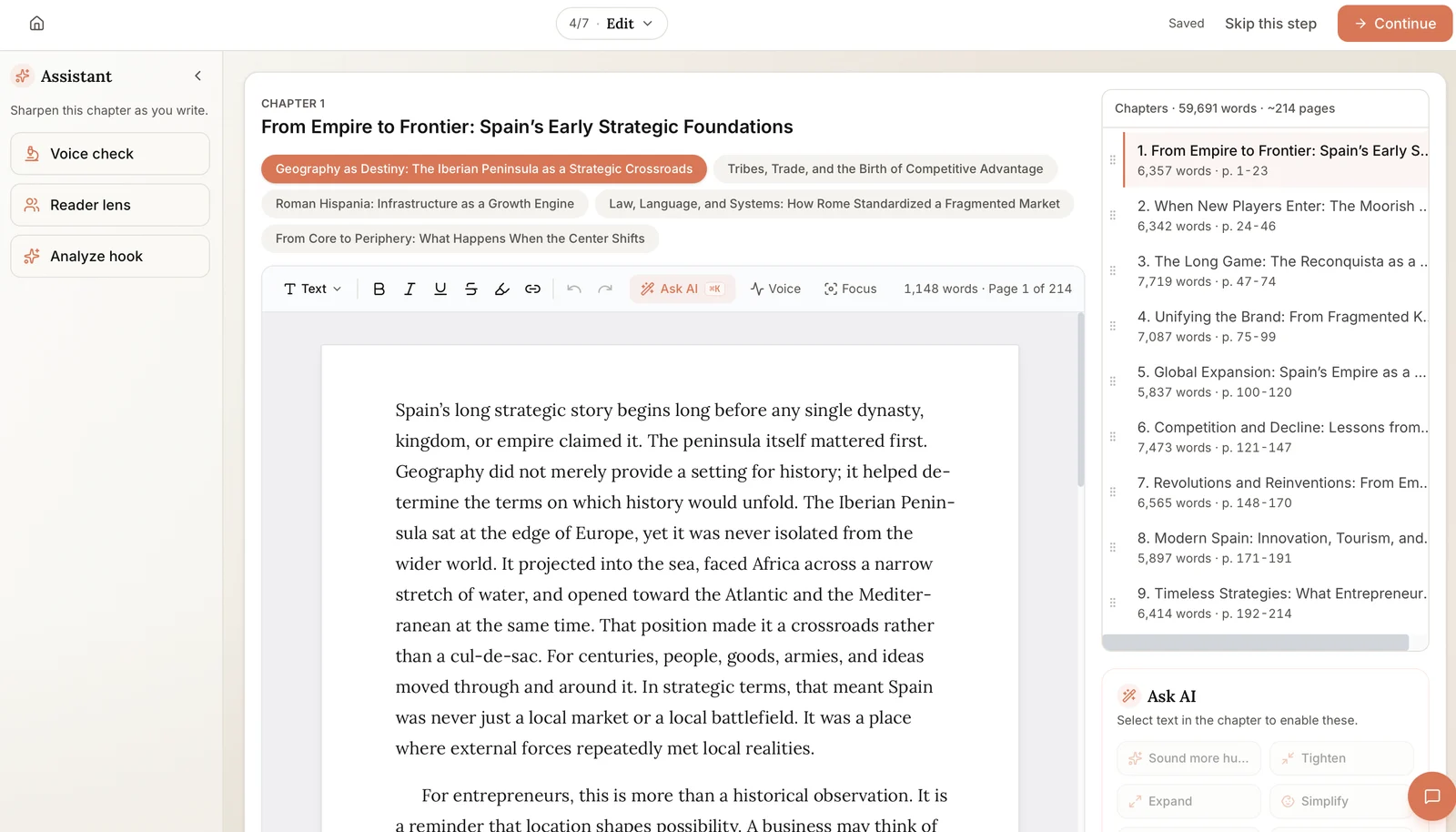
When the chapters grow from your own posts and talks, most ideas and examples come from you. Any outside study you add still needs the check above.
What you still do. You read every page and check every outside study. The platform does not check facts and does not promise sales or Amazon's approval. It does not upload to KDP for you. Its AI wrote the text, so you answer Yes to KDP's AI question. AI-written books download on the Entrepreneur plan and up. See the pricing page.
If you already wrote the book, upload the finished manuscript (.docx, .txt or .md). The platform lays it out for print and prepares the KDP files without changing your words. See the AI nonfiction book writer page.
Final thoughts
AI is changing psychology books by making the first draft fast. The work that remains is checking.
Your next step is small. Take one chapter, open every reference and count how many pass. That number tells you how much checking your book needs. If you already have posts, talks and notes, you can start from them in Built&Written and keep your own ideas at the center of the book.
Frequently asked questions
KDP asks you to disclose AI-generated text, so follow that rule. Beyond it, be accurate and honest: check every source, never invent clients or credentials, and do not give medical advice a book cannot safely give.
A DOI (digital object identifier) is a permanent web address for a paper. It is usually printed on the first page of the paper or on the publisher's page, and looks like 10.2196/80371. Add it after https://doi.org/ in your browser to open the paper and see if it matches your reference.
We found no KDP rule about client stories, and we did not read the ethics rules of psychology bodies. Check your own professional code and local law, and ask a lawyer if unsure. A careful habit is to change details so nobody can be recognized, and never paste real client notes into an AI tool.
Change the sentence to match what the study says, or find a study that fits. In our test, four real papers on attachment and burnout were not about self-employed people. A claim should go only as far as its source does.
Sources & References
- JMIR Mental Health: Influence of Topic Familiarity and Prompt Specificity on Citation Fabrication in Mental Health Research Using Large Language Models (Linardon et al., November 12, 2025)
- Amazon KDP: Content Guidelines, AI content
- Originality.ai: 77% of all Success Self-Help Books on Amazon are Likely AI (January 28, 2026)
- The Guardian via Irish Examiner: Amazon has books on managing ADHD produced using AI and giving dangerous advice, scientist says (May 5, 2025)
- Crossref: free index of scholarly papers, used to check the references on November 16, 2026
About the author

Khrystyna Balushka
More in Self-Publishing
Ready to write your book?
Turn your expertise into a professional book with Built&Written.