

Do Readers Review Books Written by AI Differently?
We used published studies and one check of our own. Amazon does not show which books were written with AI, so we could not measure their star ratings ourselves.
What is Built&Written?
Built&Written is a platform for writing nonfiction books and preparing them for publishing. Its AI writes a book from material you already have, like notes, posts and talk transcripts (the typed text of a talk), in your voice. It also formats a book you've already written without changing a word. You get a print PDF and files for KDP (Amazon's self-publishing service) and publish the book yourself.
Key takeaways
- Do readers rate AI books lower? In experiments, yes, when the label is shown. In a US study of more than a thousand adults, books labelled as written by a human were rated more positively on every measure.
- Do AI books get fewer reviews? One study found 26 reviews on average for likely AI books and about 129 for likely human books. It counts reviews. It does not compare star ratings.
- What can you control? The book. Reviewers react to what is on the page: clear ideas, your real experience and clean files.
How did we check this?
On November 10, 2026, we did two things. First, we read the original reports, not news stories about them: a study from the Nuremberg Institute for Market Decisions (NIM), a 2024 paper from the EMNLP conference, a study by Originality.ai and two KDP help pages, on AI content and on customer reviews.
Second, we opened 16 Amazon book pages, the first 16 results for "success mindset self help" in the Books department. On each page we searched the full text for "AI", "artificial intelligence", "ChatGPT" and "written by AI". This is one search on one day: a snapshot.
One limit matters most. We could not compare star ratings of AI books and human books, because no public list says which books are which.
Do readers review AI written books differently?
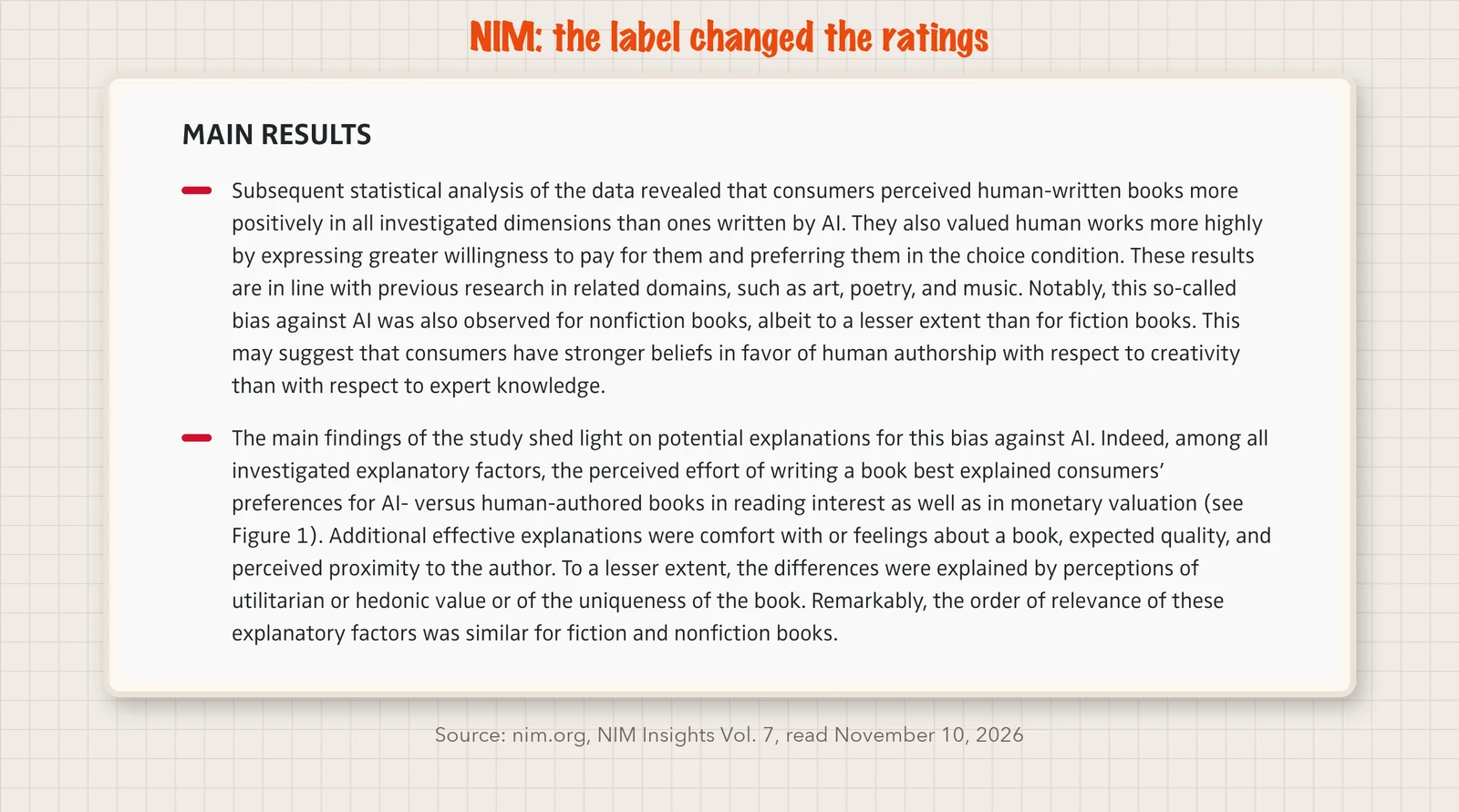
Yes, when they are told. The best evidence is an experiment. The Nuremberg Institute for Market Decisions (NIM) showed more than a thousand US adults two books on mock online sale pages. (NIM's own page says about 1,100.) One was labelled written by AI. The other was labelled written by a human. The labels were assigned at random, so the label was the only difference.
Readers rated the human label more positively on every measure the team checked. They also said they would pay more for it and picked it more often when both cost the same. NIM says the gap was smaller for nonfiction than for fiction. It also found that perceived effort, meaning how much work the reader thinks the author put in, explained the gap better than anything else.
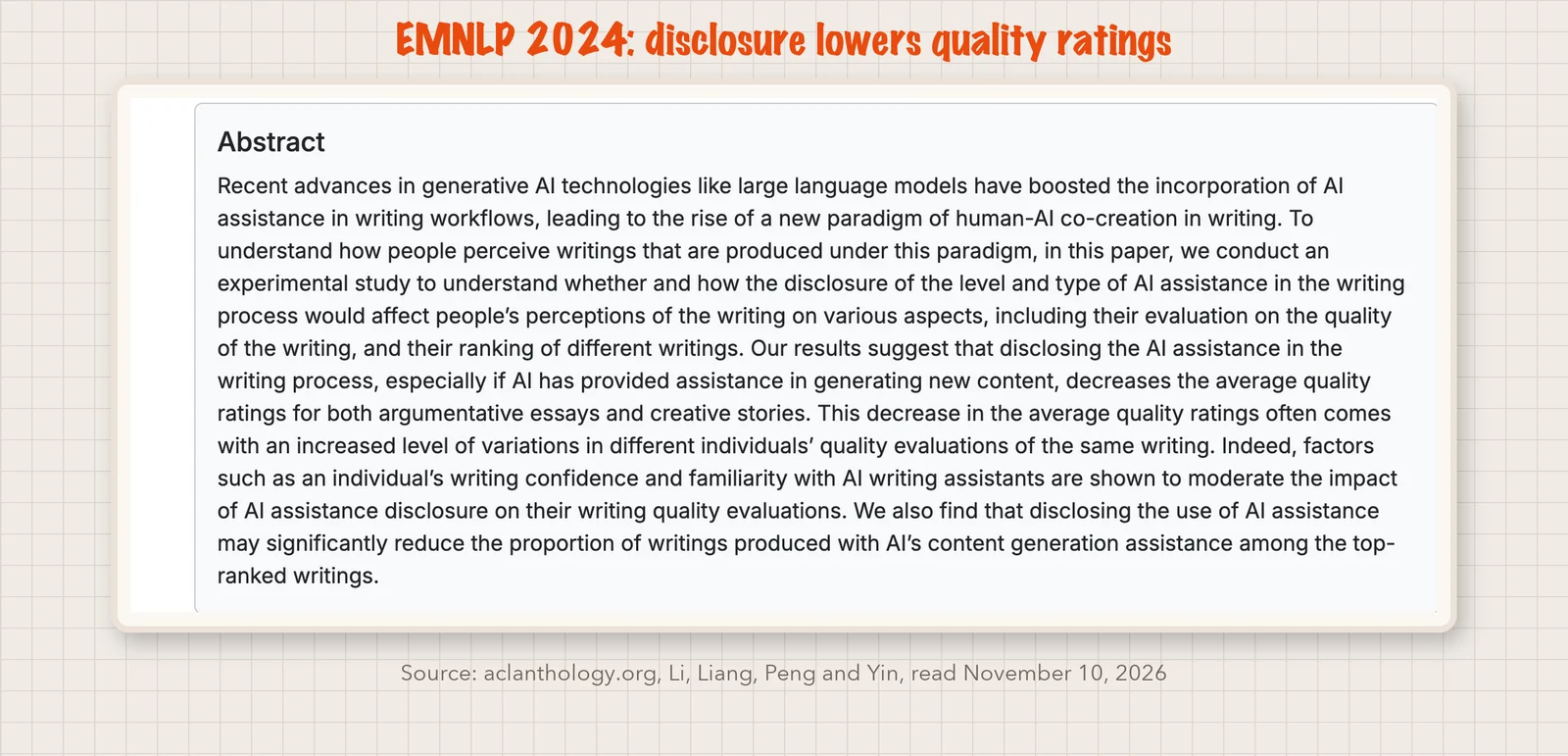
A second paper, from the 2024 EMNLP conference (Li, Liang, Peng and Yin), tested essays and short stories. Telling raters that AI helped lowered the average quality score. It was strongest when the AI created new content instead of only fixing the text.
The penalty is about the label and the effort readers imagine. It does not prove the writing is worse.
Do AI written books get fewer reviews on Amazon?
One large study says yes. Originality.ai scanned 844 paperbacks in the Success part of Amazon's Self-Help books, published between August 31 and November 28, 2025. Its detector, a tool that guesses whether text was written by AI, marked 651 as likely AI and 180 as likely human. About 13 were not classed.
The likely AI books averaged 26 reviews. The likely human books averaged about 129.
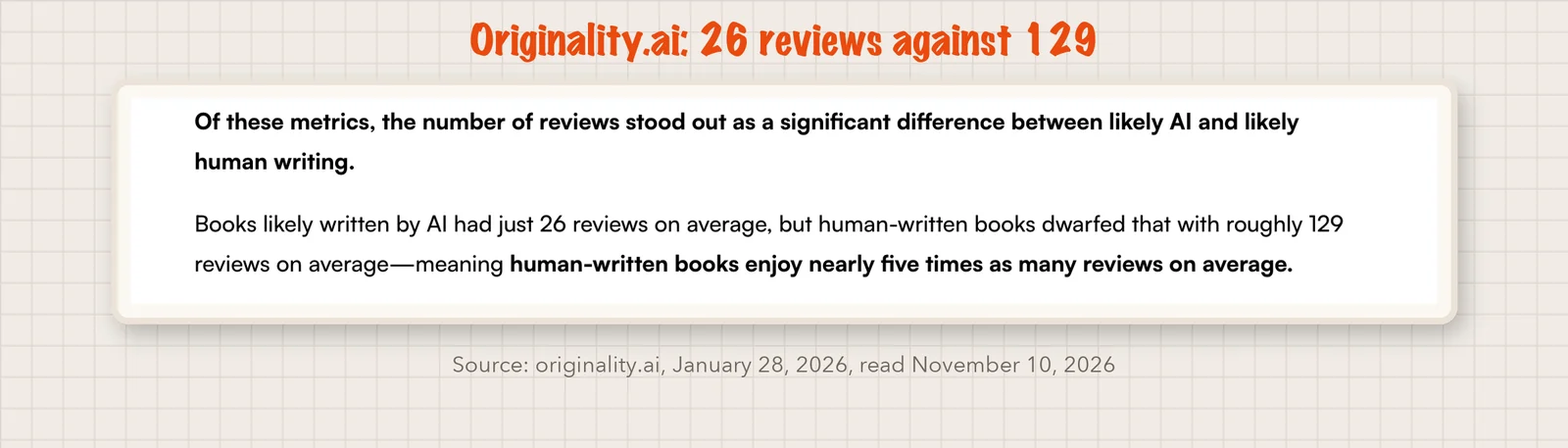
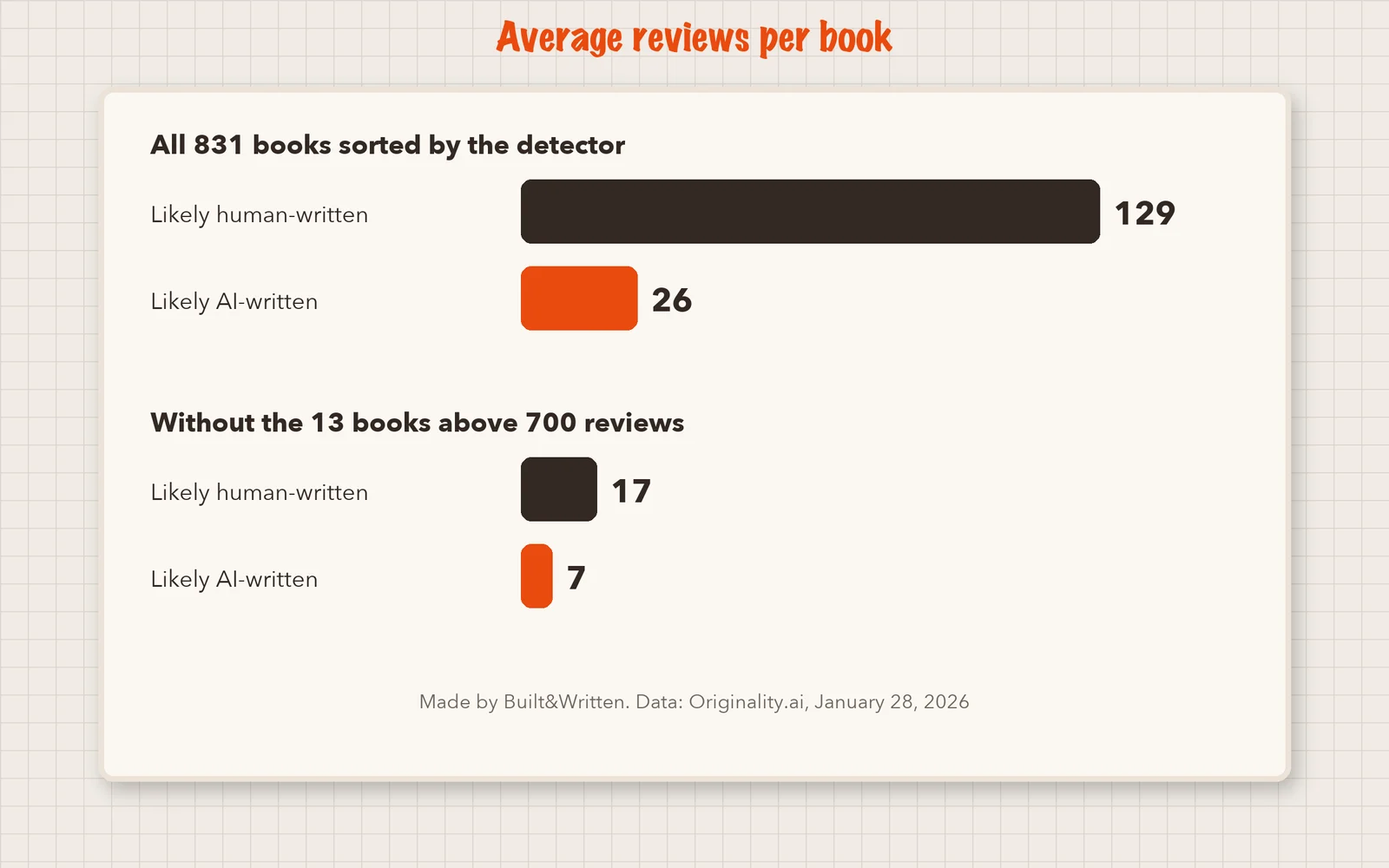
Read this number with care. The 129 is pulled up by a few old classics that are in the public domain (their copyright has ended, so anyone can republish them). One of them has more than 10,000 reviews. When Originality.ai removed the 13 books with more than 700 reviews, the averages fell to 17 for human books and 7 for AI books. The gap stays, but it is much smaller.
Two more cautions:
- It counts reviews. It does not rate them. The study only included books with an average of at least 4 stars. So it cannot say whether AI books get lower stars. It only shows how many reviews they get.
- The labels come from a detector. That is a guess, not a list of confirmed authors.
So the honest reading is this. Books the detector marked as likely AI got fewer reviews. The study does not show what those reviews say or how many stars they gave.
Can readers even see that a book was written with AI?
Not on the 16 pages we checked. KDP's content guidelines ask authors to tell Amazon when text, images or translations are AI-generated. They define that as content created by an AI tool, even if you edit it heavily afterwards. If you wrote the text yourself and used AI to edit or improve it, that is AI-assisted, and you do not have to report it. The page does not say that readers will see the answer. Our guides cover what KDP requires you to disclose and whether you can publish an AI-written book on KDP.
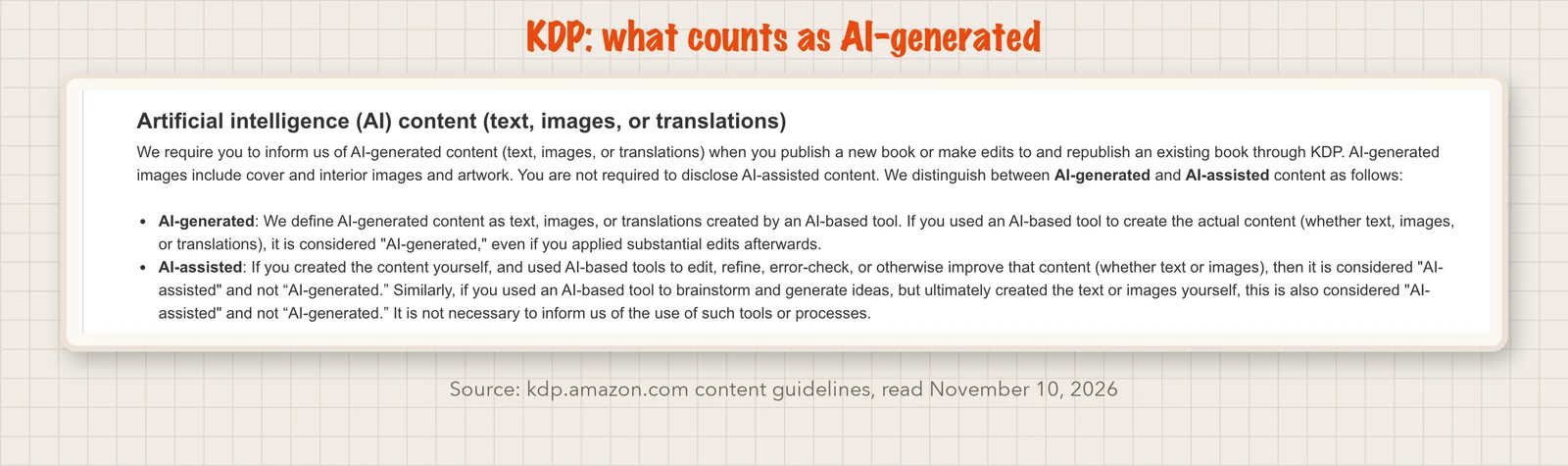
On those pages, there was no label, field or badge about how the book was written.
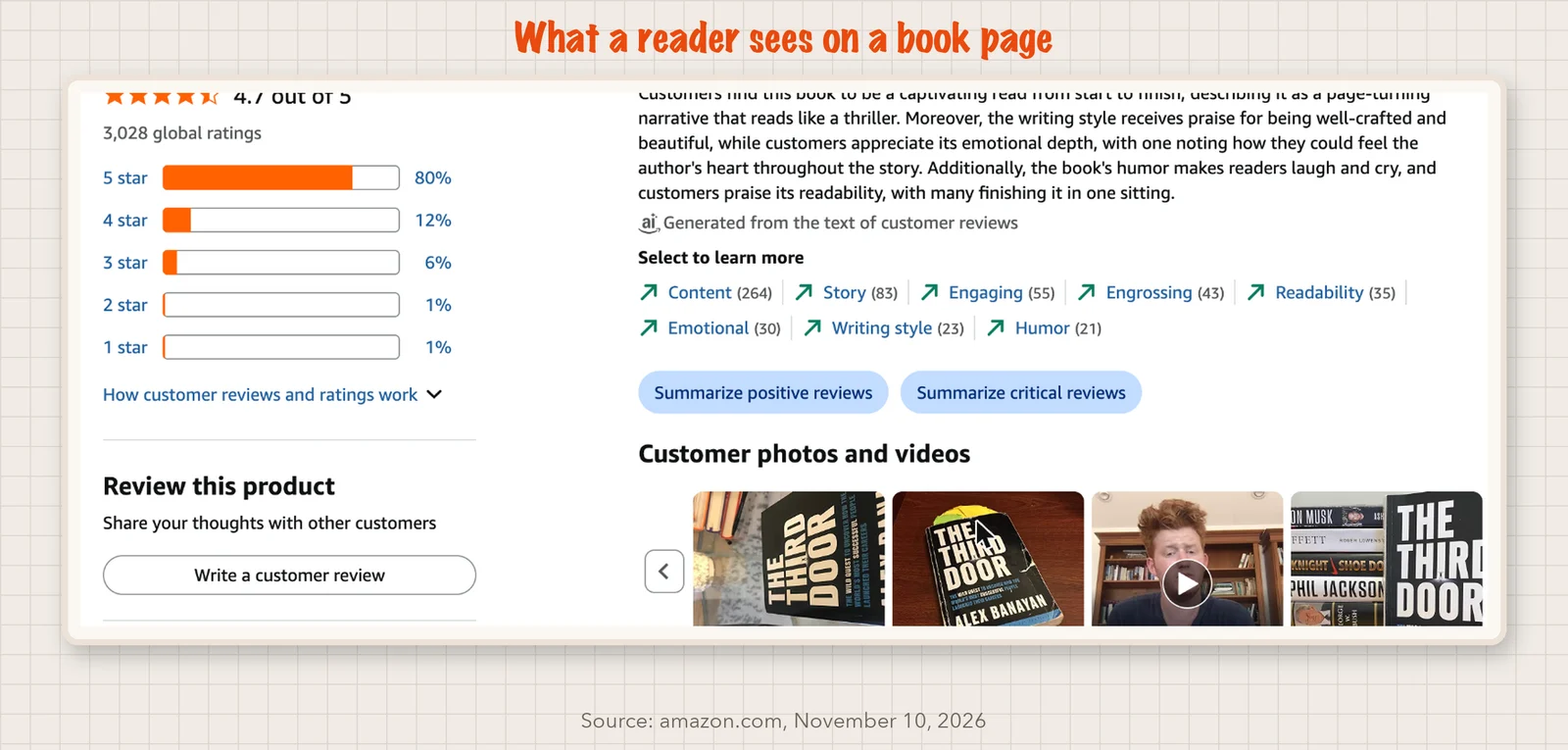
The only AI marks we found belong to Amazon. 11 of the 16 pages show a "Customers say" box, labelled as generated from the text of customer reviews. The other five have no such box.
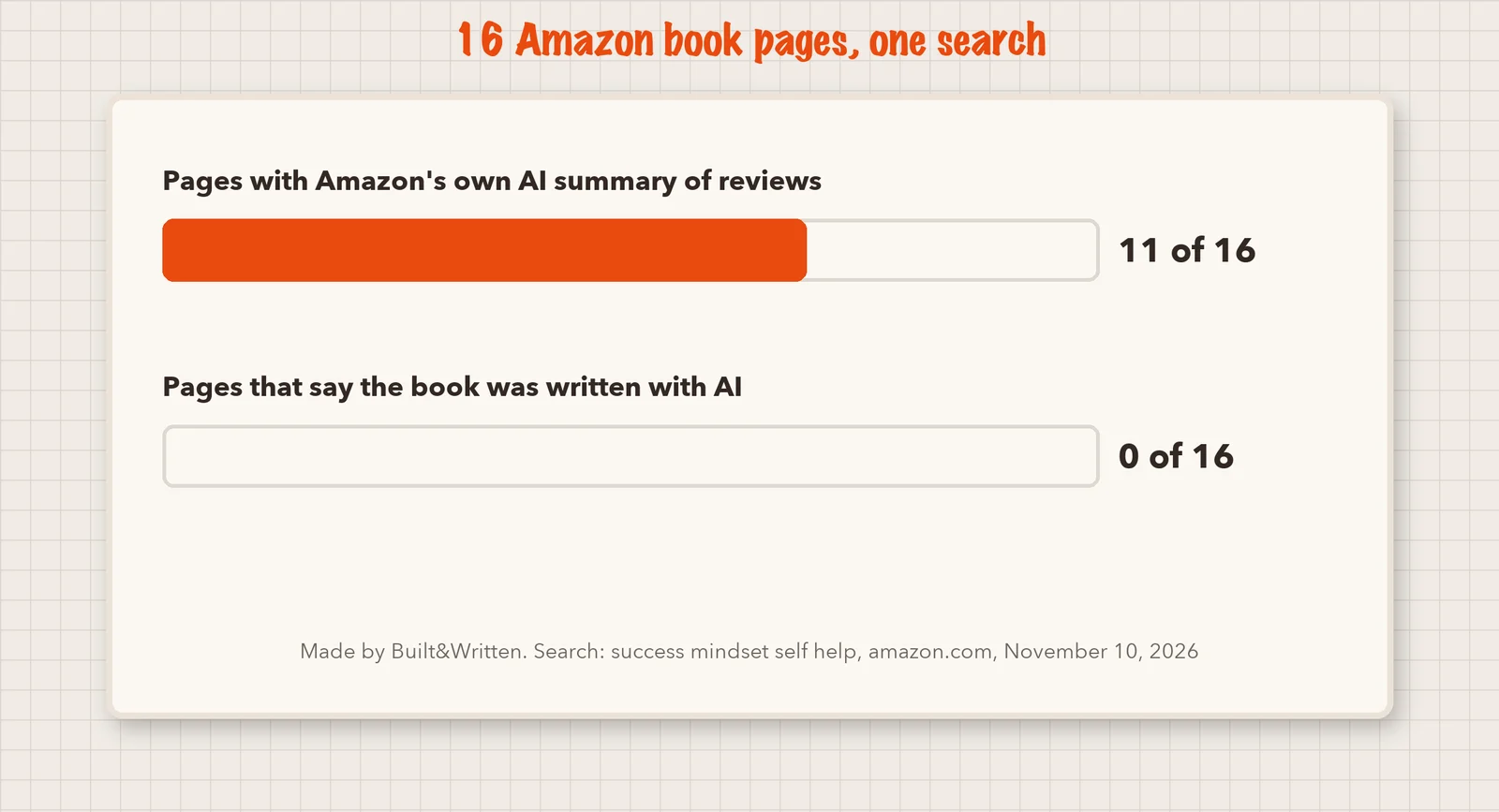
On these pages, a buyer rates a book without being told how it was made. We cannot say the same for every Amazon page.
What do these results mean for the reviews your book gets?
Three things follow from the sources above.
1. The label risk lives outside Amazon. Some readers will find out anyway: you tell them, or a podcast host asks. So decide how you will describe your process, and tell the truth.
2. Show your own input. Perceived effort drove the gap in NIM's study. A book built from your own stories, numbers and opinions shows that effort. Our article on reader trust and the flood of new books makes the same case from the market side.
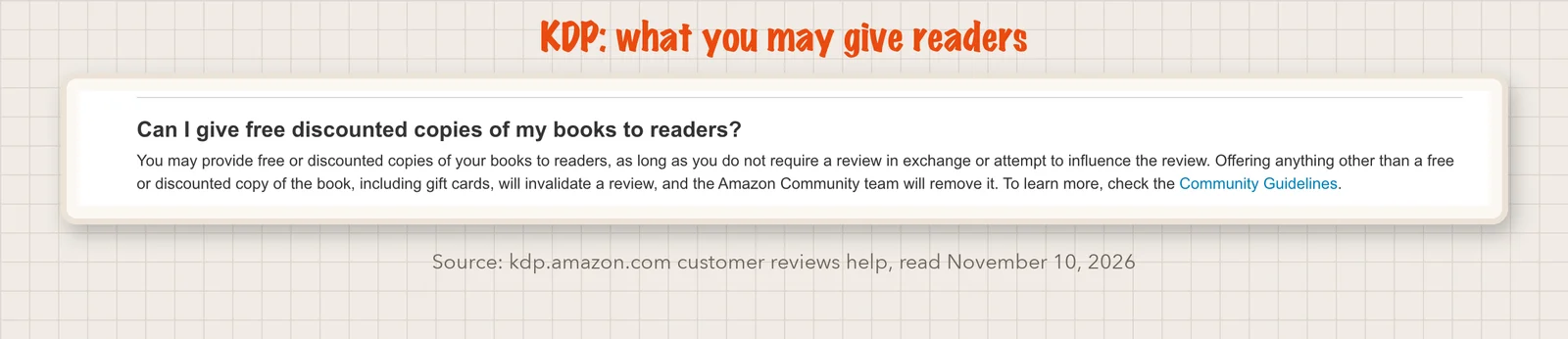
3. Reviews follow Amazon's rules, not your wishes. KDP's help page says Amazon's community team manages reviews. You may give free or discounted copies to readers if you do not require a review. Anything else given in exchange, such as a gift card, makes the review invalid and it will be removed. Amazon also calculates the star rating with a machine-learned model, not a plain average. You cannot delete a review yourself. You can only report one.
For safe ways to collect real reviews, see our guide to getting your first 25 Amazon reviews.
What should you check before you publish?
- Your own material is in it. At least one story, number or opinion per chapter that only you could add.
- It sounds like you. Read three paragraphs aloud. Cut phrases you would never say.
- Nothing is invented. Check every fact, quote and number against a source. Our test of what an AI beta reader catches and misses shows where a second reader helps.
- The pages look like a book. Font, spacing, margins and page numbers are set for print. Buyers can read a sample first, so layout problems show early.
- The cover and title match the promise. A cover that over-promises invites a bad review.
- Your disclosure to KDP is honest. Answer the AI question in the KDP form according to the definitions above.
How does Built&Written help you make a book readers review well?
Take a consultant with 40 blog posts, a folder of client notes and the written transcript of a podcast interview. This is what the work looks like in Built&Written.
- Bring the material. She pastes in the posts, notes and transcript. (People paste the text in. The platform does not turn audio into text.)
- Approve the outline. The platform proposes a chapter outline from her material. She changes it until it fits. Nothing is written before she agrees.
- Get chapters in her voice. Voice DNA learns her style from a few pages of her own writing. Her stories and numbers stay in the book because they come from her material.
- Edit and format. She edits any chapter. Layout and the cover are made for her, and she can change them.
- Download and upload. She downloads print-ready files for KDP and an EPUB (the standard ebook file), then uploads them to KDP in her own account. AI-written books download on the Entrepreneur plan and up. The print PDF and KDP files of a book you already wrote download on any paid plan. EPUB needs Entrepreneur and up.
A plain text generator answers a prompt with text. This platform keeps the material, outline, chapters, layout, cover and files in one place. See how an AI book creator differs from a text generator.
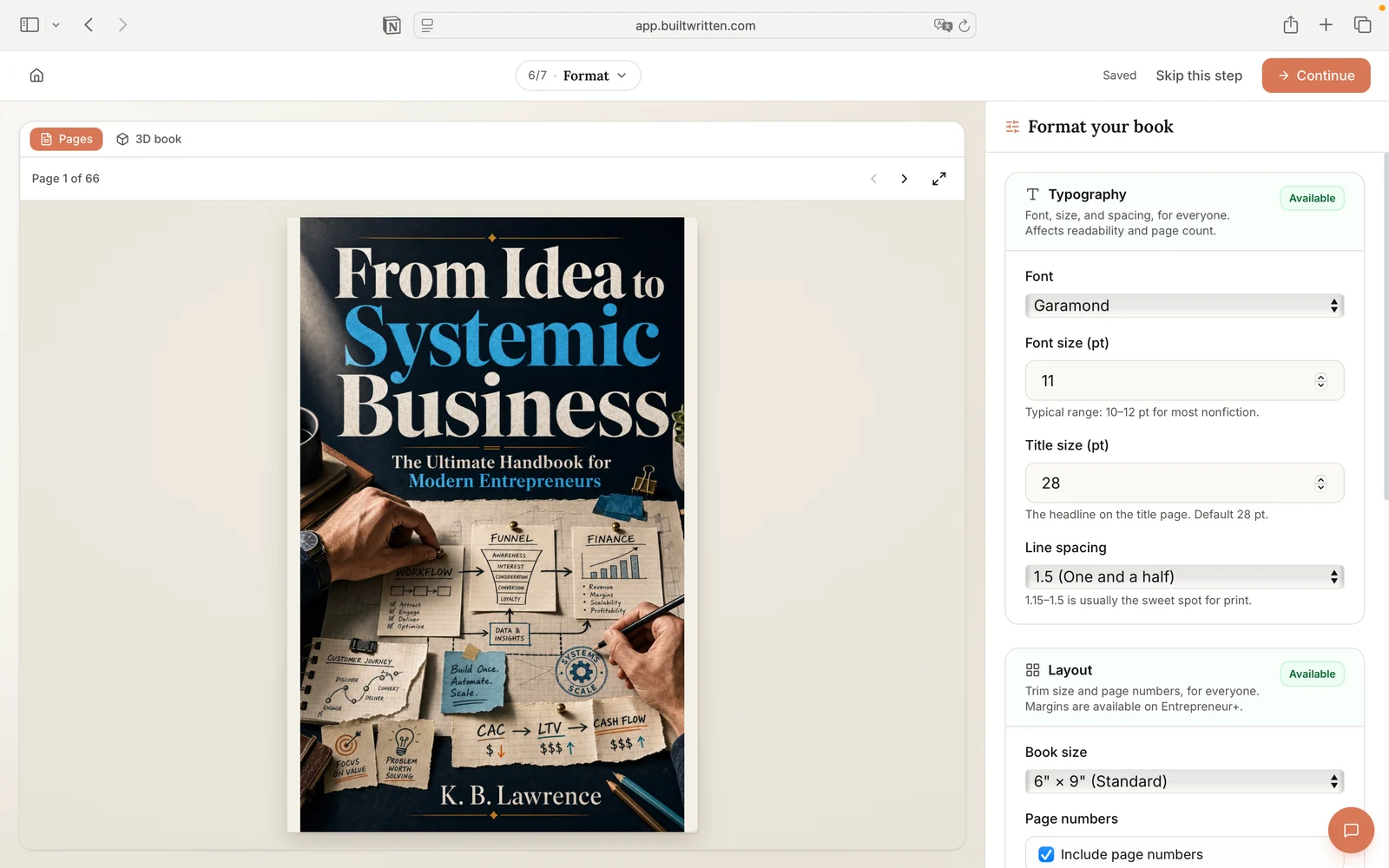
You already wrote the book. Then you can upload the finished manuscript (your complete text) as a .docx, .txt or .md file. Built&Written lays it out for print and Kindle and prepares the files for KDP. You can still edit chapters, change the cover and adjust the formatting. The panel on the right sets font, size and spacing.
We do not upload to KDP for you, and we promise no sales. See pricing for plans. Free tools at /tools help too, such as the royalty calculator (what you earn per sale).
Final thoughts
Back to the question: do readers review AI written books differently? When they are told, yes, and perceived effort drives most of the gap. So the safest plan is to make the book good, make it yours and describe your process honestly.
Built&Written is for two kinds of authors: those who have only notes and material, and those who already wrote the book. Either way, you end with a formatted book and files ready to upload to KDP. In short:
- You start from your own material, or from your finished manuscript.
- You approve the outline and edit any chapter, the cover or the formatting.
- Layout and KDP readiness checks (title, author, page count, trim size, margins, cover) are done for you.
Frequently asked questions
In experiments, yes, when the label is visible. In a [NIM study](https://www.nim.org/publikationen/detail/consumer-response-to-ai-generated-books-in-a-pressured-market) of more than a thousand US adults, human-labelled books were rated more positively and valued higher, with a smaller gap for nonfiction. We found no public data on star ratings for real AI books.
One study suggests it. Originality.ai found 26 reviews on average for books its detector marked as likely AI, against about 129 for likely human books. Without 13 outliers the numbers were 7 and 17. The labels are guesses by a detector.
Not on the 16 pages we checked on November 10, 2026. KDP asks authors to report AI-generated content to Amazon. Its guidelines page does not say readers will see it. Amazon does label its own AI summary of the reviews.
KDP requires you to tell it about AI-generated text, images and translations when you publish. AI-assisted work, where you wrote the text and AI only edited it, does not need to be reported.
No. KDP's help page says reviews posted in exchange for compensation break the rules. Free or discounted copies are fine if you do not require a review. Gift cards invalidate the review.
No. You can report a review that breaks Amazon's Community Guidelines. The Amazon Community team decides, and it does not share the outcome of the investigation.
Sources & References
- Originality.ai: 77% of all Success Self-Help Books on Amazon are Likely AI (January 28, 2026)
- NIM: Consumer Response to AI-Generated Books in a Pressured Market
- Li, Liang, Peng and Yin: How Does the Disclosure of AI Assistance Affect the Perceptions of Writing? (EMNLP 2024)
- Amazon KDP: Content guidelines, AI content
- Amazon KDP: Customer reviews help
About the author

Khrystyna Balushka
More in Self-Publishing
Ready to write your book?
Turn your expertise into a professional book with Built&Written.