
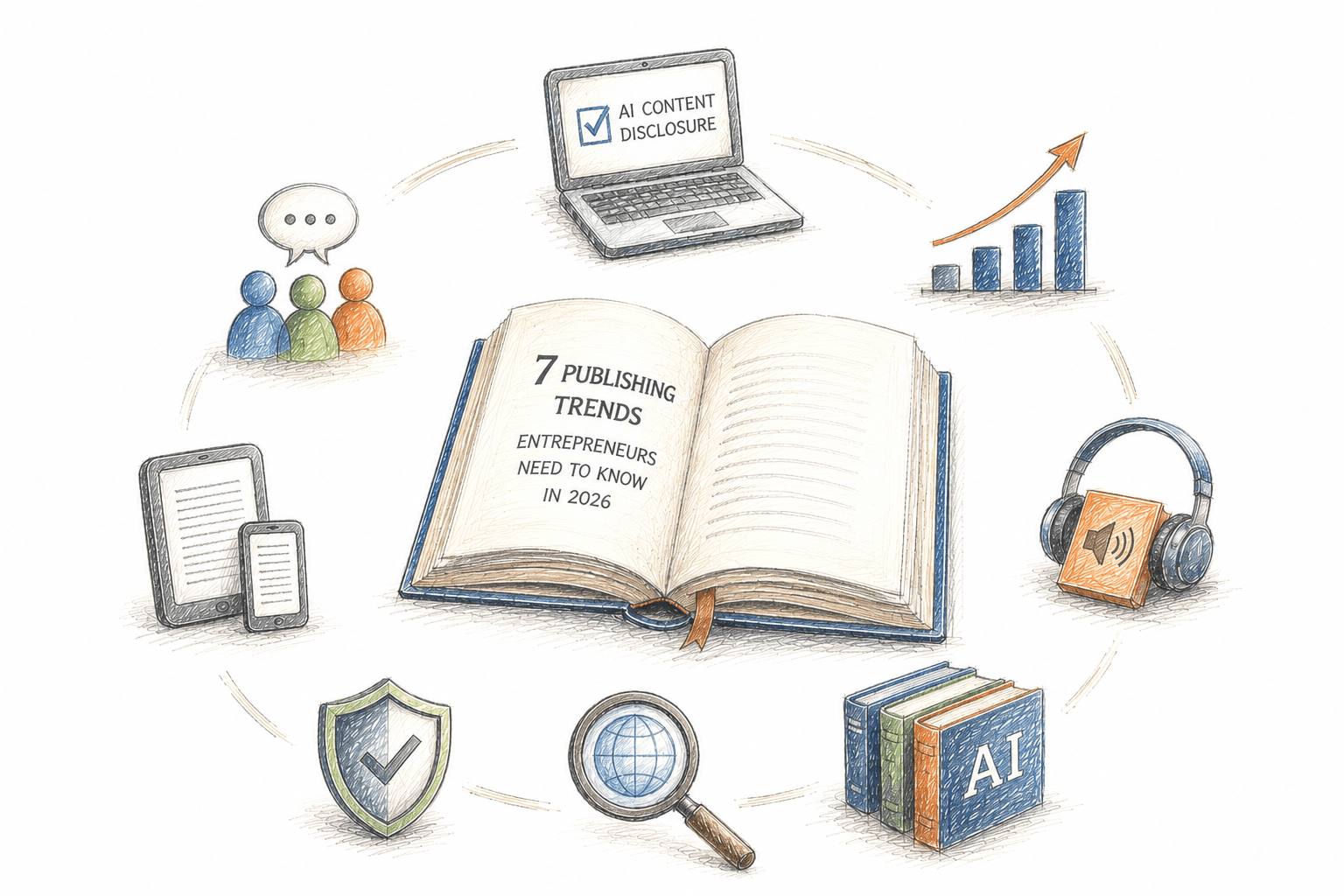

7 Publishing Trends Entrepreneurs Need to Know in 2026
- KDP now requires authors to disclose AI-generated content on every upload and caps standard accounts at three new titles a day. (Amazon KDP, 2026 policy)
- The self-publishing market grew 16.7% in 2025, more than 16 times traditional publishing's 1% growth. (Grand View Research)
- The global audiobook market is on pace to pass $13 billion in 2026, growing roughly 23% a year through 2033. (Grand View Research)
- 77% of books in Amazon's Success self-help category were likely AI-written, per a February 2026 study, as monthly uploads roughly tripled since ChatGPT launched.
- Wren tracks all seven shifts and builds a book meant to survive a disclosure checkbox, an audiobook conversion, and an AI search engine, not just an Amazon listing.
Publishing a book in 2026 means navigating rules that did not exist eighteen months ago. Amazon now asks every author to disclose AI-generated content before it will list a title. Readers screen a book's opening pages for the signals that separate real writing from a template. Here are the seven shifts that matter most this year, and what each one means for the book you are about to write.
Built&Written already helps founders and coaches turn their expertise into a finished business book, not just a drafted one. Wren generates chapters from your own notes, calls, and outline, then checks each against the shifts below.
1. AI disclosure on KDP is no longer optional
Every KDP upload in 2026 includes a private checkbox asking whether your text, images, or translations came from AI. Ordinary AI-assisted work, like brainstorming or polishing your own draft, does not need disclosure. Fully AI-generated content does, and skipping the checkbox risks removal. Amazon also capped standard accounts at three new titles a day, aimed at AI-driven accounts flooding the store. Full breakdown: Do You Have to Disclose AI in Your Book? and Can You Publish an AI-Written Book on KDP?
Wren generates chapters from the notes, calls, and outline you provide, then you review and edit every chapter before it ships. That puts most Wren books in AI-assisted territory, not AI-generated.
2. The AI book flood is forcing a trust crackdown
Monthly e-book uploads to Amazon roughly tripled since ChatGPT launched, from about 100,000 titles a month to nearly 300,000 by the end of 2025. A February 2026 scan of Amazon's Success self-help category found 77% of the books were likely AI-written, some dangerously so: Amazon has caught foraging guides that mislabeled poisonous mushrooms as safe. Readers are pulling back from anything that reads generic, a shift we track in how the AI book flood is changing reader trust.
- A named client, a real number, or a specific story behind every claim.
- Sentence rhythm that varies instead of the same 15-to-25-word pattern AI defaults to.
- A voice a competitor in your field literally could not have written.
Wren checks every chapter for the signals readers now screen for: flat rhythm, hedged claims, generic vocabulary. Same approach as How AI Helps Entrepreneurs Write Books Without Losing Their Voice.
3. Self-publishing keeps pulling ahead of traditional deals
The global self-publishing market grew 16.7% in 2025, against 1% for traditional publishing. Over 3.5 million self-published titles carried an ISBN in 2025, up 38.7% from the year before. Entrepreneurs are not waiting on an agent or a six-figure advance that rarely materializes. Full case: Is Traditional Publishing Dead in 2026? and Traditional Publishing vs Self-Publishing for Entrepreneurs.
Wren was built for this shift. It turns your notes and calls into a finished manuscript in weeks, not the year or more a traditional deal takes to reach a shelf, so you publish while the topic still matters.
4. Audiobooks moved from nice-to-have to must-have
The global audiobook market is on pace to top $13 billion in 2026 and grow roughly 23% a year through 2033, as smart speakers and bundled subscriptions pull audio into the mainstream. A coaching book that only exists as text is missing the format a growing share of readers prefer. Turning a manuscript into an audiobook is faster than most entrepreneurs expect: How to Turn Your Coaching Book Into an Audiobook in 2026.
Wren trains on your own recorded calls and notes from the start, so the manuscript it drafts already sounds like something you would say out loud. That makes the jump to audiobook narration a much shorter one.
5. Getting found by AI search engines now matters as much as Amazon SEO
ChatGPT Search handles 250 to 500 million queries a week, and Perplexity processes over a billion a month. When someone asks either for a book recommendation, the answer comes from a citation, not a results page. A book with clear, specific positioning is more likely to get cited than one buried in generic keywords. See how entrepreneurs make their books visible in the AI search era and KDP Categories and Keywords: Get Your Book Found in 2026.
Wren pushes you toward a specific, ownable topic and title instead of a generic one, because a generic book gives an AI search engine nothing distinct to cite. Specificity gets picked up. Keyword volume alone does not.
6. Direct-to-reader distribution is rising fast
30% of self-published authors now sell direct to readers, outside Amazon entirely, and another 30% plan to start in 2026. A direct sale gives you the reader's email address instead of a transaction Amazon owns, and that list is worth more than the royalty. More: grow an email list from your book and build a personal brand around it.
Wren treats the book as one step in your business, not the whole business. Every chapter points a reader toward the next step with you, whether that is your email list, your coaching program, or a call.
7. Voice and proof beat production value
When 77% of a category might be AI-written, polish stops being a differentiator. What a reader cannot get from a template is your actual experience: a specific client, a real result, an opinion you are willing to defend. That specificity compounds, the case we make in Why Thought Leadership Content Compounds (And Books Win) in 2026.
Wren solves this earlier than most tools try to. It trains on your own notes, calls, and posts before a single chapter drafts, the approach in Voice Matching AI Writing That Sounds Like You.
Two of these trends are regulatory: KDP's disclosure checkbox and upload cap. Two are format and distribution: audiobooks and direct-to-reader sales. Three are trust: the AI book flood, AI search discoverability, and voice. A book built fast and generic loses to one built specific and true.
Final thoughts
None of these seven trends are reasons to slow down. They reward entrepreneurs who publish now, while a flooded market is still sorting out who is real. A disclosed, specifically voiced book has a real advantage over the generic titles crowding it out.
Founders and coaches already use Wren to publish into this exact environment. Every chapter comes from your own notes and calls, gets checked for the same signals, and ships without a six-month draft grind. The advantage still goes to whoever writes the real book first.
Frequently asked questions
It depends on how you used it. Wren generates chapters from your own notes and calls, which typically counts as AI-assisted content KDP does not require you to disclose. Publishing an unedited draft is a different question. See Do You Have to Disclose AI in Your Book? and confirm against current policy first.
Yes: the self-publishing market grew 16.7% in 2025 against 1% for traditional publishing. Crowding is a discoverability problem, solved with a specific topic and real proof.
Not on day one, but plan for one. The market is growing roughly 23% a year, and a finished manuscript converts faster than expected. See How to Turn Your Coaching Book Into an Audiobook.
Amazon SEO gets your book found inside Amazon's own search bar. AI search visibility gets your book mentioned when someone asks ChatGPT or Perplexity for a recommendation instead. The two use different signals, and increasingly you need both.
Sources & References
About the author

Khrystyna Balushka
More in Self-Publishing
Ready to write your book?
Turn your expertise into a professional book with Built&Written.