

Can AI Help You Write a Parenting Book From What You Have Lived?
Key takeaways
- What goes in? One narrow problem, your stories of what worked and what failed, and something a parent can try tonight.
- What stays out of any AI tool? Your children's real names, school, town and health details. Change them before you paste a single note.
- Where does Built&Written fit? It turns notes you already have into a chapter plan you approve, then chapters in your voice and files for Amazon.
Can you write a parenting book from your own experience?
This article is for a parent, a teacher, a pediatric nurse or a counselor who wants to write a book about raising children. You have years of life with children behind you, and you want to put them in a book.
You don't need a degree to start. Adele Faber and Elaine Mazlish wrote How to Talk So Kids Will Listen & Listen So Kids Will Talk. Their workshop site says each is the parent of three children and both studied with the child psychologist Haim Ginott. Their books have sold over three million copies in more than thirty languages.
That is the pattern to copy: real family life, plus what you learned from people who know more, credited by name.
What should you put in a parenting book?
A reader picks up a parenting book with one problem and very little time. Plan every chapter around that.
- One narrow problem. "Parenting" is too big for one book. "Bedtime with a toddler who won't stay in bed" is a book. A 2015 C.S. Mott Children's Hospital poll asked parents of children up to age 4 what advice they share online. The top topics were sleep (28%), food (26%), discipline (19%), daycare or preschool (17%) and behavior problems (13%).
- What worked and what didn't. A plan that failed, and what you changed after it, teaches as much as a win. Readers trust the parent who admits the bad weeks.
- Something to try tonight. A script for a hard conversation, a checklist, a morning routine. Give at least one per chapter.
How to write a parenting book with AI, step by step
This route to writing a parenting book uses a general chatbot, such as ChatGPT or Claude, and a word processor.
- Gather what you already wrote. Phone notes, journal pages, blog posts, emails to other parents, the handout from a talk you gave. Put it all in one document.
- Remove real details first. Before anything goes into an AI tool, swap your children's names, ages, school and town for placeholders. The privacy section below explains why.
- Ask for a plan, not a book. Paste your notes and ask the chatbot to group them into themes and suggest chapters. Then move, cut and rename until the order fits a tired parent reading at night.
- Draft one chapter at a time, from your notes only. Tell the AI to use only the stories in your notes and to list what is missing instead of filling it in. AI tools can add a scene you never lived, such as a meltdown in a supermarket. Every story in the book must be one you lived or one you were told by the person it happened to.
- Check every claim about children. Say a sentence claims what most two-year-olds do, how much a child should sleep or when to call a doctor. Check it against a primary source. Two good ones are CDC's Developmental Milestones and the American Academy of Pediatrics' parent site, HealthyChildren.org. If you can't find support, cut the claim or tell it as your own story, for example "My son was three before he slept through the night." Medical advice is not yours to give unless you are qualified to give it.
- Read it aloud. If a line sounds like a brochure, rewrite it in your words. Keep your phrases, your jokes and your doubts.
How to write a parenting book with Built&Written
The hard part is often not the writing. It's time, and notes spread across years and apps that nobody has turned into one book in a clear order. A chatbot helps with one chapter at a time, but you carry the whole book in your head.
Built&Written starts from that pile of notes. Its AI writer, Wren, writes from the text you give it, so the stories in each chapter are yours.
| Step | By hand (Word, Google Docs or ChatGPT) | With Built&Written |
|---|---|---|
| Your notes | Copy everything into one long file | Paste text or upload PDF, DOCX, RTF, TXT or MD files, up to 50,000 words |
| Chapter plan | Write it yourself or ask a chatbot | Wren proposes an outline from your notes, and you edit it before any chapter is written |
| Your voice | Describe your style again in every prompt | Voice DNA learns it from a few pages of your writing, about 300 to 1,000 words |
| Facts about children | You check each one | The same: you check each one |
| Layout, cover, files | Learn page setup or pay a designer | Made in the app, with files for KDP (Kindle Direct Publishing, Amazon's self-publishing service) that you upload yourself |
In our test of November 5, 2026, a made-up bookkeeper's notes became a chapter that opened "I run a bookkeeping firm with nine people now, but I started it alone in 2014." All 8 facts were kept, and one story was told three times.
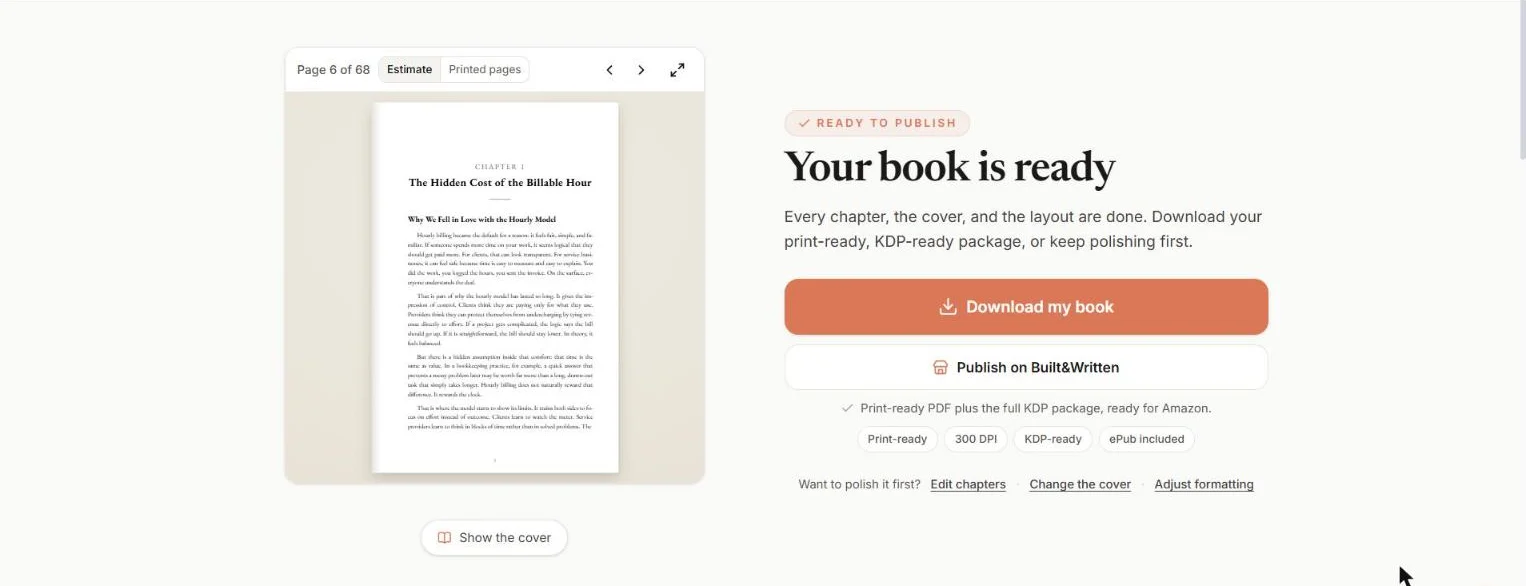
Text in the image: "Page 6 of 68". "Estimate", "Printed pages". "Chapter 1". "The Hidden Cost of the Billable Hour". "Why We Fell in Love with the Hourly Model". "Ready to publish". "Your book is ready". Buttons: "Download my book", "Publish on Built&Written". "Print-ready PDF plus the full KDP package, ready for Amazon." Labels: "Print-ready", "300 DPI", "KDP-ready", "ePub included". "Want to polish it first? Edit chapters, Change the cover, Adjust formatting". "Show the cover".
It works from text. If your stories live in voice memos, you choose how they get in: paste a transcript, or speak into the text box with your browser's dictation.
Writing and downloading an AI-written book needs a plan with AI writing (see plans).
How do you protect your children's privacy in a parenting book?
A young child can't really agree to be in a book, and a printed book can't be taken back. Parents already see the risk online. In the same Mott poll, 74% of parents of young children who use social media knew another parent who had shared too much about a child, and 52% worried their own child might one day be embarrassed by what they had shared.
Four habits protect your children in print:
- Change identifying details: names, ages, the school, the town. Say in an author's note that you did.
- Leave out what could follow them: a diagnosis, school trouble, anything a classmate could tease them about, unless the story needs it and your child agrees.
- Let older children read their passages first, and drop what they ask you to drop.
- Read the AI tool's data settings before you paste anything. Built&Written's privacy policy says its AI providers work under terms with no training on customer data.
For the other adults in your stories, like a partner, an ex or a grandparent, the checklist in our memoir guide applies.
Final thoughts
Before you draft a chapter, write the one sentence a tired parent should remember from it, and keep it at the top of the page. If a story doesn't serve that sentence, it belongs in another chapter or nowhere. When those sentences are written, Built&Written can draft the chapters around them from your own notes, and you edit every page. See how it works.
Frequently asked questions
Only after you think it through. A printed photo stays in the book for as long as copies exist, and readers will link the face to every story. A photo without faces, a drawing or a simple chart often makes the same point. If you use a family photo, ask your child when they are old enough to answer, and leave out school logos, street signs and anything that shows where you live.
Yes, about what you learned, but not about children someone could recognize. Families trusted you because of your job, and your employer has privacy rules. Schools in the US also follow FERPA, a federal law that gives parents some control over the disclosure of information from education records. Use examples built from many cases, say so, and ask your employer before you publish. Counselors face the same question with client stories, covered in our guide to writing a psychology book.
It isn't required in most cases, but a short one is wise for a book about children's health or behavior. Say plainly that the book shares your experience and does not replace advice from a pediatrician, doctor or therapist. Our book disclaimer examples include health wordings you can adapt.
Yes, if AI created any of the text, images or translations. The Content Guidelines of KDP (Kindle Direct Publishing, Amazon's self-publishing service) ask you to disclose AI-generated content when you publish. If you wrote the text yourself and used AI only to edit or improve it, KDP calls that AI-assisted, and you don't have to disclose it. Our guide on disclosing AI to KDP shows where the question appears.
Sources & References
- How To Talk Workshops (Faber and Mazlish), "About the Authors", checked November 17, 2026
- C.S. Mott Children's Hospital National Poll on Children's Health, "Parents on social media: Likes and dislikes of sharenting" (March 16, 2015), checked November 17, 2026
- CDC, "CDC's Developmental Milestones" (last updated February 16, 2026), checked November 17, 2026
- American Academy of Pediatrics, HealthyChildren.org, checked November 17, 2026
- Built&Written, Privacy Policy (last updated November 2026), checked November 17, 2026
- US Department of Education, Protecting Student Privacy, "What is FERPA?", checked November 17, 2026
- Amazon KDP, "Content Guidelines", checked November 17, 2026
- Built&Written, "AI Ghost Writer Test on What It Can and Can't Write" (test of November 5, 2026), checked November 17, 2026
About the author

Michael Pavlovskyi
More in Writing
Ready to write your book?
Turn your expertise into a professional book with Built&Written.