

How to Write a Self-Help Book That Doesn't Sound Like the Others
Key takeaways
- Why do readers put a self-help book down? Most often a first chapter about the author, or a promise bigger than the method.
- What makes a method stick? A short name and a few steps that start with a verb, like James Clear's "Make it obvious".
- Where does the proof come from? Client stories used with permission, results you can show, and research cited with care.
- Who should read it first? Two or three people from your audience.
What makes a self-help book different from the others?
Readers skip self-help books that try to help everyone. The publisher Greenleaf Book Group advises self-help authors to focus on one area of improvement. It also says to "structure content in a clear progression towards an end goal for the reader."
So writing a self-help book starts before chapter 1, with one sentence:
After this book, [one kind of reader] can [one result] [in what time or setting].
An invented example we'll use throughout: "After this book, a first-time manager can run a weekly one-to-one meeting that ends with a clear next step." Then write who the book is not for: ours is not for senior leaders. If a chapter idea doesn't serve the promise, it belongs in a different book.
How do you turn your advice into a method readers remember?
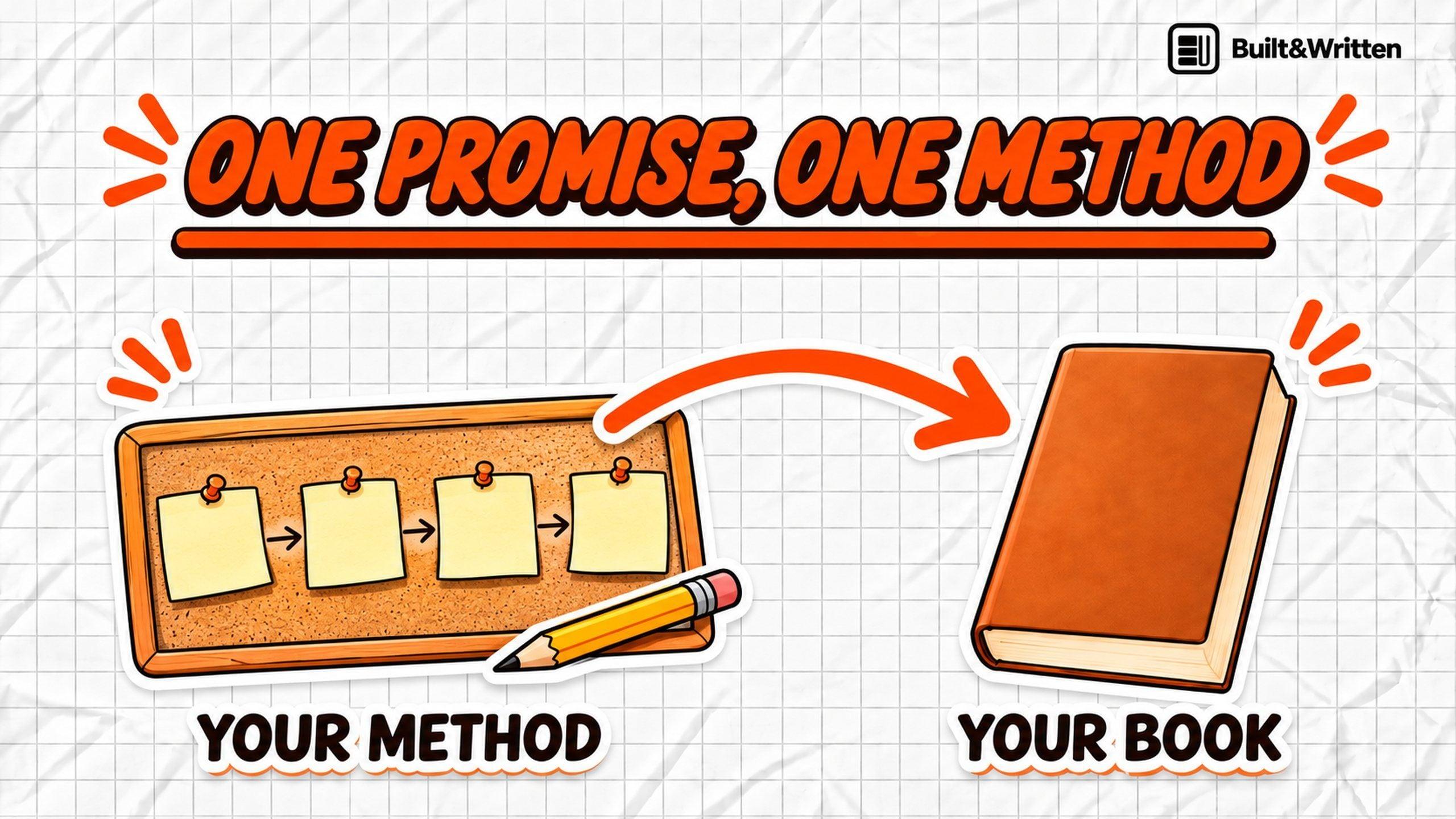
Most experts already have a method. It lives as habits, client advice and phrases they repeat. Your job is to write it down as a few steps with a name.
| Method | Its steps, as written on its own site |
|---|---|
| James Clear's Four Laws of Behavior Change | Make it obvious. Make it attractive. Make it easy. Make it satisfying. |
| Getting Things Done (GTD), from the David Allen Company | Capture, clarify, organize, reflect, engage |
Both follow rules you can copy:
- Few steps. Four or five, so a reader can repeat them after one read.
- Each step starts with a verb. "Make it easy" tells the reader what to do.
- The name says what it does. "The Weekly One-to-One" tells the reader what's inside before they open the book.
- The steps follow real life. In our manager example: prepare, ask, listen, agree, follow up.
Test the name on someone outside your field. If they ask what it stands for, rename it.
How to structure a self-help book, chapter by chapter
Once you have the steps, the structure follows. A common self-help book structure has three parts: the problem (one or two chapters), the method (one chapter per step), and keeping it going (setbacks and habits). It is close to the System Playbook, one of three shapes in our article on nonfiction book structure.
Inside each chapter, use the same four parts:
| Part | What it does | Example from the manager book (invented) |
|---|---|---|
| Story | Shows the problem in a real scene | A first one-to-one ends after ten minutes with nothing agreed |
| Principle | Explains why it happens | A meeting with no question written down drifts into status updates |
| Practice | Gives one thing to do this week | Write one question before the meeting and ask it in the first five minutes |
| Proof | Shows it works, and for whom | What happened when a client tried it (with permission), or a study you can cite |
Without the practice, you have an essay. Without the proof, you have an opinion.
To plan chapters, our book outline template gives you a page to fill in.
How Built&Written turns your scattered method into a book
The method is rarely the hard part. The hard part is that it's scattered across talks, posts and client notes, and you never get three free months to pull it into chapters.
Built&Written writes a nonfiction book from material you already have, in your voice (Voice DNA learns it from a few pages of your writing, about 300 to 1,000 words), and prepares it for KDP (Kindle Direct Publishing), Amazon's service for selling your book.
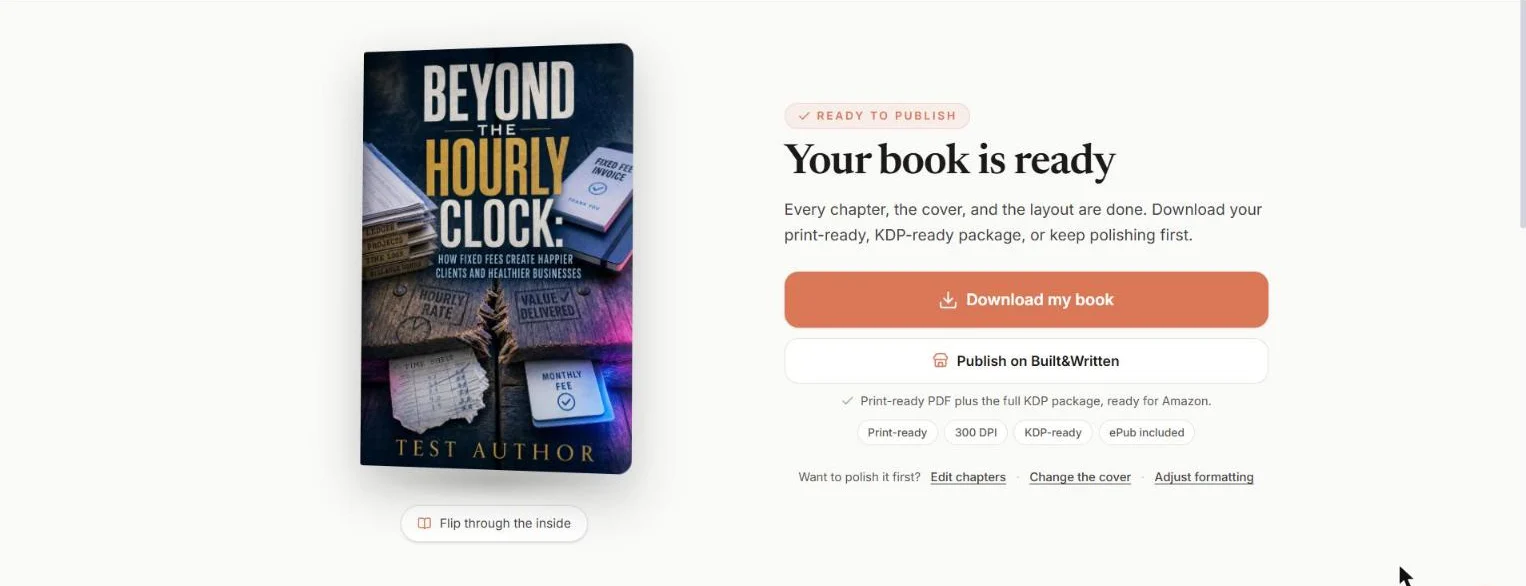
Text in the image: "7/7 Ready". "Ready to publish". "Your book is ready". "Every chapter, the cover, and the layout are done. Download your print-ready, KDP-ready package, or keep polishing first." Buttons: "Download my book", "Publish on Built&Written". "Print-ready PDF plus the full KDP package, ready for Amazon." Labels: "Print-ready", "300 DPI", "KDP-ready", "ePub included". "Want to polish it first? Edit chapters, Change the cover, Adjust formatting". "Flip through the inside".
| Step | By hand (Word, Google Docs or ChatGPT) | With Built&Written |
|---|---|---|
| Gathering your method | You copy pieces from old files into one document | You paste or upload everything into one book |
| Chapter plan | You write it, or ask a chatbot for one | Wren proposes one, and you change it until it follows your steps |
| Writing | You write every chapter, or prompt a chatbot one at a time | Wren writes each chapter from your material, in your voice |
| Layout and cover | You learn page setup or hire a designer | Layout and a cover with spine and back are made for you |
| Files for Amazon | You check KDP's file rules yourself | You download a print PDF and KDP files, then upload them yourself |
| Control | Every word is yours from the start | You approve the outline and can edit every line |
In our test on November 5, 2026, a made-up business owner's notes became a chapter that opened "I run a bookkeeping firm with nine people now, but I started it alone in 2014": all 8 facts kept, one story repeated three times.
You stay the editor. Built&Written works from text (a recorded talk needs a transcript first), and it doesn't check your facts or studies. Writing and downloading an AI-written book needs a plan with AI writing (see plans). For prompts and voice samples, read our guide to writing a self-help book with AI.
Where does the proof in a self-help book come from?
Proof comes from three places.
Your own cases, with permission. A client story is your strongest proof. Ask in writing, change details that could identify the person, and let them read the passage. Our article on using client stories in a book covers how.
Results you can show. "My clients double their output" needs numbers behind it, and the typical result next to the best one. The US Federal Trade Commission (FTC) sets a similar rule for ads: its Endorsement Guides say an ad showing exceptional results must make clear what people can generally expect. A book that sells your services can read like an ad, so hold it to that standard.
Research, cited with care. In 2015, the journal Science published a project that repeated 100 psychology experiments. About one-third to one-half of the original findings showed up again. So cite the original study, check whether others repeated it, and describe what it found in its own terms.
How do you test a self-help method before you publish?
Teach it before you print it, while changes are still free.
Beta readers. A beta reader reads your draft before publication and tells you what worked. Scribe Media recommends 2 to 3 beta readers and 5 at most, all from your target audience. It suggests two questions: "What did not work for you, and why not?" and "What did work for you, and why?"
A workshop or a short course. Teach the method live to a small group. Note which step people skip and which exercise nobody finishes. Those are the chapters to rewrite.
Where readers stop. Ask test readers to mark the page where they put the book down. The usual reasons are easy to fix once you see them:
| Why readers stop | The fix |
|---|---|
| The first chapter is about the author | Open with the reader's problem and keep your story to a page |
| The same point comes back in every chapter | Give each idea one chapter and cut the repeats |
| Exercises take an hour | Make each practice fit into an ordinary day |
| The promise is bigger than the method | Shrink the promise until the method can keep it |
Once the draft is close to final, an advance reader copy (a free early copy for reviewers) is the next step.
What makes a good self-help book title?
A good self-help book title is short, and the subtitle states the promise. Atomic Habits is the hook; its subtitle on James Clear's site, "An Easy & Proven Way to Build Good Habits & Break Bad Ones", says what you get. Our manager example could become The Weekly One-to-One: How New Managers Run Meetings That End With a Decision.
Two KDP rules apply. Amazon's metadata guidelines (the rules for a book's details, such as title and author) say the title field holds only the title as it appears on your cover, and the title and subtitle together must be fewer than 200 characters. If you're stuck, our free book title generator gives you options to react to.
Final thoughts
One thing to do this week: pick the client story you tell most often and write it as the opening scene of chapter 1, in under a page. If you can't tell it that short, the chapter's lesson isn't clear yet. Once the steps are clear, Built&Written can build the chapters around them from the talks and notes you already have. See how it works.
Frequently asked questions
Nobody can promise a bestseller. Bestseller lists rank sales, and sales depend on things outside the book, such as your audience and your launch. For an expert, a better target is a book that clients finish and recommend, which is the part you can control.
Yes, in small doses. Your story shows why you care about the problem and why readers can trust you. Greenleaf Book Group lists writing a book "solely based on overcoming a personal struggle" as a mistake, because people buy self-help to learn tools. A page of your story per chapter is usually enough, as long as it serves that chapter's lesson.
Not for the ebook. An ISBN (International Standard Book Number) identifies one edition of a book, and KDP says it is optional for ebooks. For a paperback or hardcover, KDP offers a free ISBN, but its help page says free KDP ISBNs "can only be used on KDP." If you also want to sell the print book through other stores, buy your own.
Pick the narrowest ones that match your promise. KDP lets you choose 3 categories for each book. Bookstores sort books with BISAC subject codes, and the BISAC Self-Help list includes Personal Growth / Success, Time Management, and Communication & Social Skills. In Self-Help / General, a book competes with every title on the shelf.
Sources & References
- Greenleaf Book Group, "Self-Help and Memoir Books: Do's and Don'ts", checked November 17, 2026
- James Clear, "How To Start New Habits That Actually Stick" (Four Laws of Behavior Change), checked November 17, 2026
- James Clear, "Atomic Habits" book page, checked November 17, 2026
- David Allen Company, "What is GTD?", checked November 17, 2026
- US Federal Trade Commission, "FTC's Endorsement Guides: What People Are Asking", checked November 17, 2026
- Open Science Collaboration, "Estimating the reproducibility of psychological science", Science, August 28, 2015, checked November 17, 2026
- Scribe Media, "What are Beta Readers? (& How Authors Can Find Them)", June 9, 2020, checked November 17, 2026
- Amazon KDP, "Metadata Guidelines for Books", checked November 17, 2026
- Amazon KDP, "What is an ISBN and Imprint?", checked November 17, 2026
- Amazon KDP, "KDP Categories", checked November 17, 2026
- Book Industry Study Group, BISAC Subject Headings, "Self-Help", checked November 17, 2026
- Built&Written, "AI Ghost Writer" test of November 5, 2026, checked November 17, 2026
About the author

Michael Pavlovskyi
More in Writing
Ready to write your book?
Turn your expertise into a professional book with Built&Written.