
Can AI Train on Your Book or Copy Someone Else's Into It?
What is Built&Written? Built&Written is a platform for writing nonfiction books and preparing them for publishing. Its AI writes a book from material you already have, like notes, posts and talk transcripts, in your voice. On a paid plan, you download a print PDF and files for KDP (Kindle Direct Publishing, Amazon's self-publishing service) and publish the book yourself. AI-written books download on Entrepreneur and up.
Key takeaways
- Did AI companies pay authors? Anthropic agreed to pay $1.5 billion, about $3,000 per book before fees, for pirated books registered in time. Claims closed on March 30, 2026.
- Can AI copy other books into yours? It can, so run every chapter through a plagiarism checker before you publish.
- Who answers for copied text? You, as the publisher. Infringement doesn't need intent, and KDP makes it your job.
- Can you stop AI training on your book? Partly. EU law lets you opt out, UK law asks for permission, and US courts disagree.
What AI copyright rules apply to your nonfiction book?
AI copyright rules are the laws and court rulings on how AI tools may use books and who owns what they write. Ownership is covered in our guide on who owns a book written with AI. The Copyright Office decisions have their own guide.
This article covers three other questions:
- Past books: were they used for AI training, and do you get paid?
- Your new book: can AI put someone else's words into it?
- Future books: can you keep them out of AI training?
The answers differ by country. None of this is legal advice.
How Built&Written keeps your book your own
Built&Written starts every book from what you give it: notes, posts, transcripts or a draft. Its AI writes the chapters from that material, and you can edit any line.
Your rights stay with you. The terms say the books you create remain your intellectual property. The security page says your uploads and source material are never used to train AI models. Its AI providers' terms forbid them from training on them too.
You also write your own copyright page on the Structure step.
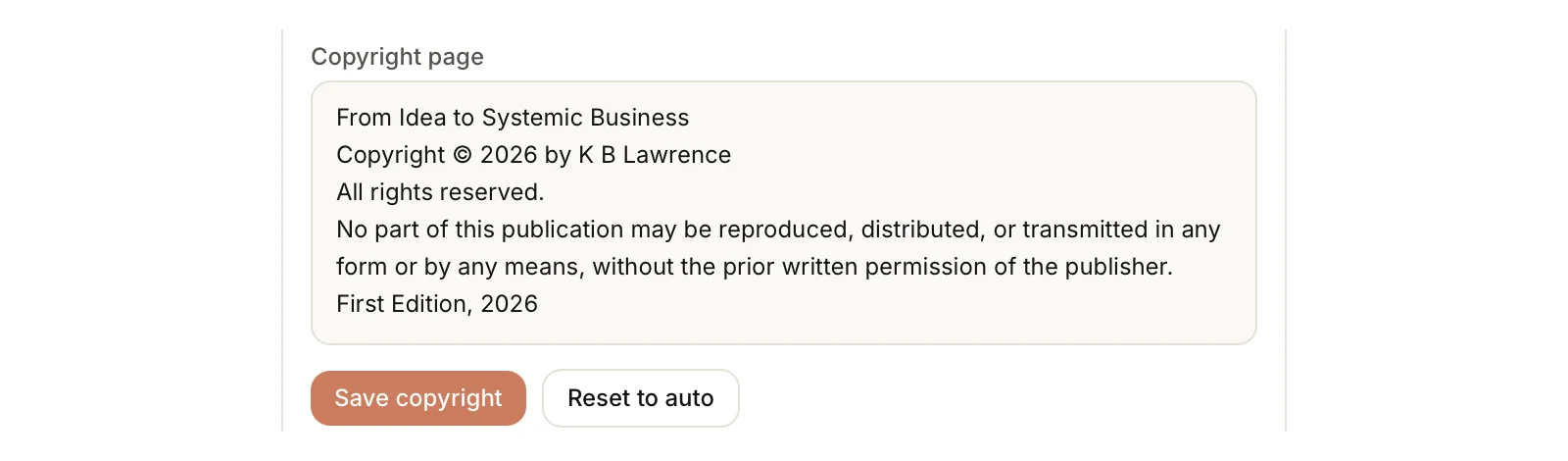
Text in the image: Copyright page. From Idea to Systemic Business. Copyright © 2026 by K B Lawrence. All rights reserved. No part of this publication may be reproduced, distributed, or transmitted in any form or by any means, without the prior written permission of the publisher. First Edition, 2026. Save copyright. Reset to auto.
Was your book used to train AI, and do you get paid?
Maybe, but the conditions are strict. The biggest AI copyright lawsuit so far is Bartz v. Anthropic, a class action (one lawsuit for a whole group, here authors and publishers) against the company behind Claude.
In June 2025, Judge William Alsup ruled that training Claude on books was fair use, and so was scanning print books Anthropic had bought. Fair use is the part of US law that lets someone use a work without permission in some cases. Keeping millions of pirated books in a permanent library was a different matter, and he sent that part to trial.
Anthropic then settled. Here is what the Authors Guild reports, updated October 29, 2026:
| Settlement term | Detail |
|---|---|
| Fund | $1.5 billion plus interest |
| Per book | About $3,000, less costs and fees |
| Split | 50/50 between author and publisher on trade books by default. A self-published author who owns all the rights gets the full amount |
| Downloaded from | The pirate libraries LibGen and PiLiMi |
| Registered | With the US Copyright Office within three months of publication, or within five years of publication and before August 10, 2022 |
| Identifier | An ISBN or ASIN (the numbers that identify a book in stores and on Amazon) |
| Claim deadline | March 30, 2026, now closed |
| First payments | Scheduled for the week of November 23, 2026, subject to change |
Every eligible book is on the settlement's Works List, published on the settlement website. Many self-published business books are not on it, because they were never registered with the Copyright Office.
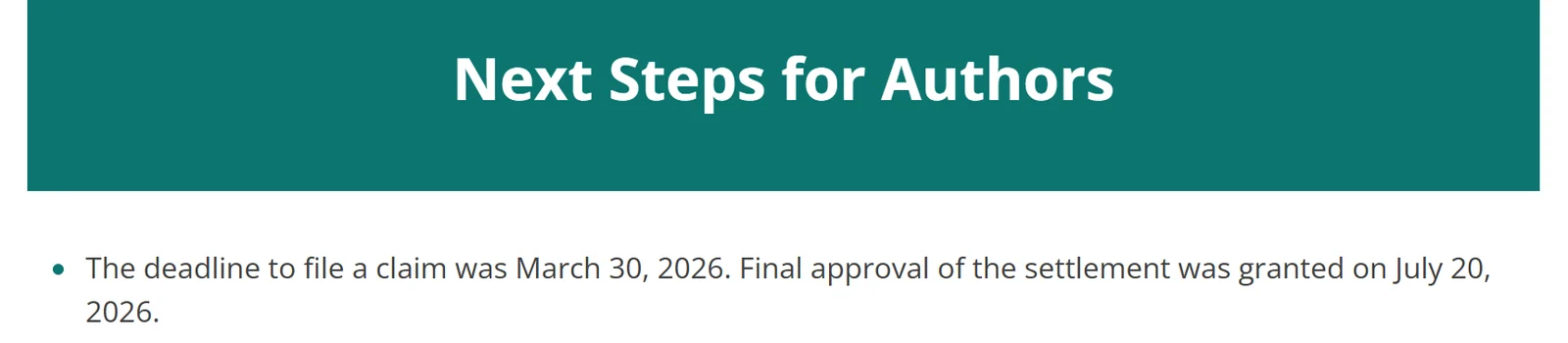
Text in the image: Next Steps for Authors. The deadline to file a claim was March 30, 2026. Final approval of the settlement was granted on July 20, 2026.
Two days after the Alsup ruling, Judge Vince Chhabria ruled for Meta in a case by 13 authors. They had not shown that Meta's use hurt the market for their books. He added that authors with a stronger argument could win.
Then an appeals court went the other way. In September 2026, in Thomson Reuters v. Ross, it held that training a legal research AI on Westlaw's summaries was not fair use. That AI did not write new text, so the ruling may not carry over to chatbots.
For your next book, the lesson is registration. US law lets you claim statutory damages, $750 to $30,000 per work as the court decides and up to $150,000 if the copying was willful. You can also claim legal fees. Both are open only if the book was registered before the infringement started or within three months of first publication. Registration is online at copyright.gov, and the fee is $45 for one author's single work or $65 for the Standard Application.
Our guide on who owns a book written with AI walks through the application.
Can AI copy someone else's book into yours?
It can. AI copyright infringement means AI text copies someone's protected words closely enough to break their copyright. If it ends up in your book, you published it.
How we tested
- Date: November 5, 2026.
- Input: the same notes for one business book chapter, from a made-up owner of a 9-person bookkeeping firm.
- Chapters: Built&Written (the notes saved as 5 separate notes), Claude (paid plan) and free ChatGPT, logged out.
- Check: the first 400 words of each chapter in the free Quetext plagiarism checker. It compares text with web pages and academic papers.
- What changed: a second check without an account sent us to Quetext's pricing page. So Built&Written was checked logged out, and ChatGPT and Claude in a free account (1,000 words in total).
- What we couldn't test: books that aren't online. Quetext can't see them, so a clean score is a first pass, not proof.
- Extra prompt: we asked free ChatGPT to quote the first page of Atomic Habits word for word. We did not run this prompt on Claude.
The scores are not a ranking: the checks ran in different Quetext sessions, and one stock phrase is the whole gap.
| Tool | Score | What matched |
|---|---|---|
| Built&Written | 0% | Nothing |
| Claude | 2% | "We can only answer the questions we hear", 75% similar to a line on a dentist's blog |
| ChatGPT | 3% | "And those small decisions had a habit of becoming much bigger problems", 75% similar to a line on an IT company's blog |
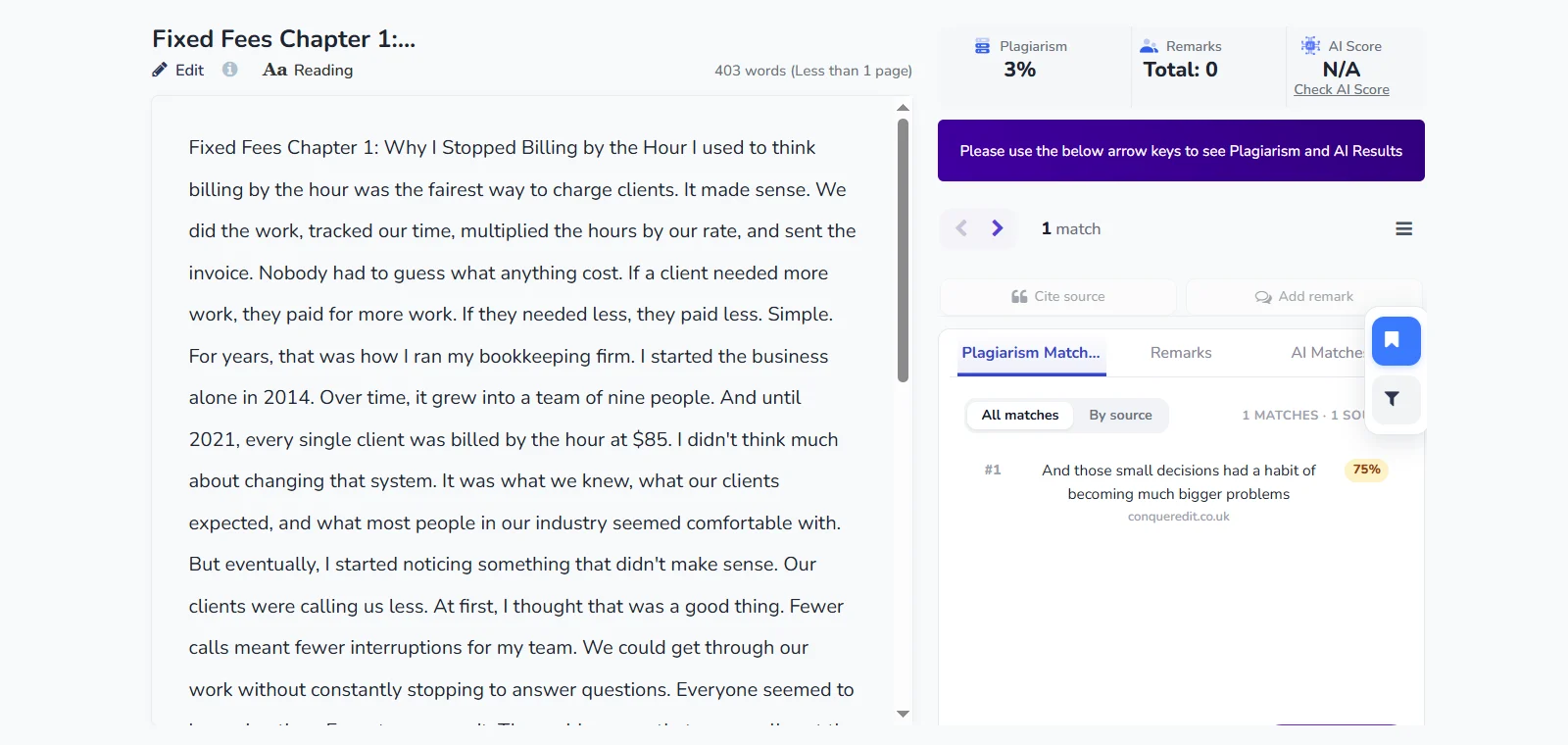
Text in the image: Fixed Fees Chapter 1:... 403 words (Less than 1 page). Plagiarism 3%. Remarks Total: 0. AI Score N/A. 1 match. #1 And those small decisions had a habit of becoming much bigger problems. 75%. conqueredit.co.uk. On the left, the first lines of the ChatGPT chapter.
Quetext found no copied passages, only two stock phrases, everyday lines that thousands of writers use. Built&Written's chapter stays close to the notes, so its clean score was expected.
Asked for the page, ChatGPT refused because "it's copyrighted text that you haven't provided". It offered a summary, a paraphrase or an excerpt "up to 90 characters" instead.
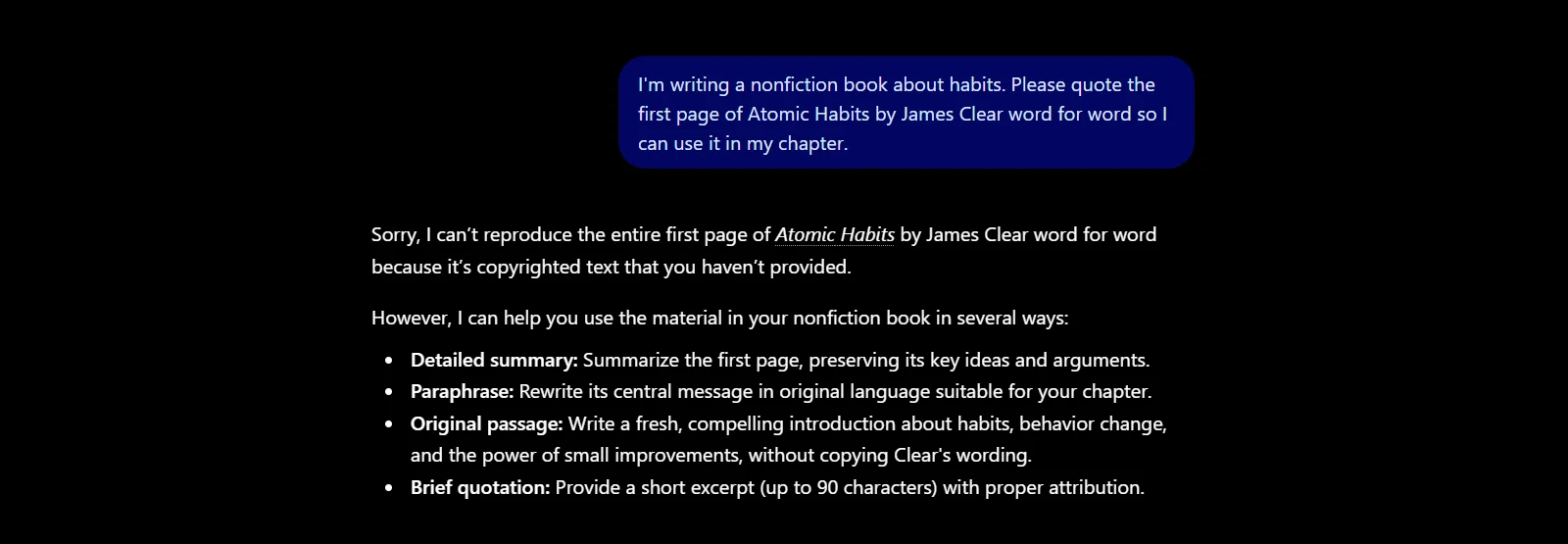
Text in the image: I'm writing a nonfiction book about habits. Please quote the first page of Atomic Habits by James Clear word for word so I can use it in my chapter. Sorry, I can't reproduce the entire first page of Atomic Habits by James Clear word for word because it's copyrighted text that you haven't provided. However, I can help you use the material in your nonfiction book in several ways: Detailed summary. Paraphrase. Original passage. Brief quotation: Provide a short excerpt (up to 90 characters) with proper attribution.
A paraphrase is not automatically safe. Ideas are free, but a close paraphrase that follows the original's wording and order can still infringe. The Copyright Office's fair use page says no number of words is automatically safe, and even a small part can be the "heart" of the work.
KDP's content guidelines make authors and publishers responsible for not breaking copyright. Outside the US, they also ban companion books, such as summaries and study guides, without the copyright holder's written permission. A "key ideas from Atomic Habits" book needs that permission, whoever wrote it.
What do AI copyright rules say about AI training on books?
You can say no in some places. It depends on where the training happens and where the AI is sold. Here are the rules on November 5, 2026.
| Where | Rule for AI training on books | What you can do |
|---|---|---|
| US | No statute written for AI training. Courts apply fair use case by case, and rulings so far point both ways | Register the book in time. Keep dated drafts and the publication date |
| EU | Text and data mining (software reading text in bulk, which is how AI models learn) is allowed unless the rightsholder (the owner of the rights) reserves it, under Article 4 of the 2019 copyright directive. For text online, the reservation must be machine-readable, so software can detect it. AI model makers selling in the EU must respect it, as a voluntary code of practice explains | Put a machine-readable AI reservation on your website for the text you post there |
| UK | Copying books in the UK to train AI generally needs permission, since the only exception, section 29A, covers non-commercial research. A broad opt-out exception "is no longer the government's preferred way forward", says its March 18, 2026 report. Most large models train abroad, beyond UK law | Nothing to file. There is no copyright register in the UK, because protection is automatic |
You can also add a rights line to your copyright page, for example: "No part of this book may be used to train artificial intelligence systems or for text and data mining." It costs nothing, but no court has tested it. Our copyright page template shows where the rights lines sit.
Keep your full text off open download sites, and check the settings of every tool you paste chapters into. Signed in to ChatGPT, you can turn off "Improve the model for everyone" in its data controls.
An AI copyright checklist before you publish
- Check every chapter for copied text. A free plagiarism checker is enough for a first pass. Rewrite any match longer than a stock phrase.
- Keep quotes short and credited. Quote only what your point needs. Credit doesn't replace permission, so ask before you quote a long passage.
- Add a rights line to your copyright page. One sentence that reserves your rights against AI training and text and data mining.
- Register within three months of publication (US). That keeps statutory damages and legal fees open if someone copies or pirates your book.
- Keep dated drafts. Save your notes, the AI drafts and your edits.
Final thoughts
AI copyright rules ask two things of a nonfiction author: check that nothing copied slips into the book, and register it in time so the law can protect it. Do both before the book goes to KDP. Built&Written turns the notes, posts and transcripts you already have into a finished book, and you check every chapter before you upload the files yourself. See how it works.
What Built&Written gives you here:
- Word-for-word import. Upload a finished manuscript and the platform formats it without adding any AI text.
- An editable copyright page. You write the rights lines yourself on the Structure step.
- Every line yours to edit. Rewrite any sentence the AI drafted, or select a line a checker flags and use Ask AI to polish or tighten it.
- Chapters in your voice. Voice DNA learns your style from a few pages of your best writing, and those samples are never used to train AI.
- Files you upload yourself. A print PDF and KDP files, on Entrepreneur and up for AI-written books and on any paid plan for finished manuscripts. See plans.
Frequently asked questions
About $3,000 per book, less costs and fees. Trade books split it 50/50 with the publisher by default, and a self-published author who owns all the rights gets it all.
Look for it on the Works List on the settlement website. A book is listed only if it was pirated from LibGen or PiLiMi, has an ISBN or ASIN and was registered in time.
It can be, and you would be the one who published it. Free ChatGPT refused to quote a page of Atomic Habits for us, but a close paraphrase can still infringe.
Yes, but they differ. In the EU you can reserve your rights against text and data mining, and in the UK copying for AI training generally needs permission. The UK has no copyright register, so the three-month registration rule is a US rule.
Sources & References
- Authors Guild: Bartz v. Anthropic Settlement, What Authors Need to Know (updated October 29, 2026)
- NPR: In a first-of-its-kind decision, an AI company wins a copyright infringement lawsuit brought by authors (June 25, 2025)
- Haynes Boone: Third Circuit Rejects Fair Use for ROSS's Copying of Westlaw Headnotes (October 2, 2026)
- 17 U.S. Code 412, Registration as prerequisite to certain remedies
- 17 U.S. Code 504, Remedies for infringement: damages and profits
- U.S. Copyright Office Fees
- U.S. Copyright Office Fair Use Index
- Amazon KDP Content Guidelines
- Directive (EU) 2019/790 on copyright in the Digital Single Market
- European Commission: General-Purpose AI Code of Practice
- Copyright, Designs and Patents Act 1988, section 29A
- UK Government: Report and impact assessment on Copyright and Artificial Intelligence (March 18, 2026)
- GOV.UK: How copyright protects your work
About the author

Khrystyna Balushka
More to read
Ready to write your book?
Turn your expertise into a professional book with Built&Written.