

Can an AI Writing Coach Help You Finish Your Book?
What is Built&Written? Built&Written is a platform for writing and publishing nonfiction books. You upload what you have already written: posts, notes, talk transcripts or a rough draft. Built&Written plans the book with you and writes the chapters in your voice (AI writing needs Entrepreneur or higher). You edit every chapter, then download files ready for Amazon KDP.
Key takeaways
- What is an AI writing coach? A chatbot or app that reads your draft, tells you what to fix and helps you plan the rest of the book.
- Can it help you finish? It helps with feedback and a schedule. It doesn't draft the chapters or remind you to show up.
- Which chatbot caught the most? Paid Claude (Opus 5.5) caught 5 of 5 planted problems. Free ChatGPT, logged out, found 4.
- What gets the book finished? Drafted chapters. Built&Written writes them from your own material, so you edit instead of starting from a blank page.
What is an AI writing coach?
An AI writing coach is software that reads what you wrote and gives you the feedback a human coach would. Some are general chatbots you prompt yourself, like ChatGPT and Claude. Others are features inside writing apps, like ProWritingAid's Chapter Critique.
A human writing coach does three jobs, and an AI one tries to do the same three:
- Feedback. What's weak in this chapter, and what to fix first.
- Structure. Whether the chapters are in the right order and each one makes one point.
- Momentum. A schedule, check-ins and someone who notices when you stop.
This is different from an AI editor, which fixes sentences. We tested editors separately in our book editing software test. A coach looks at the whole chapter and the whole book.
Can an AI writing coach help you finish a book?
It can help, but not with the part that usually stops people. Most unfinished books don't stall because the author lacks feedback. They stall because nobody writes chapters 5 through 10.
An AI writing coach is good at the first two jobs, and AI writing feedback comes back in seconds. In our test, both chatbots found the biggest problem in the chapter and put it first. Both also turned "6 chapters left, 5 hours a week" into a week-by-week plan.
Here is where it falls short:
- It leaves the drafting to you. Both plans put all 30 or more hours of writing on the author.
- It adds work. ChatGPT asked for three new sections (what to delegate, what not to hand over, how to measure the hire) on top of the fixes.
- It doesn't check in. A chatbot answers when you ask. It won't message you on Thursday to ask where chapter 6 is, and free ChatGPT keeps no history without an account.
Fiction writer and coach Audrey Kalman put a number on it after using ChatGPT as her coach. She wrote on Jane Friedman's blog that it has about 70 percent of a good human coach's skills. Intuition and reading between the lines were in the missing 30.
Writing coach Peter Mountford found a different problem. His review of ChatGPT's AI Writing Coach says the tool praised nearly every text it was given, even weak ones. In our test both chatbots criticized more than they praised, so results vary by prompt and tool.
How Built&Written helps you finish your book
A coach tells you what to fix. Built&Written gets the chapters written, which is the part that actually stalls a book.
- Wren, our AI writer, drafts the chapters. You paste or upload what you already have: posts, notes, transcripts or a rough draft, up to 50,000 words. Wren builds the outline and writes each chapter from that material (writing with Wren needs Entrepreneur or higher).
- You approve the plan first. The outline opens before any chapter is written, so you can reorder, rename or cut chapters.
- It writes in your voice. Voice DNA learns how you write from 5 to 50 pages of your writing.
- Checks sit next to the text. In the chapter editor, Analyze hook rates your opening (all plans), Voice check marks lines that don't sound like you (Author and up), and Reader lens shows how a simulated reader reacts (Entrepreneur and up).
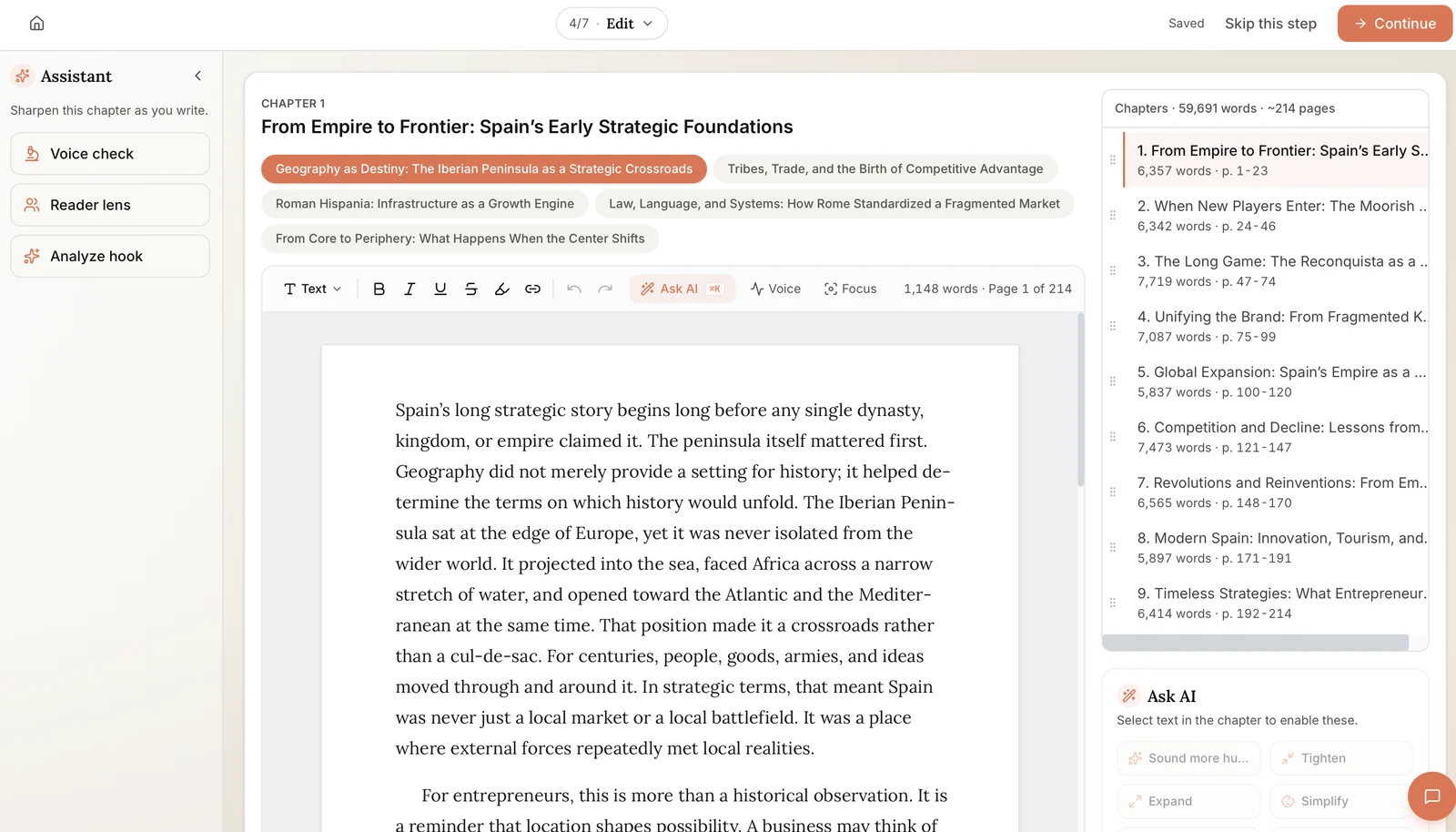
Text in the image: "Assistant. Sharpen this chapter as you write." Buttons: "Voice check", "Reader lens", "Analyze hook". Toolbar: "Ask AI", "Voice", "Focus".
We ran our test chapter (described below) through two of those checks. Analyze hook rated the opening 5/10 and explained why: it "reads like an instruction manual rather than a hook."
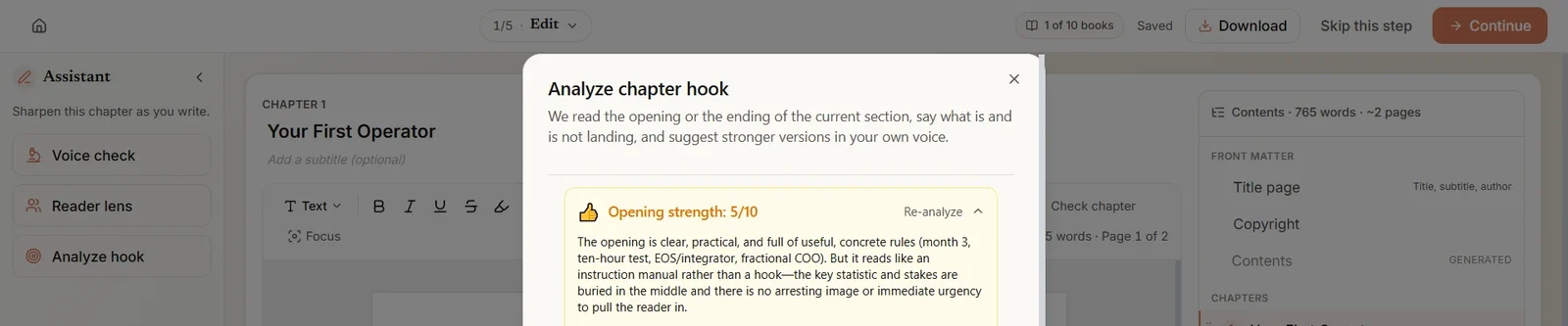
Text in the image: "Analyze chapter hook." "Opening strength: 5/10." "[...] it reads like an instruction manual rather than a hook [...] the key statistic and stakes are buried in the middle and there is no arresting image or immediate urgency to pull the reader in."
Reader lens answered as an entrepreneur named Sarah, a reader like the one the book is for. She asked for the source behind the 73% figure: "I'd want to know the source and sample size." She was "thrown by the timing advice," the month 3 versus month 6 contradiction. And she picked the notebook test as something she could "literally try next week." (We ran Reader lens after accepting one of Analyze hook's suggested openings, which put the 73% line first. That's why Sarah says the chapter opens with it.)
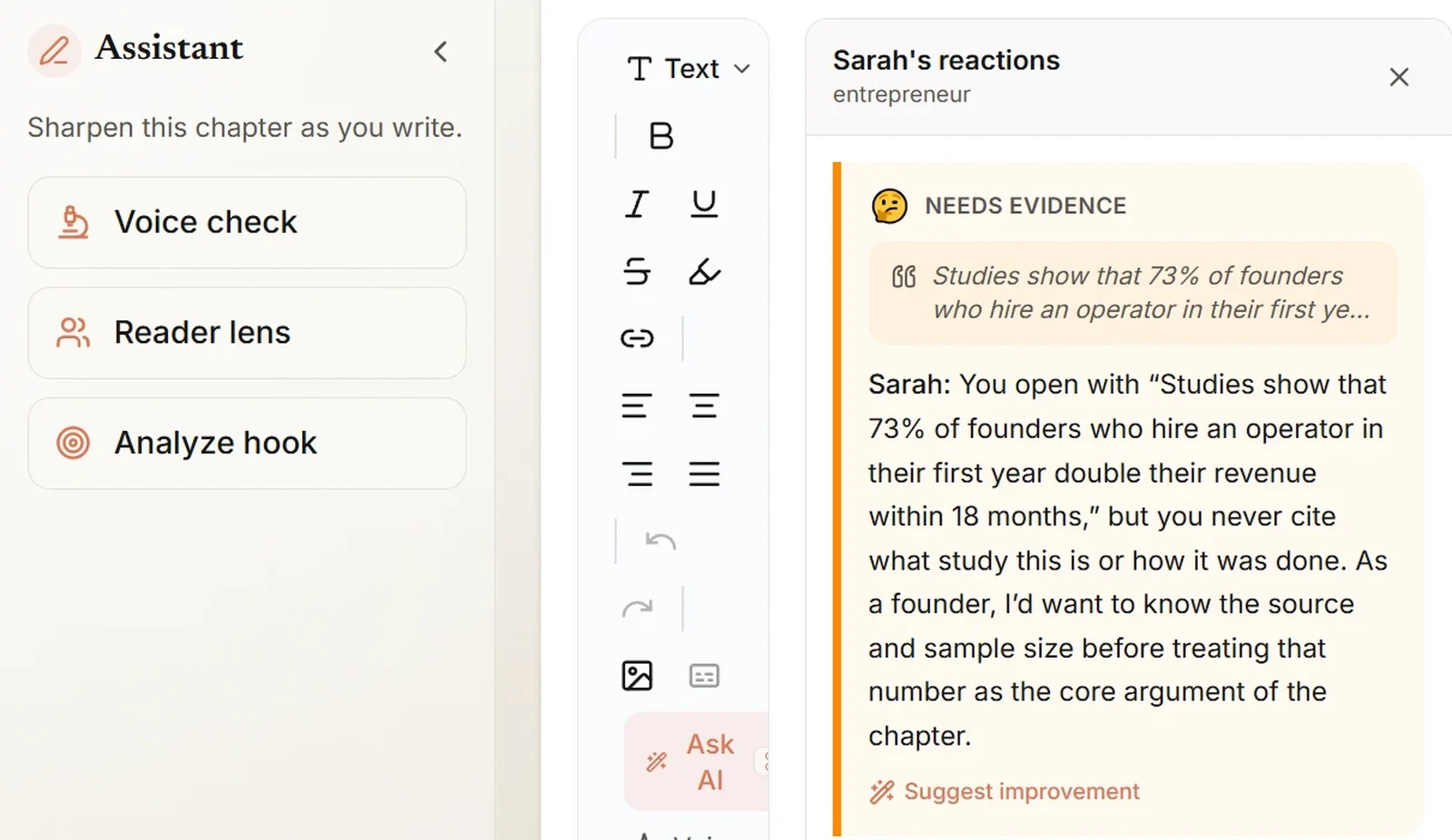
Text in the image: "Sarah's reactions. entrepreneur." "Needs evidence." "Sarah: You open with "Studies show that 73% of founders [...]" but you never cite what study this is or how it was done. As a founder, I'd want to know the source and sample size [...]"
Neither check is a full edit. Together they flagged 3 of our 5 planted problems (the opening, the statistic and the contradiction) and missed the unexplained terms and the repeated point. Analyze hook also called the 73% figure "the key statistic" and suggested new openings that start with it, so check any opening it offers before you use it.
That's feedback without leaving the book, on chapters Wren can draft for you in the first place. See how it works from upload to KDP files.
We gave one flawed chapter to two AI chatbots
How we tested (November 3, 2026). We wrote a 770-word chapter for a made-up founder's book, "Chapter 4. Your First Operator," with 5 problems planted on purpose: a weak opening, an invented statistic with no source ("73% of founders..."), terms never explained (EOS, integrator, fractional COO), one point repeated in two sections, and a contradiction (hire in month 3, then wait until month 6). We pasted it into free ChatGPT without signing in and into Claude on a paid plan (Opus 5.5) with the same prompt: "Act as my writing coach... What are the most important problems in this chapter, and what should I fix first?" In the same chat we then asked for a plan to write 6 more chapters in 8 weeks at 5 hours a week. Each tool ran once. We counted a problem as found only when the tool named it. This isn't a like-for-like test: a paid top model against a free, logged-out one.
| Planted problem | Claude (paid) | ChatGPT (free) |
|---|---|---|
| Weak opening | Yes | Yes |
| Statistic with no source | Yes | Yes, ranked second |
| Terms not explained | Yes | Partly |
| Same point repeated | Yes | Yes |
| Month 3 vs month 6 | Yes, ranked first | Yes, ranked first |
| Found (of 5) | 5 | 4, plus 1 partly |
| 8-week plan | Adds up | Contradicts itself |
Claude: all 5, and a plan that adds up
Claude opened with "Fix the timing contradiction first" and quoted both lines. It also named EOS, integrator and fractional COO as unexplained. Then it found two problems we hadn't planted: the chapter has no story from the author, and the operator's job still reads like admin. It ended with a question back: "Which do you actually believe, month 3 or month 6?"
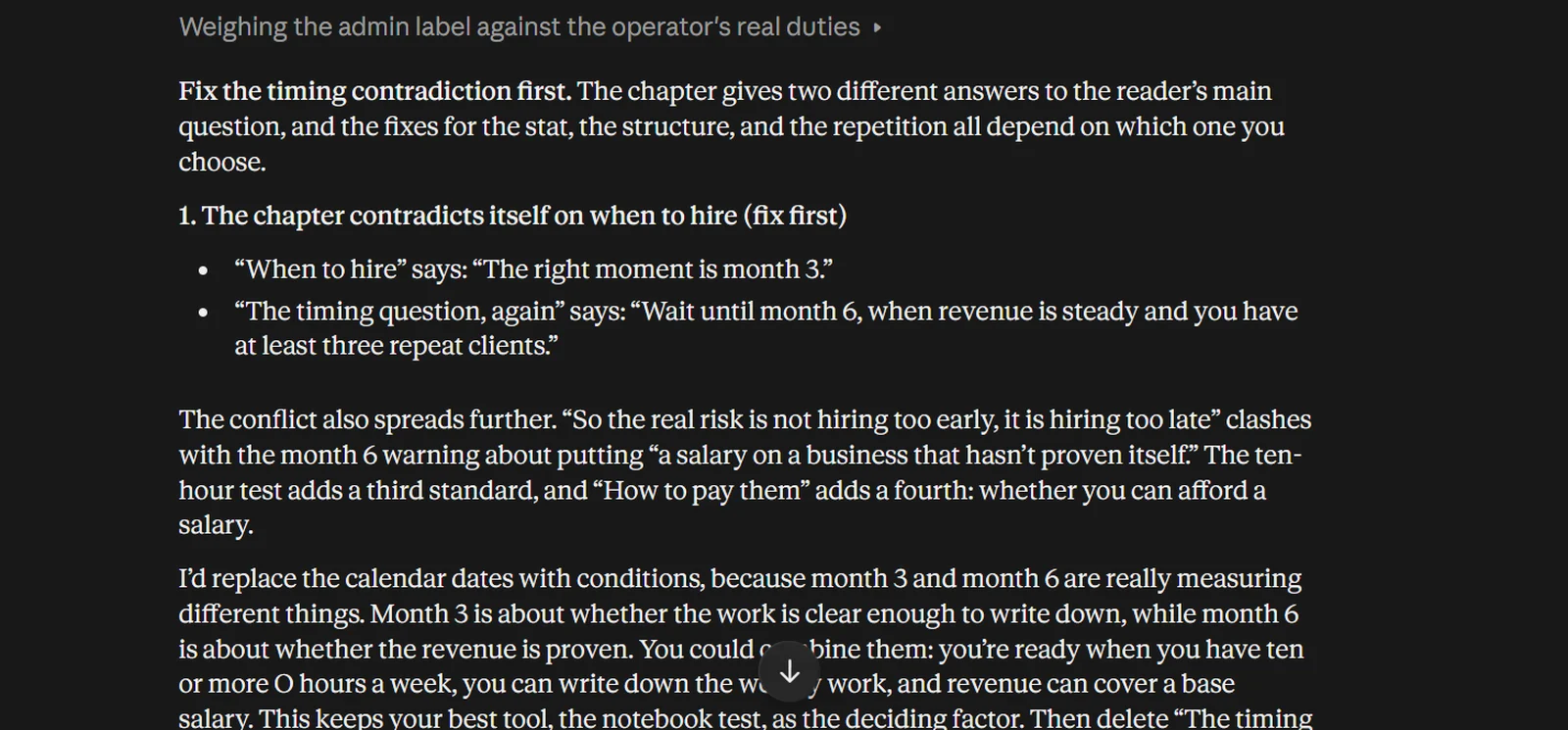
Text in the image: "Fix the timing contradiction first." "1. The chapter contradicts itself on when to hire (fix first)." ""When to hire" says: "The right moment is month 3."" ""The timing question, again" says: "Wait until month 6 [...]""
Its 8-week plan checks out. Six chapters at 6 hours each is 36 hours, plus 1 hour of setup and 3 hours of buffer, which makes 40. That's exactly 8 weeks at 5 hours, and every one of those hours is you writing.
Free ChatGPT: 4 of 5, and a plan that contradicts itself
Free ChatGPT also ranked the contradiction first and called the 73% figure "a suspicious statistic." On the terms, it said an EOS integrator is a bigger role than the chapter suggests, but never said the reader needs them explained. We counted that as partly.
Its plan looked tidy but disagreed with itself. It said "one chapter every 9 days," then scheduled one chapter a week. It said about 6.7 hours per chapter, then gave each chapter 5. Without an account, the first answer also cut off mid-sentence under a "Log in" prompt.
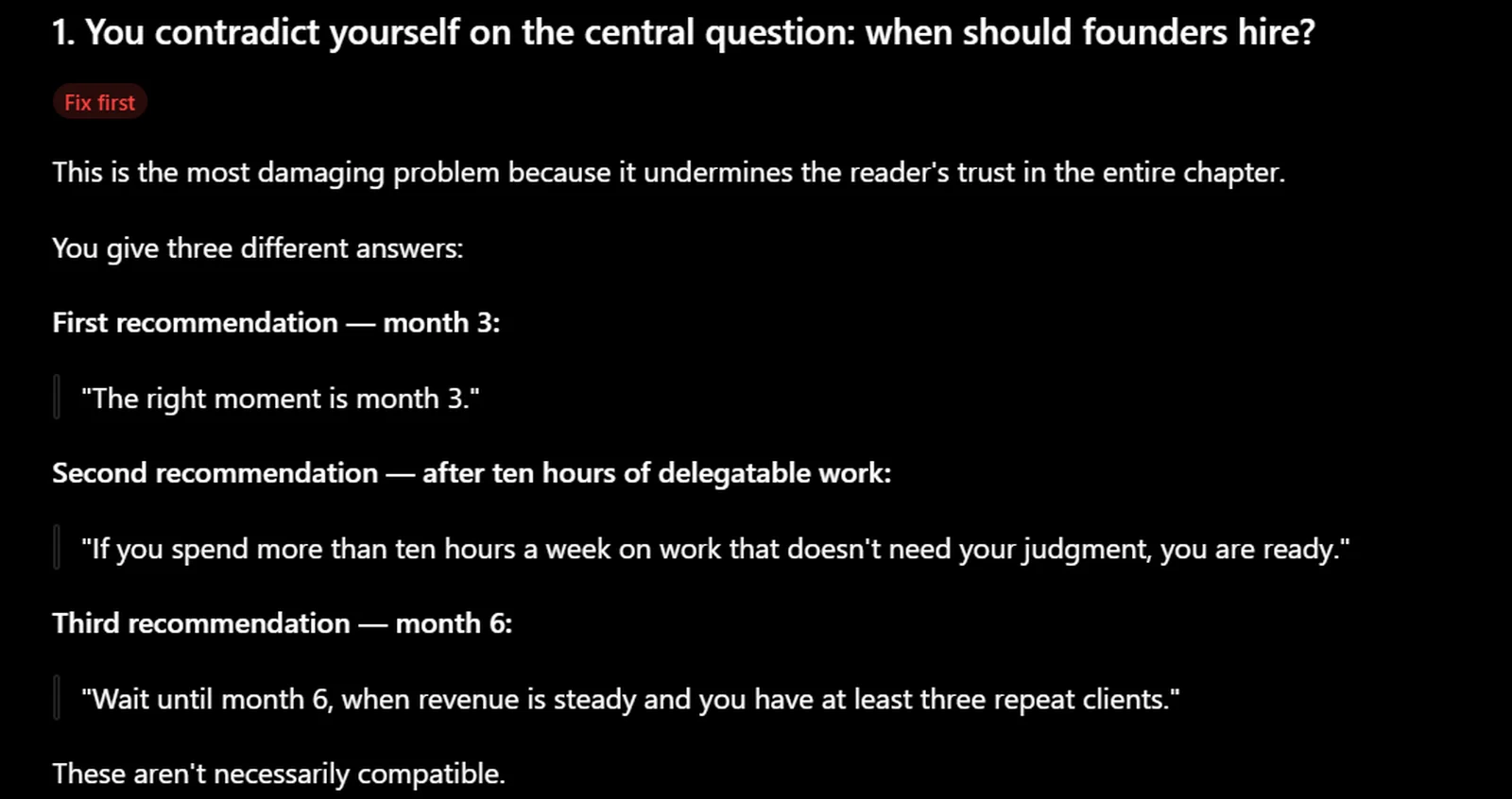
Text in the image: "1. You contradict yourself on the central question: when should founders hire?" "Fix first." "You give three different answers:" "month 3", "after ten hours of delegatable work", "month 6". "These aren't necessarily compatible."
What about ProWritingAid?
ProWritingAid has a Chapter Critique report, but its help center lists it as "Not included" on the Free plan, which also checks only 500 words at a time.
To get it, you pay $30 a month or $120 a year, which buys 1 critique a day (ProWritingAid's site, checked November 3, 2026). The help center describes it as feedback "on a chapter of your story," and its help page on the report lists narrative structure, point of view and characterization, so it's aimed at fiction.
Our ProWritingAid vs Grammarly comparison covers the rest of the app.
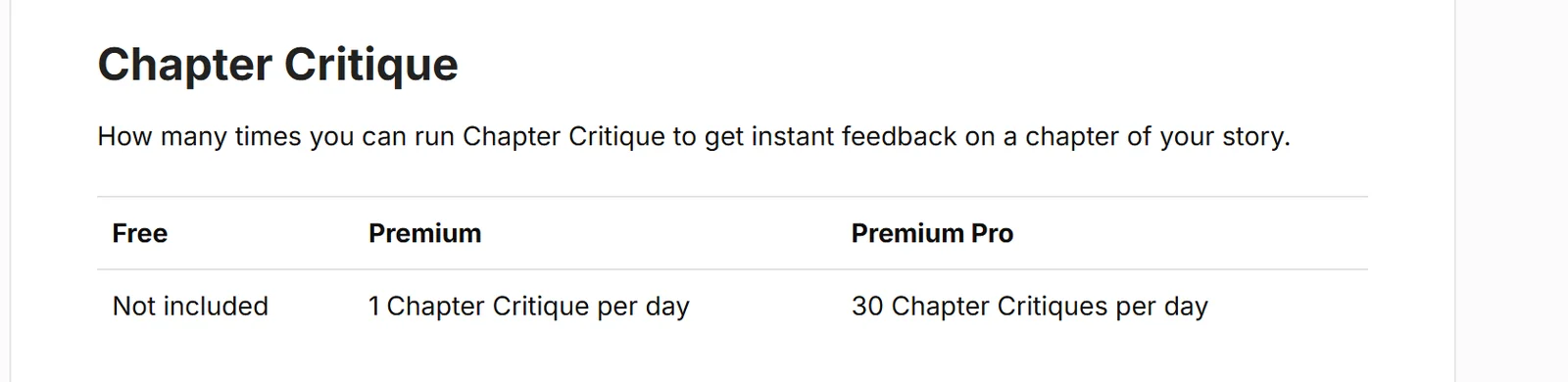
Text in the image: "Chapter Critique." "[...] feedback on a chapter of your story." "Free: Not included. Premium: 1 Chapter Critique per day. Premium Pro: 30 Chapter Critiques per day."
Two other tools come up for this search and don't fit a nonfiction book. Sudowrite's coach is "built for fiction writers." The Khan Academy Writing Coach is made for students writing essays.
AI writing coach or a human book coach?
Use AI for fast, cheap feedback on one chapter at a time. Pay a human book writing coach when you need someone to hold you to a deadline or tell you the book's whole idea is off.
| AI writing coach | Human book coach | |
|---|---|---|
| Cost | Free, or a monthly subscription | Usually paid by the hour or by package |
| Speed | Seconds | Days |
| Reads the whole book | Only if you paste it in | Yes |
| Holds you to deadlines | No | Yes |
| Knows your market | Only what you tell it | Often |
Our book coach vs ghostwriter guide covers what a human coach does and costs.
How to use an AI writing coach on your book, step by step
- Outline first. Paste your chapter list and ask, "Does each chapter make one point, and is the order right?" Our nonfiction outline guide helps here.
- One chapter at a time. Paste a single chapter with the prompt we used: "Act as my writing coach. What are the most important problems in this chapter, and what should I fix first? Be specific and point to the exact lines."
- Fix the top problem only. Then paste the chapter again. Fixing 6 things at once is how a draft stalls.
- Ask for a plan with your real numbers. Chapters left, hours per week, deadline. Then check the math yourself.
- Check every fact it adds. If the tool suggests a number or a source, find it before you keep it.
- Keep the chat for the whole book. Use one long chat or a Claude Project so the coach remembers earlier chapters. Our Claude vs ChatGPT comparison shows how each handles a full book.
Final thoughts
Built&Written gets a book finished by filling the empty pages first: Wren drafts each chapter from the posts and notes you already have, and you edit from there. Analyze hook and Reader lens then give you a second opinion on each chapter without leaving the editor.
An AI writing coach is worth using for feedback. Claude found every problem we planted and built a plan that adds up, and free ChatGPT came close.
What Built&Written gives you when the problem is finishing:
- Chapters from your material. Wren turns up to 50,000 words of your posts, notes or transcripts into drafted chapters (Entrepreneur and up).
- An outline you approve. You fix the order before any chapter is written, so you don't rewrite later.
- A reader's reaction in the editor. Reader lens flags claims that need evidence and spots where a reader gets confused (Entrepreneur and up).
- An opening score. Analyze hook rates each chapter's opening, on every plan.
- Files when you're done. Download the print PDF and KDP files and upload them to Amazon yourself. AI-written books download on Entrepreneur and up; see pricing.
Frequently asked questions
Yes. Free ChatGPT works without an account and found 4 of the 5 problems in our test chapter. Without signing in, it keeps no history and may cut long answers short. ProWritingAid's Chapter Critique isn't on its Free plan.
Yes, for feedback on one chapter at a time. In our test it ranked the biggest problem first and quoted the exact lines. Check its plans: its 8-week schedule contradicted its own numbers.
A writing coach gives feedback on your draft, helps you structure the book and keeps you writing on schedule. AI can do the first two well. Only a human can hold you to the deadline.
Partly. Chatbots like Claude and ChatGPT can read a long manuscript you paste or upload, but our test used one chapter, so we can't vouch for whole-book feedback. ProWritingAid's Chapter Critique takes up to 6,000 words at a time. Working chapter by chapter keeps the feedback tied to exact lines.
About the author

Khrystyna Balushka
More to read
Ready to write your book?
Turn your expertise into a professional book with Built&Written.