

How Long Does It Take to Write a Book With AI?
AI can generate 50,000 words in a day. That doesn't mean you've written a book worth publishing.
For entrepreneurs, founders, and consultants, the real challenge isn't filling pages. It's turning years of expertise into a clear, accurate nonfiction book that readers can trust.
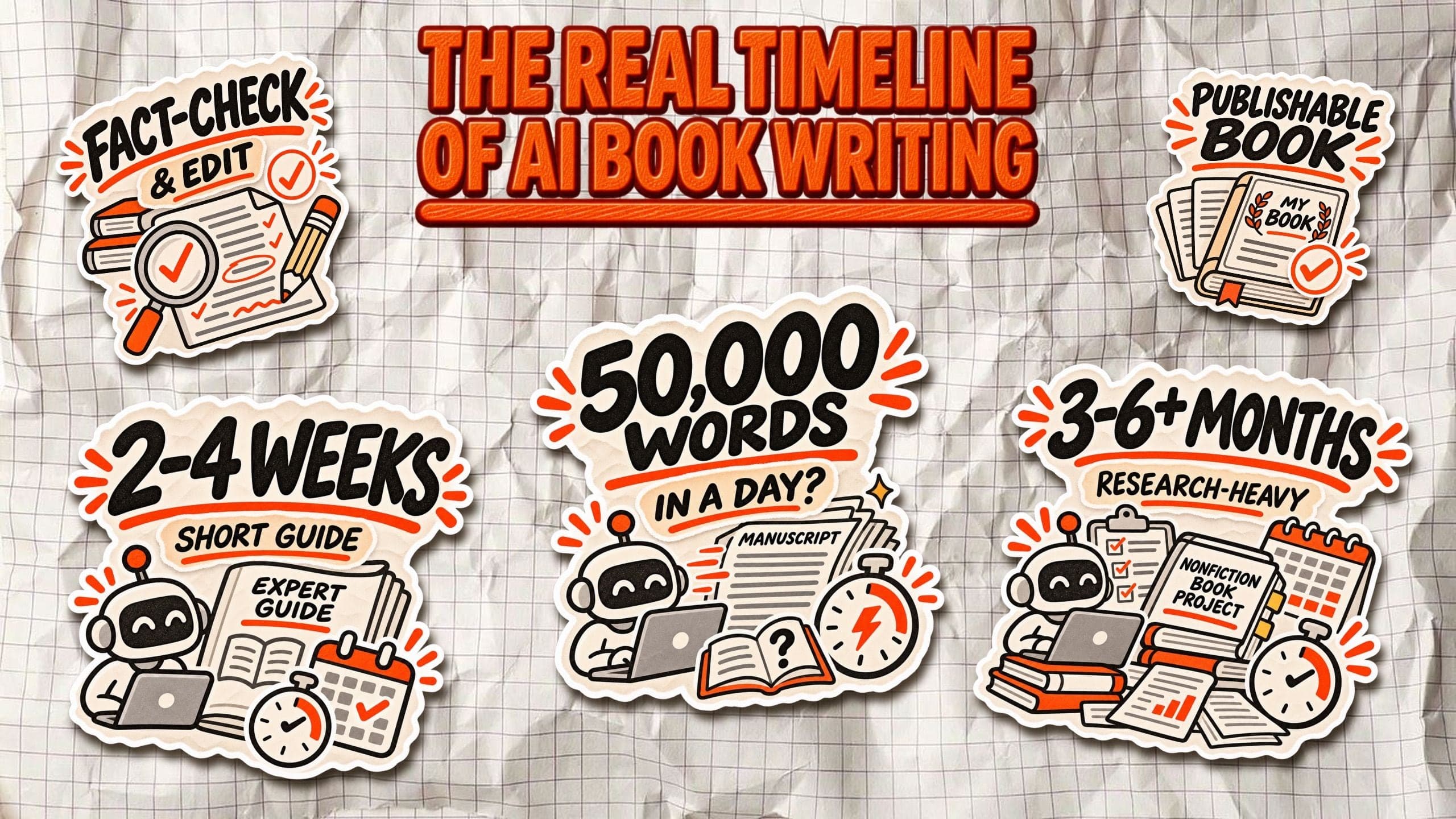
Writing a nonfiction book with AI can take anywhere from a few weeks to several months. A short guide built from existing materials might take 2 to 4 weeks, while a 30,000 to 50,000-word business book could require 6 to 12 weeks of consistent work. These are planning estimates, not industry averages. AI can produce a rough draft much faster, but research, fact-checking, editing, and formatting still take time.
AI speeds up drafting and organization. It doesn't eliminate fact-checking, editorial decisions, or your responsibility for the final manuscript.
How long does it actually take to write a book with AI?
Writing a nonfiction book with AI can take anywhere from a few weeks to several months. The biggest variable isn't how fast AI generates text. It's how much work your book needs before anyone should read it.
A consultant turning an existing workshop into a 15,000-word guide has a head start. A founder writing a 50,000-word business book from scattered notes needs more planning. An expert building an evidence-heavy book from original research faces an even longer process.
For planning purposes, the estimates below assume that the author already understands the book's subject, works consistently each week, uses AI for outlining and drafting, and personally reviews the manuscript. They are illustrative scenarios rather than measured averages from published authors. A book requiring original interviews, new research, or several rounds of external editing will take longer.
| Book type | Word count | Estimated completion time |
|---|---|---|
| Short expert guide | 10,000 to 20,000 | 2 to 4 weeks |
| Standard nonfiction book | 30,000 to 50,000 | 6 to 12 weeks |
| Research-heavy nonfiction | 50,000 to 70,000 | 3 to 6+ months |
These are illustrative planning estimates, not measured industry averages. They assume one author working consistently with AI assistance, with time allocated for research, verification, editing, and production.
Your existing material matters as much as word count. Recorded presentations, verified case studies, and approved frameworks can reduce preparation time. Starting with an idea and no supporting evidence adds weeks of research.
The quality standard matters too. AI might generate a rough 50,000-word manuscript in hours, but that draft still needs structural editing, factual checks, and consistent terminology.
The useful deadline isn't when AI finishes generating chapters. It's when you have a manuscript that's accurate, coherent, and ready to publish.
How much time can AI save when writing a nonfiction book?
AI can save hours of work, especially during the early stages of writing a nonfiction book. But the savings depend on which tasks you delegate and how much review the output requires.
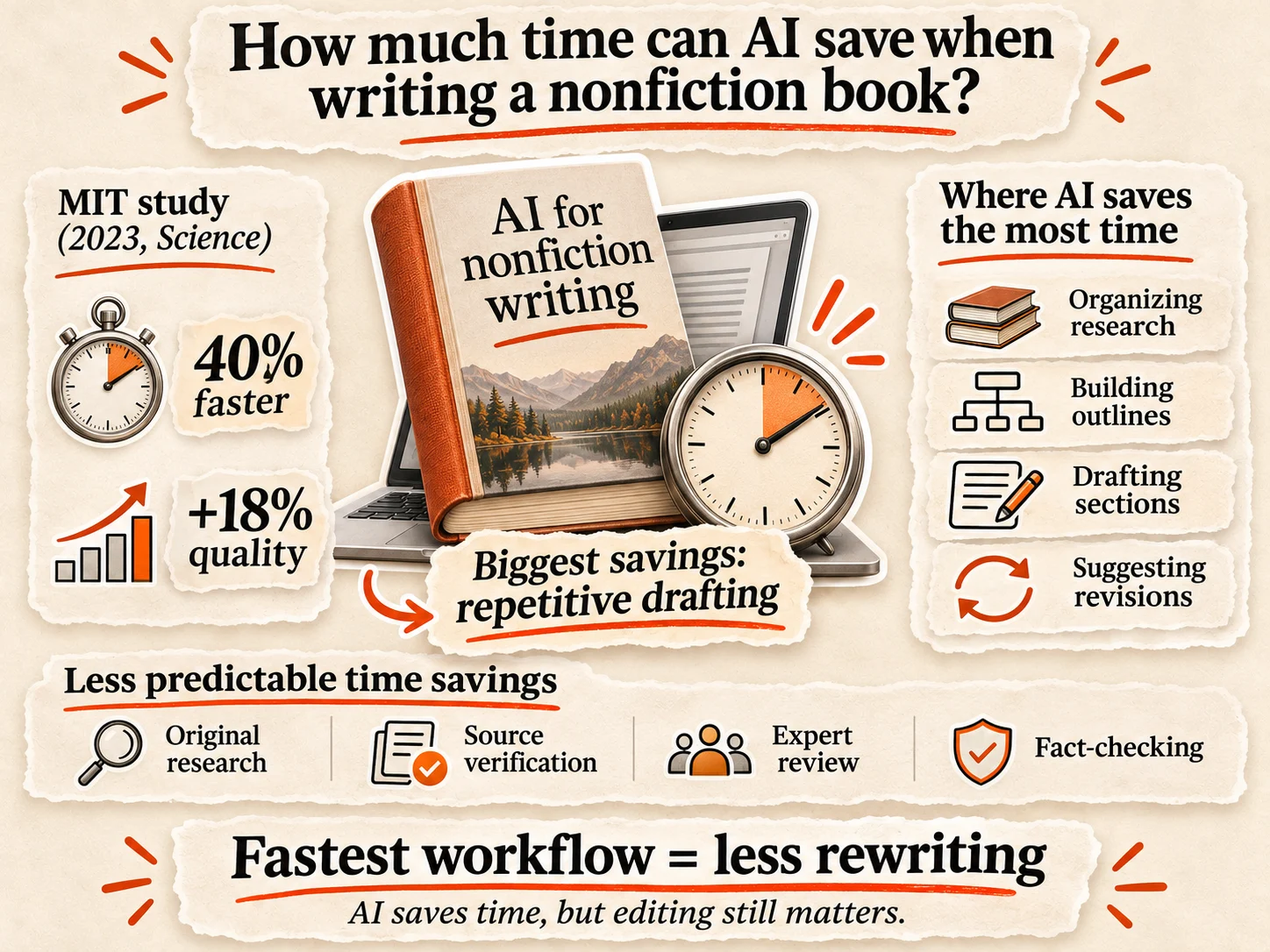
A 2023 study by MIT researchers Shakked Noy and Whitney Zhang, published in Science, found that professionals using ChatGPT completed certain writing tasks 40% faster, with independently evaluated output quality improving by 18%. However, the experiment involved shorter professional writing assignments, not complete books, and did not require rigorous factual verification.
For nonfiction authors, AI is particularly useful for:
- Organizing research: Turning scattered notes, interviews, and transcripts into structured material.
- Building outlines: Arranging ideas into chapters and identifying gaps.
- Drafting sections: Developing prose from approved facts, examples, and frameworks.
- Suggesting revisions: Flagging repetition, unclear explanations, and inconsistent terminology.
The time savings become less predictable during original research, source verification, expert review, and fact-checking. AI can assist with these tasks, but it cannot guarantee accuracy.
That's where impressive AI writing speed claims become misleading, as our own end-to-end AI book-writing experiment demonstrated. Generating a chapter in minutes sounds productive until you spend hours correcting invented references, repetitive arguments, or inaccurate claims.
The biggest time savings come from reducing repetitive drafting work, not eliminating editorial responsibility. For a credible nonfiction book, that distinction matters more than any headline percentage.
The five stages of writing a book with AI, and how long each takes
AI can draft chapters in minutes. But drafting is only one part of producing a nonfiction book. The work still follows five stages, each requiring different levels of human involvement.
Consider a consultant creating a 40,000-word business book from existing presentations, client examples, and research. Here's a realistic planning scenario for someone working roughly 15 to 20 hours per week.
| Stage | Estimated time | Main task |
|---|---|---|
| Planning and outlining | 3 to 5 days | Define the book's argument and structure |
| Research and source collection | 1 to 2 weeks | Organize and verify supporting material |
| AI-assisted drafting | 1 to 2 weeks | Develop chapters from approved sources |
| Fact-checking and editing | 2 to 3 weeks | Correct facts, structure, and language |
| Formatting and publishing preparation | 3 to 7 days | Prepare and review final files |
Total: approximately 6 to 10 weeks, allowing for overlapping tasks and revisions. These are illustrative estimates, not measured industry averages.
1. Planning and outlining
Start with the intended reader, the problem your book solves, and its central argument. AI can propose chapter structures and identify missing topics. You decide what belongs.
Example: A leadership consultant wants to write a book for first-time managers who struggle to lead teams after being promoted.
They define three things before outlining:
- Target reader: Professionals managing a team for the first time.
- Reader's problem: They have technical expertise but little experience delegating, giving feedback, or resolving conflicts.
- Central argument: Becoming a good manager requires developing leadership skills, not simply being good at your previous job.
The consultant asks AI to propose a 10-chapter outline based on these goals and their existing training materials. AI suggests chapters on delegation, communication, hiring, performance reviews, and team motivation.
A weak outline creates expensive revisions later.
2. Research and source collection
Gather interviews, published research, case studies, and existing business materials. AI can categorize sources and summarize documents, but you must check whether the evidence supports each claim.
Starting with organized research can shorten this stage considerably.
3. AI-assisted drafting
Generate chapters individually using approved outlines and reference material. Review each section before moving forward.
Draft a 1,500-word chapter on [Topic] using the outline and reference materials below.
Follow the approved structure, explain concepts in practical language, and incorporate the provided client example.
Use only the supplied materials for factual claims. Do not invent statistics, research findings, client stories, or quotations. Flag any information that needs additional evidence.
Chapter outline:
[Insert approved outline]Reference materials:
[Insert workshop notes and anonymized client example]
This is often the fastest stage with AI, particularly when the author already has substantial material.
4. Fact-checking and editing
Verify statistics, quotations, references, and factual claims. Remove repetitive explanations, correct terminology, and check whether chapters build a coherent argument.
Act as a nonfiction book editor and fact-checker. Review the chapter below for factual accuracy, clarity, consistency, and structure.
Complete the following tasks:
- Fact-checking: Identify statistics, quotations, research references, and factual claims that need verification. Check them against the provided source materials. Do not invent sources or citations. Flag anything you cannot verify as "Needs verification."
- Repetition: Highlight explanations or ideas repeated unnecessarily and suggest where to combine or remove them.
- Terminology: Identify inconsistent terms and ensure the chapter follows my four-step delegation framework: Define, Assign, Support, Review.
- Consistency: Check that the client example matches the original notes and contains no invented details or exaggerated outcomes.
- Structure: Evaluate whether the chapter follows the approved outline and builds a clear, logical argument.
Present your findings in a table with three columns: Original passage, Issue identified, Suggested correction.
Do not silently rewrite unsupported claims. Explain what needs correction and why.
Chapter draft:
[Paste AI-generated chapter]Approved outline and reference materials:
[Paste original outline, workshop notes, and client example]
Expect this stage to take longer than generating the draft.
5. Formatting and publishing preparation
Prepare the table of contents, references, front matter, and final manuscript files. Check formatting, book dimensions, page breaks, and ebook compatibility.
For Amazon KDP, use its official publishing guidelines to confirm current file requirements.
The critical distinction: AI compresses drafting time, but research quality and editorial standards determine how quickly the complete book is ready to publish.
Can AI write a 50,000-word book in a day?
Yes, AI can generate 50,000 words in a single day. But producing that much text and writing a publishable nonfiction book are two different things.
A one-day AI manuscript often has problems that aren't obvious at first glance:
- Repetition: The same ideas appear across chapters, disguised by different wording.
- Factual errors: AI may invent statistics, misrepresent research, or generate references that don't exist.
- Inconsistent arguments: Chapters can contradict each other or use different definitions for the same concepts.
- Weak transitions: Individual sections might read well but fail to build a coherent argument.
Fast drafting becomes more practical when the author already has substantial original material. A consultant with recorded workshops, verified case studies, a detailed outline, and established frameworks could use AI to assemble a rough manuscript much faster than someone starting from scratch.
Still, every chapter needs review for accuracy, structure, and consistency.
The bottom line: Generating 50,000 words in 24 hours is possible. Producing 50,000 words of reliable, publication-ready nonfiction in that time is a very different challenge.
What slows down the AI book writing process?
AI can generate chapters quickly, but poor preparation often turns that speed advantage into weeks of unnecessary revisions.
The biggest delays usually come from five mistakes:
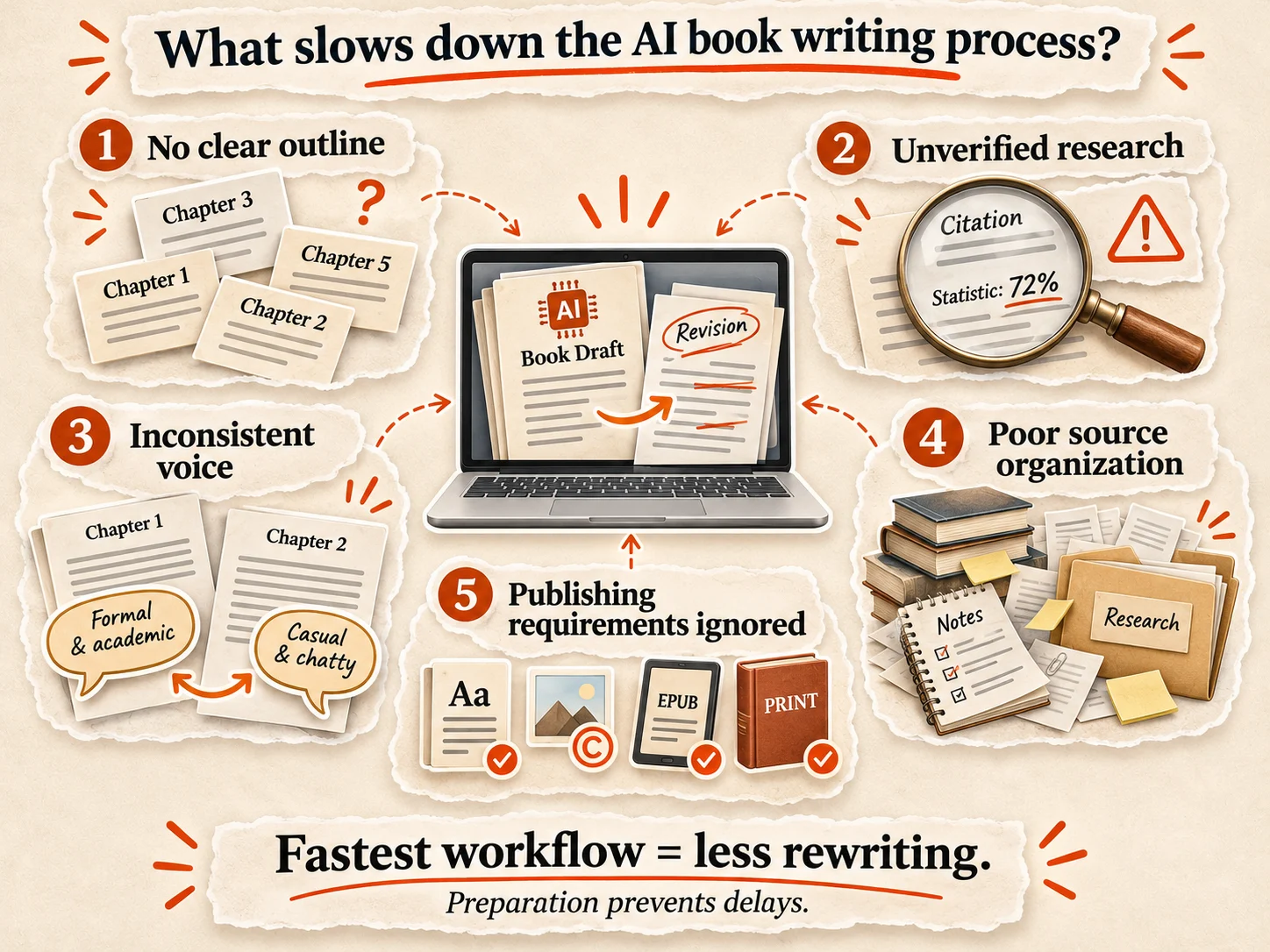
1. Starting without a clear outline. If your book lacks a defined argument and chapter structure, AI may produce disconnected sections. Fixing the structure later often means rewriting entire chapters.
2. Trusting AI-generated research. Asking AI to supply statistics, studies, or citations without verified sources creates extra work. Every unsupported claim needs checking, correcting, or removing.
3. Losing a consistent voice. Without clear writing guidelines, chapters can sound like they came from different authors. Repeatedly adjusting tone and terminology slows the editing process.
4. Poor source organization. Scattered research, changing definitions, and forgotten editorial decisions make it harder to maintain consistency across a 40,000-word manuscript.
5. Ignoring publishing requirements. Leaving references, image permissions, formatting, and ebook checks until the final week can reveal problems that require substantial revisions.
The common problem is treating AI-generated text as finished content rather than a draft that needs direction.
A few days spent organizing research, defining terminology, and approving an outline can prevent much larger delays later.
The fastest AI book writing workflow isn't the one that generates words quickest. It's the one that minimizes avoidable rewriting.
How to write a nonfiction book faster with AI without sacrificing quality
The fastest way to write a credible nonfiction book with AI is to give it better material, clearer instructions, and fewer opportunities to invent information.
Here's a practical workflow for entrepreneurs, consultants, and subject-matter experts:
1. Define your reader and book promise. Identify who needs your expertise, what problem the book solves, and what readers should understand by the final chapter.
2. Organize what you already know. Collect presentations, interviews, blog posts, client examples, and research. Separate verified facts from personal opinions and untested ideas.
3. Approve the outline before drafting. Use AI to suggest chapters, but review their sequence, purpose, and supporting evidence. Fix structural problems before generating thousands of words.
4. Draft section by section. Supply relevant source material for each section. Review the output against your original argument before continuing.
5. Maintain a manuscript reference document. Record approved facts, definitions, terminology, and voice guidelines to prevent inconsistencies between chapters.
6. Verify and edit continuously. Check citations, statistics, and examples as you go. Don't leave every correction until the manuscript is complete.
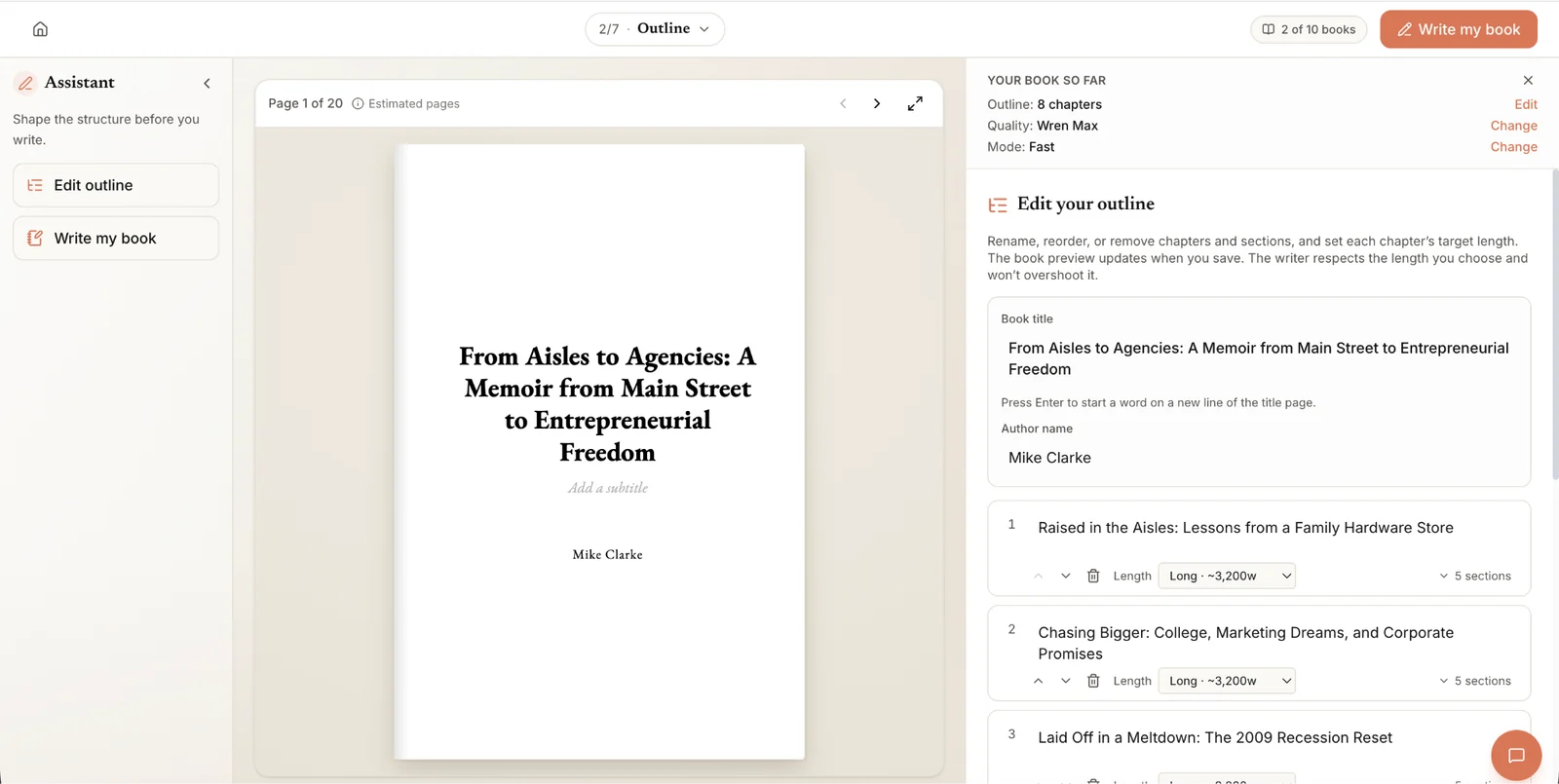
Platforms like Built&Written can help organize existing material, develop chapters with AI assistance, and maintain a consistent author voice through Voice DNA. Its editing tools also keep manuscript revisions under your control.
The goal isn't to eliminate human work. It's to spend less time producing rough text and more time making your expertise accurate, useful, and publication-ready.
What's a realistic AI book writing schedule?
For an expert with existing research, presentations, and case studies, a 40,000-word nonfiction book could take approximately 6 to 10 weeks with AI assistance.
Here's how that schedule might look when working 15 to 20 hours per week:
- Week 1: Planning. Define the audience, central argument, chapter structure, and book promise.
- Weeks 2 to 3: Research. Organize existing material, verify sources, and identify gaps that need additional evidence.
- Weeks 3 to 4: Drafting. Use AI to develop individual chapters from approved outlines and research.
- Weeks 5 to 7: Editing. Check factual claims, improve transitions, remove repetition, and review the manuscript's overall consistency.
- Weeks 8 to 10: Final production. Prepare references, format the manuscript, and check print and ebook files.
These stages can overlap. A short business guide built from existing workshops might take only a few weeks. A research-heavy book requiring interviews, original data, or expert review could take several months.
The verdict: Don't measure your progress by how many words AI generates each day. Measure it by how many accurate, complete, and verified chapters are ready for publication.
Frequently asked questions
AI can generate a book-length draft in one day, especially with a detailed outline and existing research. However, producing a coherent, fact-checked, publication-ready nonfiction book usually requires additional time for editing and verification.
A 30,000-word nonfiction book might take 4 to 8 weeks with AI assistance. The timeline assumes organized source material and consistent work. Starting research from scratch or conducting original interviews can extend the process.
Plan for approximately 6 to 12 weeks when working consistently with existing research. A heavily researched manuscript may require several months. These are illustrative estimates, not industry averages.
AI can accelerate outlining, drafting, and revisions. However, the overall time savings depend on how much human review and fact-checking the manuscript requires. Faster text generation doesn't guarantee faster publication.
Editing often takes longer. AI can generate chapters quickly, but checking facts, improving structure, eliminating repetition, and maintaining consistency across a full manuscript require careful review.
Yes. Amazon KDP permits AI-generated content, provided it meets publishing guidelines. You must disclose AI-generated text, images, or translations during publication. AI-assisted content does not require disclosure under [Amazon KDP's current content guidelines](https://kdp.amazon.com/en_US/help/topic/G200644110).
About the author

Polina Karlashchuk
More in informational
Ready to write your book?
Turn your expertise into a professional book with Built&Written.