

How Business Authors Use AI Differently From Novelists
A novelist can invent a business, create its founder, and make up an entire success story. A founder writing a business book doesn't have that luxury. Their facts, examples, and advice need to hold up outside the manuscript.
AI writing for business books works differently from AI-assisted fiction writing because the two genres depend on different kinds of evidence. Novelists can use AI to explore imagined situations, characters, and dialogue. Business authors use it to structure real expertise, explain research, and develop practical arguments. When a claim concerns actual people, companies, or results, the author needs evidence to support it.
The difference matters because readers may act on what a business book teaches. A fabricated statistic or invented case study can undermine the author's credibility.
Why do business authors and novelists use AI differently?
The biggest difference is what the finished book needs to accomplish.
A novel needs to tell a compelling story. Characters should feel believable, plots should make sense, and the narrative should keep readers engaged. AI can help brainstorm conflicts, explore alternative endings, or spot inconsistencies in a fictional world.
A business book has a different job. It needs to explain something accurately and give readers knowledge they can apply. For founders, consultants, and experts, the book also represents their professional reputation.
That difference shapes the entire AI workflow.
| Business nonfiction | Fiction | |
|---|---|---|
| Purpose | Teach, explain, build credibility | Tell a compelling story |
| Source material | Research, interviews, frameworks, professional experience | Imagined characters, settings, plot ideas |
| AI's role | Organize expertise, structure arguments, clarify explanations | Brainstorm stories, develop scenes, explore dialogue |
| Verification | Check facts, citations, statistics, and real-world claims | Check narrative logic, continuity, and consistency |
| Final output | Accurate, actionable, trustworthy content | Engaging, coherent storytelling |
Business authors rarely begin with nothing. They may already have years of client experience, presentation decks, research notes, workshop materials, and original frameworks.
The challenge is deciding what belongs in the book and explaining it clearly.
AI can help organize that material, but it cannot replace the expertise behind it. A polished chapter is only valuable if its underlying claims are sound.
How business authors use AI to organize their expertise
Most business authors don't start with a blank page. They start with too much material.
A consultant might have years of client presentations. A founder might have internal reports, interviews, and lessons from building a company. An industry expert might have research notes, workshop recordings, and frameworks they've refined through experience.
The challenge is turning that scattered knowledge into a book readers can follow.
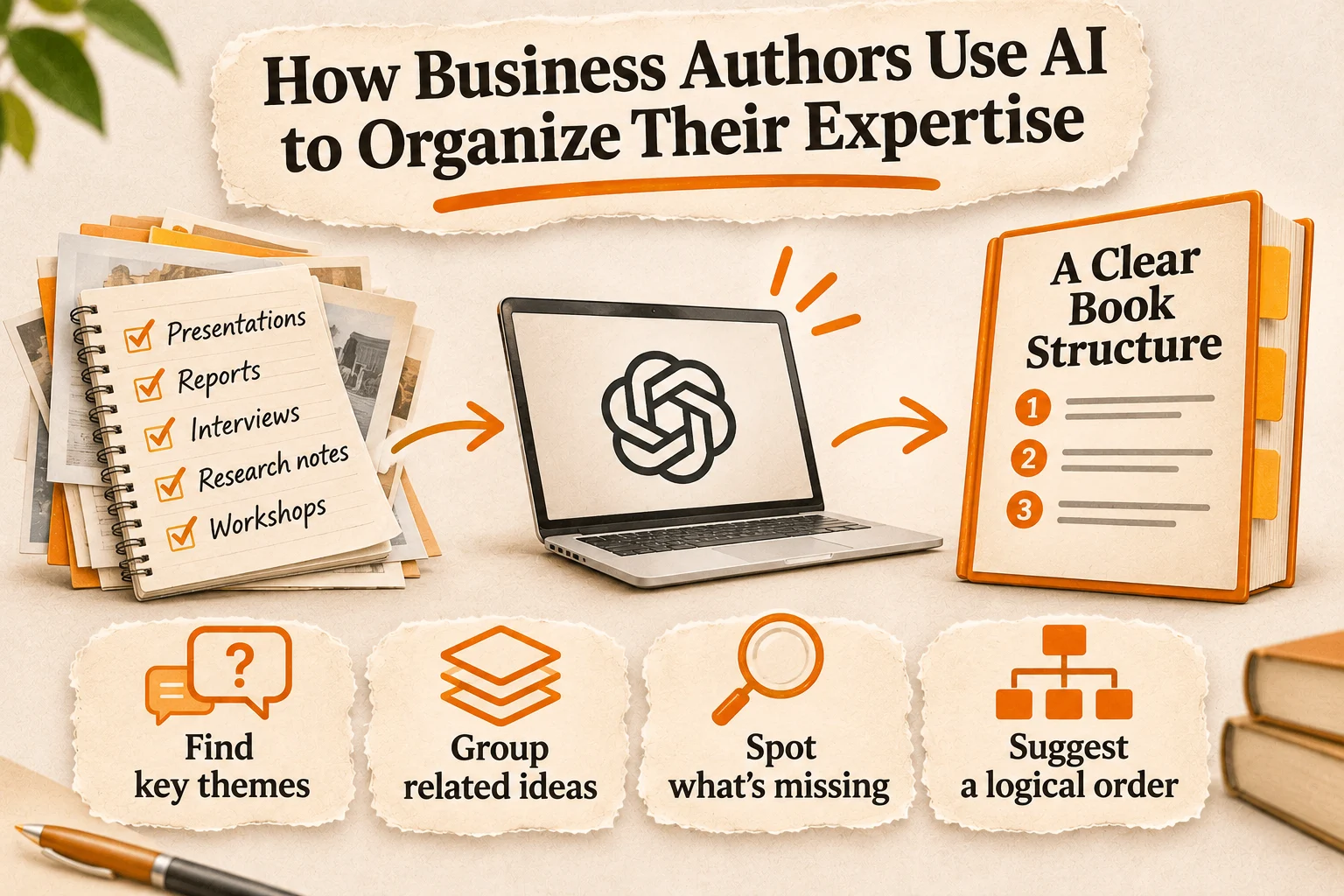
AI can help by analyzing existing material and identifying patterns that aren't immediately obvious. For example, an author could upload transcripts from several workshops and ask AI to:
Identify recurring questions and themes.
Group related ideas into potential chapters.
Find concepts that need clearer explanations.
Suggest a logical order for introducing frameworks.
This is different from how AI might support fiction development. A novelist could ask for unexpected plot twists or alternative character motivations. A business author needs AI to work with what they actually know, not invent new experiences to fill gaps.
Consider a consultant developing a book about organizational change. AI might notice that several presentations discuss employee resistance, communication failures, and leadership accountability. Those themes could become the foundation of three chapters.
But if the source material contains no evidence about employee retention, AI shouldn't manufacture statistics or case studies to make the argument stronger.
The distinction is simple: AI can organize expertise, but it cannot create professional experience the author doesn't have.
How AI-assisted drafting differs between business books and novels
Once the outline is ready, AI can help turn raw material into readable chapters. But the drafting process looks different depending on what the book is supposed to deliver.
For fiction, AI might generate dialogue, describe a setting, or suggest how a character reacts to a conflict. The author can evaluate those suggestions based on storytelling quality and consistency.
Business nonfiction requires a more controlled approach. Authors can provide AI with approved outlines, interview transcripts, research notes, and verified examples, then ask it to draft specific sections using only that material.
The goal isn't simply to produce convincing prose. It's to explain real ideas without changing their meaning.
Business books also contain elements that demand different kinds of attention:
Frameworks: Steps and principles must reflect the author's actual methodology.
Case studies: Real examples need accurate details and appropriate permission or anonymization.
Exercises: Questions and worksheets should help readers apply what they've learned.
Practical explanations: Advice should be specific enough to follow, with limitations clearly stated.
Consider two authors using a similar AI prompt:
| Fiction author | Business author |
|---|---|
| "Write a scene where a CEO makes a risky decision that saves the company." | "Using my interview notes, explain how the CEO evaluated a risky decision. Don't add events or outcomes absent from the source." |
The first prompt encourages invention. The second sets boundaries around evidence.
This distinction matters because AI can write a persuasive business story that never happened. Without clear labeling, readers may interpret an invented example as a documented case.
A useful rule: draft from evidence first, then improve the writing. If a chapter needs another example, find one or label it as hypothetical. Don't let AI quietly invent supporting material.
Example prompt for a business nonfiction chapter:
Using the workshop transcripts, interview notes, and approved outline I've provided, draft a 500-word section about leadership communication during organizational change.
Use only these materials for factual claims, quotations, company examples, and outcomes. Preserve the definitions and terminology in my notes. Do not invent statistics, client experiences, citations, or results.
If the sources do not support a claim, list the evidence gap separately instead of filling it with a plausible example. Distinguish my professional recommendations from documented findings.
Why fact-checking matters more in business nonfiction
A fictional character can quote an invented statistic. A business author cannot present one as fact without risking their credibility.
AI hallucinations occur when a model produces information that sounds convincing but is false. In business nonfiction, that might mean fabricated research, nonexistent citations, misquoted experts, or unsupported claims about company performance.
This isn't a theoretical concern. A 2025 Stanford study, first released in 2024 and published in the Journal of Empirical Legal Studies in 2025, found that specialized AI legal research tools still produced hallucinations in 17% to 33% of responses, depending on the tool. The results concern legal research, not business-book drafting, but they demonstrate why AI-generated references require independent verification.
Authors should distinguish between factual claims and professional interpretations. Statistics, quotations, dates, and documented case studies need verifiable sources. Opinions and recommendations should be clearly presented as the author's judgment, supported by reasoning or experience.
A practical fact-checking process has four steps:
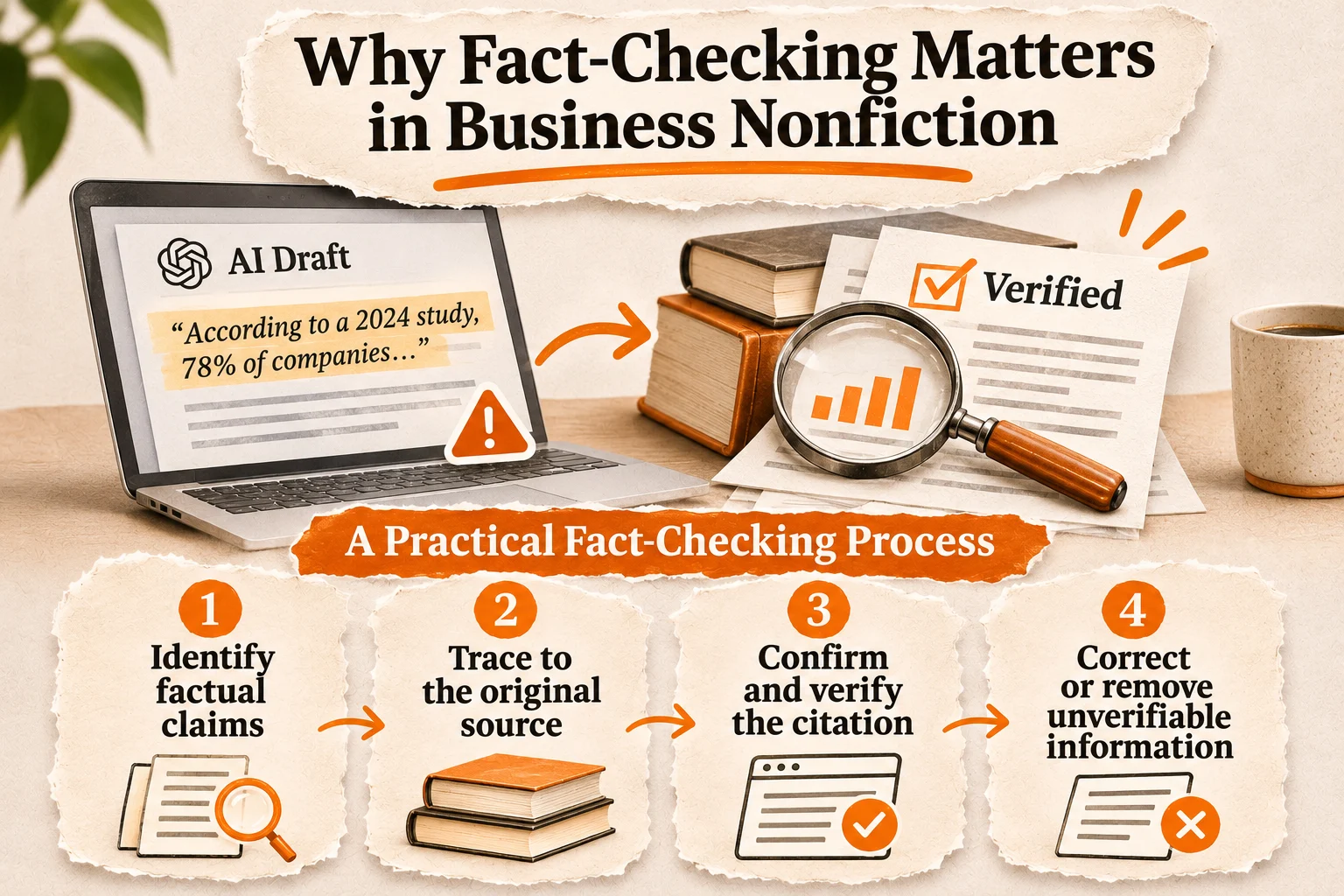
Identify factual claims in every AI-assisted chapter.
Trace each claim to its original research, document, or interview.
Confirm that citations exist and actually support the statements attached to them.
Correct or remove anything that cannot be verified.
Even when AI works from supplied documents, authors should check whether the draft accurately represents those sources.
For business authors, factual accuracy is part of professional credibility. Readers may apply the advice, recommend the book, or question the author's expertise. A convincing paragraph cannot compensate for unreliable evidence.
How business authors keep their voice and authority when using AI
A business book shouldn't sound like anyone could have written it. Readers want the author's experience, judgment, and perspective, not a collection of polished advice they could find anywhere.
For novelists, voice often means consistent narration, believable dialogue, and distinct characters. For business authors, it also means explaining ideas through their own frameworks, professional experiences, and conclusions.
AI can weaken that distinction. Generic phrases replace specific observations. Complex ideas become oversimplified, making it harder for authors to preserve their voice.
An author might call a concept "customer retention" in Chapter 2, "client loyalty" in Chapter 5, and "relationship management" in Chapter 8, even when those terms have different meanings.
One way to prevent this is to create a manuscript reference document containing:
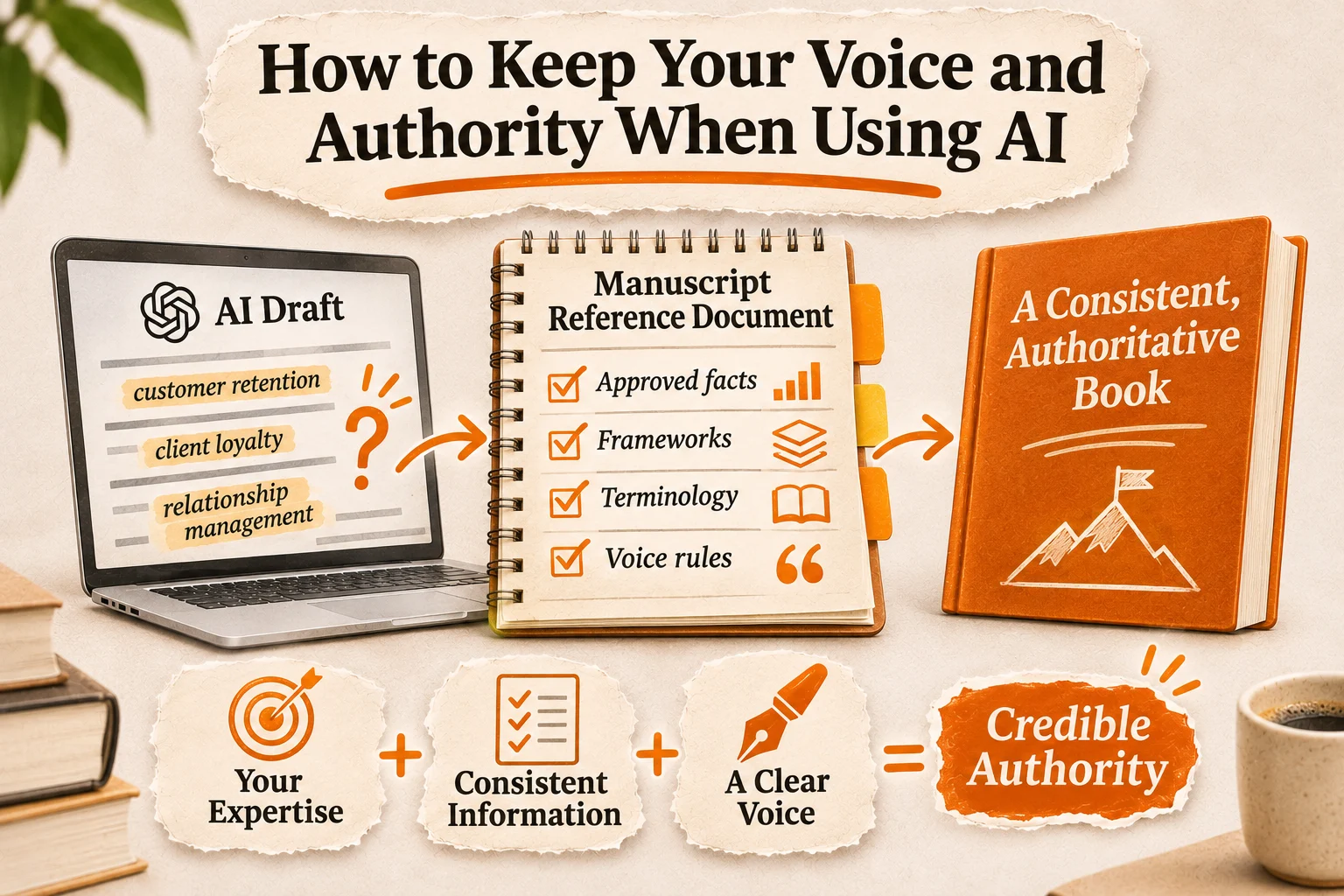
Approved facts: Verified claims, statistics, and original sources.
Frameworks: The author's methods, definitions, and principles.
Terminology: Preferred terms and explanations used consistently.
Voice rules: Sentence structure, vocabulary, tone, and phrases to avoid.
Use this document when drafting and reviewing each chapter. AI can compare sections, flag contradictions, and suggest clearer wording. The author must decide whether those suggestions preserve the intended meaning.
Built&Written supports this approach by organizing source material into an editable chapter structure and developing manuscript drafts from the author's existing content. Its Voice DNA feature uses writing samples to help maintain a consistent style across chapters.
For example, if the author defines customer retention as the percentage of customers who remain active over a period, AI should preserve that definition across chapters. It shouldn't substitute client loyalty or relationship management unless the author intends a different meaning. A consistent writing style matters, but consistent concepts matter just as much.
But matching someone's writing style isn't the same as reproducing their expertise. AI cannot determine which professional experiences matter most or which conclusions deserve emphasis.
The author's authority comes from what they know and believe, not how convincingly AI imitates their sentences.
What should business authors use AI for, and what should they handle themselves?
AI can speed up the mechanical parts of writing a business book, but it shouldn't make decisions that depend on the author's expertise.
The most useful approach is to separate tasks AI can assist with from responsibilities the author must retain.
| AI can help with | The author remains responsible for |
|---|---|
| Organizing research: Summarizing documents and grouping related ideas | Deciding which sources are credible and relevant |
| Structuring chapters: Suggesting outlines and logical transitions | Determining what the book teaches and which arguments matter |
| Editing: Improving clarity, removing repetition, and suggesting revisions | Preserving personal experience, judgment, and point of view |
| Checking consistency: Flagging conflicting terminology and unsupported statements | Verifying facts, statistics, quotations, and citations |
| Preparing content: Formatting sections, assembling chapters, and reviewing structure | Approving the final manuscript and publishing decisions |
This division also helps authors avoid two common mistakes: accepting polished AI output without questioning it and spending hours manually completing tasks that AI could simplify.
For example, AI can compare five chapters for repeated explanations. It can suggest which passages to shorten. But only the author can decide whether a repeated concept is unnecessary or essential to understanding the framework.
The decision rule is simple: use AI when the task involves organizing, drafting, or improving existing material. Keep control when it requires factual judgment, professional accountability, or a decision about what readers should learn.
Final thoughts
Business authors get the most from AI when they follow a structured process that keeps their expertise at the center.
A practical workflow has seven stages:
Research: The author gathers credible sources and original insights.
Organize: AI groups notes, interviews, and existing materials.
Outline: AI suggests structures, while the author chooses the argument.
Draft: AI develops sections from approved material, without inventing evidence.
Verify: The author checks factual claims against original sources.
Edit: AI helps improve clarity, consistency, and readability.
Final review: The author approves the manuscript, including its advice, examples, and conclusions.
Novelists may use AI to explore what could happen. Business authors need it to communicate what they know.
The value of an AI-assisted business book comes from the expertise behind it, not the amount of text AI can generate.
Frequently asked questions
Business authors use AI to organize expertise, structure arguments, and explain verified information. Fiction workflows emphasize character development, dialogue, and storytelling. Business nonfiction requires additional attention to factual accuracy, practical usefulness, and the author's professional credibility.
Yes. AI can help turn interviews, presentations, research notes, and original frameworks into structured chapter drafts. However, the author must provide the underlying knowledge, review the explanations, verify factual claims, and approve the final manuscript.
AI can draft case studies from verified source material, but it may introduce unsupported details. Authors should check names, figures, timelines, and outcomes against original records. Invented examples should be clearly labeled as hypothetical rather than presented as documented events.
Provide verified source materials, restrict drafting to those sources, and ask AI to identify missing evidence instead of filling gaps. Check every statistic, quotation, citation, and factual claim against its original source before publication.
Yes, when the content is AI-generated. Under [Amazon KDP's content guidelines](https://kdp.amazon.com/en_US/help/topic/G200672390), publishers must disclose AI-generated text, images, and translations during submission. AI-assisted content, such as human-written material edited or refined using AI, does not require disclosure to KDP. Substantial human editing of AI-generated content does not remove the disclosure requirement.
Fiction writers can invent characters, events, and settings, but real-world details may still require research. Historical events, scientific explanations, real locations, and references to actual people should be checked when accuracy matters to the story. Business authors face additional verification demands because readers may rely on their claims, case studies, and advice as factual guidance.
Sources & References
About the author

Polina Karlashchuk
More in informational
Ready to write your book?
Turn your expertise into a professional book with Built&Written.