

Which AI Is Best for Psychology Writing That Gets the Science Right?
Key takeaways
- Which tools search real papers? Elicit, Consensus and Scite, by their own sites, checked November 16, 2026.
- What do they cost? Most have a free plan. The paid plans we could see run from $12 to $49 a month.
- Who checks the facts? You do. A linked source shows where a claim came from. It does not prove the study says what your sentence says.
What should you look for in the best AI for psychology writing?
Search "best AI for psychology" and most top results in November 2026 are AI therapy apps and note takers for clinics. This article is for a psychologist, therapist, coach or student who writes about psychology, in articles, a course or a book. For help with your own mental health, talk to a licensed professional.
For a writer, the risk is getting the science wrong. In a 2025 study, GPT-4o invented about 1 in 5 of its references. In our own November 2026 test, ChatGPT invented none. It did give one real study with the wrong journal and a broken DOI. Both are in our article on AI in psychology.
We compared seven tools on four questions, using each tool's own website, checked November 16, 2026. We did not sign up for them.
- Where do the facts come from? The model's memory, a web search, a database of papers, or your own material.
- Can you open every source? A link or a DOI (a permanent web address for a paper) lets you check a claim in one click.
- Does it show whether research agrees? One study is not the whole field.
- What do you hold at the end? A chat answer, a research report, or a finished book.
Can ChatGPT or Claude write about psychology accurately?
They explain well and draft fast. Accuracy depends on whether they search or answer from memory.
ChatGPT and Claude are general AI chatbots. Both can explain a concept like cognitive dissonance in plain words, suggest an outline or tighten your paragraph. Both can search the web:
- ChatGPT: its pricing page lists search on the Free, Go, Plus and Pro plans. Deep research, which reads many sources and writes a report, is "Limited" on Free and Go. The page showed no dollar amounts when we checked.
- Claude: the free plan can "Search the web". Research reports need Pro, which costs $20 a month, or $17 a month billed yearly, on Claude's pricing page.
Where they stop: a reference list written from memory is where wrong details slip in, so ask the chatbot to search. Our Claude vs ChatGPT comparison shows how the two handle the same book notes.
How Built&Written turns your own material into a psychology book
Many psychologists and coaches already have the content for a book: years of blog posts, workshop handouts, the typed text of talks. The problem is turning that pile into one book in a clear order, without asking a chatbot to fill gaps with facts from somewhere else.
Built&Written starts from that pile. Its AI writer, Wren, works from the text you give it, so the ideas and examples in each chapter come from you. Here is the difference from the chatbot route above.
| Step | By hand (Word, Google Docs or ChatGPT) | With Built&Written |
|---|---|---|
| Gathering your material | Copy posts, handouts and transcripts into one long file | Paste text or upload PDF, DOCX, RTF, TXT or MD files, up to 50,000 words |
| Chapter plan | Write the outline yourself, or ask a chatbot for one | Wren proposes an outline from your material; you change it before any chapter is written |
| Your voice | Describe your style in every prompt | Voice DNA learns it from a few pages of your writing |
| Studies you cite | You find and check each one | The same: you find and check each one |
| Layout, cover, files | Learn page setup or pay a designer | Made in the app, including files for KDP (Kindle Direct Publishing, Amazon's service for self-published books), which you upload yourself |
What it does with real notes. We tested this on November 5, 2026, with notes from a made-up business owner, saved in the app's Your writing library:
| His notes | The opening of chapter 1 |
|---|---|
| "I run a bookkeeping firm with 9 people. I started it alone in 2014. Until 2021 we billed every client by the hour, at $85 an hour." | "I run a bookkeeping firm with nine people now, but I started it alone in 2014. For a long time, we billed every client by the hour at $85 an hour. It seemed straightforward, but it created a real problem for both sides." |
All 8 facts in his notes made it into the chapter, with no new numbers or names. One story came back three times, so you still edit.
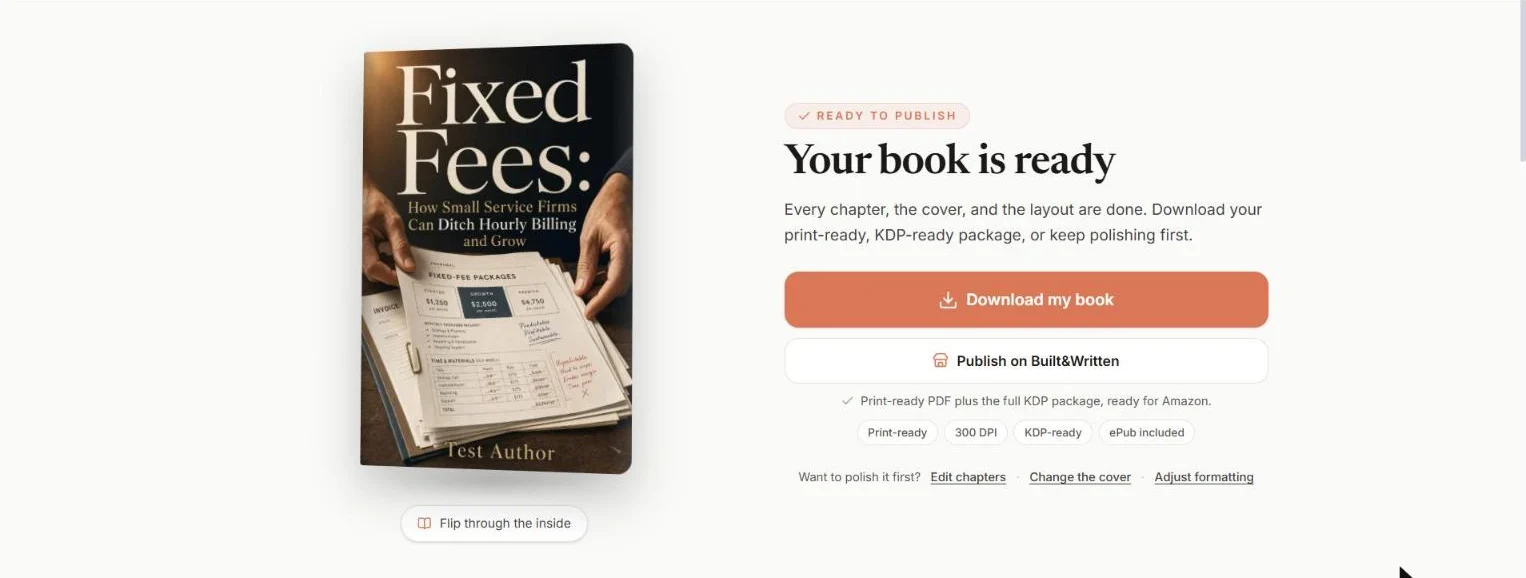
Text in the image: "7/7 Ready". "Ready to publish". "Your book is ready". "Every chapter, the cover, and the layout are done. Download your print-ready, KDP-ready package, or keep polishing first." Buttons: "Download my book", "Publish on Built&Written". "Print-ready PDF plus the full KDP package, ready for Amazon." Labels: "Print-ready", "300 DPI", "KDP-ready", "ePub included". "Want to polish it first? Edit chapters, Change the cover, Adjust formatting". "Flip through the inside".
It works from text: there is no audio upload, so paste the transcript of a talk.
Writing and downloading an AI-drafted book needs a plan with AI writing (see plans). Because AI wrote the text, KDP asks you to say so when you publish; our guide explains what to disclose to KDP.
Which AI tools search real psychology research?
Four tools start from sources instead of memory. They find studies well. None of them writes your book.
Perplexity is an AI search engine. Its help center says each answer "includes numbered citations linking to the original sources", gathered from articles, websites and journals. Perplexity Pro promises "10x as many citations per answer". One answer can mix blogs and journals.
Elicit searches research papers. Its free Basic plan offers "Unlimited search across more than 138 million papers", and the site says every AI claim comes with "sentence-level citations". Pro costs $49 a user a month, billed as $588 a year, and adds a systematic review workflow that can screen 5,000 papers (Elicit pricing).
Consensus calls itself "an AI academic search engine for peer-reviewed literature" and says it searches 400 million plus papers. Its Consensus Meter shows how much studies agree on a yes or no question, such as whether a therapy reduces anxiety. The free plan includes unlimited paper searches and 3 Deep reviews a month. Pro costs $20 a month or $144 a year (Consensus help center).
Scite shows "how later research has supported, challenged, or discussed" a paper, from more than 1.6 billion citations. That helps you see whether later studies backed a finding you want to cite. Basic costs $12 a month and Pro $40 a month, both billed yearly, with a 7-day free trial (Scite pricing).
What this means for you: use these tools to find and test the studies behind a claim. They give you answers, reports and reading lists, not chapters.
Which is the best AI for psychology writing for you?
| Tool | Where its facts come from | Price (checked November 16, 2026) | Best for |
|---|---|---|---|
| ChatGPT | Its training, or a web search when it runs one | Free plan; paid plans on its pricing page | Explaining a concept in plain words and first drafts you check |
| Claude | Its training, or a web search, also on the free plan | Free plan; Pro $20 a month | The same, with Research reports on Pro |
| Perplexity | Web pages and journals, with numbered citations | Free plan; Pro on its plans page | Quick answers with every source one click away |
| Elicit | More than 138 million papers | Free Basic; Pro $49 a month, billed yearly | Literature reviews and pulling data from many studies |
| Consensus | 400 million plus papers | Free plan; Pro on its plans page | Yes or no research questions and where studies agree |
| Scite | Citations showing how later papers treated a study | From $12 a month, billed yearly | Checking whether a study you cite still holds up |
| Built&Written | Your own posts, notes and transcripts | See its pricing page | Turning material you wrote into a book with files for Amazon, as the section above shows |
What the others do better: Elicit, Consensus and Scite search and read real papers. ChatGPT and Claude answer open questions on any topic and cost nothing to try. Perplexity puts a source link on every answer. Built&Written is the tool here that ends with a finished book.
Final thoughts
Before you pay, ask the free plan of two tools the same question from your own field and compare what each one cites. The one whose sources you would put in your own book is the one to keep. Once your studies are checked and your posts and talks sit in one place, Built&Written can turn them into a chapter plan you approve and a book in your voice. See how it works.
Frequently asked questions
Cite the study, not the tool. An AI answer points you to sources; it is not one itself. Open the paper the tool names, read the part that supports your sentence, and put that paper in your reference list. If you quote what a chatbot said, say so in the text and treat it as an opinion, not as evidence.
Partly. Scite shows how later papers treated a study, and Elicit and Consensus help you find the right paper. None of the pages we read promises to check a whole reference list for a book or article. Open each DOI at doi.org, compare the authors, year and journal, and read the abstract. Our AI in psychology article, linked above, has a step by step list.
It depends on the book. A book for clients can lean on your own cases and method, with a few key studies where a claim needs support. A book for colleagues or students needs full references. Either way, a short reference list you checked beats a long one you didn't.
For coursework, start with a tool that searches papers, such as Consensus or Elicit, because their answers point to real studies you can read and cite. Use a chatbot to explain a hard concept in simpler words, then check it against your textbook. Check your school's rules on AI before you use any of them for graded work.
Sources & References
- Built&Written, "How AI is changing the way psychology books get written" (Deakin study and ChatGPT reference test)
- ChatGPT, Pricing
- Claude, Plans and pricing
- Perplexity Help Center, "How does Perplexity work?"
- Perplexity Help Center, "What is Perplexity Pro?"
- Elicit, homepage and pricing
- Consensus, homepage
- Consensus Help Center, "Subscription plans" (dated September 12, 2026)
- Scite, homepage and pricing
About the author

Michael Pavlovskyi
More in Writing
Ready to write your book?
Turn your expertise into a professional book with Built&Written.