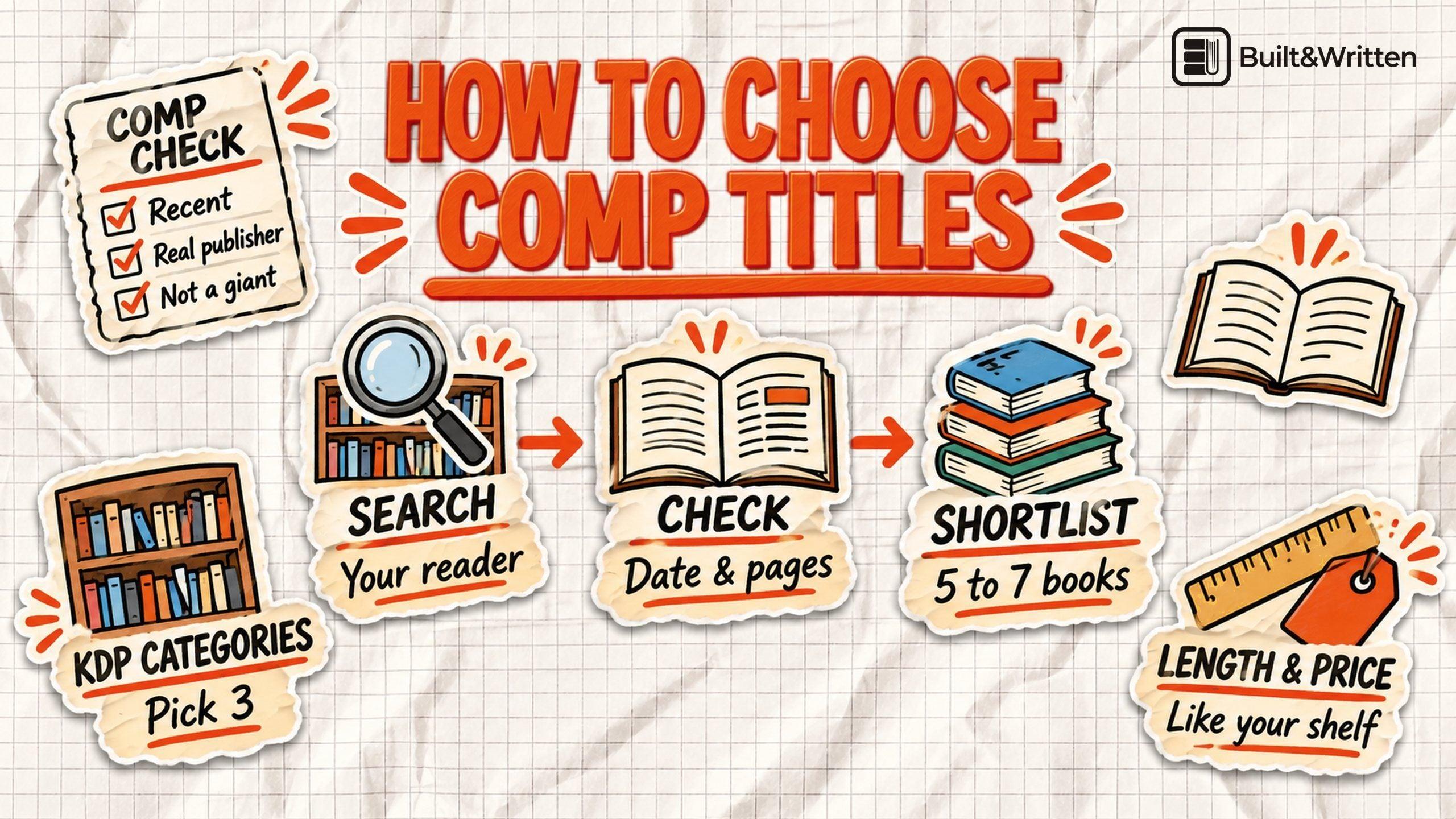
Comp titles are recent books that are similar to yours. "Comp" is short for comparable. You list them to show that readers already buy books like yours, and to show where your book will sit on the shelf.
Agents and publishers often ask for comp titles in a book proposal. If you publish on Amazon yourself, they are still useful, even if nobody asks for them. They help you see which shelves your book belongs on, how long similar books are and what readers expect to pay.
This guide explains what agents and publishers usually look for in comp titles. It also shows a real search we ran on November 26, 2026, with the books, dates and page counts we found.
Skip to our real comp title search
What are comp titles?
A comp title is a published book that is similar to yours in a way that matters to a buyer. Penguin Random House says comps are like yours in one of two ways: what they are about, or how they are expected to sell.
Editors use comps to decide whether to buy a book. Sales reps use them to describe a new book to stores in one line.
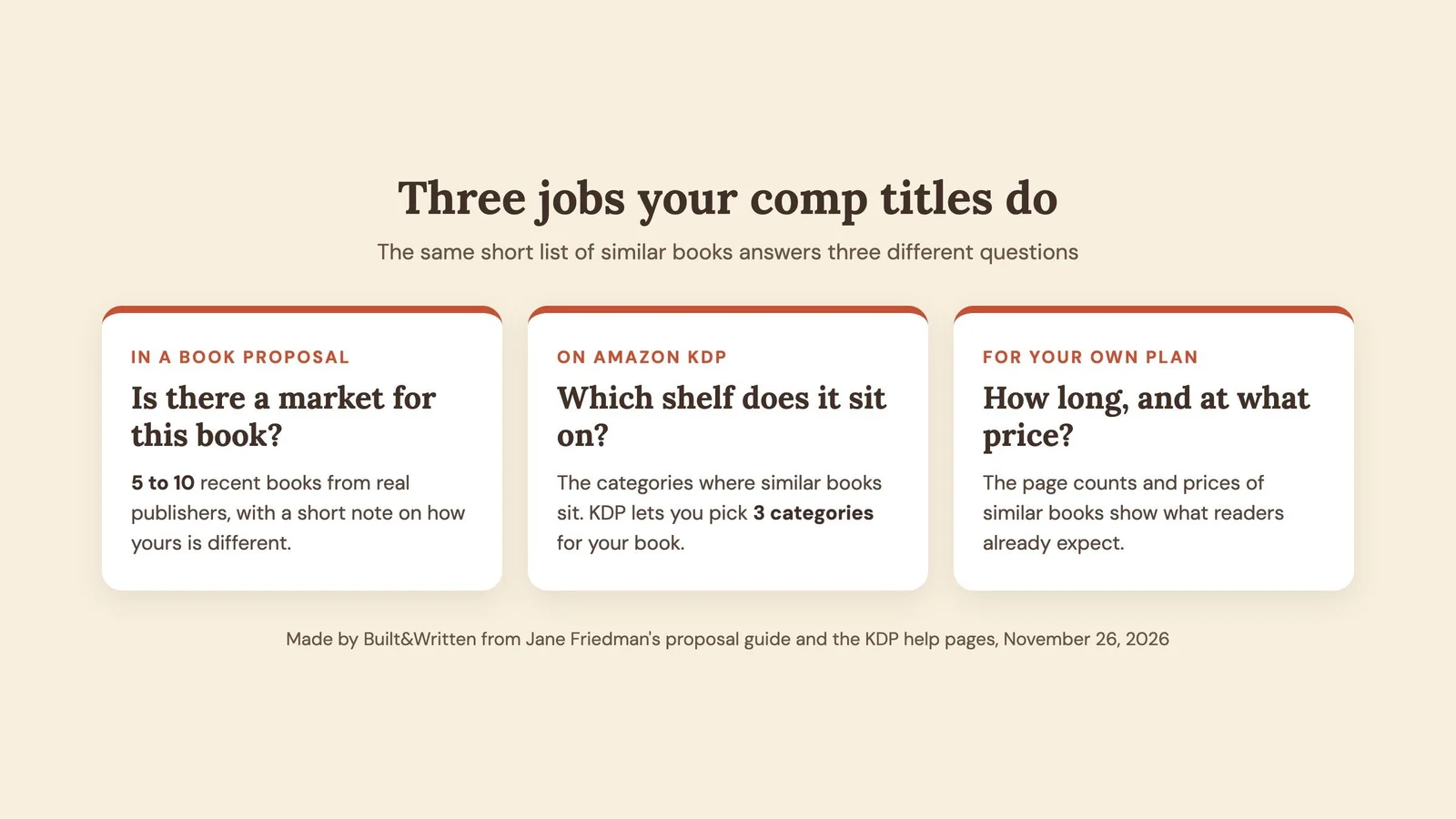
| Where you use comps | What they show | Who reads them |
|---|---|---|
| A book proposal | That a market exists for your book | Agents and editors |
| Your Amazon KDP setup | Which categories fit your book | You, then Amazon's shoppers |
| Your own plan | A normal length and price for your kind of book | You |
KDP (Kindle Direct Publishing) is Amazon's service for selling your own book on Amazon. A category is the virtual shelf where Amazon lists your book, like a section in a bookstore.
How many comp titles do you need, and how old can they be?
Most guides ask for 5 to 10 books from the last five years. They differ a little on the details.
| Source | How many | How recent |
|---|---|---|
| Jane Friedman | 5 to 10, fewer for a niche book | Within five years, ideally a few |
| Writer's Digest | 5 to 7 | Within five years |
| Penguin Random House | Not given | Two or three years is ideal |
| Nathan Bransford | Not fixed | At least one from a major publisher in the last five years |
A safe rule follows from the table. Aim for 5 to 7 books, each first published in the last five years. If you write about a narrow topic, a few strong comps are better than ten weak ones.
Friedman also lists what to note for each book. That means the title, subtitle, author, publisher, year, page count, price, first format (hardcover or paperback) and ISBN. The ISBN is the 13-digit number that identifies one edition of a book. Then she suggests about 100 to 200 words on what the book covers and how yours is different.
How to choose comp titles in 5 steps
Step 1. Describe your book in one line
Write one sentence that names your reader and what they get. For example: "A practical guide for adult children who care for an aging parent while holding a full-time job." This line is your filter. A book that would not interest that reader is not a comp, however famous it is.
Step 2. Search the way your reader searches
Type your reader's own words into a bookstore search. Then sort the results by bestsellers. That shows you what people actually buy. Writer's Digest also suggests browsing the bookstore section for your topic and "best of" lists.
Step 3. Open each book's details
Every store page has a details box. Write down the publisher, the date, the page count and the price. A spreadsheet with one row per book works well.
Step 4. Run three checks
Keep a book only if it passes all three.
- It is recent. It first came out in the last five years. A new paperback of an older book does not count as new.
- It comes from a real publisher. You can name the publisher and find its other books. Friedman warns that a list of mostly self-published books with few reviews is "a big problem" in a proposal.
- It is not a giant. Friedman says to avoid international bestsellers and books everyone has read. Bransford gives the same advice.
Step 5. Read the book and write your note
Bransford says to read at least part of every book you list. Then write how your book is different. Friedman adds a warning: do not trash the books you compare yourself to.
We tried it: comp titles for a caregiving book
How we checked. On November 26, 2026, we searched Barnes & Noble for "caring for aging parents". The book idea from Step 1 is our own example, made up for this test. We opened the first 11 book pages and wrote down the publisher, date and page count from each one. We used Barnes & Noble because its pages show these details in one box. Amazon pages show the same facts under "Product details".
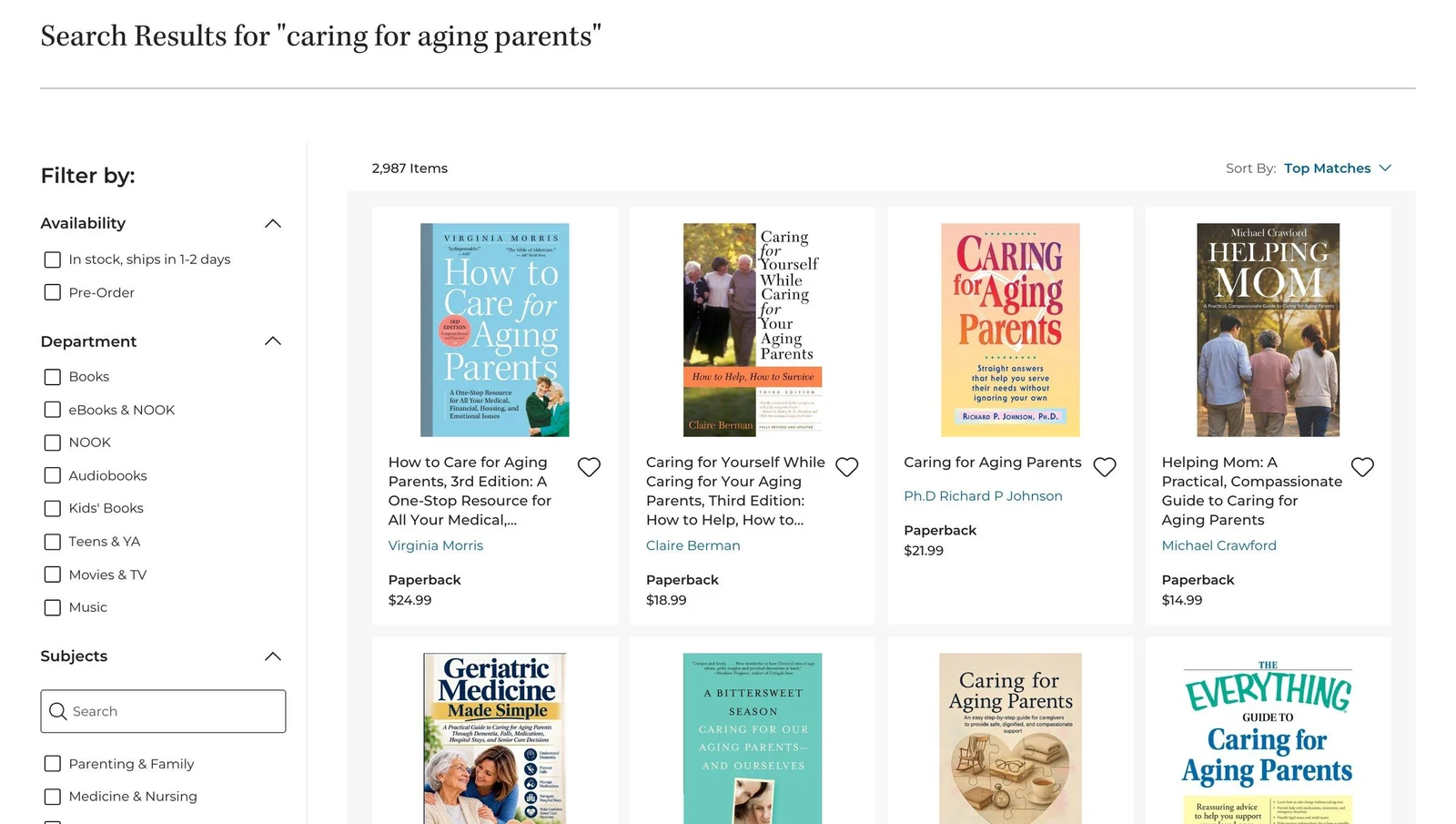
Then we ran the three checks from Step 4.
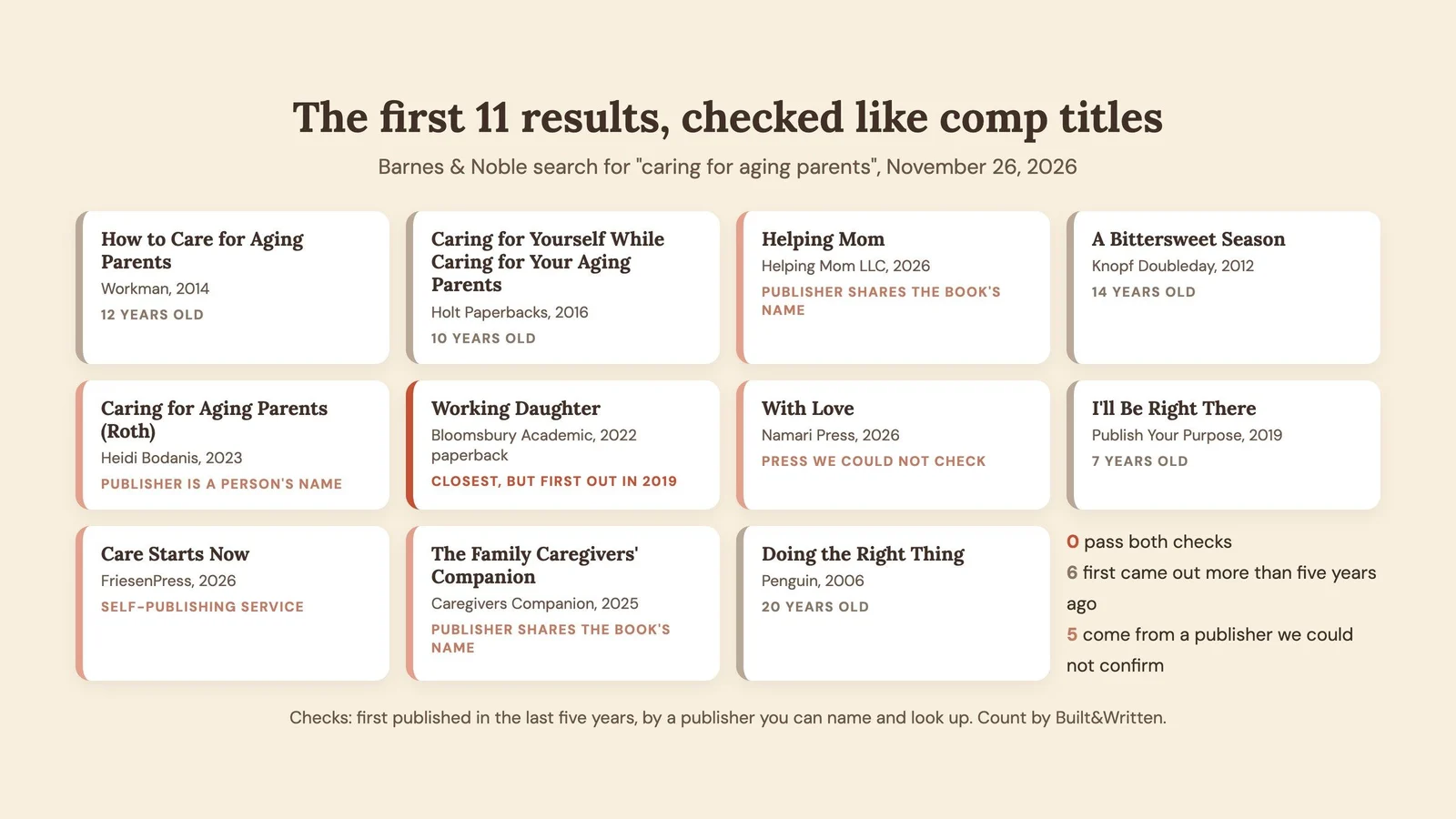
None of the first 11 books passed both checks. There were two reasons.
- Six were too old. The oldest came out in 2006. How to Care for Aging Parents by Virginia Morris (Workman, 2014) has 688 pages and still sits at the top of the search.
- Five came from publishers we could not confirm. One was FriesenPress, which calls itself a self-publishing service. Two listed a publisher with the same name as the book.
The closest was Working Daughter, one of the six. Barnes & Noble lists a 2022 paperback from Bloomsbury Academic. But the hardcover came out in 2019 from Rowman & Littlefield, according to its NetGalley listing. That is seven years ago.
This is the main lesson of the test. The top of a search shows you the shelf. You still have to dig for the comps.
So we changed one thing. We sorted the same search by bestsellers and opened the books again. This time five books passed, based on the dates the store shows.
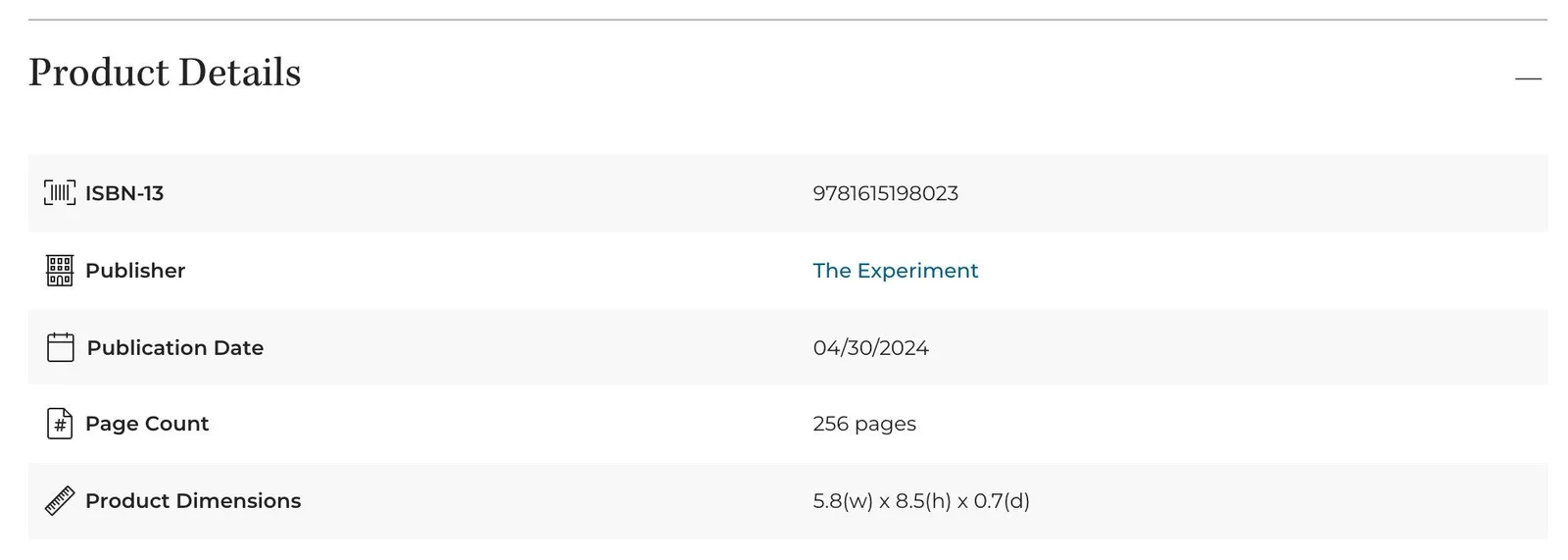
| Book | Publisher | Year | Pages | Price on Barnes & Noble |
|---|---|---|---|---|
| Let's Talk About Aging Parents, Laura Tamblyn Watts | The Experiment | 2024 | 256 | $18.95 paperback |
| Successfully Navigating Your Parents' Senior Years, Star Bradbury | BenBella Books | 2023 | 312 | $19.95 paperback |
| Positive Caregiving, Sarah Teten Kanter | The Collective Book Studio | 2023 | 216 | $18.95 paperback |
| The Complete Eldercare Planner, 4th edition, Joy Loverde | Harmony/Rodale/Convergent | 2023 | 416 | $23.00 paperback |
| Aging Out, Lucy Schiller | Flatiron Books | 2026 | 272 | $29.99 hardcover |
Prices and dates come from the Barnes & Noble pages on November 26, 2026. The Complete Eldercare Planner is a revised edition of an older book. Friedman would call it a "cornerstone", a classic of the category that you mention in your introduction. Aging Out is reported nonfiction, so it works as a comp for tone.
The list also answers two practical questions.
- How long? The five books run from 216 to 416 pages. The middle one has 272 pages. Next to these books, a 120-page guide might feel shorter than readers expect. That conclusion holds for this shelf only. Another topic can have much shorter books.
- What price? The four paperbacks cost $18.95 to $23.00. That is the range a shopper sees for this kind of book.
Before you use a book like these, check the date of its first edition.
How comp titles help you pick KDP categories
KDP lets you pick 3 categories when you set up your book. Its help page says: "See where similar books are categorized." Your comp list is that set of similar books.
Amazon shows where each book sits. A book's Best Sellers Rank is its sales position compared with other books. KDP says the rank in each category shows under Product Details on the book's Amazon page. A book can rank in up to three category lists.
Here is how to use it.
- Open each comp on Amazon and scroll to Product details.
- Copy the category names from the Best Sellers Rank line.
- Count which categories come up most often across your list.
- Keep the ones that truly describe your book. A category that fits a comp may not fit yours, so check it against your own topic and reader. KDP may remove a category that does not fit.
Why look at the rank at all? It shows how a book is doing compared with other books in that category, based on what customers buy. It does not tell you how many copies the book sold. KDP adds two cautions. Each format (ebook, paperback, hardcover) has its own rank. And rank is "not an accurate way" to compare books across categories. Use ranks to see where books sit. They cannot predict your own sales.
One more difference matters here. For a proposal, you leave self-published books out. For KDP categories, you look at everything on the shelf, self-published books included, because those are the books your reader sees next to yours. Our guide to KDP categories and keywords covers the rest of that setup.
Mistakes that weaken a comp list
When your list is ready, it goes into the comparable titles part of your book proposal. To see what strong recent books share, read what this year's best nonfiction books have in common.
Turn your comp research into a book with Built&Written
Comp research leaves you with useful facts: who your reader is, how long the book should be and which shelf it belongs on. The hard part comes next. You still need a full manuscript that fits those facts.
Built&Written is a platform for writing and publishing nonfiction books. You paste in your notes, posts or talk transcripts, or upload a manuscript you already have. Built&Written proposes a chapter outline, and you change it before any writing starts. Then it writes the book chapter by chapter in your voice. Its Voice DNA feature learns that voice from a few pages of your own writing, about 300 to 1,000 words.
Your comp list helps on the very first screen. There you choose a target book length and can name authors whose style you admire. In our caregiving test, the comps ran from 216 to 416 pages, so the "Comprehensive, 200+ pages" option would fit that shelf.
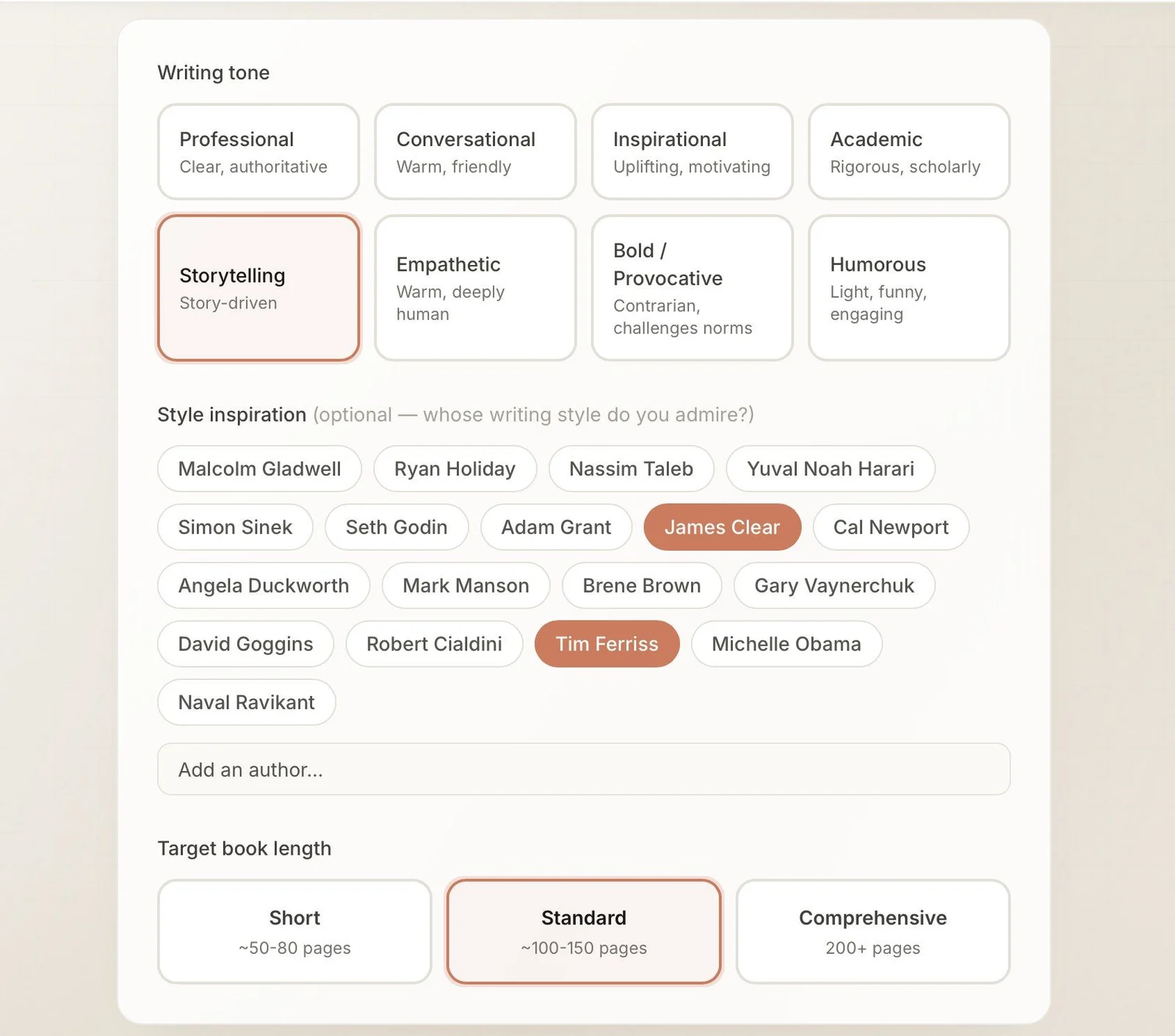
At the end, the KDP Launch Co-pilot drafts your title, subtitle, description, keywords and categories. Check its category ideas against the ones your comps sit in. The free KDP keywords generator helps with the search words too.
It has limits. Built&Written cannot pick your comp titles for you or promise sales. You read and approve every chapter. It makes the files, and you upload them to KDP yourself.
Final thoughts
Choosing comp titles takes time, and the first search may not give you what you need. Start with one line about your reader. Look for books that match your topic, and check each one before it goes on your list. Then use the list to see where your book fits, what readers already have and what your book can add.
Frequently asked questions
In a proposal, mostly no. Writer's Digest allows one exception: a recent self-published title that sold well and has strong reviews. Jane Friedman warns that a list made mostly of self-published books with few reviews hurts a proposal. For choosing KDP categories, self-published books on your shelf are useful to study, because shoppers see them next to yours.
The guides disagree. Jane Friedman says you do not need Amazon rank, star ratings, reviews or sales numbers in a proposal. Writer's Digest suggests adding the category rankings and the number of ratings. Check what the agent or publisher you are writing to asks for. If they say nothing, Friedman's shorter format is the safer default.
Sometimes. A guest post on Jane Friedman's site says film, TV, podcasts and authors can work as comps. The same post quotes Janet Reid: once a book has become a movie, assume it is no longer a good comp. For a nonfiction proposal, books should still make up most of your list.
Jane Friedman offers a rule of thumb in a reply on her site: look for dozens of Amazon reviews or ratings, and ideally over a hundred if the book has been out more than a year. Very few reviews can mean the book sold little. Too many, and it may be a giant you should leave out.
Sources & References
- Jane Friedman, Start Here: How to Write a Book Proposal
- Star Wuerdemann on Jane Friedman's site, How to Find Compelling Comps for Your Book
- Debra Eckerling, Writer's Digest, The Why, What, How of Comp Titles for Your Nonfiction Book Proposal
- Andrea Bachofen, Penguin Random House News for Authors, Comp Titles: An Elevator Pitch for Your Book
- Nathan Bransford, How to come up with good comp titles for your book
- Amazon KDP Help, KDP Categories
- Amazon KDP Help, Sales Ranking
- Barnes & Noble search results for caring for aging parents
- NetGalley, Working Daughter by Liz O'Donnell, Rowman & Littlefield hardcover
- FriesenPress, self-publishing services
About the author