

How Much of an AI-Written Book Do You Still Have to Fix?
To edit AI generated content in a book, read all of it and fix four things: facts and quotes, repetition, generic examples, and voice. In nine AI-written chapters we checked, every quote was correct. Still, one verse came from outside our material, one picture repeated in three chapters, and 35 sentences leaned on the same kind of contrast. Plan for the editing to take longer than the writing.
How much of an AI-written book do you have to edit?
You have to read every page. Editing AI generated content means checking a draft that an AI wrote and changing what is wrong, repeated, vague or unlike you. You do not have to rewrite every sentence. Most of the work falls into four jobs.
- Facts and sources. Every quote, number, name and date needs a check against its source.
- Repetition. The same idea or picture shows up in several chapters.
- Generic examples. The AI fills gaps with stock pictures that could fit any book.
- Voice. The text slips into habits that do not sound like you.
There is also a rule behind this. Amazon KDP says in its content guidelines that you are responsible for checking that all AI-generated and AI-assisted content follows its rules. So the check is yours, whoever wrote the first draft.
We did not want to guess how much each job weighs, so we measured it on a real AI written book.
What did we find when we checked a real AI-written book?
How we tested, November 21, 2026.
- The book. On November 19, 2026 we uploaded seven public-domain sermons by C. H. Spurgeon to the Built&Written platform, 47,115 words in total. The platform wrote a 41,834-word book in nine chapters. We described that run in our guide on how pastors can turn sermons into a book.
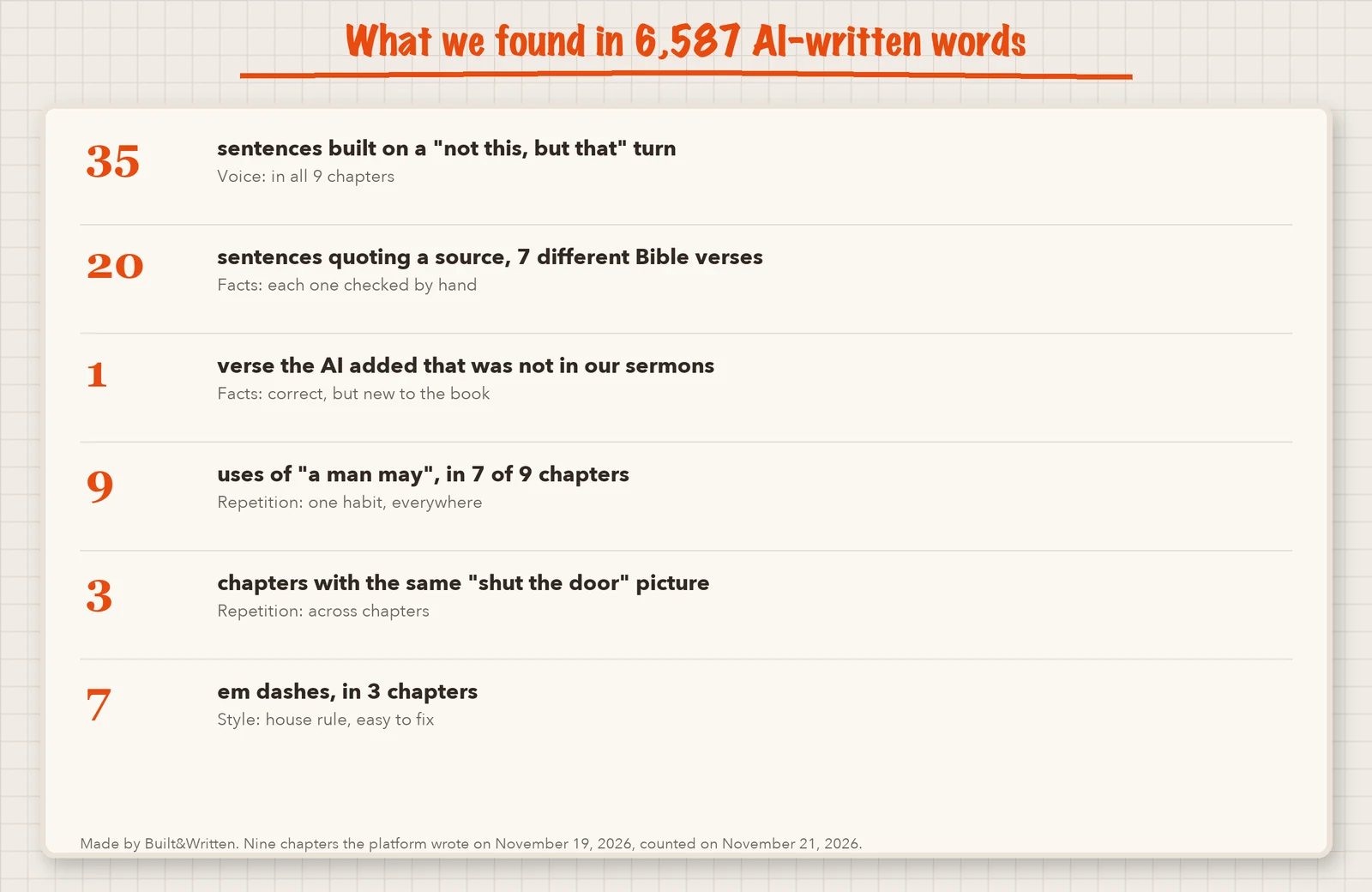
- The sample. We saved the part of each chapter that the editor shows on screen. That came to 6,587 words and 392 sentences, about one sixth of the book.
- The counts. A short script counted sentence length, repeated phrases, quotes and dashes. We then read every flagged sentence ourselves and checked each Bible quote against the King James Version on Bible Gateway.
- The limits. This is one book, one kind of material and one AI tool. Our sermon book had quotes and no numbers. A business book would have more numbers and fewer quotes. Treat our counts as an example, and run the same checks on your own draft.
How do you edit AI generated content for facts and sources?
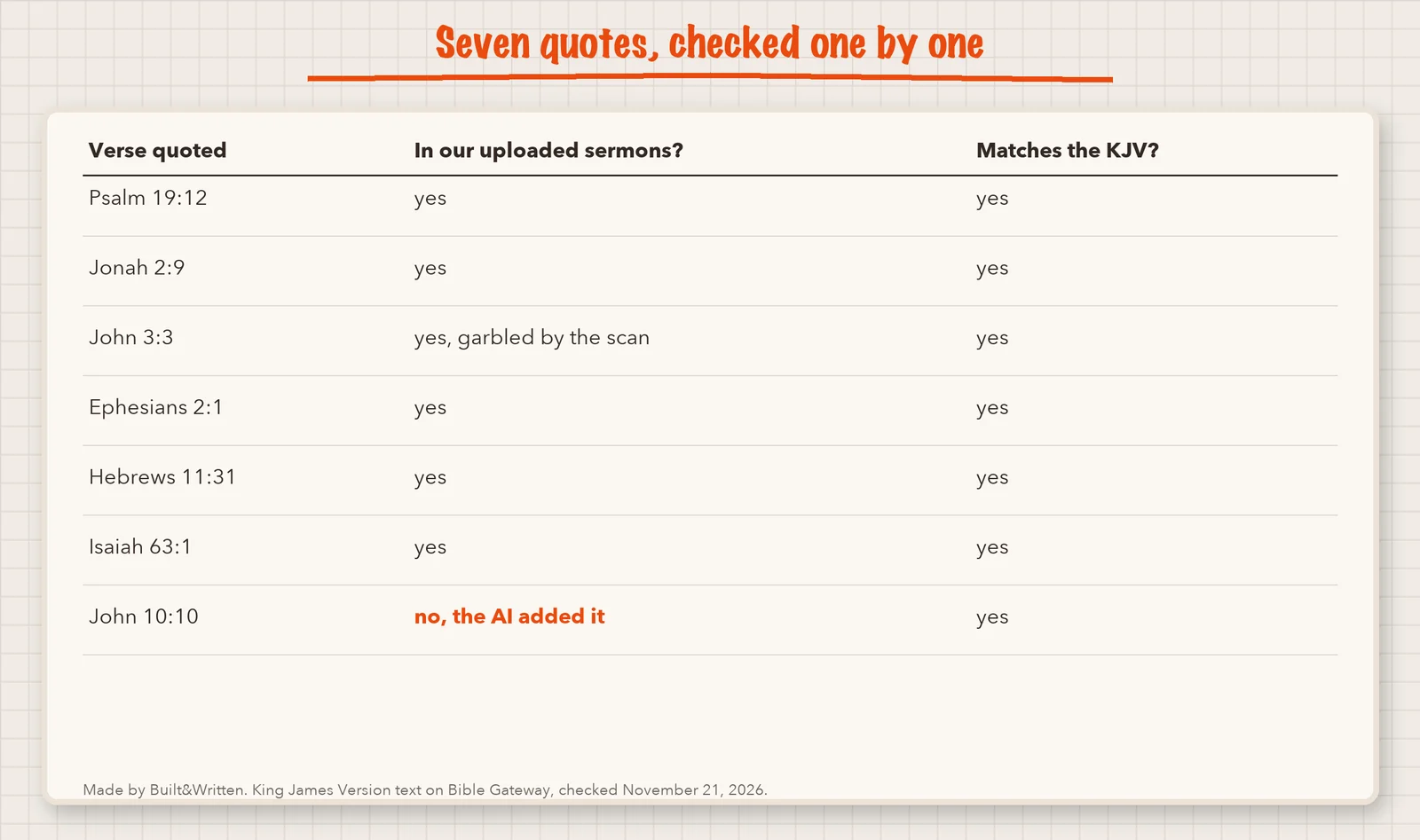
We checked. Our sample had 20 sentences with quotation marks. They quoted seven different Bible verses. All seven matched the King James wording. One result surprised us. John 3:3 was garbled in our upload, because the old scan read "Except" as "Ifccoept". The AI still printed the verse correctly.
Another verse, John 10:10, was not in our 47,115 words at all. The AI brought it in. It was quoted correctly, but it was new to the book. An author would want to know that, because every quote in the book carries the author's name.
Our book was easy, because its sources were public and short. Books with research are harder. A 2023 study in Scientific Reports asked ChatGPT to write short literature reviews and then checked 636 references. The authors found that more than half of the GPT-3.5 references and about one in five of the GPT-4 references were made up. Those are older models, but the lesson stays: a reference that looks real is not proof.
How to do this job:
- Search your draft for quotation marks, numbers, years, names and the words "study", "survey" and "research".
- Open the source for each one yourself. Match the exact words and numbers.
- Mark anything that is not in your own material. Keep it only after you check it.
- Delete what you cannot find. A missing source is a reason to cut.
We wrote a full guide on writing a nonfiction book with AI without making up facts.
How do you edit AI generated text for repetition?
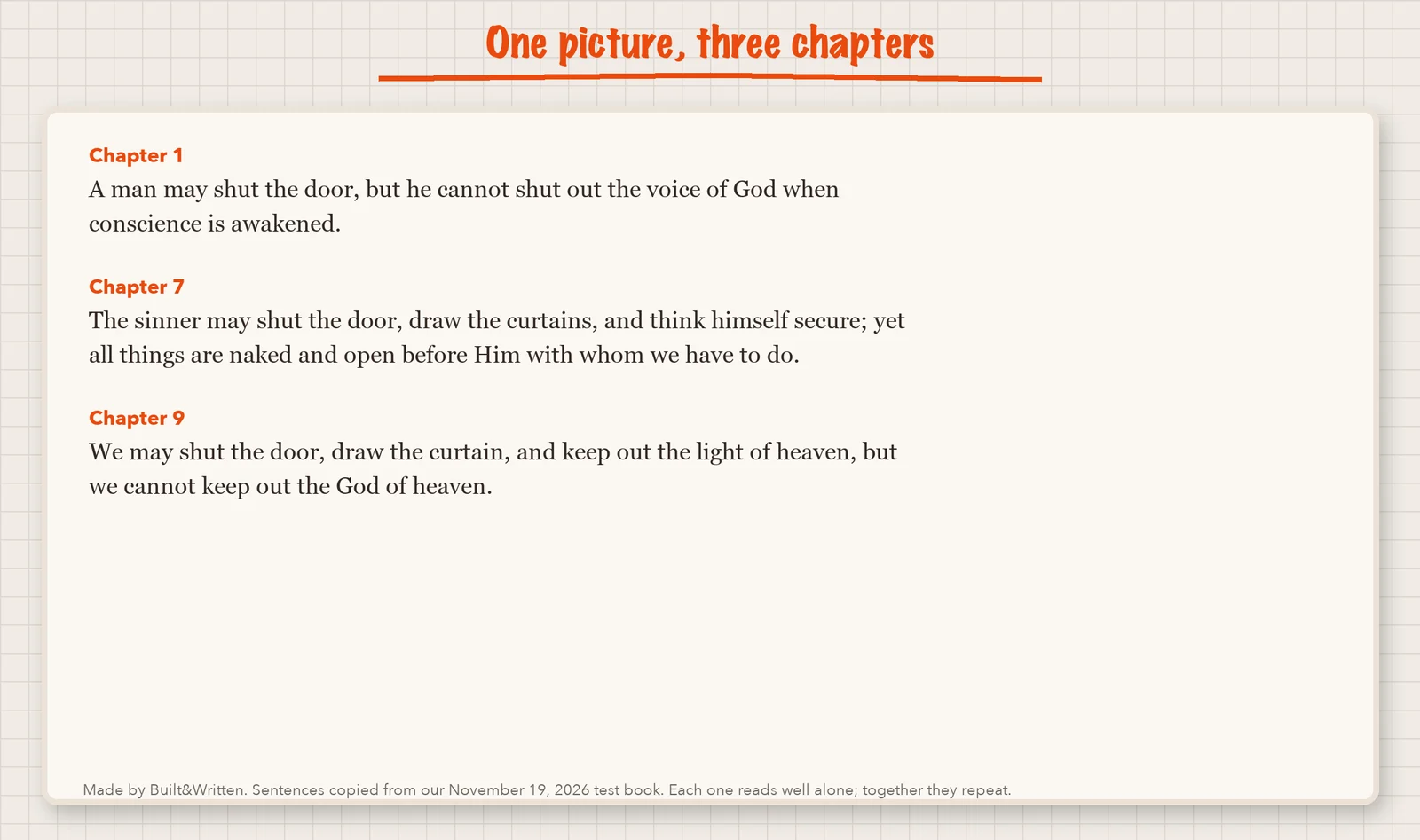
We checked. Each chapter read well on its own. The problems showed up only when we put chapters side by side. The phrase "a man may" appeared 9 times in 7 of the 9 chapters. The phrase "so it is with" opened a comparison in three chapters. The same picture, a sinner who shuts the door and still cannot hide from God, appeared in chapters 1, 7 and 9. Chapters 2 and 7 used the same prayer line.
How to do this job:
- Read two or three chapters in one sitting. Repetition hides when you read one chapter a day.
- When a line feels familiar, search the whole book for its key words.
- Keep the best use of each picture or story. Cut or change the others.
- Look for whole ideas that repeat too. Two chapters that make the same point need one point each.
If a story matters to the book, keep it whole in the chapter where it fits best. In the other chapters, point back to it in one short line. Here is how that could look with the door picture from chapter 9.
Before (chapter 9, as the AI wrote it): We may shut the door, draw the curtain, and keep out the light of heaven, but we cannot keep out the God of heaven.
After (our edit): We met this closed door in chapter 1. Hiding from God does not work.
Where does Built&Written fit in the editing work?
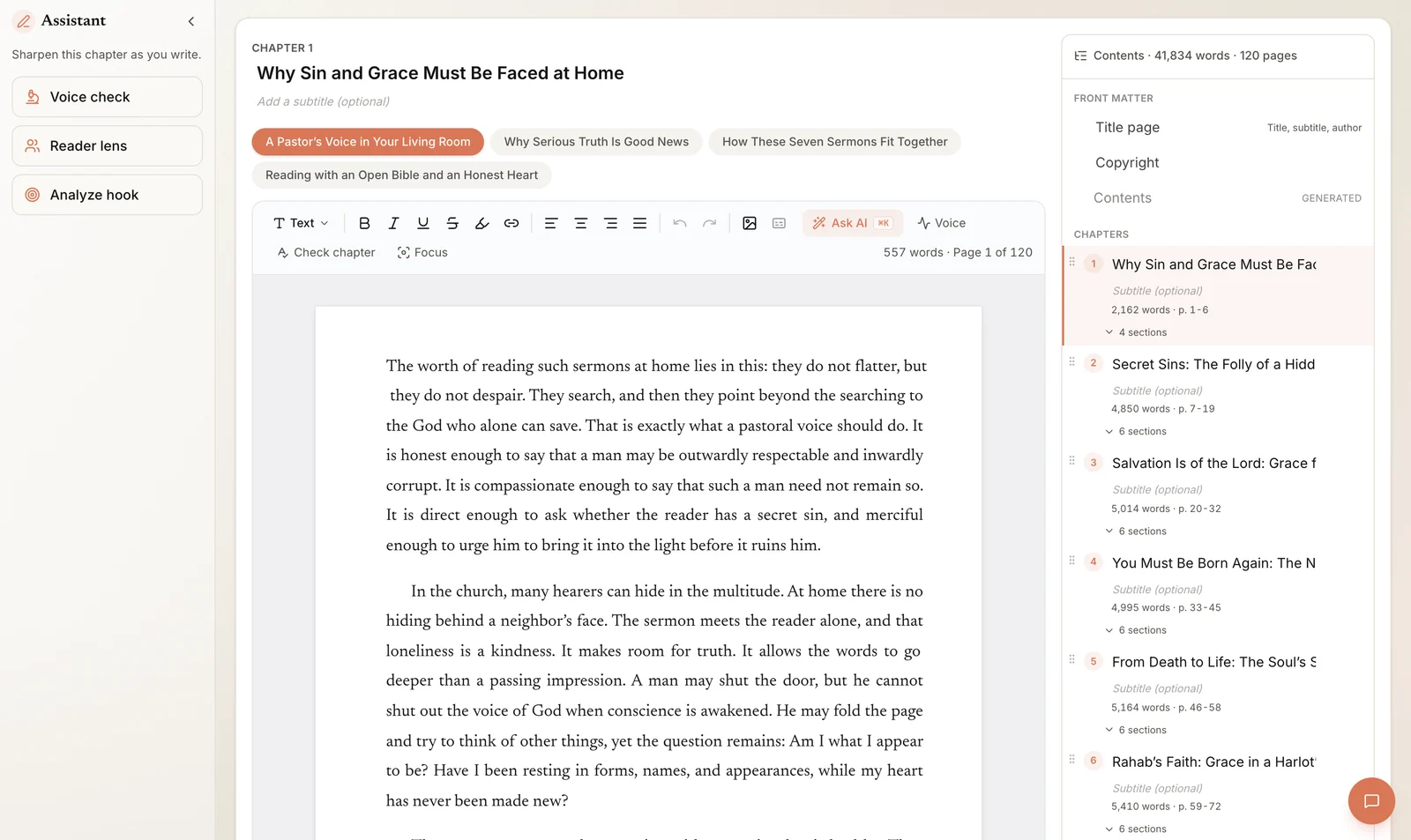
You have now seen the first two jobs. Before the other two, here is where a book platform helps. Built&Written is a platform for writing nonfiction books and preparing them for Amazon KDP. You paste or upload your own notes, posts or transcripts, and the platform writes the book chapter by chapter in the book generator. Then you read and change every chapter in one editor. The test book in this article was made there.
Here is how the platform helps with the four jobs.
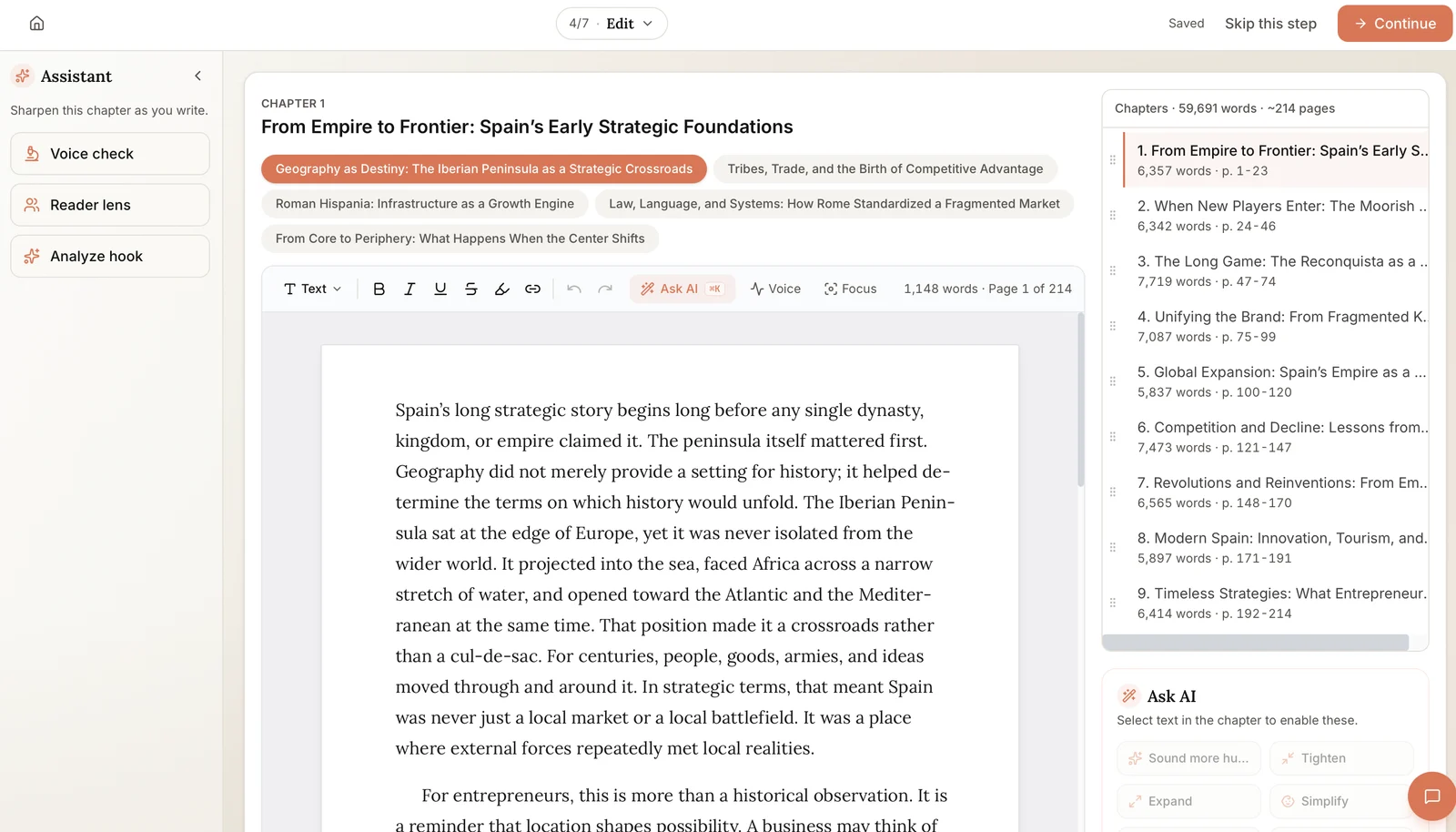
- Repetition. Repeats hide when chapters sit in separate files. In the platform the whole book is in one editor, and the contents panel lists every chapter with its length. You can read chapter 1 and chapter 7 one after the other and fix both in the same place.
- Voice. Before the book is written, Voice DNA learns your style from a few pages of your writing, about 300 to 1,000 words. Put your strongest piece first. It does not promise a perfect match, so you still read for voice (see the voice check below).
- Lines that sound off. You do not have to retype every weak sentence. Select a passage and Ask AI can tighten, simplify or expand it. You read the new version and keep it or drop it.
- Your own manuscript. If you wrote the book yourself, you can upload it and polish it in the book editor.
Here is what stays with you. The fact check is yours: open each source yourself. No person edits the book for you. The platform cannot promise sales or approval from Amazon. You read every chapter and you make the final call.
Here is what the platform takes off your hands. Your notes become a structured book, and the chapters sit in one editor. When the text is ready, the platform formats it, builds the cover and exports the KDP files. You upload them to KDP yourself. Our pricing page shows which plan includes which export.
How do you replace generic examples with your own?
A generic example is a story or comparison that could sit in almost any book. The AI uses one when your material does not give it a real case. The risk is simple: your own stories get replaced by general scenes that you never lived.
We checked. Chapter 1 explains a hard truth with a doctor who names a disease to help a patient. It also talks about a family Bible and a living room. A later chapter compares sins to a few grains against a whole harvest. We searched the uploaded sermons. "Family Bible", "living room", "grains" and "harvest" did not appear in them at all. The one doctor scene in the sermons is a different story. The AI added these pictures.
Nothing in them is false, just general. Here is a fix that keeps the point and drops the stock picture (step 4 below).
Before (chapter 1, as the AI wrote it): A physician does not harm a patient by naming the disease. He helps him.
After (our edit): Naming a sin plainly is a kindness. It is the first step toward healing.
If you have a real case, use it in place of the doctor. A story from your own work beats both versions.
How to do this job:
- Underline every example, story and comparison in a chapter.
- Ask of each one: did this come from my material?
- Swap the generic ones for a real case from your work, a client story you may share, or a moment you lived.
- If you have no real example, keep the plain point and drop the picture.
This job takes the most thought, because only you hold the replacements.
How do you fix voice drift in an AI-written book?
Voice drift means the text slowly stops sounding like the author. Say you write short sentences with plain words. The AI may slowly add longer sentences, fancy turns of phrase and patterns you never use. Each line looks fine. Together they sound like someone else.
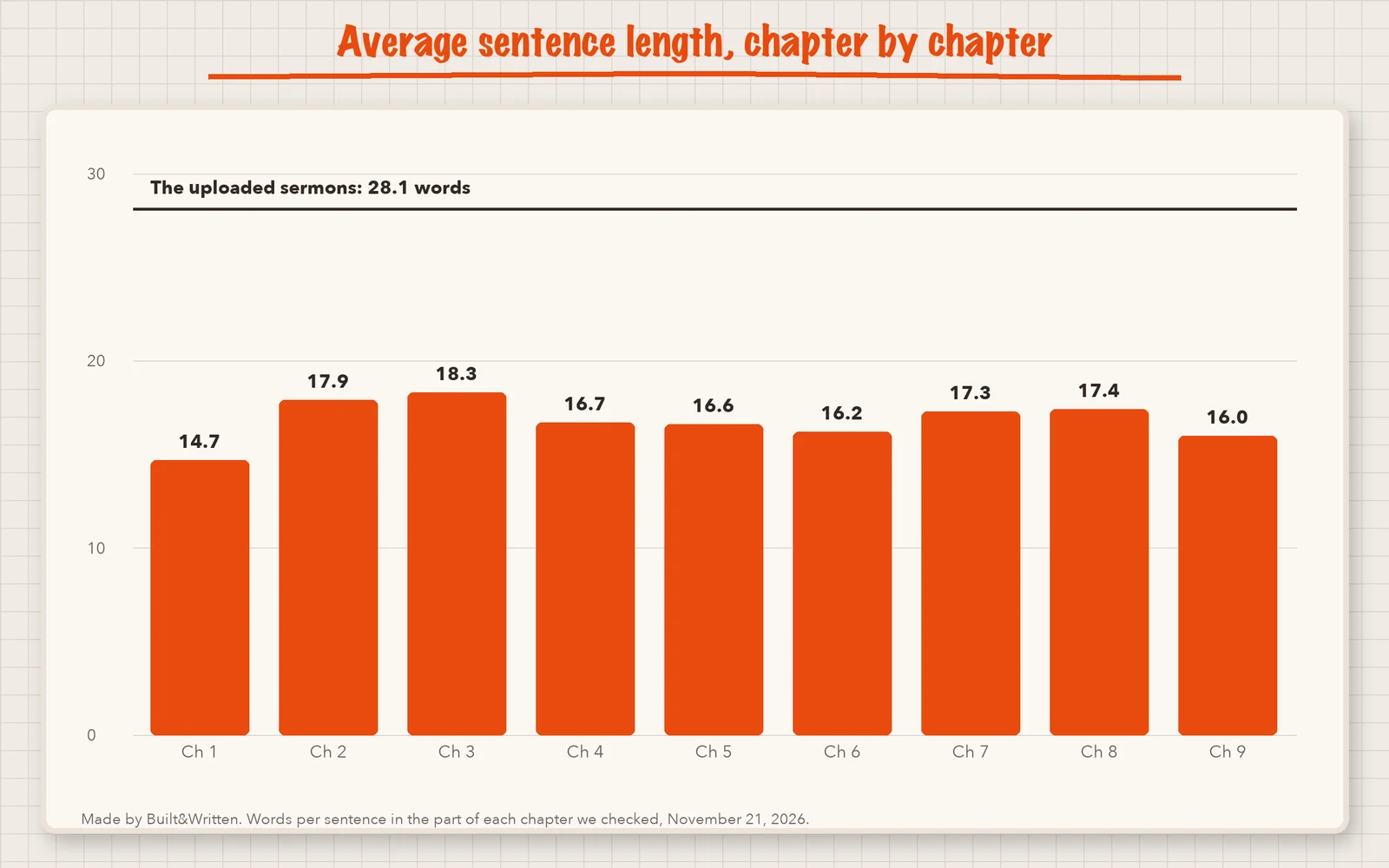
We checked. Sentence length stayed steady. The nine chapters averaged between 14.7 and 18.3 words a sentence. Our uploaded sermons averaged 28.1. The platform turned long spoken sentences into shorter written ones, and it kept that pace in every chapter.
We did find a sentence habit. 35 of the 392 sentences turned on a contrast, such as "they do not flatter, but they do not despair". Every chapter had some. One such line is strong. Thirty-five in one sixth of a book is a habit. We also found 7 em dashes in three chapters. If your own style uses commas or periods there, search for them and change them.
How to do this job:
- Read one page of your own writing. Then read one page of the draft aloud.
- Mark the sentences you would never say.
- Search for patterns: "not only", "but rather", long dashes, the same opening word.
- Rewrite the marked lines in your words, and leave the rest.
Before (chapter 1, as the AI wrote it): They do not flatter, but they do not despair.
After (our edit, for an author who writes plainly): These sermons are honest, and they still give hope.
Our article on six signs your writing sounds like AI lists more patterns to look for.
How long does editing AI generated content take?
Longer than the writing. Our numbers here come from two different places, so we keep them apart.
From an earlier test (a different book). We wrote a six-chapter book with ChatGPT from consulting sources. The chapters took about 45 minutes to generate. The hands-on work took about six hours. Structural review alone took 1 hour 15 minutes, and line editing took 2 hours 30 minutes. That run is described in can AI write a whole book.
An estimate for the whole sermon book (not a count). We checked about one sixth of the book. The full book has 41,834 words, about 6.35 times our sample. If the rest reads like the sample, the whole book would hold about 127 sentences with quotes. It would also hold about 222 contrast sentences and about 44 em dashes. We did not count these. We multiplied. The estimate still shows that editing a book is a project of days. A single afternoon is not enough.
What changes the time:
- Your material. A draft built from your own notes has fewer facts to check than one built from a short prompt.
- The kind of book. A book full of studies and numbers needs more checking than a book of personal advice.
For a full schedule, from outline to files, see how long it takes to write a book with AI.
Final thoughts
An AI-written book is a first draft. Read all of it. Check every fact and quote, cut what repeats, replace the stock pictures with your own, and read it aloud for your voice. In our test the AI got every quote right and still needed that full read.
Start with one chapter today. Run the four checks on it and time yourself. Then you will know how long your book needs.
Frequently asked questions
Yes. KDP's content guidelines say text created by an AI-based tool counts as AI-generated even if you made substantial edits afterward. You tell KDP when you publish or republish the book. If you wrote the text yourself and only used AI to polish it, KDP calls that AI-assisted and does not ask you to disclose it. Either way, KDP says you are responsible for checking that the content follows its guidelines.
Yes, as a helper. An AI can shorten a passage, simplify it or point out repeated words. It cannot confirm that a quote or a number is true, because it can repeat the same mistake it made the first time. Use AI for the wording and open the sources yourself for the facts. Then read the changed passage again before you accept it.
KDP does not require one. Editors do different jobs. One kind looks at the whole book: its order, its gaps and its repeats. Another kind fixes sentences, grammar and small mistakes. The Editorial Freelancers Association publishes a rate chart, so you can estimate the cost before you hire. Do the fact check yourself first, so the editor works on a clean draft.
Yes, and you should. Google says it rewards high-quality content however it is produced, and that appropriate use of AI is not against its guidelines. What breaks its spam policies is content made mainly to manipulate search rankings. Editing adds the facts, examples and checks that make a post useful to readers, which is what Google says it looks for.
Sources & References
- Content Guidelines, AI content section, Amazon KDP Help, checked 2026-11-21
- Walters and Wilder, Fabrication and errors in the bibliographic citations generated by ChatGPT, Scientific Reports, 2023
- Psalm 19:12, Jonah 2:9, John 3:3, Ephesians 2:1, Hebrews 11:31, Isaiah 63:1 and John 10:10, King James Version, Bible Gateway, checked 2026-11-21
- Editorial Rates, Editorial Freelancers Association, checked 2026-11-21
- Google Search's guidance about AI-generated content, Google Search Central, 2023
About the author