

Is It Ethical to Use AI to Write a Book if the Ideas Are Yours?
You spent ten years developing a business framework. AI helped you turn that expertise into a manuscript in six weeks. Is that cheating?
The ideas are yours. The research comes from your experience. But if AI wrote most of the sentences, can you still claim the book as your own?
There's a difference between developing original expertise and putting it into words. AI can handle much of the second task, but that doesn't automatically settle the question of authorship. Readers buy nonfiction books for the knowledge, judgment, and credibility of the person whose name is on the cover.
Is it ethical to use AI to write a book?
Yes, using AI to write a book can be ethical, even when AI drafts entire chapters. What matters is whether the author contributes genuine expertise, controls the argument, verifies the facts, and is honest about AI's role. But ethical authorship and legal copyright are different questions: you can responsibly publish an AI-assisted book without owning copyright in every AI-generated sentence. The real test is whether the knowledge, judgment, and responsibility behind the book are yours.
Consider a business consultant who has spent years advising companies. They have their own framework, client experience, research, and practical lessons. Using AI to organize those materials, develop an outline, or draft chapters doesn't erase their contribution. The knowledge behind the book still comes from them.
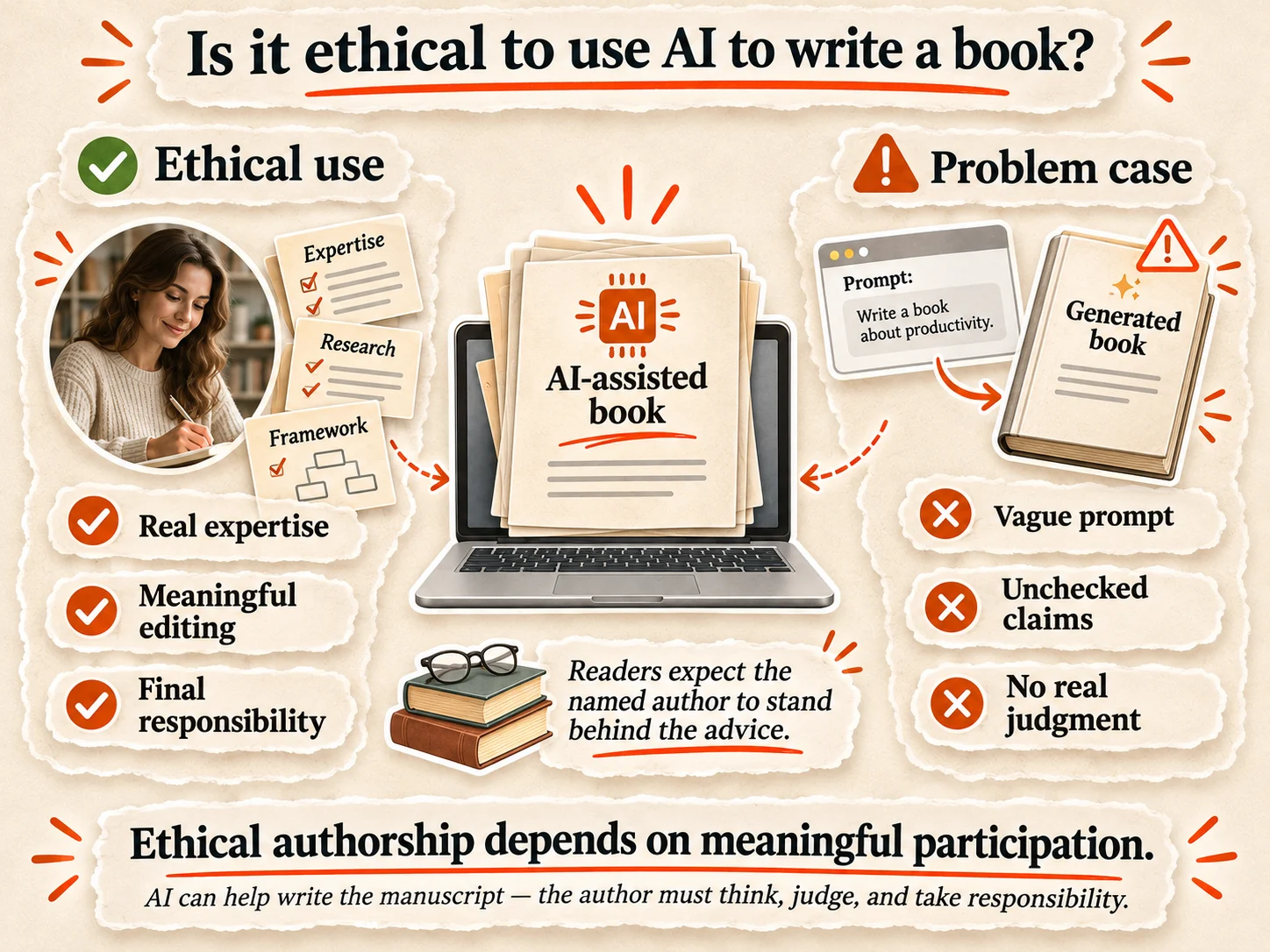
Now consider someone who asks ChatGPT to generate a 50,000-word business book on a topic they barely understand. They publish the result under their name without checking its claims. Both books involved AI, but the authors contributed very different levels of expertise and judgment.
The main objection to AI-written books is reasonable. Readers expect the person named on the cover to understand and stand behind the advice they're selling. They don't necessarily expect that person to have typed every sentence.
That's why ethical authorship depends on meaningful participation, not the percentage of text produced by AI. The author must shape the arguments, evaluate the evidence, and make the final decisions. AI can help produce the manuscript, but it cannot take responsibility for what the book teaches.
Does owning the ideas make you the author of an AI-written book?
Having the original ideas makes you the source of the book's knowledge, but it doesn't automatically make you the author of every sentence AI generates. There's a difference between contributing ideas and creating the actual expression of those ideas.
For nonfiction authors, that distinction matters. You might develop a business framework, collect years of research, provide detailed notes, and choose real examples from your professional experience. These are meaningful intellectual contributions, even if AI helps turn them into readable chapters.
But the extent of your involvement can vary considerably.
| Human contribution | AI involvement | Ethical consideration |
|---|---|---|
| Author writes the manuscript | AI fixes grammar and clarity | Low concern when the author controls the content |
| Author supplies detailed research and examples | AI drafts sections that the author reviews and revises | Can be ethical with fact-checking and honest disclosure |
| Author provides an outline and limited source material | AI produces most chapters | More scrutiny of originality, accuracy, and author contribution |
| Author provides only a short prompt | AI generates an entire book with little review | High risk of misleading readers about the author's expertise |
This comparison illustrates different levels of creative involvement, not legal categories of authorship.
The first two approaches preserve substantial human direction. The third raises harder ethical questions, particularly if the author presents AI-generated analysis as their own professional judgment.
The distinction is between directing the work and merely approving the output. Reviewing a generated manuscript doesn't necessarily mean you've contributed the expertise, reasoning, or original expression readers expect.
Your ideas establish the foundation. Your decisions, revisions, and accountability determine how much of the finished book you can genuinely stand behind.
Where is the ethical line between AI assistance and AI ghostwriting?
The ethical line isn't simply whether AI writes a paragraph or an entire chapter. It's whether the author provides the substance behind the words and takes responsibility for the result.
Using AI to brainstorm, organize research, build an outline, improve clarity, or identify gaps in an argument generally raises fewer ethical concerns. These tasks support the author's thinking rather than replace it.
Substantial AI drafting requires more scrutiny.
Consider a consultant with ten years of client experience. They upload their own research, workshop materials, and detailed notes. AI helps turn those materials into chapters. The consultant checks the claims, rewrites weak arguments, and ensures every recommendation reflects their professional judgment.
Now consider an entrepreneur who enters a prompt asking AI to write a complete leadership book. The resulting manuscript includes invented case studies, unsupported statistics, and advice the entrepreneur has never tested. They publish it without meaningful review.
Both used AI to generate prose. Only one maintained control over the book's substance.
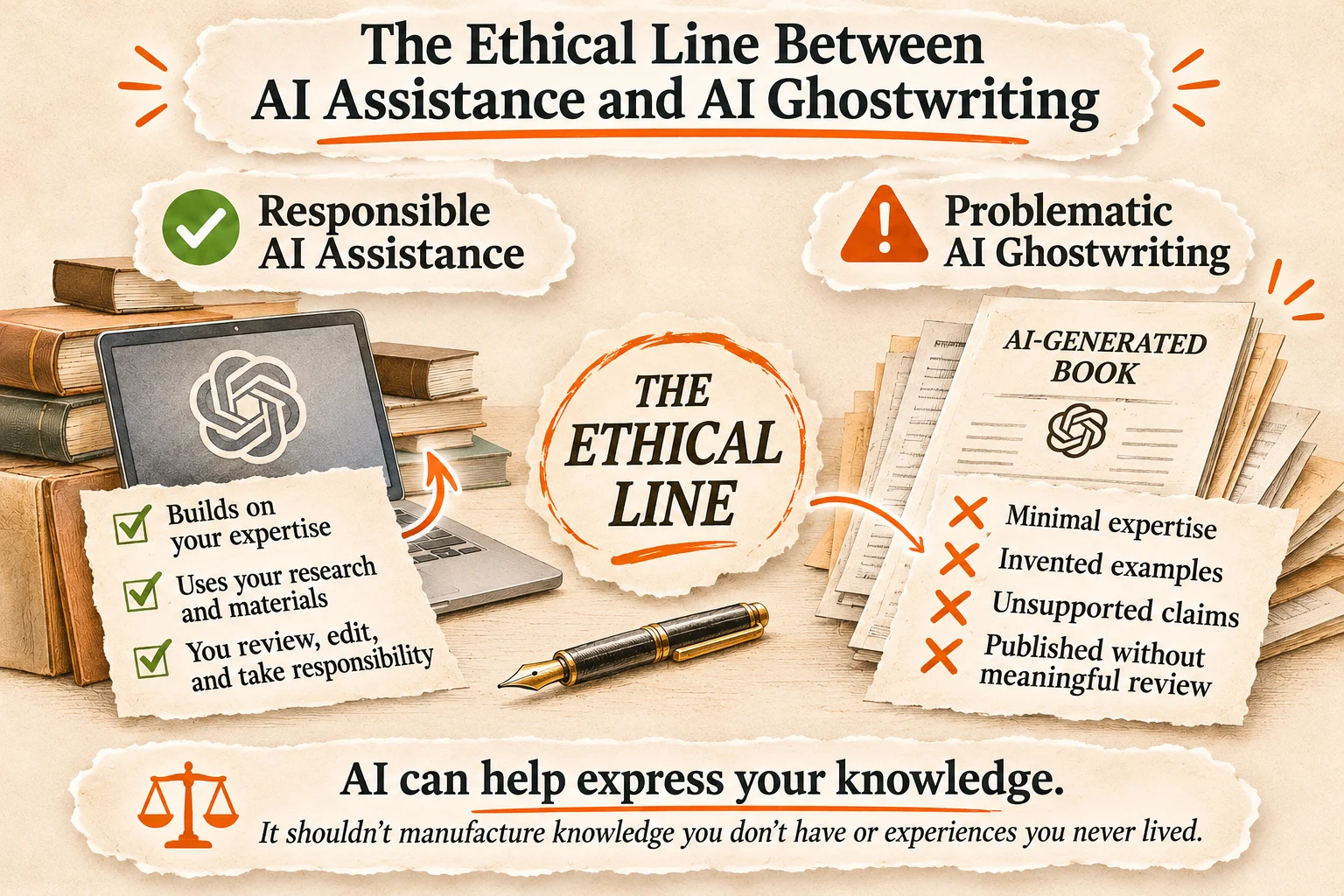
The ethical risks increase when AI invents expertise, fabricates client experiences, or produces claims the author cannot independently defend. Presenting those details as personal knowledge misleads readers, regardless of who supplied the original prompt.
AI ghostwriting isn't automatically unethical. Human ghostwriting has long existed in nonfiction publishing. But substantial AI drafting creates additional responsibilities because generated material can sound authoritative without being accurate.
The practical boundary is straightforward: AI can help express your knowledge. It shouldn't manufacture knowledge you don't have or experiences you never lived.
The four tests of responsible AI authorship
Before publishing an AI-assisted nonfiction book, put it through four tests.
The expertise test: Does the book contain knowledge, examples, and conclusions you genuinely understand?
The evidence test: Can you trace factual claims, quotations, and statistics to trustworthy sources?
The control test: Did you make the important decisions about the book's arguments, explanations, and final wording?
The transparency test: Have you followed your publisher's AI policies, and have you avoided misleading readers about your contribution?
A book that passes all four has a stronger ethical foundation than one whose author merely approves an AI-generated draft. These tests are a practical editorial framework, not a legal definition of authorship or a guarantee of copyright protection.
Can you copyright a book if AI wrote some of the text?
Yes, a book containing AI-generated text can qualify for copyright protection, but that protection generally covers the human author's original contributions, not material generated entirely by AI.
According to the U.S. Copyright Office's January 2025 report, copyright requires sufficient human authorship. Using AI doesn't automatically disqualify a book, but asking AI to generate text doesn't automatically make that text copyrightable either.
The distinction comes down to creative control.
If you write original chapters, develop explanations, and use AI to improve their clarity, your human-authored expression can remain protected. If AI generates sections that you creatively rewrite, your original modifications may also qualify.
The Copyright Office also recognizes protection for sufficiently creative human selection, coordination, and arrangement of material. For example, thoughtfully organizing AI-generated passages into a larger nonfiction work may create protectable authorship in the overall structure, without granting copyright over the underlying AI-generated passages.
Prompts alone generally aren't enough. Even detailed instructions may not give you sufficient control over the specific words and expressions an AI system produces.
These decisions are evaluated case by case under U.S. law. Other countries may apply different rules.
Importantly, copyright and ethics are separate questions. A book can be ethically produced without every sentence qualifying for copyright protection. Conversely, owning copyright doesn't guarantee that every claim in the book is accurate or responsibly presented.
Your legal rights depend on your creative contribution. Your credibility depends on what you publish.
Do you have to disclose AI use when publishing a book?
You must disclose AI-generated content to Amazon KDP, but you don't necessarily have to tell readers about every AI tool you used. The requirements depend on how the content was created, where you're publishing, and any contractual obligations.
Under Amazon KDP's Content Guidelines, two categories matter:
- AI-generated: AI creates the actual text, images, or translations. You must disclose this to KDP, even if you substantially edit the content afterward.
- AI-assisted: You create the content yourself and use AI for brainstorming, grammar corrections, editing, or refinement. KDP doesn't require disclosure.
These are platform requirements, not universal laws. Copyright registration and traditional publishing contracts may impose separate obligations.
But disclosure to a platform isn't the same as transparency with readers.
The Authors Guild's May 2026 best practices recommend publicly disclosing substantial AI-generated text. The reasoning is straightforward: readers deserve to understand who contributed to a book they're purchasing.
A short statement in the front matter could say:
"This book is based on my original research, professional experience, and frameworks. AI tools assisted with drafting and editing. I reviewed and verified the final manuscript and take responsibility for its content."
You don't need to document every spelling correction. But when AI produces significant portions of a manuscript, transparency helps protect the credibility your book is meant to establish.
The practical rule: Follow your publisher's requirements, and don't let readers form a misleading impression of your contribution.
How can you use AI to write a book without misleading readers?
The safest approach is to treat AI as a production assistant, not a substitute for your expertise. Your knowledge should drive the manuscript, and every important editorial decision should remain yours.
Here's a five-step workflow for keeping that distinction clear.
- Start with your own material. Gather research, client insights, presentations, frameworks, and examples you've developed. Give AI evidence to work from rather than asking it to invent expertise.
- Control the argument. Build the outline around what you actually believe and can defend. Decide which claims belong in each chapter, which examples support them, and what readers should learn.
- Verify facts and citations. Check statistics against original sources, confirm quotations, and inspect every reference. AI can produce convincing citations to publications that don't exist. Never treat a generated reference as verified evidence.
- Rewrite generic passages. Replace vague advice with specific reasoning, real examples, and terminology from your professional work. If a paragraph sounds convincing but says nothing distinctive, it probably needs your input.
- Review before publishing. Check the complete manuscript for factual accuracy, originality, consistency, disclosure requirements, and unsupported claims. Don't assume individual chapter reviews catch every problem.
Built&Written is designed for nonfiction authors who already have material to work from. You can bring in your notes, posts, and transcripts, approve the book's outline, and edit the chapters AI drafts before publishing. You remain responsible for verifying the facts and answering Amazon KDP's AI disclosure questions. The platform helps turn your expertise into a manuscript; it doesn't independently guarantee that every claim is accurate.
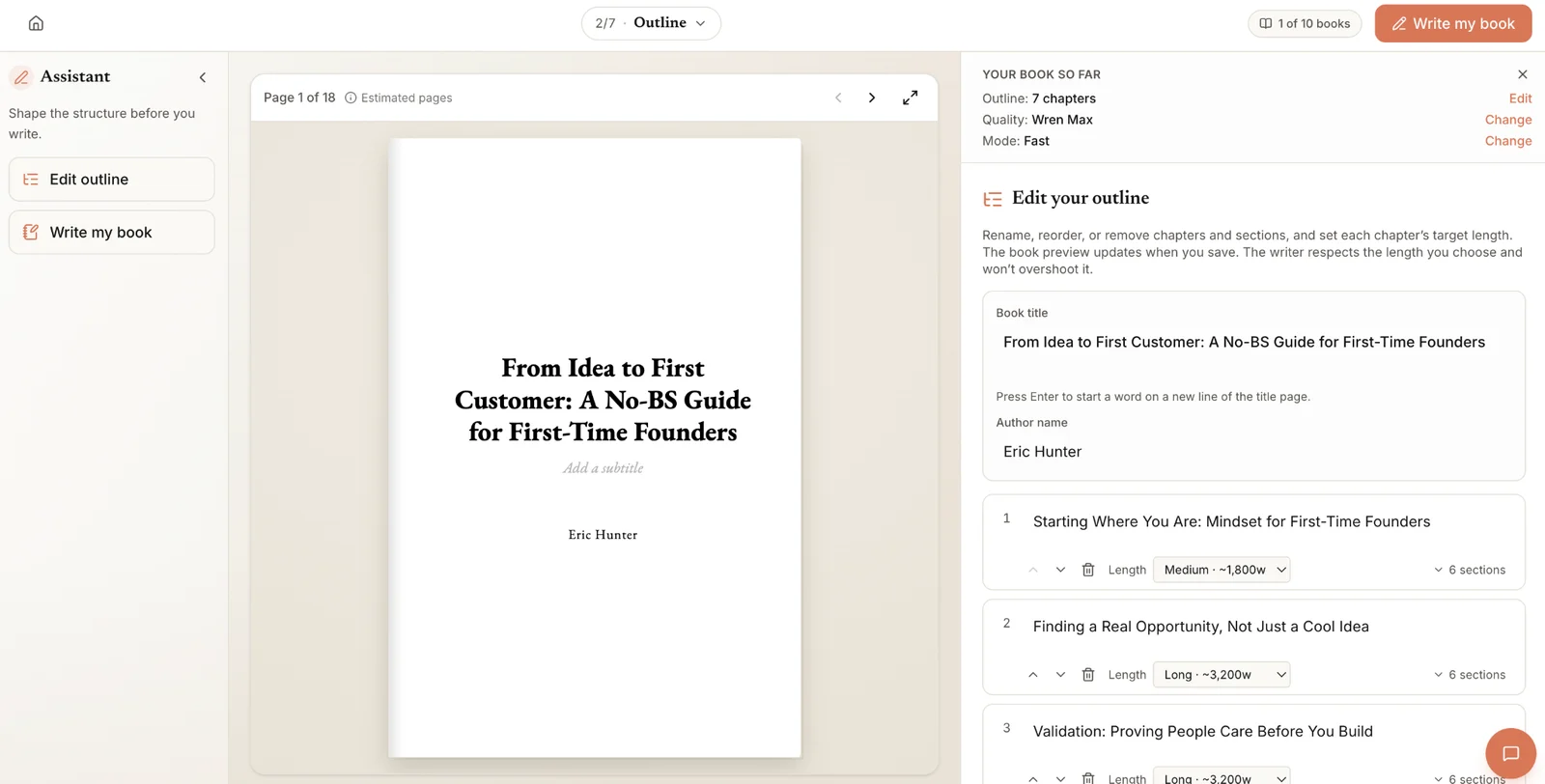
But no writing platform can guarantee ethical authorship or replace independent fact-checking.
The final test is simple: If a reader challenges a claim in your book, can you explain where it came from and why you stand behind it?
The verdict: When is an AI-assisted book genuinely yours?
Return to the expert who spent ten years developing a business framework and six weeks turning it into a manuscript with AI. Did the software write some of the sentences? Yes. Does that erase a decade of research, experience, and original thinking? No.
An AI-assisted book can genuinely be yours when you contribute the expertise, control the substance, and take responsibility for the result.
Typing every word isn't what makes someone a credible nonfiction author. Developing useful ideas, making informed decisions, and explaining them accurately matters far more.
But having the ideas doesn't excuse careless execution. If AI invents supporting evidence, misrepresents your experience, or produces arguments you don't understand, publishing those claims under your name becomes your responsibility.
Before publishing, ask yourself three questions:
- Can I defend the arguments in this book?
- Can I explain where the evidence comes from?
- Can I stand behind every chapter without relying on AI to justify it?
If the answers are yes, AI's involvement doesn't automatically undermine your authorship.
Using AI to write your book can be ethical. Your ideas give the book its foundation, but your expertise, evidence, editorial decisions, and accountability determine whether you can genuinely stand behind the finished work. AI can produce the words. You remain responsible for what those words tell readers.
Frequently asked questions
Not necessarily. Using ChatGPT to organize ideas, improve explanations, or draft material from your expertise can be ethical. It becomes problematic when you misrepresent AI-generated knowledge as your own or violate a publishing agreement.
Yes, if you've made meaningful intellectual contributions and genuinely directed the work. However, claiming authorship doesn't automatically give you copyright protection over AI-generated passages.
Not inherently. Selling AI-generated nonfiction becomes ethically questionable when the content contains unverified claims, fabricated expertise, or misleading representations about its creation. Buyers deserve accurate information.
Yes. Amazon KDP permits AI-generated content that complies with its publishing guidelines. You must disclose AI-generated text, images, and translations during publishing, even if you've substantially edited them afterward.
Not always. KDP requires disclosure to the platform, not necessarily a public statement. However, the Authors Guild recommends informing readers when AI generated substantial portions of the text.
Absolutely. Your original research, frameworks, professional insights, and creative decisions can make a nonfiction book distinctive. AI involvement doesn't erase those contributions, although purely AI-generated expression generally lacks U.S. copyright protection.
Sources & References
About the author

Polina Karlashchuk
More in informational
Ready to write your book?
Turn your expertise into a professional book with Built&Written.