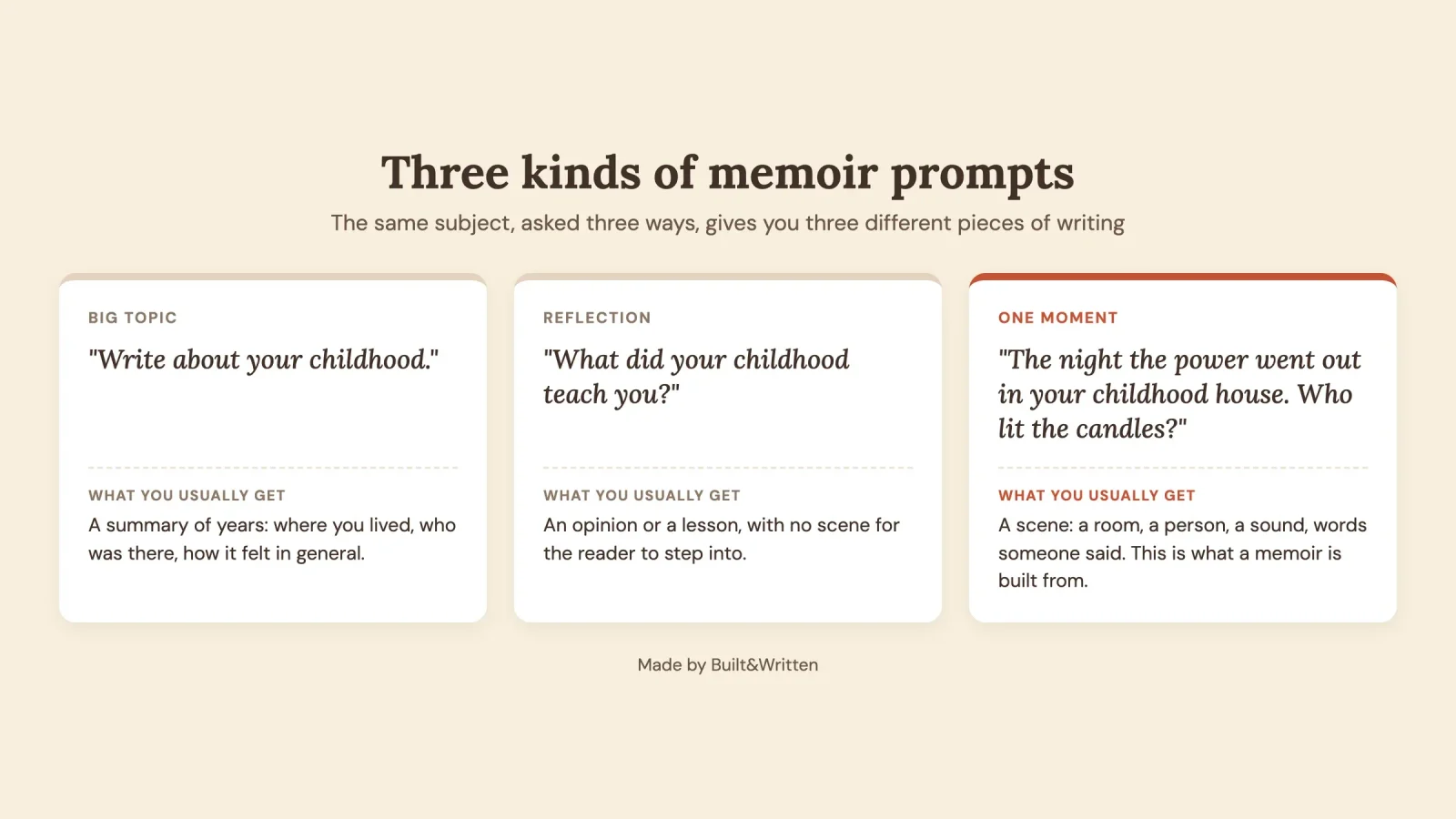
The best memoir writing prompts ask about one specific moment, such as one day or one conversation. Broad prompts like "write about your childhood" usually give you a summary. Specific prompts give you a scene you can write.
In 2006, two researchers gave 93 older adults one cue each: a word, a picture or a smell. Each person then told a memory from their own life. The memories that came from smells were the oldest. Most of them came from the first ten years of life, and people said these memories felt more like going back in time (Willander and Larsson, 2006).
The study shows that a simple cue can bring back a memory from your life. The same idea helps when you write. Instead of asking about your whole childhood, start with a smell, a place, an object or a moment.
If you sat down to write your life story and got one flat paragraph, better questions will help. Below are 36 memoir writing prompts and a simple way to turn any broad question into a specific memory. Start with any question. You do not need to answer all 36.
Skip to the 36 memoir writing prompts
What makes a good memoir writing prompt?
A memoir writing prompt is a short question that brings back one memory you can write down. A good one points to a single moment you can picture. A weak one points to a whole topic.
"What was your childhood like?" may lead to a few sentences about your family, school and home. "What could you hear at night from your bedroom as a child?" gives you something specific to remember.
A memoir is a true story built from scenes. A scene is one moment told as it happened, with where you were, who was there and what someone said. Our guide on how to write a memoir shows how scenes become chapters.
We sorted 200 memoir writing prompts. Here is what we found
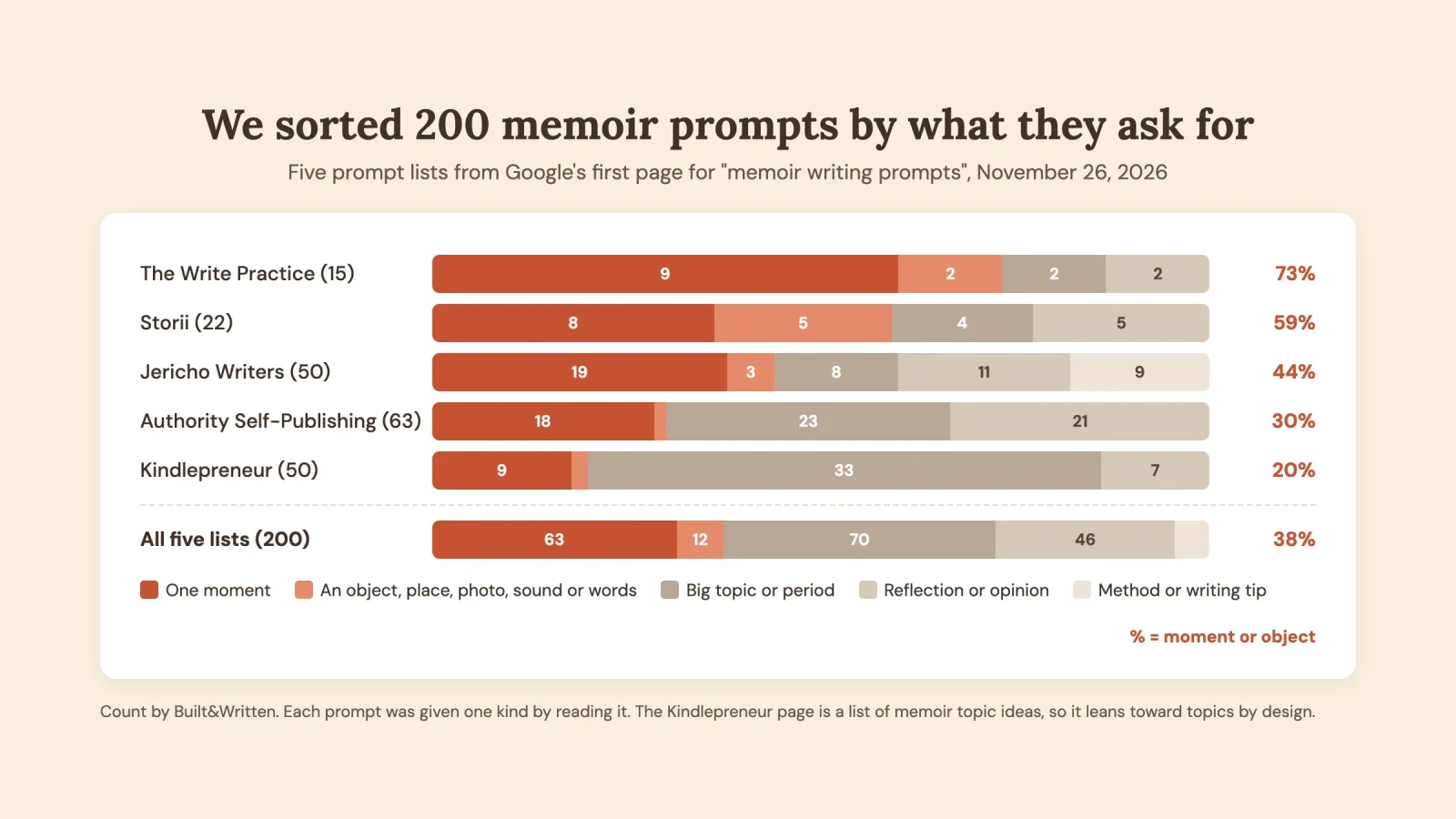
How we checked. On November 26, 2026, we opened five prompt lists from Google's first page for "memoir writing prompts": The Write Practice, Storii, Jericho Writers, Authority Self-Publishing and Kindlepreneur. Together they hold 200 prompts. We read each one and sorted it into one category, based on what it asks you to recall. This is our own classification, so treat the numbers as a guide.
Here is what the count shows.
- 75 of the 200 prompts (38%) point to one moment or one object. "The first time you met the love of your life" is one of them.
- 116 (58%) ask about a broad topic or for an opinion. "How has technology shaped your life?" does not lead to a scene.
- The remaining 9 are writing tips, such as "show, don't tell".
- Within the 75, only 12 start with an object, a place, a photo, a sound or words someone said. The memory studies above suggest that sensory cues can bring back older memories, so prompts built around objects, places and sounds are worth trying.
Some lists give broad topics, which helps when you are choosing what to write about. The 36 prompts below aim at a particular moment, place, conversation or object.
36 memoir writing prompts that pull out stories
Pick the prompts that bring a memory to mind.
Places and senses
- Walk through the front door of the house you grew up in. What do you smell first?
- Where did you sleep as a child? What could you hear at night?
- Name a kitchen you remember. Who stood at the stove, and what were they making?
- Describe the car your family drove. Where did you sit, and where were you going?
- What did your grandparents' house smell like on a holiday?
- Name a room you were afraid to enter. What was in it?
People and their words
- Write down one sentence a parent said that you still hear. When did they say it?
- Who taught you to do something with your hands? What do you remember about the first time they showed you?
- Describe the first time you saw a parent cry.
- Name a teacher who saw something in you. What did they say or do?
- Write the last conversation you had with someone you lost.
- Who made you laugh until you could not breathe? Tell that day.
Turning points
- Tell the day you left home. What did you carry out the door?
- Write the phone call that changed your life. Where were you standing?
- Describe the morning after a big decision. What did you do first?
- Tell the moment you knew a relationship was over.
- Write about your first night in a new city or country. Where did you sleep, and what do you remember seeing or hearing?
- Describe a moment you were proud of and never told anyone about.
Objects and photos
- Pick one photo from before you were 12. Who took it, and what happened just after?
- Name a small object you still keep. How did you get it?
- Describe a piece of clothing you loved. Where did you wear it?
- Find a letter or a card you saved. Who wrote it, and why did you keep it?
- What did you buy with your first paycheck? Where is it now?
- Name a song that takes you back to one exact place. Where are you when it plays?
Work, money and hard times
- Describe your first day at your first job. Who showed you what to do?
- Tell a time money was tight at home. What did your family go without?
- Write about the moment you received news that changed something in your life. Where were you, and who told you?
- Describe a mistake at work that you still think about.
- Tell the night you could not sleep because of a worry. What was it?
- Write about someone who helped you when you could not ask for help.
Small, happy and funny
- Describe a summer afternoon from your childhood, hour by hour.
- Tell the family story everyone repeats at dinner. Then tell your version.
- Write about a meal that went wrong.
- Describe a holiday tradition only your family had.
- Tell the time you laughed at exactly the wrong moment.
- Write about a pet and one thing it did that nobody forgot.
Some of these prompts may bring back difficult memories. You do not have to answer every question. Write only what you feel comfortable sharing. A memory can stay in your personal notes and does not have to go into your book.
How to turn any memoir prompt into a moment
You can shrink any big prompt with three questions.
- When exactly? Pick one day, or one hour, inside the topic.
- Where were you? Name the room, the street or the car.
- What did someone say? Write the words as you remember them.
Here is how that works on two common prompts.
| Big prompt | The same prompt as a moment |
|---|---|
| Write about your childhood. | Think of a night from your childhood when the power went out. Where were you, and who came into the room? |
| What did your first job teach you? | Your first payday. What did you buy on the way home? |
A date, a place or one question about what happened next can turn any broad topic into a story.
How to use memoir writing prompts so the stories keep coming
Write one prompt a day, for a short time
One prompt on The Write Practice asks you to write for fifteen minutes. That is a useful starting point, because a short session is easy to begin. Do not edit while you write.
Use the real thing when you can
A 2007 follow-up by the same researchers found that memories cued by a smell were more emotional than those cued by words (Willander and Larsson, 2007). So when a prompt mentions a smell, a song or an object, try finding the real thing. Open the spice jar or play the song. It may help you remember more details. The studies did not test writing, so treat this as an idea worth trying.
Ask someone else the questions
If you are writing a parent's story, turn the prompts into interview questions. StoryCorps keeps a list of them, and FamilySearch suggests recording interviews and making a timeline of the life. Our guide on writing a family history book covers the research side. Memory is not perfect, so check names and dates against letters, photos and records. The National Archives has a starting page.
Be careful when writing about living people. An article on Jane Friedman's site calls libel, a false statement that harms someone's reputation, often the biggest legal risk for writers. Truth helps but does not stop someone from suing, and a changed name may not hide a person readers can recognize. If a story could seriously harm someone, talk to a publishing lawyer before you publish.
From prompt answers to a memoir with Built&Written
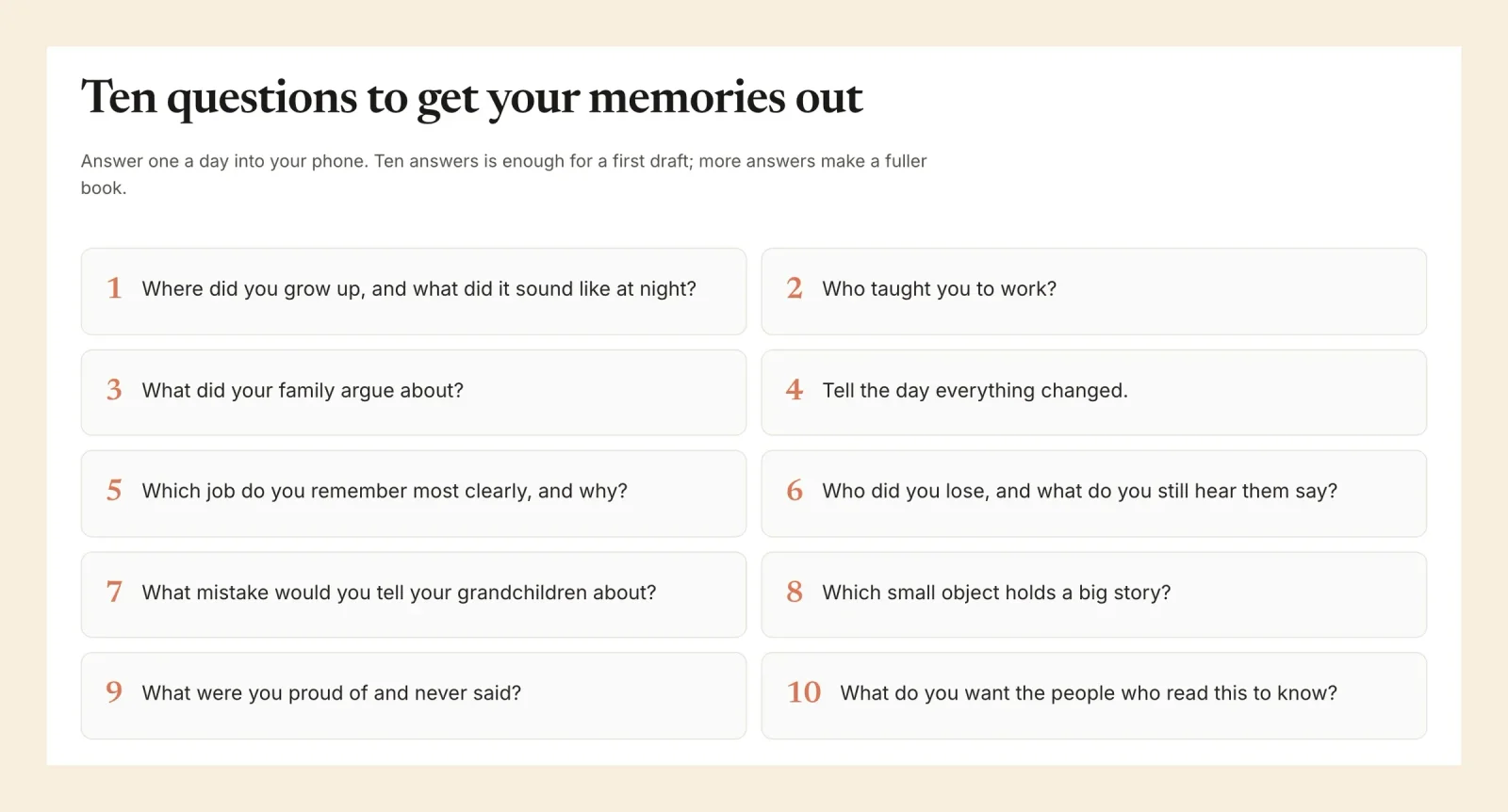
After a few weeks of prompts, you may have 20 or 30 stories in a notebook, a journal or on your phone. You have the memories, but not yet a book. You still need to sort them and turn them into chapters.
Built&Written is a platform that helps you turn notes, memories and written material into a nonfiction book. You paste in your stories or interview transcripts, and it makes a chapter plan. You review the plan, and then the platform drafts the book. Its AI memoir writer page has its own list of ten questions.
Here is how your prompt answers become a book on Built&Written.
- Paste your answers. The platform reads text, so type voice memos up first or paste a transcript.
- Add a sample of your writing. A letter or an email helps the AI understand how you write. Built&Written calls this Voice DNA. It works from a few pages, about 300 to 1,000 words.
- Review the chapter plan. The platform suggests a structure from your material. You can rename, move or remove chapters before the AI starts writing.
- Read every line. The AI writes chapters from your material, but it can add details or change facts. Check every name, date, place and conversation against your memories.
- Download the files. You get a laid-out book with a cover. You upload it yourself to Amazon KDP (Kindle Direct Publishing), Amazon's service for self-published books, to sell it or order printed copies for your family.
We tried it with five prompt answers
How we tested. On November 26, 2026, we answered prompts 3, 13, 14, 23 and 32 for a made-up storyteller, a retired mail carrier we called Annie. The answers came to 582 words. We added a 94-word letter in her voice and pasted it all into Built&Written. This was a single test with invented material, so your results may differ.
The platform identified the material as a memoir and, about 30 seconds later, proposed a seven-chapter plan in the order of Annie's life.
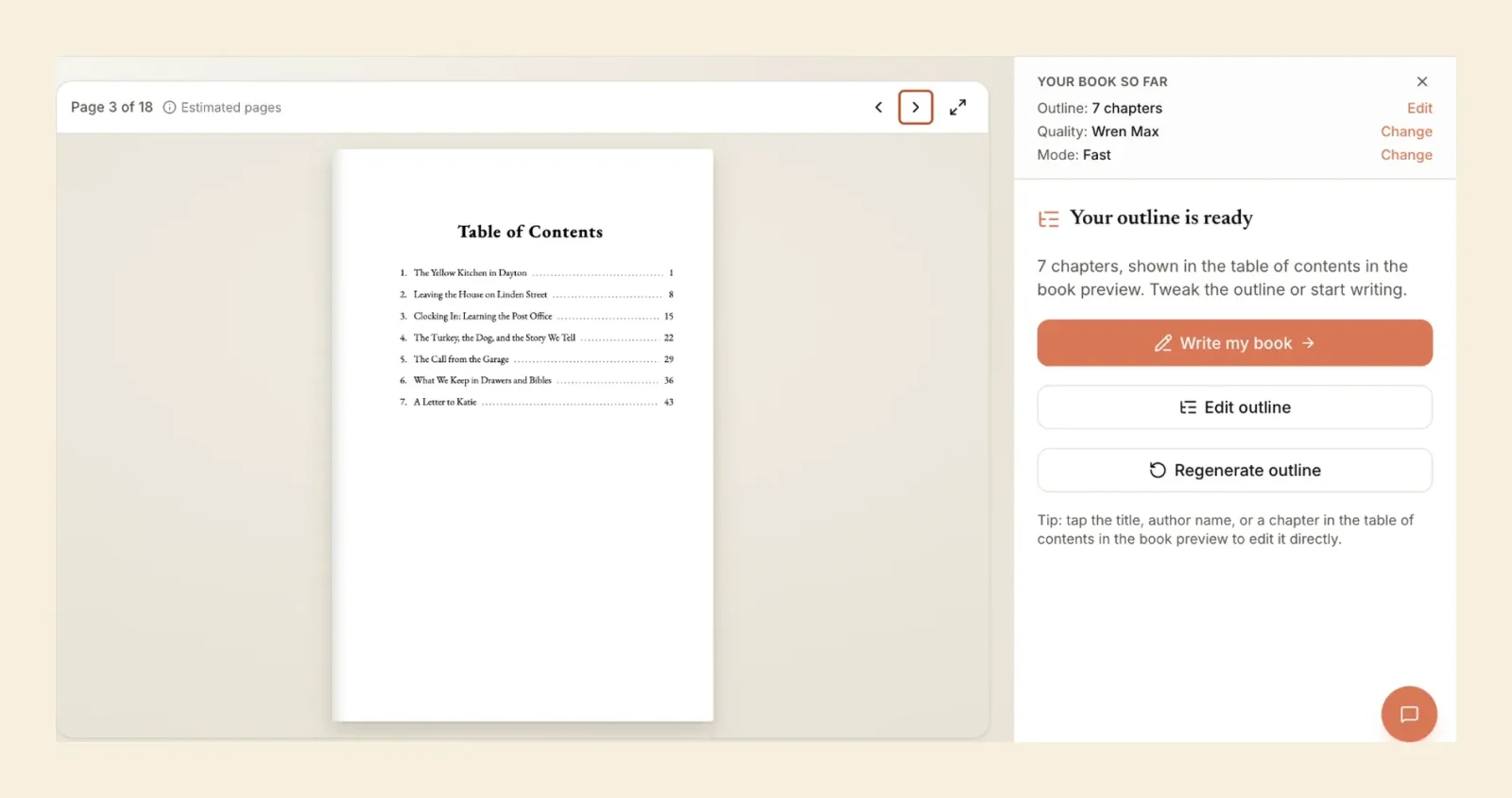
Then Wren Pro, the platform's AI writer, drafted about 19,000 words, or 50 pages. We read all seven chapters next to Annie's answers. The extra length does not mean the AI had more facts about Annie's life. It can expand scenes, but it may also fill gaps with details nobody provided.
- Most details stayed the same. The $412 paycheck, the $29 Timex, the note "2:40", her sister Carol and the dog Buster all came through as written.
- Some details were added. Chapter 2 names Linden Street. The answers never named a street.
- One fact shifted once. In one sentence the drive to Columbus became "a little over an hour". Annie said about an hour and a half, and the rest of the chapter kept that.
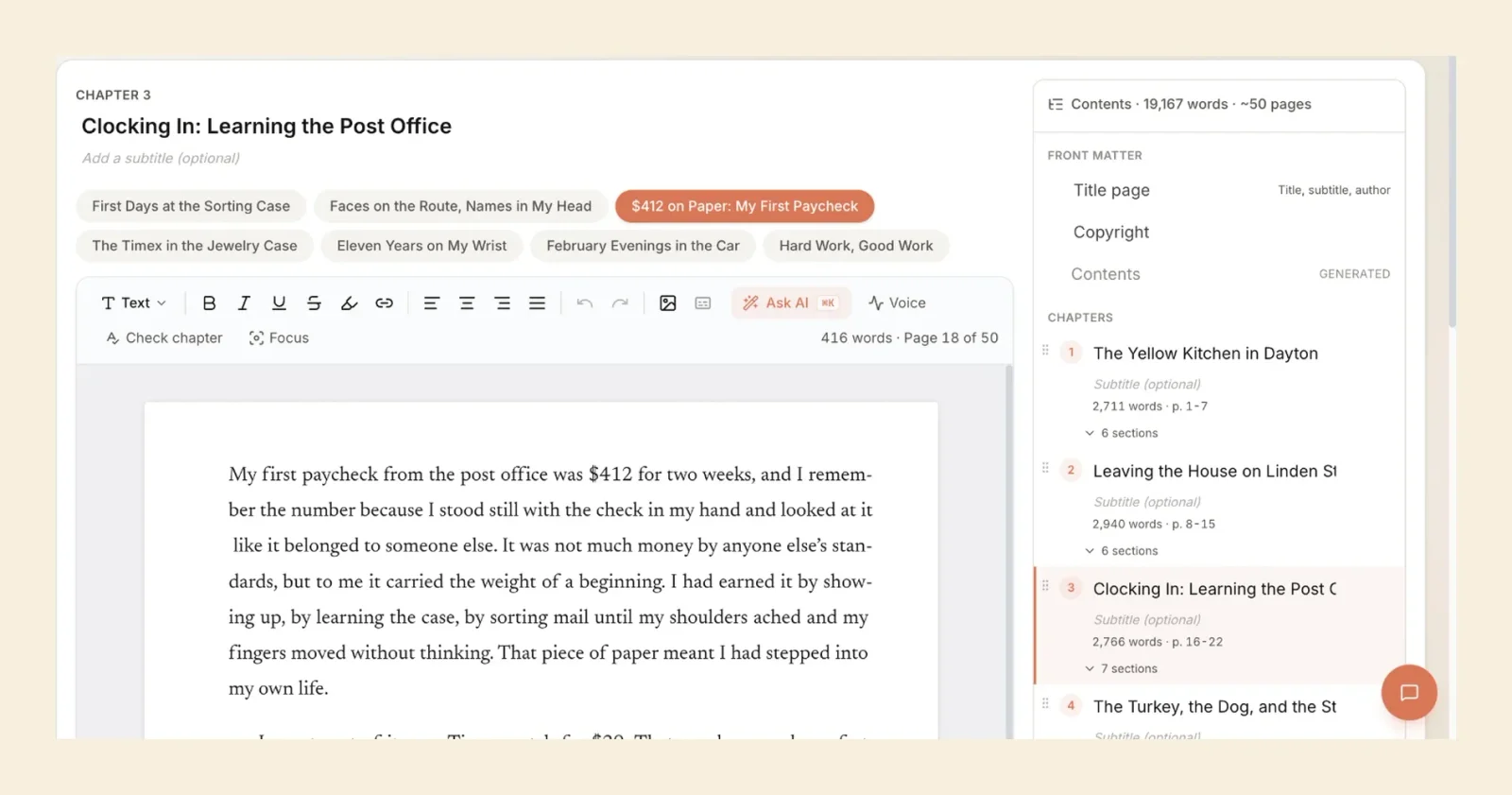
The prompts gave the AI specific moments to work with, and most details we checked stayed in place. But the draft still added information and changed one fact. Keep your answers open next to the chapters and remove anything that did not happen. If you would rather write every word yourself, Built&Written can also format your finished book for print without changing it.
Final thoughts
The best memoir writing prompts ask about one specific moment. Pick one prompt today, set a timer for fifteen minutes and write. Do it again tomorrow. Over time, you will have a collection of stories you can start turning into a book.
Frequently asked questions
There is no fixed number. Ten answers can give you a starting point for a draft, but the result depends on how much detail you include. More answers give the AI more material. Group your stories by period of your life and look for gaps.
Yes. Most prompts work as interview questions if you change "you" to the person you are asking. Record the conversation with their permission, then type it up. StoryCorps publishes free question lists for family conversations, and FamilySearch suggests gathering photos and documents too.
No. Start with the prompt that brings back the strongest memory, even if it comes from the middle of your life. Once you have many answers, sort them by time or by theme. In our test, the platform also proposed an order that followed her life.
They overlap. Journal prompts often ask about today, your feelings or your goals. Memoir prompts ask about the past and aim for a scene a reader can follow. Tie a journal prompt to one exact moment, and it works for a memoir.
Sources & References
- Willander and Larsson, Smell your way back to childhood (2006)
- Willander and Larsson, Olfaction and emotion (2007)
- The Write Practice, 10 Memoir Writing Prompts
- Storii, Journal Prompts for Memoir Writing
- Jericho Writers, Memoir Writing Prompts
- Authority Self-Publishing, 63 Memoir Writing Prompts
- Kindlepreneur, Topics for Memoirs
- StoryCorps, Great Questions
- FamilySearch, Writing Your Family and Personal History
- National Archives, Resources for Genealogists
- Jane Friedman, How Can I Avoid Lawsuits When Writing Memoir?
About the author