

Book Writing Templates for Nonfiction, Chapter by Chapter
You want to write a nonfiction book, and you are looking for book templates to plan it. You know your topic. What you don't know is how to split it into chapters, or what each chapter should say.
Most templates you find don't help with that. Search for book templates, and the top results are page designs. Book Design Templates sells page layouts. Amazon KDP (Kindle Direct Publishing, Amazon's service for selling your book) offers manuscript templates in Microsoft Word that set the page size and margins.
Search for a book writing template, and most of what you find was made for novels. Reedsy's list of book writing templates, updated on November 19, 2026, opens with eight fiction tools, such as the Hero's Journey and character profiles.
This page gives you what those miss: one chapter template for each kind of nonfiction book.
Skip to the five chapter templates
What is a book writing template?
A book writing template is a fill-in plan for what a book says. It sets the order of the chapters and the few lines each chapter has to answer. A formatting template does a different job. It sets how the pages look, with the page size, margins, fonts and title page.
| Book writing template | Formatting template | |
|---|---|---|
| What it shapes | What each chapter says | How each page looks |
| When you use it | Before and while you write | When the text is finished |
| Example | The five templates on this page | KDP's Word manuscript templates |
If you are still deciding what to write in Chapter 1, you need a book writing template. If your text is finished and you want the pages to look ready for print, you need a formatting template.
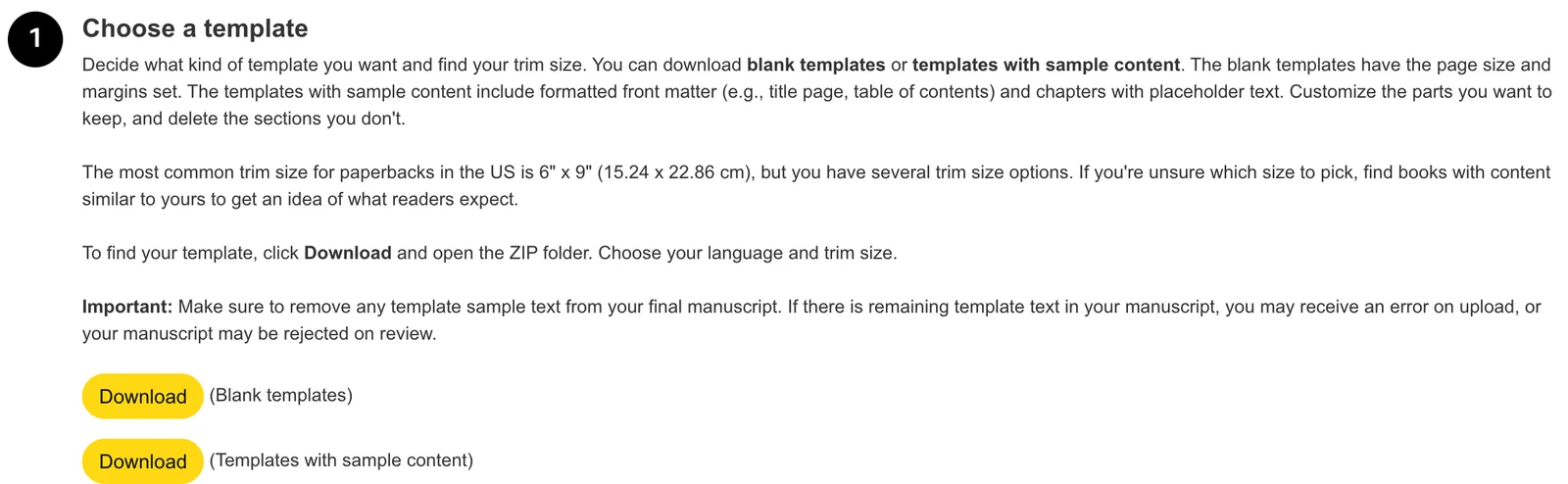
KDP's templates come blank, with the page size and margins set, or with sample content: a title page, a table of contents and placeholder chapters. Either way, what goes in each chapter is up to you.
For the plan of the whole book, with its promise and its parts, our book outline template takes about an afternoon. The templates below go one level down, inside each chapter.
Once you have a plan for your chapters, the next step is turning it into a book. Built&Written can help with that, starting from the notes, stories and writing you already have. We show how it works further down.
Which book template fits your nonfiction book?
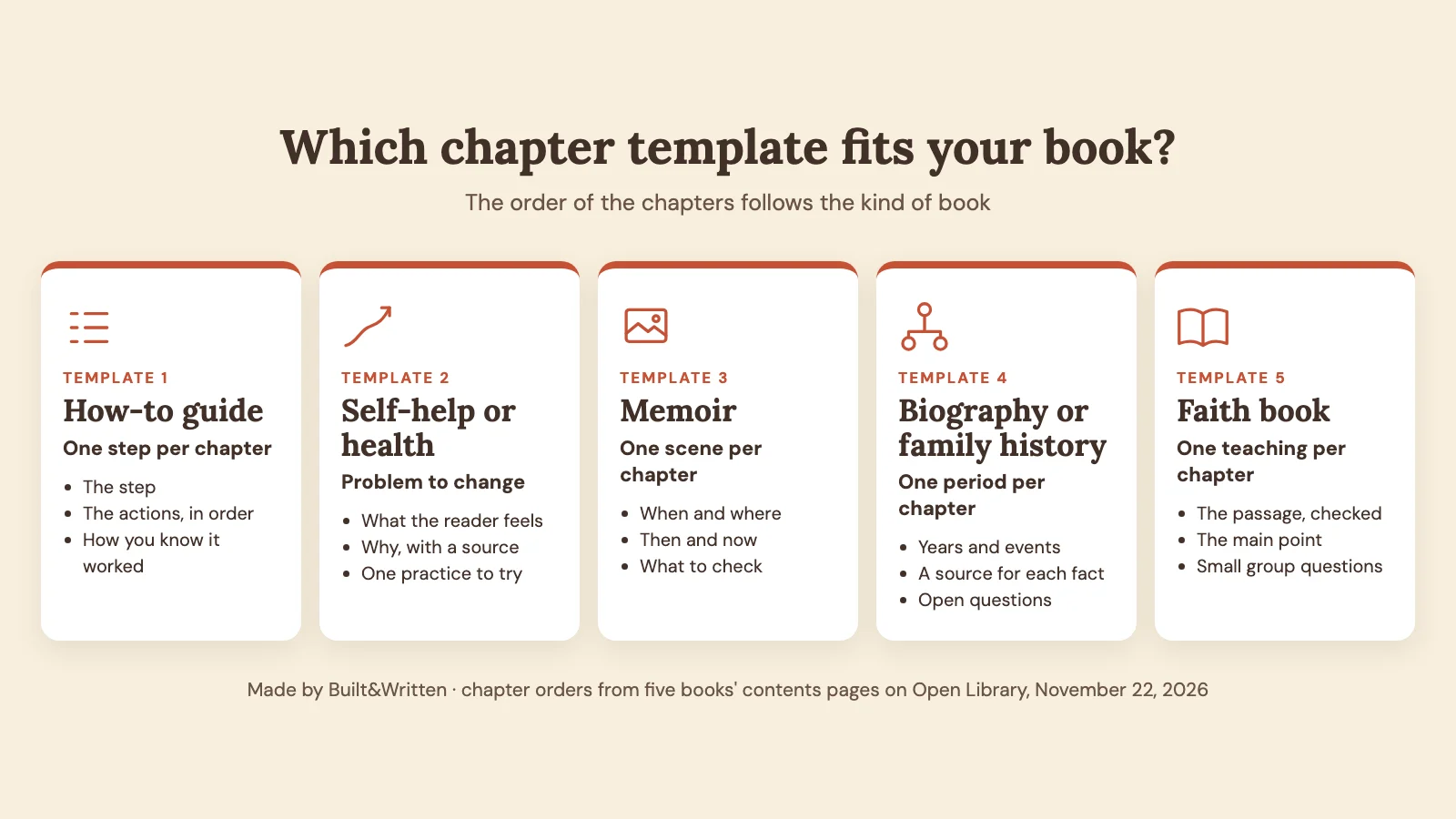
The order of the chapters follows the kind of book. Find yours in the table, then use the template with the same number below. Each example is a well-known book whose contents page we read on Open Library on November 22, 2026.
| Your book | What each chapter does | A real book that does it |
|---|---|---|
| 1. How-to guide | Teaches one step, in the order the reader follows them | Getting Things Done, David Allen |
| 2. Self-help or health | Helps the reader understand one problem and move toward a change | Daring Greatly, Brené Brown |
| 3. Memoir | Tells one part of your life through one event or memory | Educated, Tara Westover |
| 4. Biography or family history | Covers one period of the person's life | Steve Jobs, Walter Isaacson |
| 5. Faith book | Focuses on one idea or teaching | The Purpose Driven Life, Rick Warren |
Memoir is also the most common choice on Built&Written. When authors start a book on the platform, they pick one of nine book types. Of the more than 950 books started with a type picked, 30% are memoirs and 12% are faith books. How-to guides and self-help are 10% each (Built&Written data, November 2026).
Five book chapter templates for nonfiction
Copy the template for your book type into a document. Repeat it once for every chapter. Answer each line in a sentence or two, and leave the full paragraphs for later.
1. How-to guide: one step per chapter
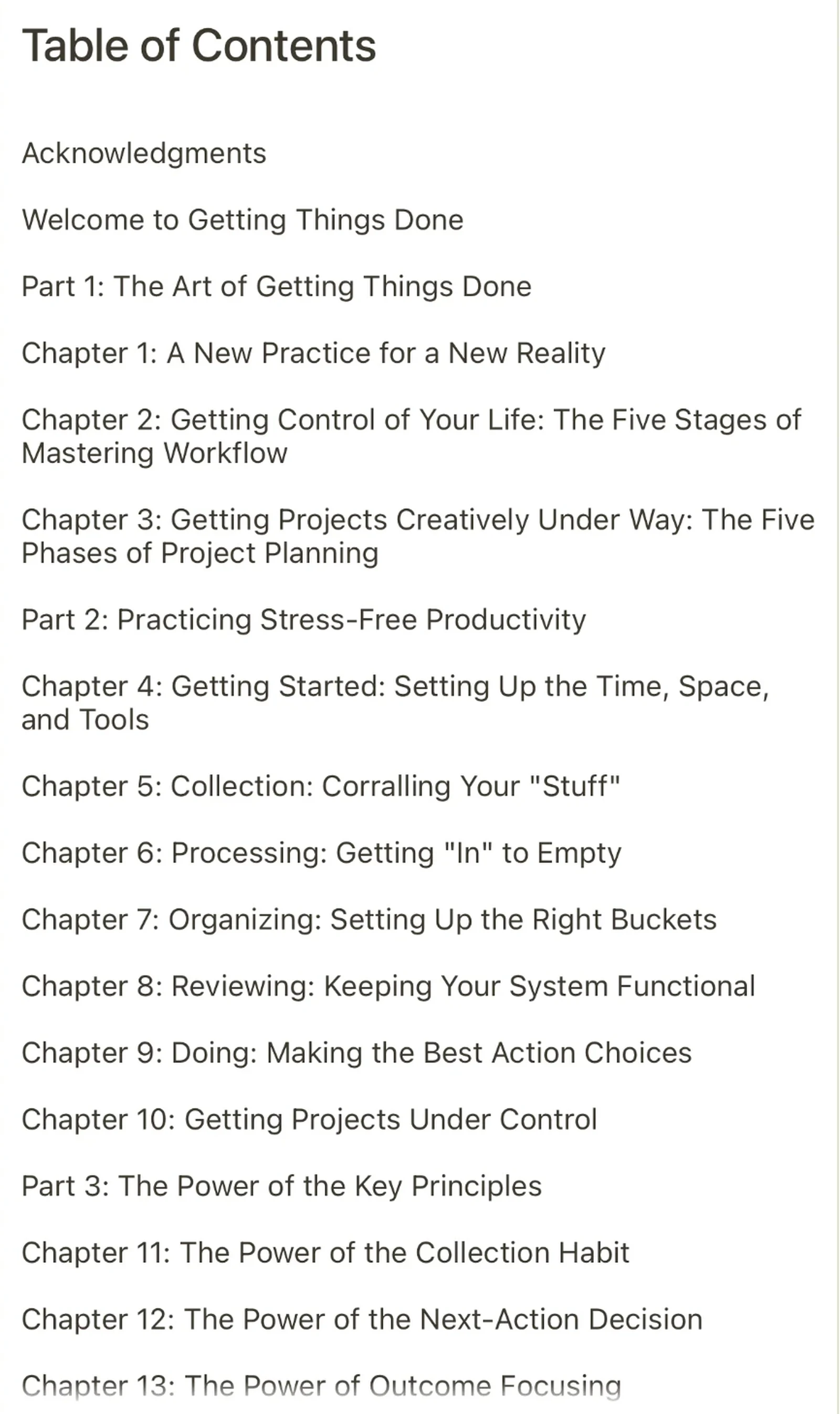
In a how-to book, each chapter teaches one step the reader takes. Getting Things Done (2015 edition) teaches its method in Part 2, mostly one step per chapter: "Collection", "Processing", "Organizing", "Reviewing" and "Doing".
Chapter [number]: [the step, as a verb]
- Before this step: what the reader already knows or has done
- The step, in one sentence:
- What they need: tools, time, materials
- The actions, in order: 1. ... 2. ... 3. ...
- What usually goes wrong, and the fix:
- How the reader knows it worked:
The last line keeps the chapter honest. If you cannot say how the reader checks the result, the step is still too vague.
2. Self-help or health: from the problem to the change
A self-help book template moves the reader, chapter by chapter, from something they feel to something they can try. Daring Greatly follows that path. It starts with the problem ("Scarcity"), then moves to what readers can change at work, at school and at home.
Chapter [number]: [the problem or the change, in the reader's words]
- What the reader feels or keeps doing:
- Why this happens: your explanation and the source that supports it
- A story that shows it: yours, or one you have permission to tell
- The practice: one thing the reader can try this week
- A question for the reader:
- Source check: where each fact or health claim comes from
The source line matters most in health books. Check each health claim against a reliable, up-to-date source. MedlinePlus has a short guide to judging health information. And promise no result you cannot back up. Our guide to writing a self-help book helps you find an angle of your own.
3. Memoir: one scene per chapter
A memoir chapter is built around a scene: one time and place you can see clearly. Educated works this way. Its Open Library record lists 40 short titles, from "Choose the Good" to "Educated". Most of them name an object, a phrase or a moment from the story, like "The Midwife" and "Cream Shoes".
This memoir template gives each scene six lines.
Chapter [number]: [a phrase, object or place from the scene]
- When and where: year, place, your age
- What happened, in order:
- What you felt then:
- What you understand now:
- Who else was there, and how might they remember it:
- What to check: a date, a name, a record, a person to ask
Two lines protect you. "What to check" is there because memory slips. FamilySearch's guide to writing a personal history suggests recording interviews with relatives, gathering letters and photos, and making a timeline of your life. It also asks you to include the funny moments.
The line about who else was there matters because real people can be hurt, and some may sue. A guide to memoir and lawsuits on Jane Friedman's site explains the main risks. A false statement that damages someone's reputation is libel. True but private details can also cause trouble. Changing a name helps only if no one can tell who it is. For a risky passage, ask a lawyer.
Our guide on how to write a memoir covers the rest of the process.
4. Biography or family history: one period per chapter
A biography usually follows the person's life in order. Steve Jobs runs through his life in 42 chapters, from "Childhood" to "Legacy". A family history can use the same order, with one person or one generation per chapter.
Chapter [number]: [the years, or the person]
- Years covered:
- The main events, in order:
- Who else is in it:
- Source for each fact: letter, record, photo, interview
- What this chapter shows about the person: their character, choices or life
- Open questions: what you could not confirm
The last two lines keep the book true. Where the records stop, say that you could not confirm it.
Facts are free to use, but someone else's writing is not. The US Copyright Office says copyright does not protect facts, though it can protect the way they are written. So use the dates and events, and tell them in your own words. Our guide on writing a family history book shows how to turn research into chapters.
5. Faith book: one teaching per chapter
Many faith books group their chapters by theme. The Purpose Driven Life (2002 edition) has 40 short chapters. After an opening section, they are grouped into five parts, and each part is one purpose, such as "You were formed for God's family". A book built from a sermon series often works the same way, with one teaching per chapter.
Chapter [number]: [the teaching, in one line]
- The passage: book, chapter, verse, and the translation you quote
- The main point, in one sentence:
- A story that shows it: from your life, or a clear example
- What it means for the reader this week:
- Questions for a small group:
Check every verse word for word, and name the translation you quote. Each Bible publisher sets its own rules for quoting, including rules for AI tools. Crossway, which publishes the ESV, says on its permissions page that the ESV text may not be used or processed by any AI system. So never paste ESV text into an AI tool. Our testimony guide shows how a short faith story can grow into a book.
A filled-in chapter, as an example
Here is template 3 filled in for one memoir chapter. We made it up to show the shape, so it is nobody's real story.
Chapter 4: The Blue Suitcase
When and where. Summer 1979, my grandparents' farm in Ohio. I was nine.
What happened. My parents left me there for the summer. On the first night I unpacked the blue suitcase and cried.
What I felt then. Sent away, and sure I had done something wrong.
What I understand now. They were saving to buy our first house.
Who else was there. My mother, who remembers it her own way.
What to check. The year. Ask my brother, and find the photo with the farm truck.
You do not need to write the full story here. The template helps you remember what happened, what mattered to you and what you want to include. Once you have those details, you have a starting point for the chapter, and you already know what to check first.
How Built&Written turns book templates into a book
Say you have filled in templates for ten chapters. Now you have a pile of short answers. Two stories cover the same summer. One scene could be a chapter or just a paragraph. And a few lines per chapter are still far from a book.
Built&Written is a platform for writing and publishing nonfiction books. It starts from what you already have, so you never face a blank page. Here is how it works:
- Bring your material. Paste or upload your filled-in templates, notes, posts or the transcript of a talk.
- Get a structure. The platform reads it and proposes a chapter outline.
- Shape it. Rename, move or delete chapters, and set each one's length.
- Draft the chapters. The platform writes each chapter from your material. If you add a sample of your own writing, about 300 to 1,000 words, it tries to match your style. You still read and edit every line.
What happened when we gave it six templates
We wanted to know one thing. Can the platform take short answers, with no chapter written yet, and turn them into a book structure that makes sense?
On November 22, 2026, we gave it six filled-in memoir templates. They were short test notes about events and memories, written like the example above.
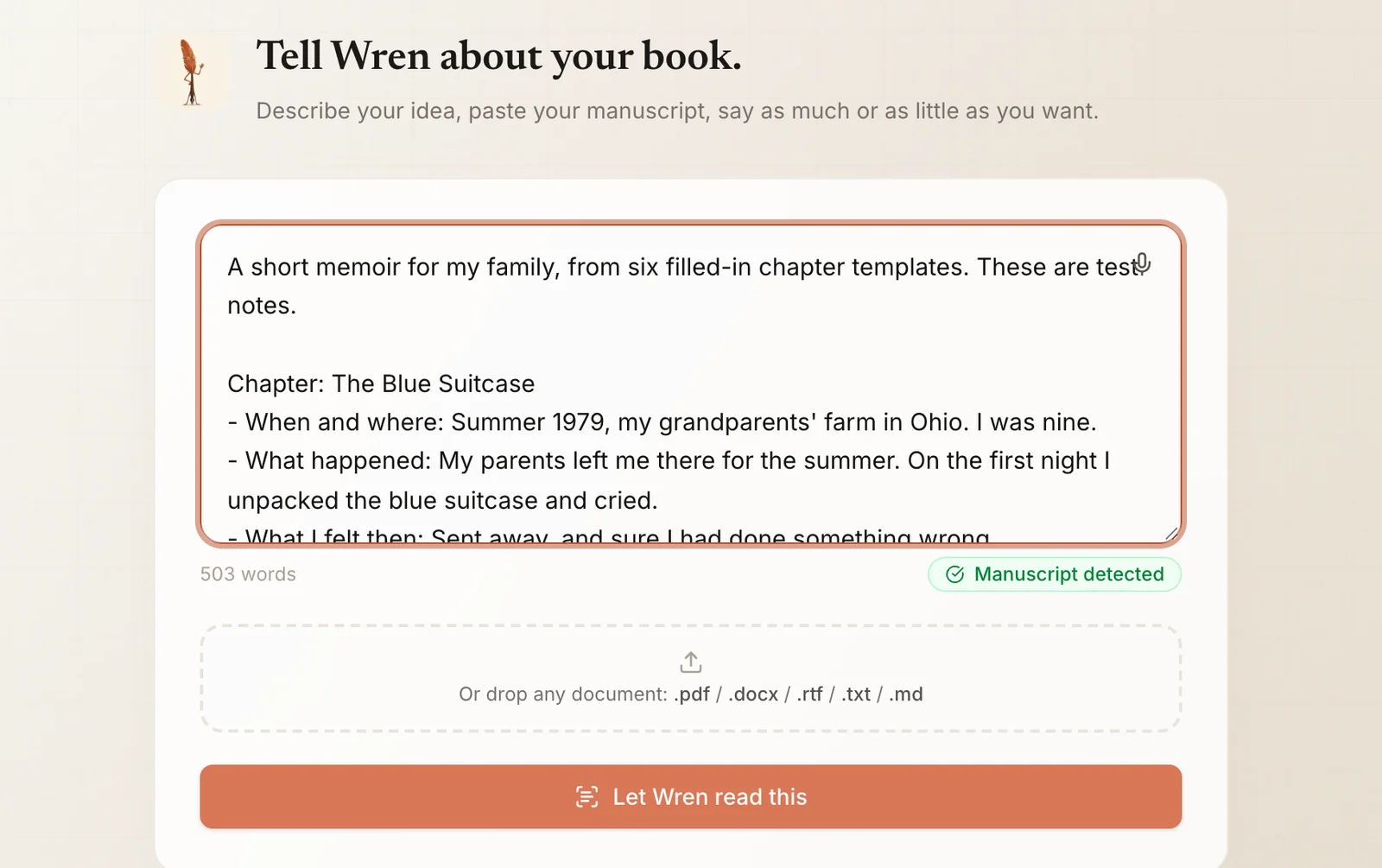
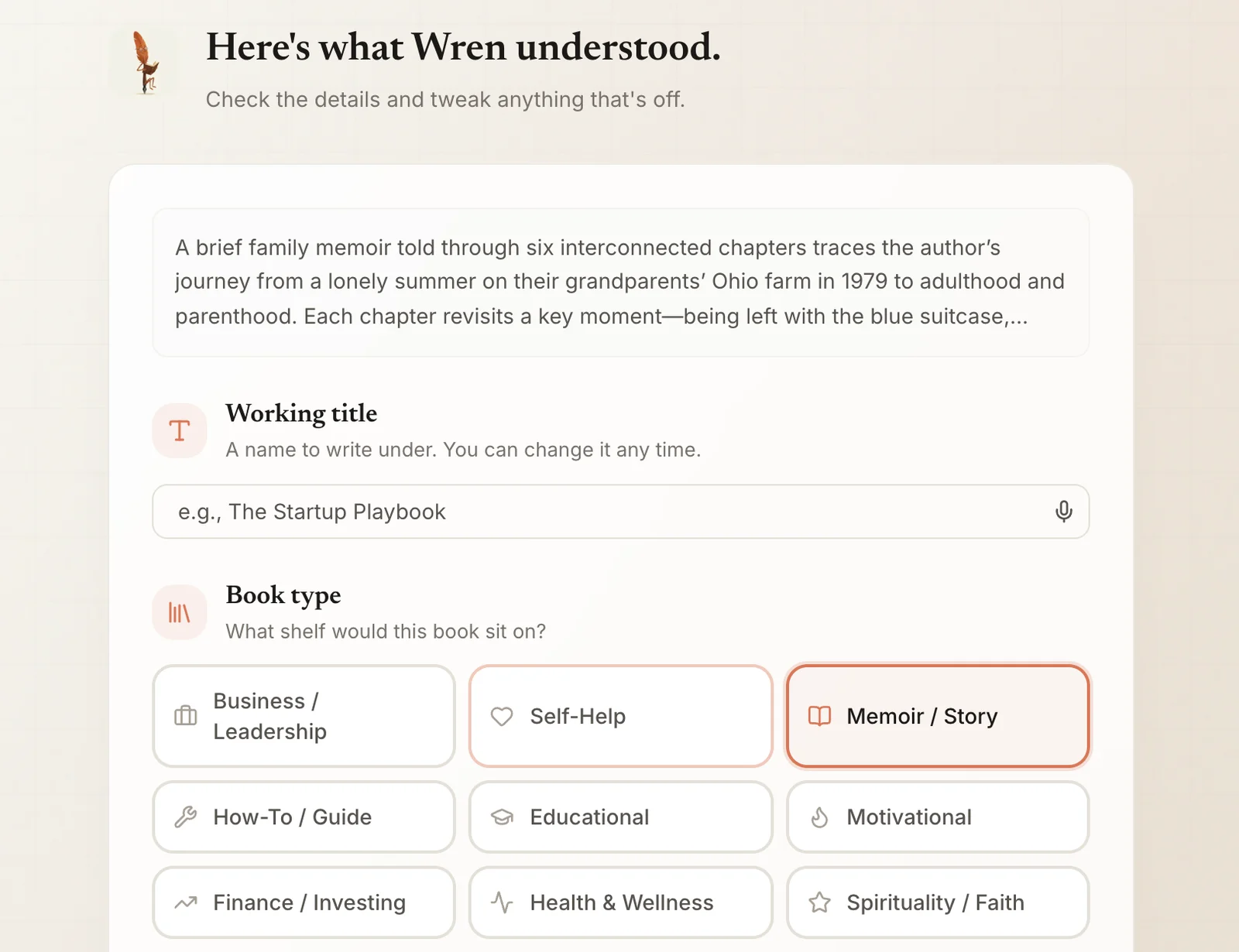
After reading them, the platform summed up the book in a few lines. It picked Memoir / Story as the book type by itself and suggested a storytelling tone. You can change any of these before you go on.
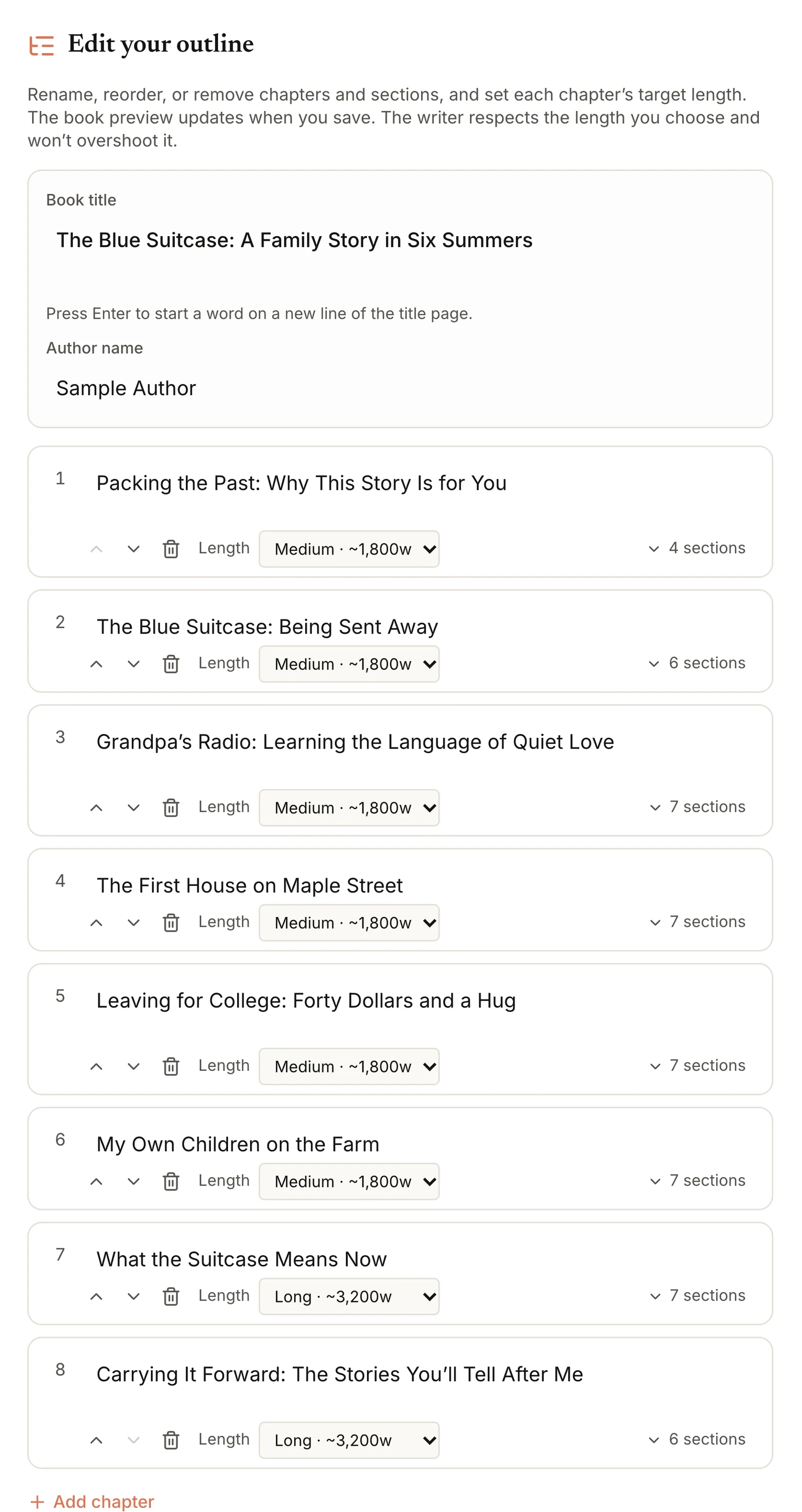
Then it proposed a chapter outline.
Here is what the test showed:
- What worked. The six scenes came back as chapters 2 to 7, in the order we gave them. They kept the titles we wrote, and three got a short subtitle.
- What to check. The platform added an opening and a closing chapter that our notes did not cover. Those two need stories of your own, or you delete them.
- What you control. Nothing is fixed at this point. You can rename, move or remove any chapter, change its length or ask for a new outline.
Then we let it write the book in its fast mode. It took about two minutes. Our 503 words of notes became eight chapters and about 19,300 words in all.
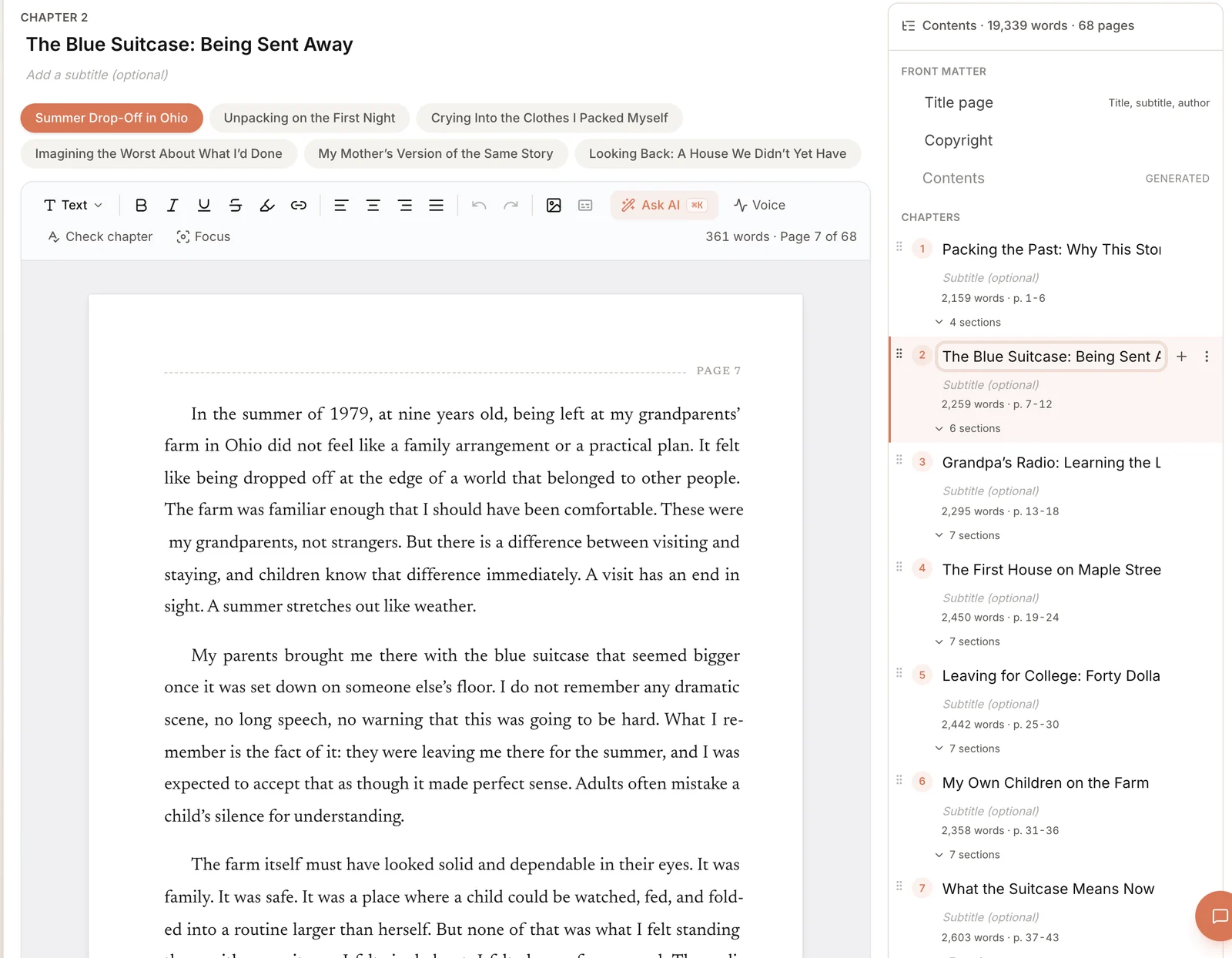
We read the first page of the Blue Suitcase chapter against our notes. The year, the farm, the age, the suitcase and the feeling of being sent away were all there. The platform also added reflection and small details we never wrote, such as a car about to pull away. And it made the narrator a girl, which our notes never said. So read every line of a draft like this. Keep what is true, and change anything that did not happen that way.
Which way fits your book
- A memoir or family history. The memoir writer works the same way. AI can help you organize and write your story, but it does not know anything you have not told it. So give it real stories, and read and check every line.
- A faith book from your sermons. Sermons to book turns a sermon series into chapters grouped by theme. It does not check Bible verses, so that part stays with you.
- A finished manuscript. You do not need the templates or the AI writing at all. Upload your manuscript, keep every word, and format it for KDP. You download the print PDF and the KDP files, and you upload the book to Amazon yourself.
Mistakes that make a template work against you
Our article on how many pages a chapter should be shows what published nonfiction does. The word count to pages calculator turns your total into pages.
Final thoughts
Start with the chapter you know best. Choose the template that fits your book and fill in a few lines. You do not need to write the whole chapter yet.
Once you have notes, stories or other writing, Built&Written can organize them into a book outline and draft the chapters from them. You stay in control of the structure, and you edit the text as you go.
You already have a starting point. The next step is turning it into a book.
Frequently asked questions
Only in part. Novel templates are built around plot and characters. A nonfiction chapter needs other lines: the reader's problem, the steps, the facts and where each fact comes from. A memoir can borrow the idea of scenes, but it still needs a line for checking names and dates.
There is no set number. The five books we checked range from 7 chapters in Daring Greatly to 42 in Steve Jobs. In those five, the method books use fewer chapters and the life stories use many short ones. Plan what each chapter must do first, and let the number follow.
No, but a simple one helps you start. FamilySearch's guide to writing a personal history suggests making a timeline of your life first. Use that timeline as your list of scenes. Then fill in template 3 for each scene, in any order you like.
Sometimes, but there is no safe number of words. The US Copyright Office says no set amount is automatically allowed without permission. Each case is judged on its own, including how much you quote and whether it hurts the market for the original. Letters are often unpublished, which can count against fair use. The facts in them are free to use. For long quotes, ask the copyright owner or a lawyer.
Sources & References
- Book writing templates, Reedsy, updated November 19, 2026, checked November 22, 2026
- Paperback and Hardcover Manuscript Templates, KDP Help, checked November 22, 2026
- Book Design Templates, interior layouts for Word, Pages, Affinity and InDesign, checked November 22, 2026
- Getting Things Done by David Allen (Penguin Books, 2015), table of contents, Open Library
- Daring Greatly by Brené Brown (Gotham Books, 2012), table of contents, Open Library
- Educated by Tara Westover (2018), table of contents, Open Library
- Steve Jobs by Walter Isaacson (Simon & Schuster, 2011), table of contents, Open Library
- The Purpose Driven Life by Rick Warren (Zondervan, 2002), table of contents, Open Library
- Evaluating Health Information, MedlinePlus
- Writing Your Family and Personal History, FamilySearch Wiki
- How Can I Avoid Lawsuits When Writing Memoir? Lisa Cooper Ellison, Jane Friedman
- What Does Copyright Protect? U.S. Copyright Office
- U.S. Copyright Office Fair Use Index
- Permissions Requests, Crossway, checked November 22, 2026
About the author