

What Is a Preface, and Does Your Nonfiction Book Need One?
You wrote the last chapter. Now you are putting together the pages that come before chapter one. There is a title page, a copyright page and a contents page. Then a blank page with one word at the top: Preface.
Many first-time authors stop here. Do I need this page? What goes on it? Is it the same as an introduction?
This guide answers those questions in plain words. By the end, you will know whether your book needs a preface, what to put in it and how to write your own. You will also see a real preface from an old cookbook and a short modern example.
What is a preface in a book?
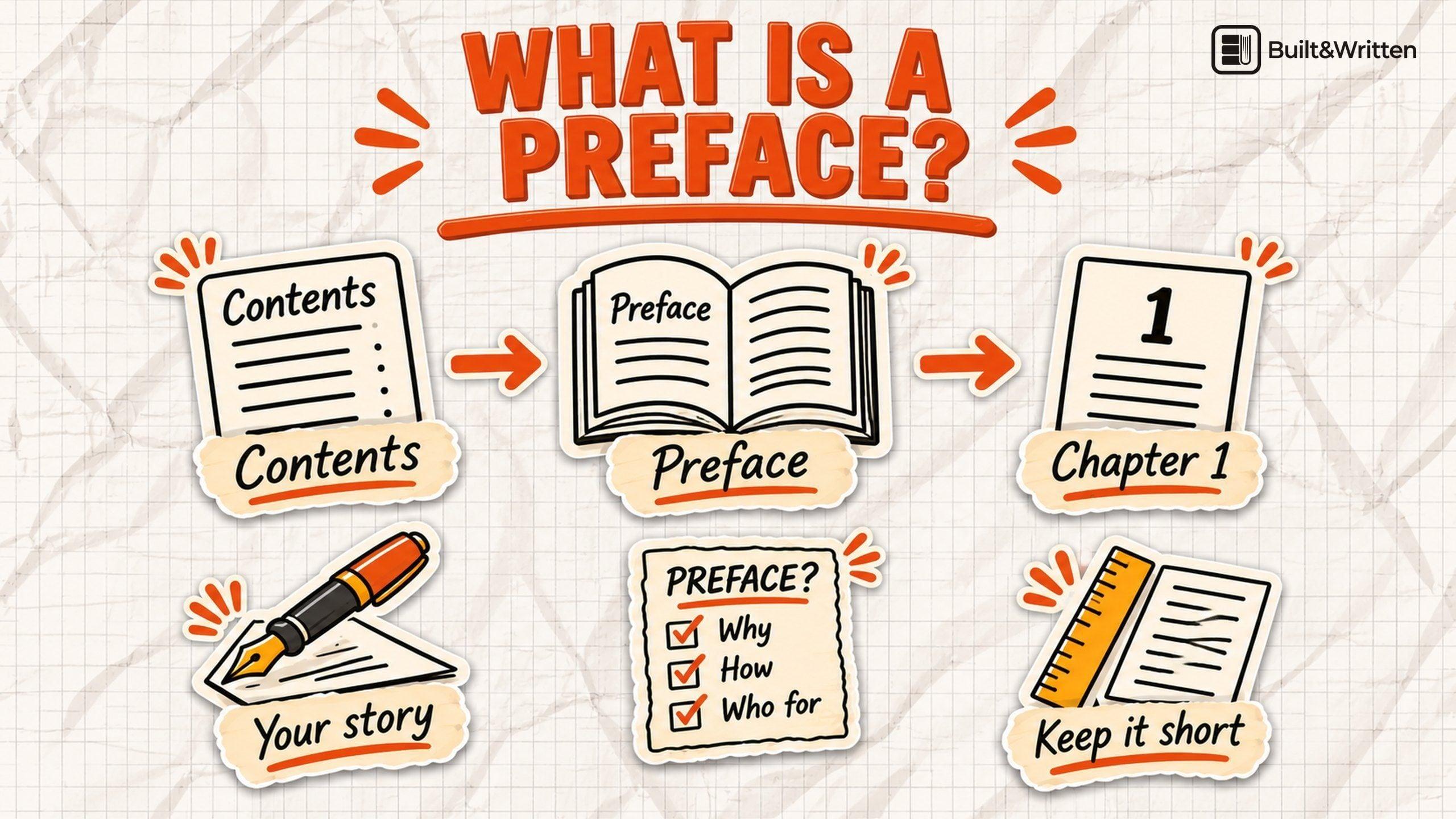
A preface is a short note from the author at the front of a book. It tells the reader why the book exists and how it came to be. Dictionary.com defines it as a statement by the book's author or editor that sets out the book's purpose and scope.
The word comes from the Latin praefatio, which means "a saying beforehand", according to the same dictionary entry. That is a good way to remember it. It is what you say before the book begins.
The publisher Greenleaf Book Group puts it simply: a preface tells readers how and why the book came into being. Literary agent Steve Laube adds that it can cover why the book matters to the reader and what they should take away.
| A preface answers | A preface leaves for later |
|---|---|
| Why did you write this book? | The main argument of the book |
| How was it made? | The steps, lessons or stories themselves |
| Who is it for? | A chapter-by-chapter tour |
Think of the preface as the story behind the book. The introduction is where you start explaining the subject itself.
Take a book about running a small business. The preface might say why you decided to write it and where your experience comes from. The introduction would say what problem the book solves, what the reader will learn and where the main topic begins.
A preface is easy to confuse with two other opening pages. Someone else writes the foreword, and the introduction opens the book's main content. Our guide to the foreword, the preface and the introduction compares all three side by side. This article stays with the preface.
What goes in a preface
A preface is personal and short. Most good ones use some of the lines below. Few use all of them, so pick the ones that fit your book.
That last line matters. If your thank-you list runs to a page, give it a separate page. Our acknowledgments examples show how to write one.
Where the preface goes in your book
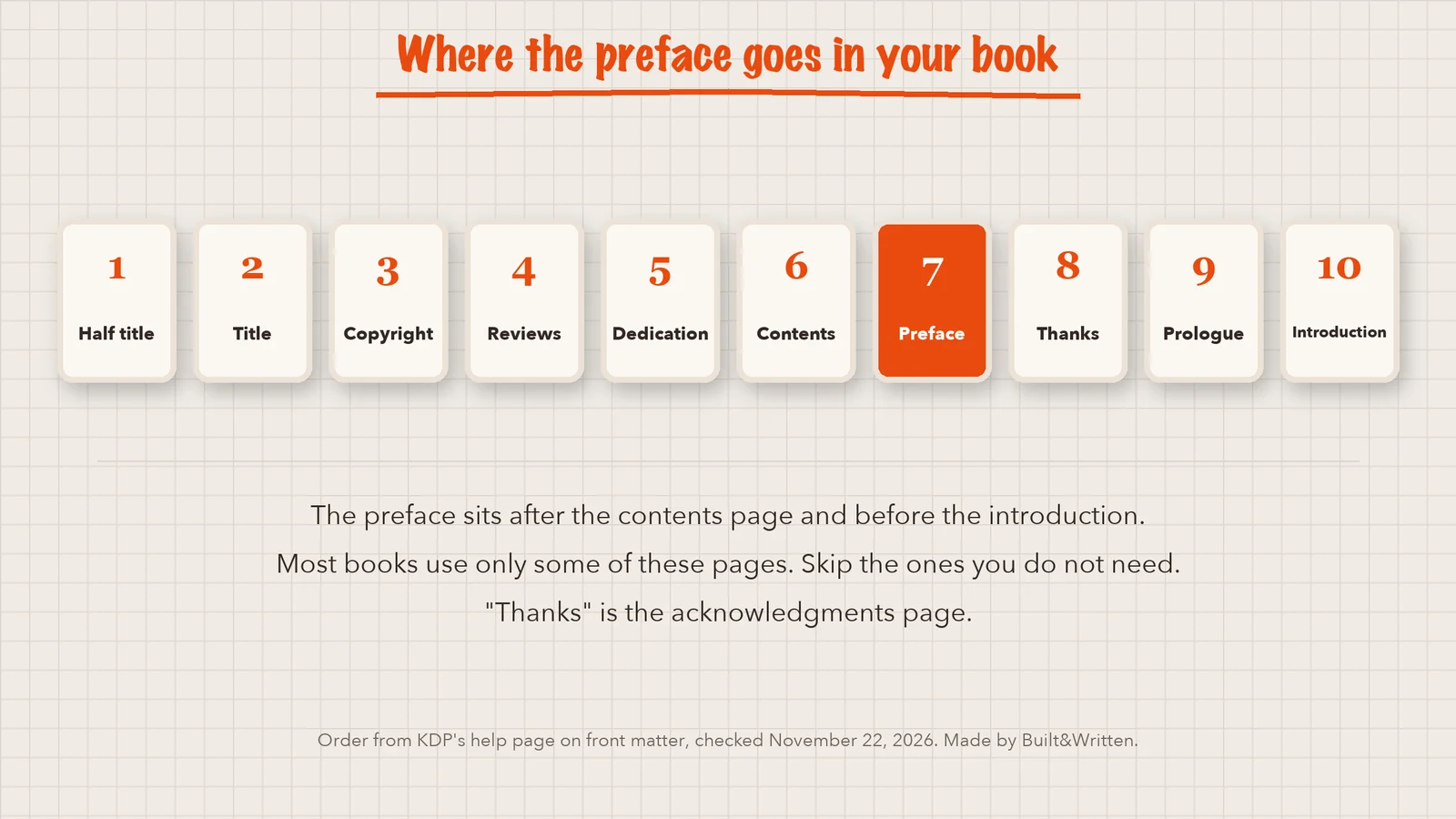
The preface belongs to the front matter. Front matter means the pages before chapter one. KDP's help page on front matter lists the usual order:
- Half title
- Title
- Copyright
- Reviews and praise
- Dedication
- Table of contents
- Preface
- Acknowledgments
- Prologue
- Introduction
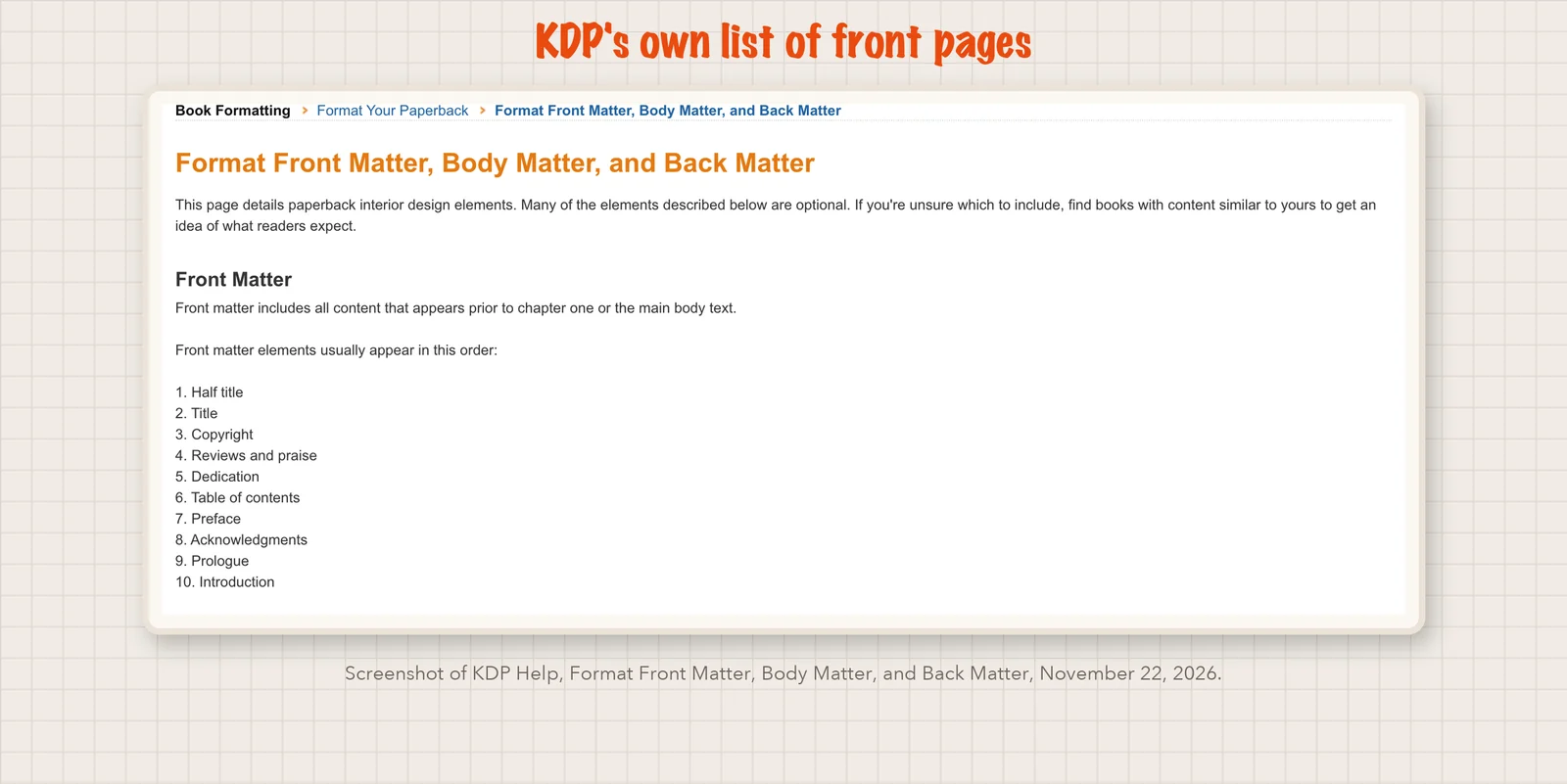
Treat this list as the usual order. KDP's page itself says many of these elements are optional, and most books skip several. If you add a dedication, it still comes before the contents, and the preface still comes after them. Our guide to the parts of a book walks through every page from the front cover to the back.
Some books give the preface another name. Steve Laube notes that a publisher may call it an "Author's Note". The page does the same job either way.
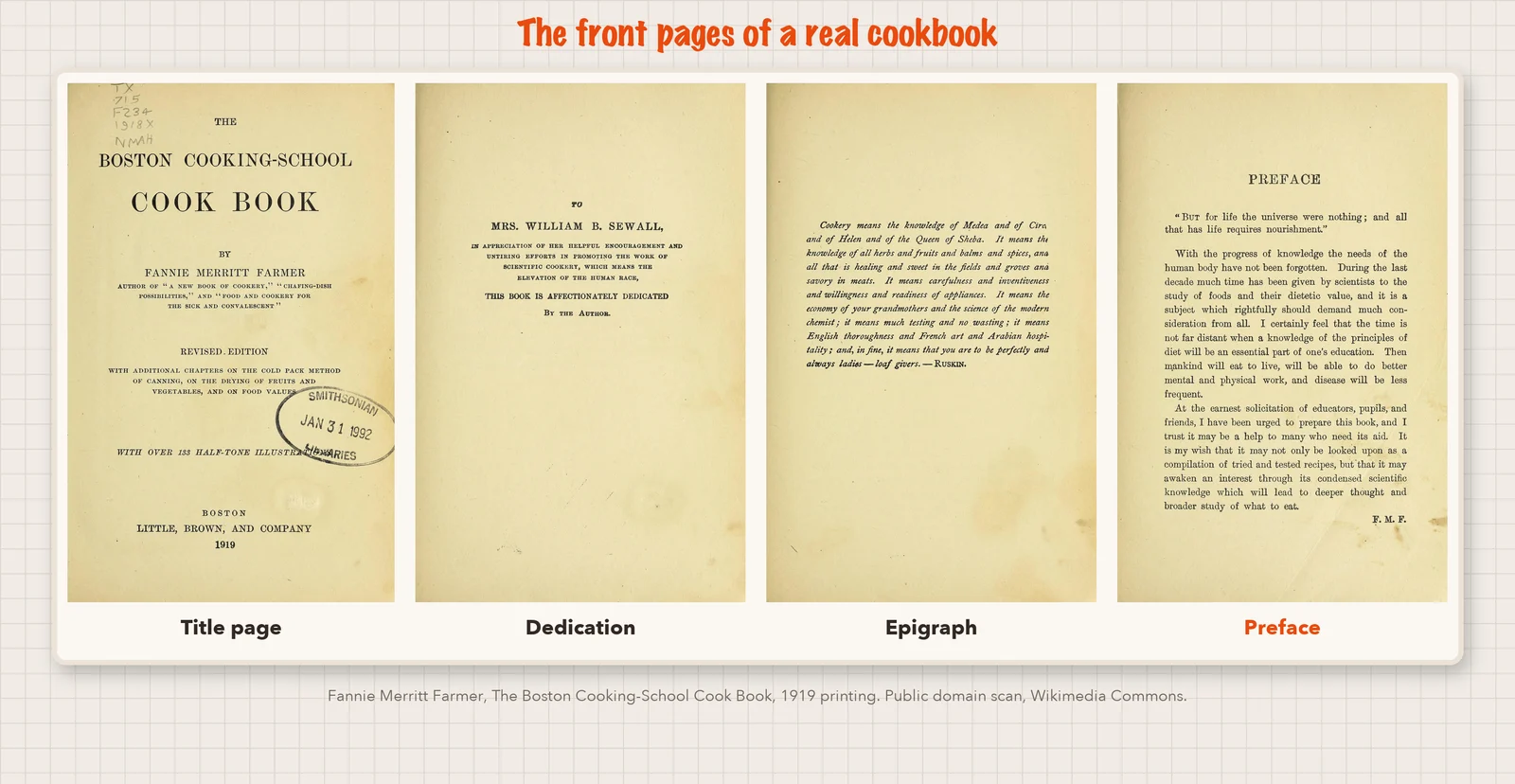
Real books rarely follow this list page for page. Many skip pages, and some add pages that are not on it. Here is one real example. Fannie Merritt Farmer's The Boston Cooking-School Cook Book first came out in 1896. A 1919 printing, now in the public domain, has a title page, a copyright page and a dedication. Then comes a short quotation called an epigraph, a page KDP's list does not include. The preface comes right after it.
Does your nonfiction book need a preface?
No. A preface is optional. Steve Laube says it plainly: there are no rules here. Plenty of good nonfiction books go straight from the contents page to the introduction or to chapter one.
Greenleaf notes that most nonfiction books include at least one opening page of this kind. That can be a foreword, a preface or an introduction. So the real question is whether your book needs this particular page.
Write a preface when the story behind the book helps the reader trust it. Skip it when the book can start without that story. Here is how that plays out for common kinds of nonfiction, meaning true books such as memoirs, cookbooks, how-to guides and faith books.
| Book | A preface helps when | You can skip it when |
|---|---|---|
| Memoir or family history | You want to say why you wrote it, who it is for, or that you changed names | The first chapter already tells why |
| Family or church cookbook | You want to say where the recipes came from and who shared them | The book is a short collection for one event |
| Faith book or devotional | You want to share what led you to write it, or which Bible translation you quote | The book opens with a short welcome instead |
| How-to or business book | The book grew from years of work that explain your method | Readers want the steps, and the introduction covers why |
| New edition of any book | You need to say what changed | Nothing important changed |
A simple test helps. Read your draft preface, then read your introduction. If they say the same thing, keep the introduction and cut the preface.
How your preface affects Amazon's free preview
Here is a reason to keep it short that most guides skip. Amazon lets shoppers read part of your book for free before they buy. This free part is called the preview or sample.
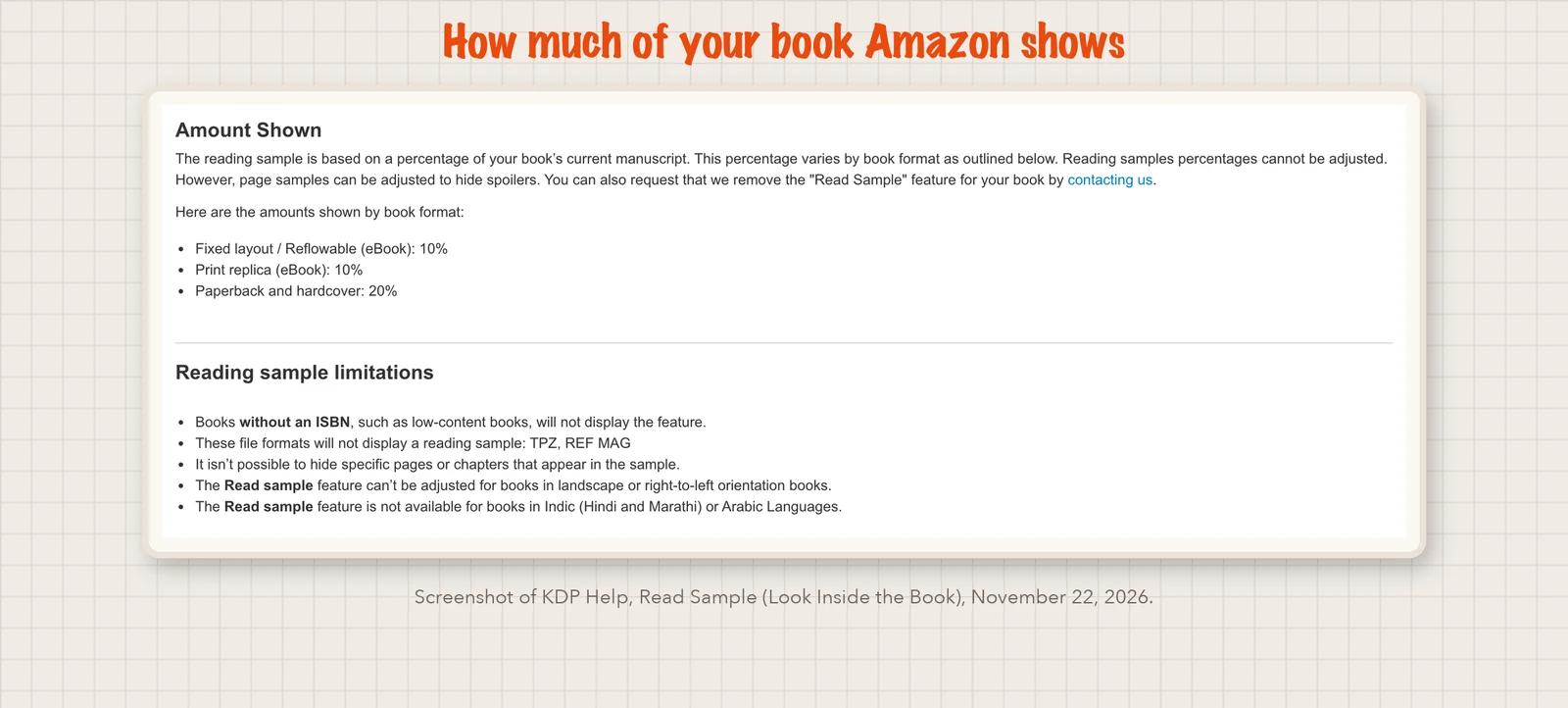
According to KDP's Read Sample help page, the sample is 10% of an ebook and 20% of a printed book, either a paperback (soft cover) or a hardcover. You cannot change those numbers. You also cannot hide specific pages or chapters from the sample.
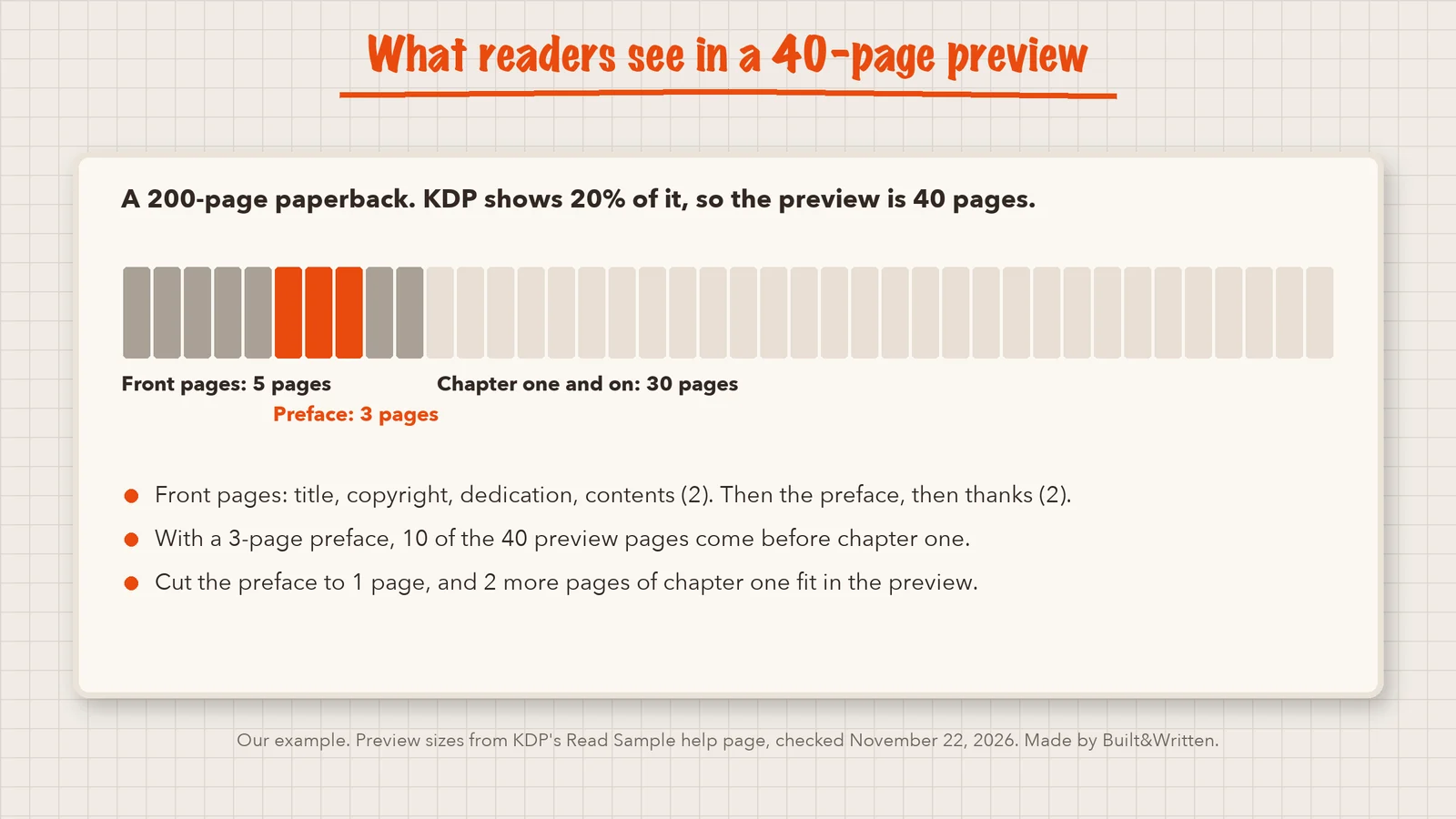
The sample is a share of your whole manuscript (the full text of your book), and the front pages are part of it. Here is an example with round numbers for a 200-page paperback. Your own book will be different, so treat it as a way to do the math:
- Preview: 20% of 200 pages is 40 pages.
- Front pages: title 1, copyright 1, dedication 1, contents 2, preface 3, thanks 2. That adds up to 10 pages.
- Result: in a preview that opens at the start of the book, 10 of the 40 pages come before chapter one. That is a quarter of the preview.
Cut the preface to one page and two more pages of chapter one fit in the preview. For an ebook the sample is 10%, so the same front pages take up an even bigger share of it. Chapter one is the part that shows a shopper what your book is really like.
This is no reason to drop a preface your book needs. If it helps the reader, keep it. Just make it no longer than it has to be, and cut any part that repeats the introduction.
How long should a preface be?
Aim for about one page. Many prefaces need no more. Reedsy's guide to the preface says two to three pages at most, and Steve Laube calls a preface "usually quite short". Treat those as a guide. No rule sets the length.
If yours runs longer, look for parts that belong somewhere else. Thanks can go on the acknowledgments page. The book's main ideas can go in the introduction.
Not sure how many pages your draft fills? Our free word count to pages calculator turns a word count into a page count.
How to write a preface in five steps
Write it in the same voice as the rest of the book. A preface that sounds stiff or formal sets the wrong tone for the chapters that follow.
A short preface example
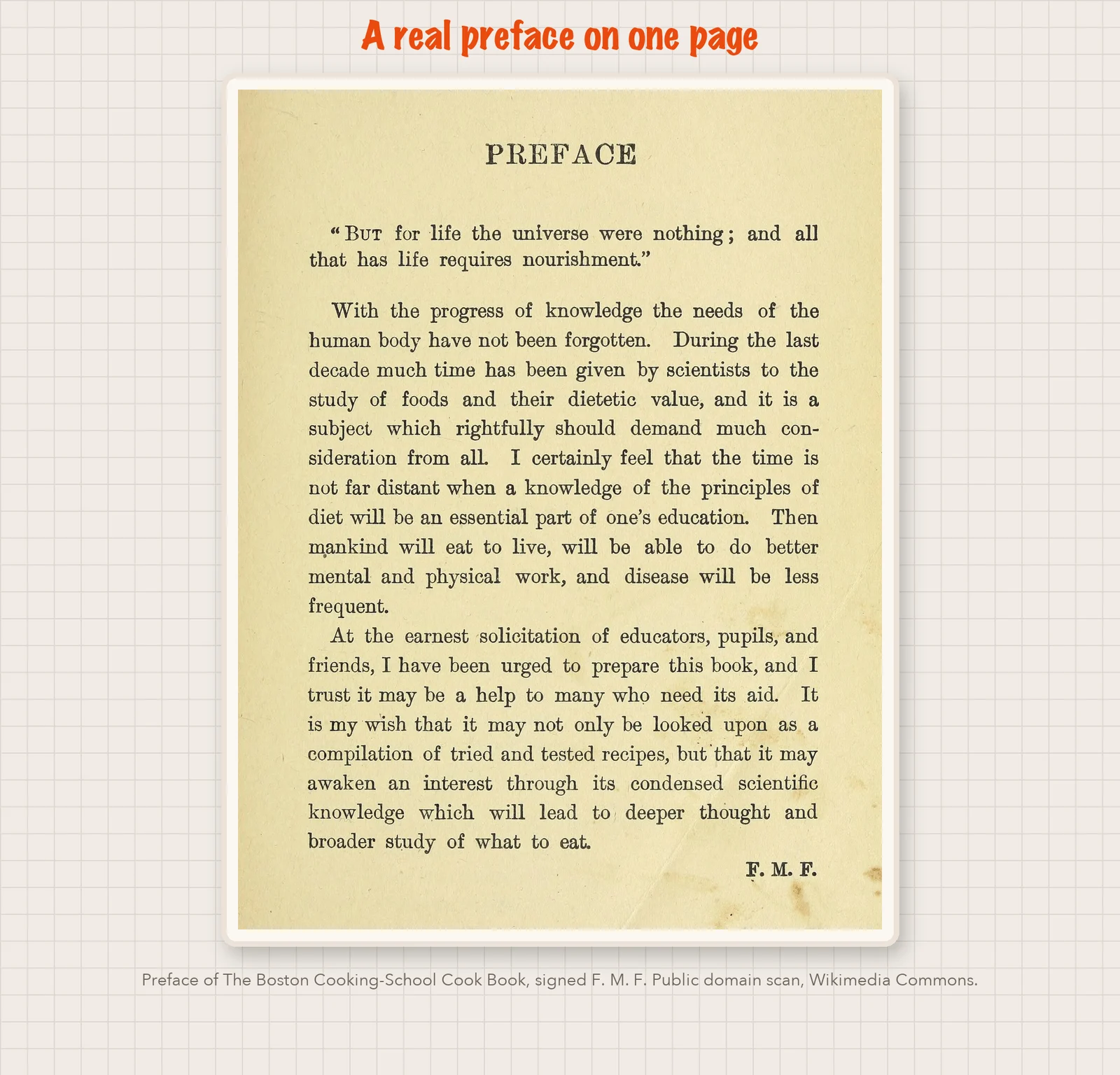
Start with a real one. Fannie Farmer's preface fits on one page. In the first paragraph, she says why knowing about food matters. In the second, she names who asked for the book: "educators, pupils, and friends". She signs it with her initials, F. M. F.
Below is a modern example for a family history book. We wrote it to show the shape. It is not a real person's preface. Swap in your own story.
For a family history book, written to show the shape.
Why. When my grandmother died, I found a shoebox of letters under her bed. Most were from her brother, written during the years he worked in another state. Nobody in the family had read them.
How. Over three years I read every letter. I spoke with my mother and two cousins, and I checked dates against census records. Where memories did not match, I say so in the text.
Choices. I changed the names of two neighbors who are still living.
Who for. I wrote this book for my children and their cousins, so they know where our family comes from.
Thanks. Thank you to my mother, who answered every question twice.
[Your name], [your city], [year]
It works because each part does one job. The reader learns why the book exists, how it was made and who it is for. Then the preface gets out of the way.
The labels (Why, How and the rest) are only there to show the parts. In your own book, write the preface as normal paragraphs, with no labels.
If you are writing a life story, our guide on how to write a memoir covers the chapters that come after it.
Your preface when you build the book with Built&Written
The preface is the one page that has to come from you. Only you know why you wrote the book and how it came together. A tool can format that page. It cannot know your reasons.
Built&Written is a platform for writing and publishing nonfiction books. It helps in two situations. You have a finished manuscript and need it laid out as a book. Or you have notes and other material but no book yet. Either way, you end with files ready for KDP.
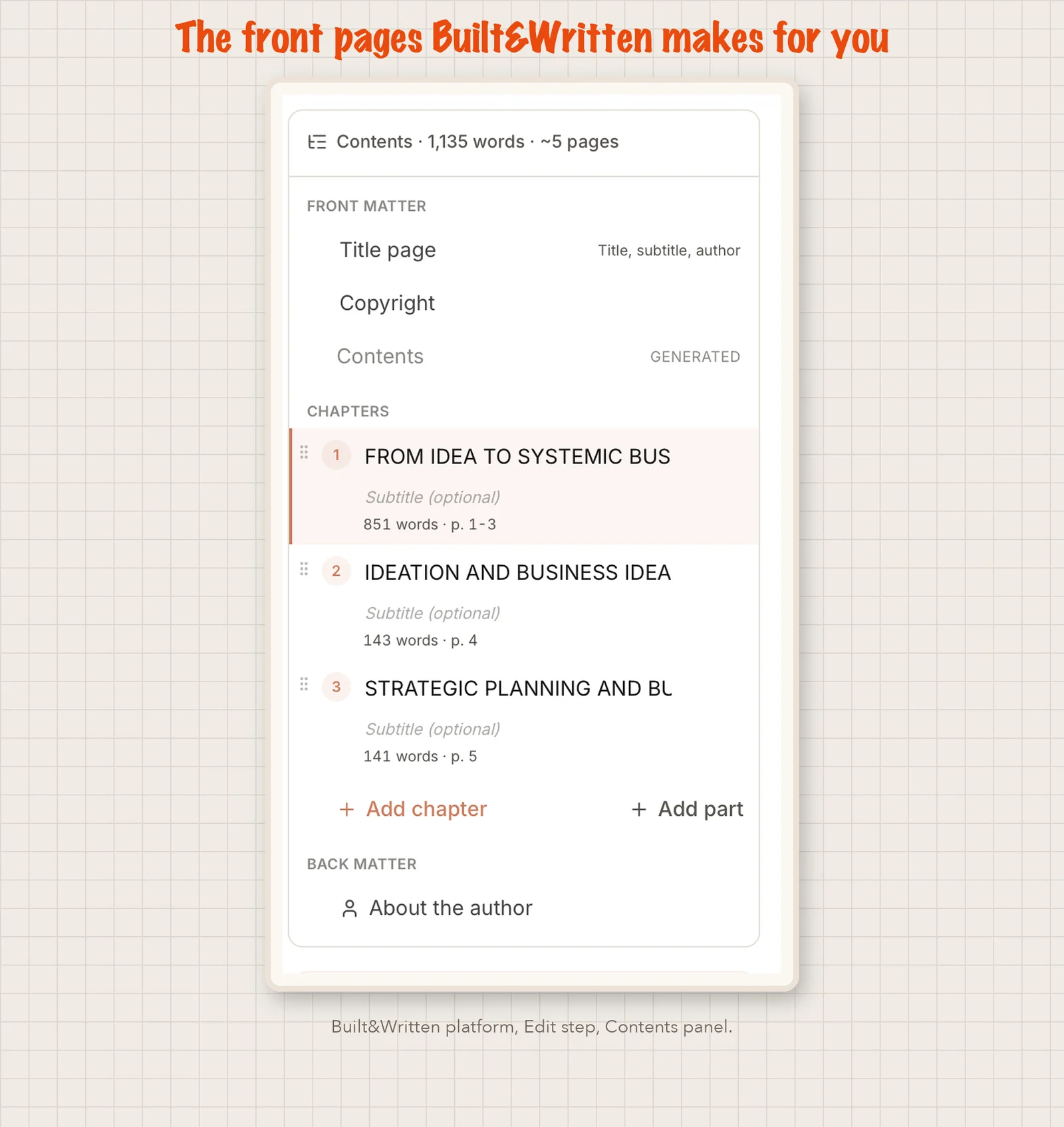
If your manuscript is finished, the writing is done, but the book still has to be laid out. Doing that by hand means building the front pages, a contents page, the margins and every chapter start yourself. Instead, you upload the file. Word, EPUB, Markdown and plain text files all work. Built&Written keeps every word, preface included, and formats the finished manuscript for KDP.
Look through the result before you upload it.
If you have material but no book yet, you do not need to write 200 pages first. You can start with what you already have. Here is the path from a messy folder to a book:
- You bring your material: notes, blog posts, talk transcripts or old documents. You paste them in or upload the files.
- Built&Written learns your voice from a few pages of your writing, about 300 to 1,000 words.
- It reads your material and proposes a chapter outline. You change it until the plan fits your book.
- It writes the chapters in your own voice, one at a time, using what you gave it.
- You read each chapter, fix the facts and add what only you know. Then the same layout steps make your KDP files.
Your material stays the source. The platform does not know a story you never told it. So if a chapter includes a personal story, a name or a date, check that it reads the way it really happened. Then write the preface yourself, in a few honest paragraphs.
Built&Written does not upload the book to Amazon for you. It makes the files, and you upload them to KDP. You can compare the plans to see which one fits your book.
Should you write one?
A preface is optional. Write one if the story behind your book adds something the introduction does not. If it only repeats the introduction, leave it out. If you keep it, make it short and specific.
Frequently asked questions
In American English, preface is pronounced PREF-iss, with the stress on the first syllable. Dictionary.com gives it as "pref-is". It does not rhyme with "face", even though the word is spelled with "face" at the end. The British pronunciation in Collins is the same. The word comes from the Latin praefatio, meaning "a saying beforehand".
You can, but you do not have to. Reedsy's guide notes that a preface often ends with the author's name and a date. Some authors use only initials. A signature and date work well in a memoir or a new edition, where the time of writing matters to the reader.
Often, but not in every book. Literary agent Steve Laube notes that a publisher may call the preface an "Author's Note". The label varies from book to book, so look at what the page does. If it says why and how you wrote the book, it is doing a preface's job. Pick one name and use it once.
No. Dictionary.com defines a preface as a statement by the book's author or editor. If someone else writes an opening piece about you and your book, that piece is called a foreword. Greenleaf Book Group describes the preface as the author's own account of how and why the book came into being, so it should be in your words.
Sources & References
- Preface, definition, origin and pronunciation, Dictionary.com, checked 2026-11-22
- Format Front Matter, Body Matter, and Back Matter, KDP Help, checked 2026-11-22
- Read Sample (Look Inside the Book), KDP Help, checked 2026-11-22
- Distinguishing Between a Foreword, a Preface, and an Introduction, Greenleaf Book Group, checked 2026-11-22
- What Is a Preface, Reedsy, checked 2026-11-22
- Preface, Foreword, Introduction, Oh My!, Steve Laube Agency, July 26, 2021, checked 2026-11-22
- The Boston Cooking-School Cook Book, 1919 printing, public domain scan, Wikimedia Commons, checked 2026-11-22
- The Boston Cooking-School Cook Book, Wikisource (first published 1896), checked 2026-11-22
About the author