

How Experts Use Generative AI to Promote a Book Without Ads
What is Built&Written? Built&Written is a platform for writing nonfiction books and preparing them for publishing. Its AI writes a book from material you already have, like notes, posts and talk transcripts, in your voice. It also formats a book you've already written without changing a word. You get a print PDF and files for KDP (Kindle Direct Publishing, Amazon's self-publishing service) and publish the book yourself.
Key takeaways
- How do you promote a book on social media for free? Post one idea, story or number from the book per post, on the platform where your clients already read, and link the book every time.
- Can AI write those posts? Yes. ChatGPT and Claude each turned a 1,404-word chapter into 3 LinkedIn posts and 2 X posts from one prompt.
- What goes wrong? In our test, ChatGPT added 2 lines the chapter never said and wrote both X posts over the 280-character limit. Claude's 5 posts kept to the chapter.
- What does Built&Written add? Launch-day posts drafted from your own book on Entrepreneur and up, plus an Amazon description and keywords on Author and up. You edit and post them yourself.
How to promote a book on social media without paying for ads
Post ideas from the book on your own profiles. For a nonfiction book, organic posts are the cheapest promotion you have. An organic post is one you publish on your own profile without paying the platform to show it.
A business book sells on its ideas. A post that teaches one of those ideas proves the book is worth reading. A post that only says "my book is out" gives a reader no reason to click. The best book promotion ideas are already in your chapters: each post reads like a short lesson, with the book named at the end.
For paid routes, see our guides to book promotion services and Amazon ads.
How Built&Written turns your book into launch posts
Built&Written writes your launch-day posts from the finished book. When the book reaches the Ready stage, you get one tab per platform, each with a post drafted from your book's details.
| Promotion task | By hand | With Built&Written |
|---|---|---|
| Launch posts | Written and resized for each platform | Drafted for X, LinkedIn, Reddit, Threads and Facebook (Entrepreneur and up) |
| Voice | Hard to keep the same across 5 platforms | The book is written in your voice with Voice DNA, from 5 to 50 pages of your writing |
| Amazon page to link to | Description and keywords written by hand | Description, 7 keywords and 2 categories drafted on Author and up |
| Files to publish | A formatter, or weeks in layout software | Print PDF and KDP files you upload yourself |
Text in the image: X. LinkedIn. Reddit. Threads. Facebook. LinkedIn post. copy & paste.
The kit covers launch day. For the weeks after, your posts come from the chapters, one idea at a time, as in the steps below. Nothing posts on its own: you read each draft, fix what you'd never say, and paste it in yourself.
Which social media platforms work for a nonfiction book?
LinkedIn first, then your email list. Those are the two places where people who buy expertise already read long posts.
| Platform | Post length limit | What to post from the book | Best for |
|---|---|---|---|
| 3,000 characters | One idea, story or framework per post | Consultants, founders, B2B experts | |
| Email list | None set by a platform | A chapter excerpt with a link to the book | Anyone with subscribers |
| X | 280 characters, 25,000 with Premium | One sharp line or number from the book | Tech, policy and media topics |
| Threads | 500 characters | A short take with a question | Experts already active on Instagram |
| Depends on the community | Answers to real questions, book mentioned only where a community allows it | Niche professional topics |
On Reddit, go slowly. Its own etiquette page suggests that only 1 in 10 of your posts be your own content. Each community's moderators decide what counts as spam.
If you post on LinkedIn already, start a newsletter there too. Any member can create one, and LinkedIn emails each edition to your subscribers.
How to promote a book on LinkedIn
Write in first person and put the idea in the first two lines. End with the book title and one link. Our post on why LinkedIn's best writers are becoming authors covers the opposite direction, from posts to a book.
How to promote a book on social media with AI, step by step
This is how to promote your book with AI, one chapter at a time. Most of the time goes into checking.
- Pick one chapter. Choose one with a clear idea, a story or a number.
- List 5 ideas by hand. These keep the AI on your message.
- Give the AI the chapter and the ideas. Paste both into ChatGPT or Claude with a prompt like the one below.
- Check each post against the chapter. Use the 5 checks further down.
- Schedule and link. Add the book title and your Amazon link to every post, then spread them over 2 weeks.
Prompt you can copy: Here is a chapter from my nonfiction book and the 5 ideas I want readers to remember. Write one LinkedIn post per idea, under 1,300 characters, in first person. Use only facts from the chapter. No hashtags, no long dashes. End each post with the line "From my book [title]".
AI book marketing goes beyond posts. If you want a full launch calendar, an AI marketing plan generator can draft one, and our review shows where those plans fall short.
What did ChatGPT and Claude write from one chapter?
Claude kept to the chapter. ChatGPT added to it and ran over X's limit.
| What we counted | ChatGPT | Claude |
|---|---|---|
| Lines not in the chapter | 2 | 0 |
| X posts over 280 characters | 2 of 2 | 0 of 2 |
| Long dashes | 1 | 0 |
| Hashtags | 15 | 0 |
| "It isn't X. It's Y." lines | 5 | 0 |
| How the book was named | "my book", no link | a slot for the title and link |
| Posts ready after small edits | 3 of 5 | 5 of 5 |
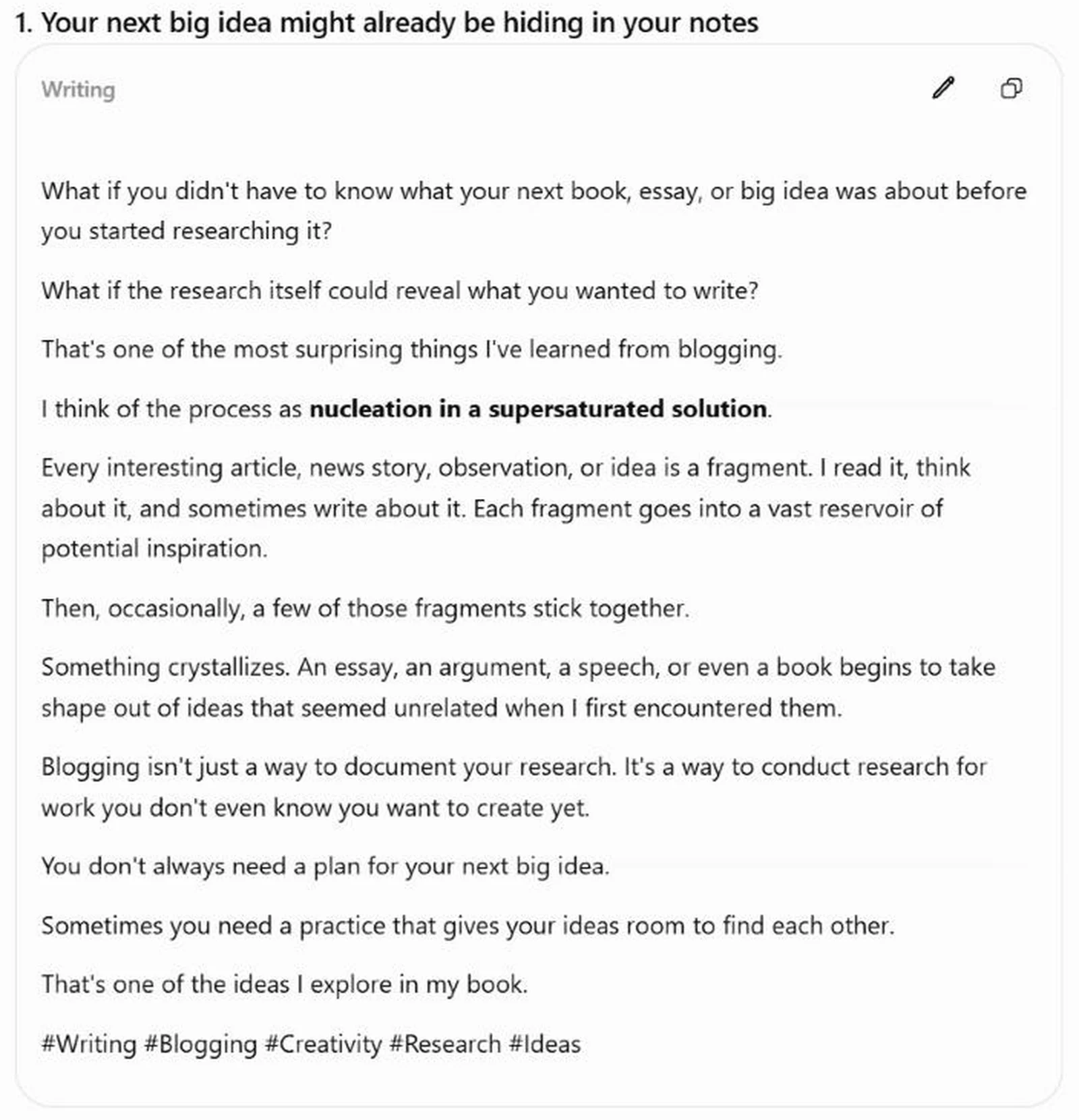
ChatGPT's first X post opened with a number: "Your next essay might be hiding in 10,000 things you've already written." The chapter says "tens of thousands of posts" and never 10,000. ChatGPT then told us every idea came from the chapter. Its X posts ran to 389 and 344 characters, so neither would publish on a free X account.
Text in the image: 1. Your next big idea might already be hiding in your notes. What if you didn't have to know what your next book, essay, or big idea was about before you started researching it? What if the research itself could reveal what you wanted to write? That's one of the most surprising things I've learned from blogging. I think of the process as nucleation in a supersaturated solution. Every interesting article, news story, observation, or idea is a fragment. I read it, think about it, and sometimes write about it. Each fragment goes into a vast reservoir of potential inspiration. Then, occasionally, a few of those fragments stick together. Something crystallizes. An essay, an argument, a speech, or even a book begins to take shape out of ideas that seemed unrelated when I first encountered them. Blogging isn't just a way to document your research. It's a way to conduct research for work you don't even know you want to create yet. You don't always need a plan for your next big idea. Sometimes you need a practice that gives your ideas room to find each other. That's one of the ideas I explore in my book. #Writing #Blogging #Creativity #Research #Ideas
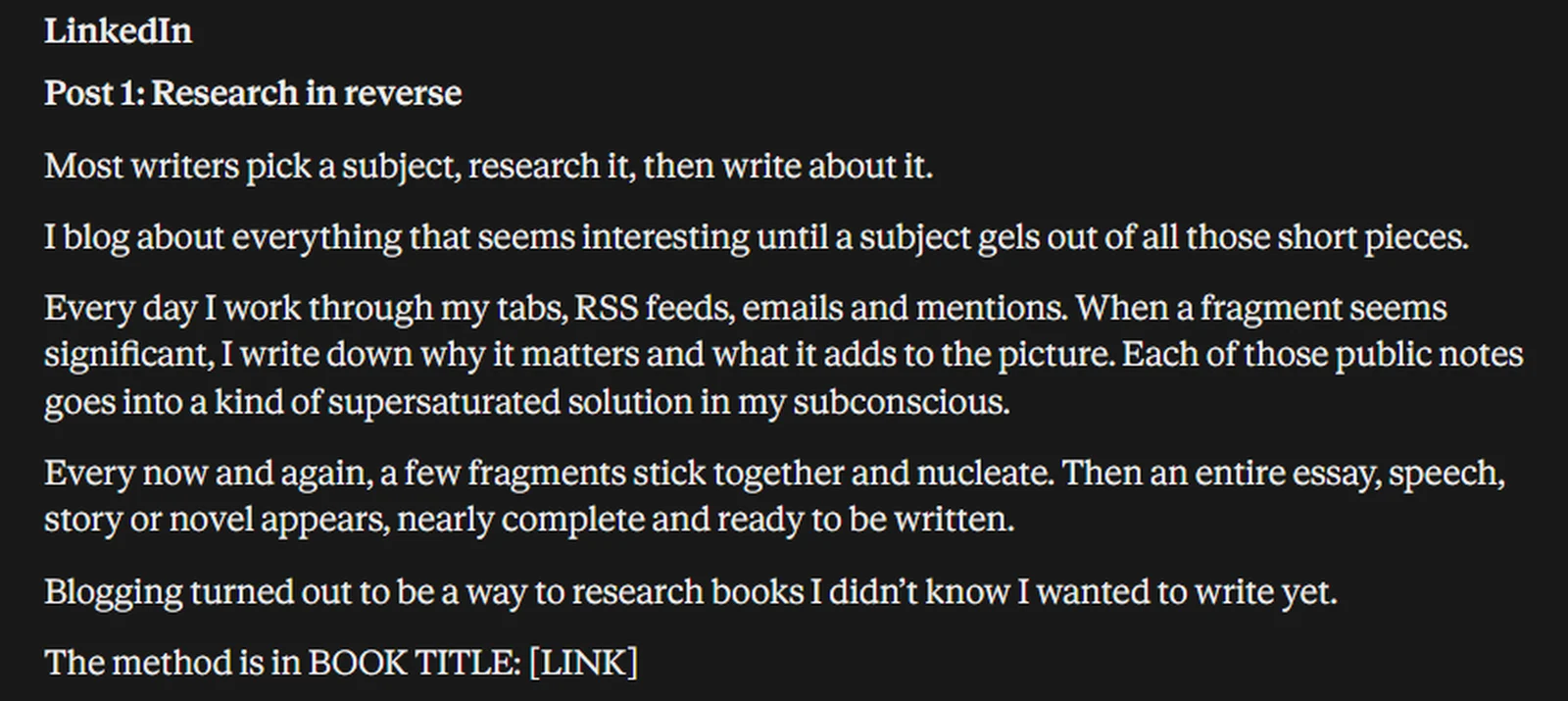
Claude built its posts from the chapter's own facts: 1945, Vannevar Bush, a 1,500-word essay written in about an hour, 19 years of posts. It left "BOOK TITLE: [LINK]" for us to fill in.
Text in the image: Post 1: Research in reverse. Most writers pick a subject, research it, then write about it. I blog about everything that seems interesting until a subject gels out of all those short pieces. Every day I work through my tabs, RSS feeds, emails and mentions. When a fragment seems significant, I write down why it matters and what it adds to the picture. Each of those public notes goes into a kind of supersaturated solution in my subconscious. Every now and again, a few fragments stick together and nucleate. Then an entire essay, speech, story or novel appears, nearly complete and ready to be written. Blogging turned out to be a way to research books I didn't know I wanted to write yet. The method is in BOOK TITLE: [LINK]
Neither tool knew the book's title, because our prompt didn't give it. Put the title and link in your prompt and you skip that fix.
How we tested
- Date: November 9, 2026.
- Chapter: the last two thirds of Cory Doctorow's essay "The Memex Method" (Pluralistic, 2021), 1,404 words, about how a daily blog turns into books. It names real dates and numbers, so added facts are easy to spot.
- Prompt, same for both: "Write 3 LinkedIn posts and 2 X posts to promote the book. Use only facts and ideas from the chapter."
- Tools: ChatGPT, free and logged out; Claude on a paid plan with Opus 5.5. The plans differ, so read this as one run of each tool.
- What we counted: lines not in the chapter, long dashes and AI-sounding phrases, length against each platform's limit, and how many posts could go out without edits.
- Not scored: Built&Written. Its posts come from a whole book in your account, so one pasted chapter wouldn't be a fair comparison.
What to check before you post an AI-written book post
Check every draft, from any tool, for these 5 things before it goes out.
- Every fact is in the book. Compare each number, name and claim with the chapter. Delete anything you can't point to.
- It fits the platform. Count characters on X and Threads. A post over the limit won't go out there.
- It sounds like you. Remove long dashes, "It isn't X. It's Y." lines and wall-of-hashtag endings.
- It names the book. Add the title and one link. "My book" with no link sells nothing.
- It makes one point. If a post makes three points, split it into three posts.
How often should you post about your book?
Two or three posts a week is a pace most experts can keep. A chapter with 5 ideas gives you about two weeks of posts.
Mix book posts with your usual work posts, and post your strongest idea again a month later in new words.
Final thoughts
Built&Written turns your material into a finished book and drafts the posts for launch day, so promotion starts from your own chapters. After that, promote a book on social media the way you'd teach it: one idea per post, the book named at the end, every fact checked against the chapter. See how it works.
- Launch posts from your own book. On Entrepreneur and up, Built&Written drafts a launch post for X, LinkedIn, Reddit, Threads and Facebook from your finished book.
- A voice that matches the book. Voice DNA learns your style from 5 to 50 pages of your writing, so the excerpts you post sound like the rest of your work.
- A page worth linking to. The listing co-pilot drafts your Amazon description, 7 keywords and 2 categories on Author and up.
- You stay in control. Nothing is posted for you, so every line that goes out is one you read first. Plans are on the pricing page.
Frequently asked questions
Post one idea from the book per post, on LinkedIn and your email list first, and link the book every time. Two or three posts a week is enough. AI can draft the posts, but check each one against the chapter before it goes out.
Use the channels you already own: your LinkedIn profile, your email list, podcast interviews and guest articles. Turn each chapter into a few posts. None of this needs an ad budget.
Yes. Paste one chapter, list the ideas you want, and ask for facts from that chapter only. Then check every number and name against the book before you post.
LinkedIn, for most business and expert books. It allows long posts, and your colleagues and clients already read there. X and Threads work for short lines and numbers from the book, within their tighter limits.
Sources & References
About the author

Michael Pavlovskyi
More in Book Marketing
Ready to write your book?
Turn your expertise into a professional book with Built&Written.