

How Generative AI Changed the Way Business Books Get Promoted
What is Built&Written? Built&Written is a platform for writing nonfiction books and preparing them for publishing. Its AI writes a book from material you already have, like notes, posts and talk transcripts, in your voice. It also formats a book you've already written without changing a word. You get a print PDF and files for KDP (Kindle Direct Publishing, Amazon's self-publishing service) and publish the book yourself. AI-written books download on Entrepreneur and up.
Key takeaways
- How do you market a self published book today? Make it easy to find and easy to quote: a complete Amazon page, a page on your own site and mentions in the lists, podcasts and articles that AI assistants read.
- Do AI assistants recommend self-published books? Yes. At least 2 of the 19 titles in our test were self-published, and ChatGPT's top pick for experts was one of them.
- What changed in search? Google users clicked a regular link on 8% of visits that showed an AI summary, and on 15% of visits without one, Pew Research found.
- What can Built&Written do for the launch? Draft the Amazon description, 7 keywords and 2 categories on Author and up, plus launch posts for X, LinkedIn, Reddit, Threads and Facebook on Entrepreneur and up. You post and upload them yourself.
What changed when buyers started asking AI for books?
Generative AI is software that writes new text in answer to a question. A buyer looking for a business book now meets it in three places:
- Chat assistants. ChatGPT answers "what's the best book on…" with a short list and its sources.
- Google. AI Overviews put a summary above the results. AI Mode, which Google began rolling out to everyone in the US on May 20, 2025, answers on a full page and takes follow-up questions.
- Amazon. Amazon says its shopping assistant Rufus helped over 300 million customers in 2025. On May 13, 2026 it was renamed Alexa for Shopping.
Competition grew too. Bowker counted 3,529,980 self-published print and ebook titles in the US in 2025, up 38.7% from 2024, Publishers Weekly reported. Our post on the AI book flood covers what that does to reader trust.
For an author, this means a buyer often meets your book first in an AI answer, built from pages that describe it.
How Built&Written gets your book ready to promote
Built&Written makes what has to exist before anyone can recommend your book: the book itself and the words that describe it on Amazon.
| Promotion task | By hand | With Built&Written |
|---|---|---|
| A finished book from your posts, talks and notes | Months of writing, or a ghostwriter | The AI writes it from your material, in your voice |
| Amazon book description | Written from scratch, then formatted for KDP | Drafted as formatted text you paste into KDP |
| Amazon keywords and categories | Guessed, or researched in a paid tool | 7 keywords with competition estimates and 2 category suggestions |
| Launch posts | Written one by one | A launch post for X, LinkedIn, Reddit, Threads and Facebook (Entrepreneur and up) |
| Files for Amazon | A formatter, or weeks in layout software | Print PDF and KDP files with the cover sized to your page count |
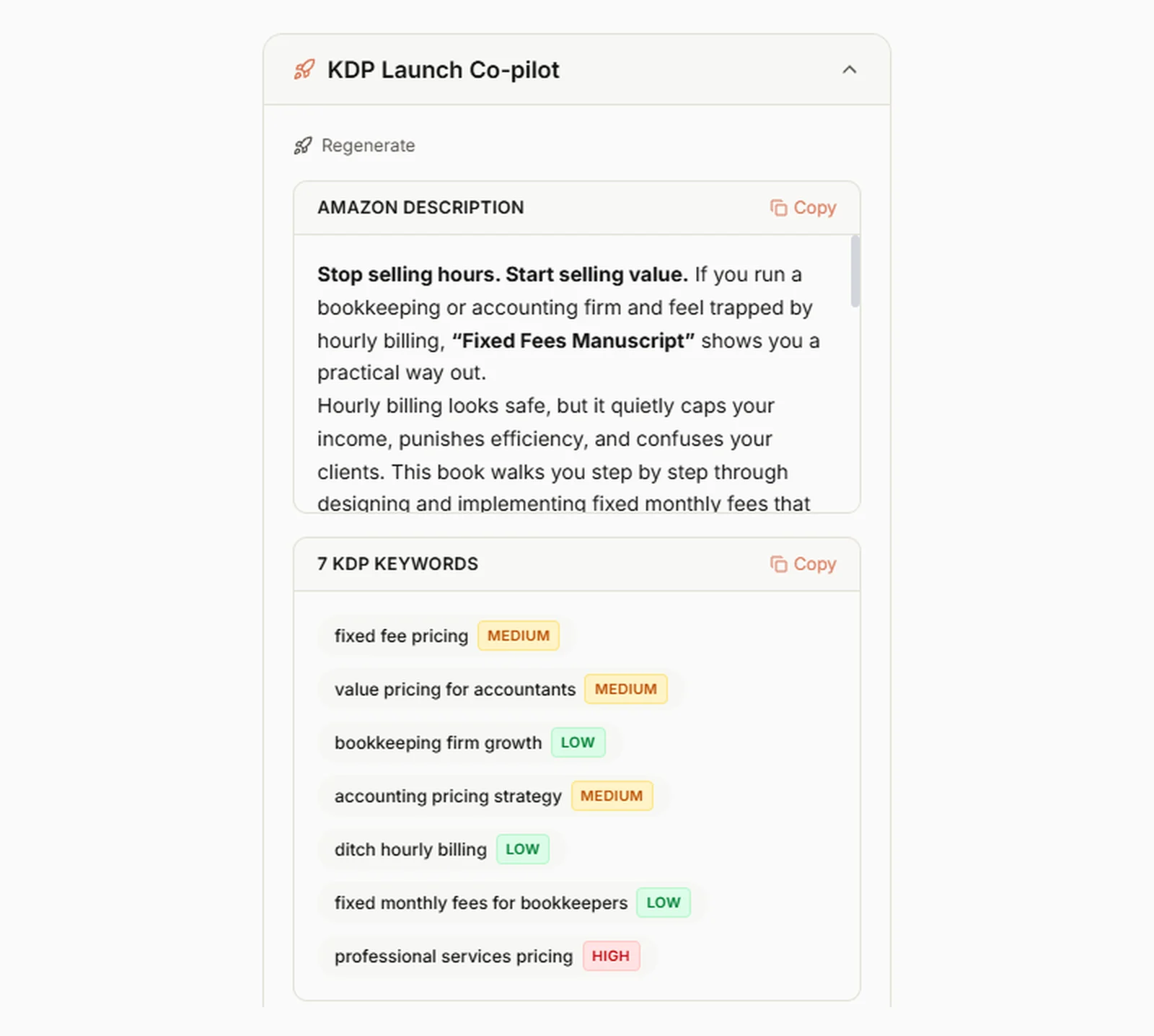
Text in the image: KDP Launch Co-pilot. Amazon description: Stop selling hours. Start selling value. If you run a bookkeeping or accounting firm and feel trapped by hourly billing, "Fixed Fees Manuscript" shows you a practical way out. Hourly billing looks safe, but it quietly caps your income, punishes efficiency, and confuses your clients. This book walks you step by step through designing and implementing fixed monthly fees that… 7 KDP keywords: fixed fee pricing (medium), value pricing for accountants (medium), bookkeeping firm growth (low), accounting pricing strategy (medium), ditch hourly billing (low), fixed monthly fees for bookkeepers (low), professional services pricing (high).
The listing co-pilot writes your Amazon listing on Author and up, in your book's language. You choose the title and subtitle yourself, because those are the words a buyer and an AI assistant match to the question.
The free book description scorer and KDP keywords generator help you check it first.
Which books do AI assistants recommend, and why?
AI book recommendations come from what the assistant can read about a book. We asked ChatGPT and Google AI Mode the same three questions a business buyer might ask.
| Question | Assistant | Books named | Who published them |
|---|---|---|---|
| Pricing for consultants | ChatGPT | Value-Based Fees (Alan Weiss), Implementing Value Pricing (Ronald J. Baker), Confessions of the Pricing Man (Hermann Simon) | 3 traditional publishers |
| Pricing for consultants, first try | Google AI Mode | Value-Based Fees, Pricing Consulting Services (E. Michael Shays), Pricing Analytics and Cost Based Pricing Essentials (Cyran Delver) | 1 traditional, 1 self-published, 1 small press we couldn't classify |
| Pricing for consultants, second try | Google AI Mode | Value-Based Fees, The Win Without Pitching Manifesto (Blair Enns), Pricing Analytics and Cost Based Pricing Essentials | 1 traditional, 1 self-published, 1 small press we couldn't classify |
| Hiring a first team | ChatGPT | Who (Geoff Smart, Randy Street), The Best Team Wins (Adam Robinson), High Output Management (Andrew Grove) | 2 traditional, 1 hybrid publisher (the author pays to publish) |
| Hiring a first team | Google AI Mode | Who, Recruit the Remarkable (J. Patrick Gorman), Hire Smart from the Start | 2 traditional, 1 most likely self-published |
| Writing nonfiction as an expert | ChatGPT | How to Write Non-Fiction (Joanna Penn), On Writing Well (William Zinsser), Good Prose (Tracy Kidder, Richard Todd), Storycraft (Jack Hart), The Craft of Research (Wayne C. Booth and others) | 1 self-published, 2 traditional, 2 university presses |
| Writing nonfiction as an expert | Google AI Mode | How to Write a Bestseller (Tilar J. Mazzeo), On Writing Well, Write Useful Books (Rob Fitzpatrick), Thinking Like Your Editor (Susan Rabiner, Alfred Fortunato) | 2 traditional, 1 university press, 1 most likely self-published |
The seven answers named 19 different books.
- Self-published books get in. Google AI Mode named Pricing Analytics and Cost Based Pricing Essentials in both pricing answers, and it's listed as independently published, the label KDP gives self-published books. ChatGPT's top pick for experts, How to Write Non-Fiction, comes out under Curl Up Press, Joanna Penn's own imprint. So a small publisher name won't keep you out.
- The sources are pages that describe books. ChatGPT linked the publisher's page for Value-Based Fees, Alan Weiss's own site, a "best books on pricing" article and university library guides. Google AI Mode showed its own book listings as sources, plus "best books" lists for the hiring question. So the more pages describe your book clearly, the more likely it is to be named.
- Your description can become the answer. Google AI Mode's hiring answer echoed the description of Hire Ready, a book shown as a source card: "Most founders don't have a hiring process. They have a breaking point."
- Answers change and can be wrong. Asked the pricing question twice, Google AI Mode gave 3 books each time, with 2 titles in both. It also named Dave Brereton as the author of Hire Smart from the Start, a book we could only find under the name Dave Carvajal. So check the answers yourself once a month, as in step 6 below.
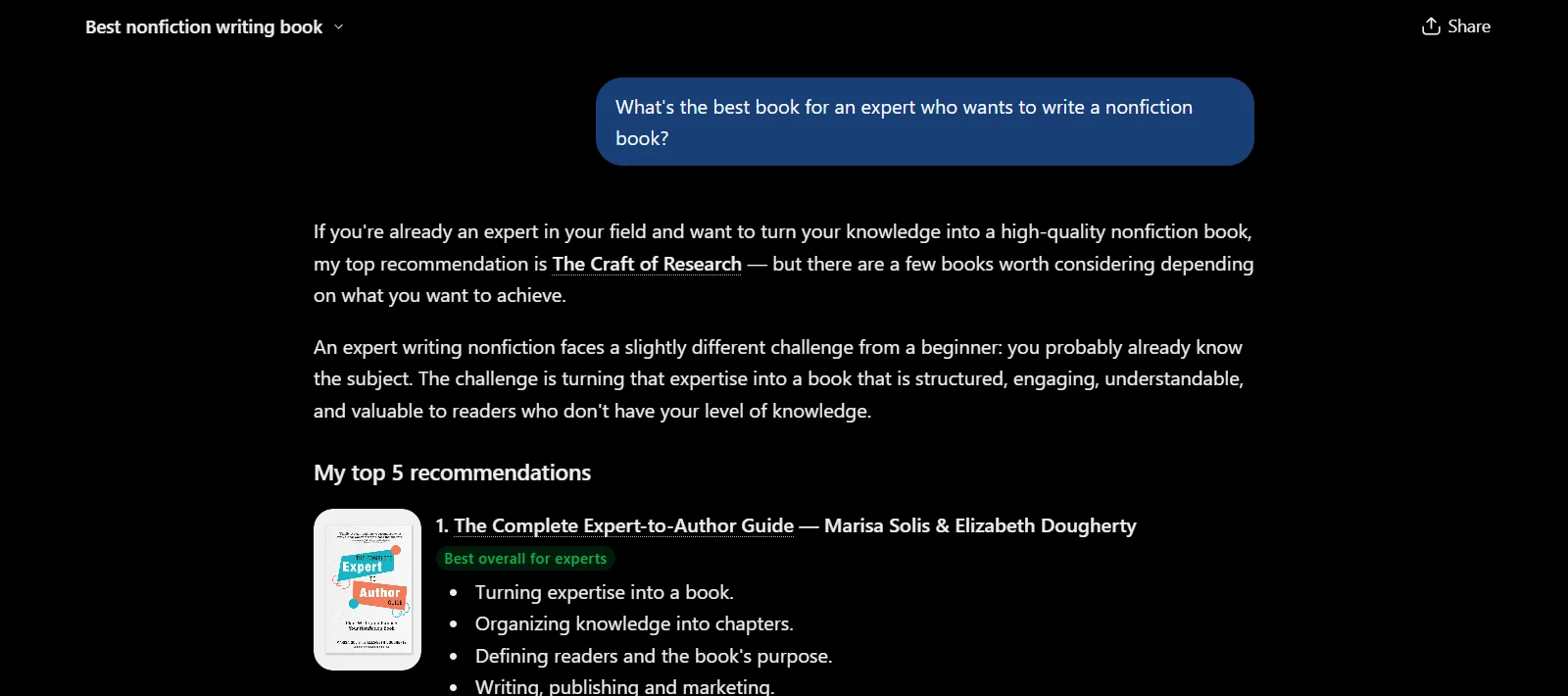
Text in the image: What's the best book for an expert who wants to write a nonfiction book? My top recommendation is The Craft of Research. My top 5 recommendations. 1. The Complete Expert-to-Author Guide, Marisa Solis and Elizabeth Dougherty. Best overall for experts.
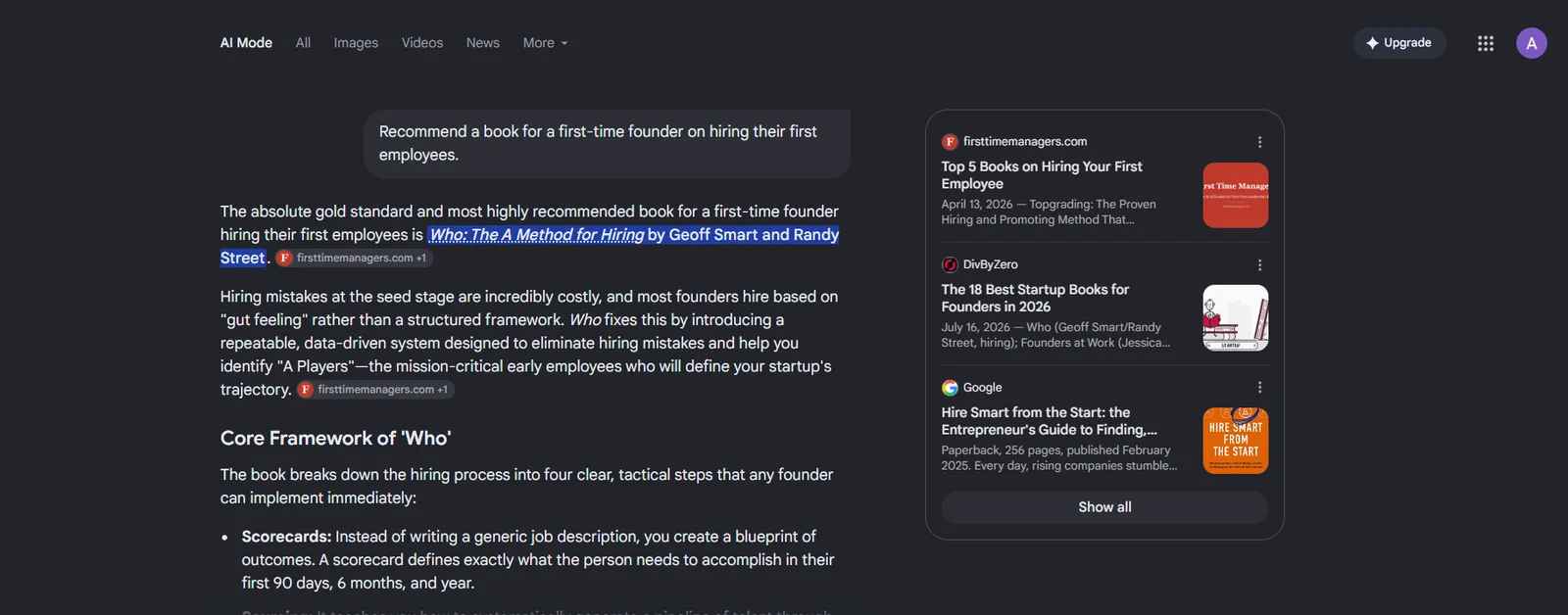
Text in the image: The most highly recommended book for a first-time founder hiring their first employees is Who: The A Method for Hiring by Geoff Smart and Randy Street. Sources: firsttimemanagers.com, Top 5 Books on Hiring Your First Employee. DivByZero, The 18 Best Startup Books for Founders in 2026. Google, Hire Smart from the Start.
How we tested
- Date: November 9, 2026, and November 10 for the Google AI Mode pricing question, in a browser not signed in to any service.
- Assistants: ChatGPT (the free version at chatgpt.com) and Google AI Mode (google.com).
- Questions, typed exactly: "What's the best book on pricing for consultants?", "Recommend a book for a first-time founder on hiring their first employees." and "What's the best book for an expert who wants to write a nonfiction book?"
- Method: a new chat for every question, with Google set to US English. We asked Google AI Mode the pricing question twice to see whether the answer changes.
- Publisher check: publisher, retailer, library and author pages. "Most likely self-published" means a company named after the author or sales only from the author's site.
- Size: seven answers over two days, so treat it as a snapshot.
How to market a self published book when buyers ask AI
How to market a book used to mean ads, a launch and hoping for search traffic. To market a self published book today, make every place that describes it say the same clear thing: who the book is for and what problem it solves. AI assistants build their answers from those places.
Google says there are no additional requirements to appear in AI Overviews or AI Mode. A page only has to be indexed and eligible to show in Google Search with a snippet, the same as regular search.
- Write the Amazon description as an answer. Open with the reader and the problem in one sentence, because that sentence is what gets quoted. Our guide to Amazon categories and keywords covers the fields below it.
- Set up your author page. An Amazon Author Central page links all your books and your bio.
- Give the book a page on your own site. Use plain text: who it's for, the chapter list, a sample and where to buy.
- Get onto the lists AI reads. Pitch writers of "best books on…" articles in your field, appear on podcasts that publish show notes and write guest articles that name the book. A podcast booking agency can do the pitching for you.
- Collect honest reviews. Ask early readers to review the book on Amazon and Goodreads, and never offer anything for a positive review. Our guide on getting book reviews on Amazon covers what Amazon allows.
- Ask the assistants yourself. Once a month, ask ChatGPT and Google AI Mode your buyers' questions, note which pages they cite and get your book onto those pages.
Which promotion channels still work?
Channels where buyers already trust you still work.
| Channel | Why it still works |
|---|---|
| Your email list | Subscribers already know you, and no AI sits between you |
| Talks and podcasts | A listener hears you for an hour, and show notes stay online for AI to read |
| LinkedIn posts from the book | Each post shows a piece of the book to the people who hire you |
| Amazon ads | They reach buyers already shopping on Amazon |
A 6-week book marketing plan for a nonfiction author
This book marketing plan starts on launch week. It's our advice and wasn't part of the test.
| Week | What you do |
|---|---|
| 1 | Publish the book, finish the Amazon description, keywords, categories and Author Central page |
| 2 | Add a book page to your site and email your list |
| 3 | Post one idea from the book on LinkedIn every other day and ask 10 early readers for honest reviews |
| 4 | Pitch 5 podcasts and 5 writers of "best books on…" articles |
| 5 | Write one guest article built on a framework from the book |
| 6 | Ask the assistants your buyers' questions and note what they cite |
Final thoughts
Built&Written gives you the two things every promotion plan starts with: a finished book in your voice and a drafted Amazon listing. Our test showed what comes next: AI assistants recommend the books the web already describes clearly, and self-published books make their lists. So marketing a self published book now means putting the same clear description on every page they read, from your Amazon page to podcast show notes. Start with the listing, then work through the six weeks. See how it works.
- A listing ready on launch day. On Author and up, your Amazon description, keywords and categories are drafted before the first post goes out.
- Launch posts from your own chapters. On Entrepreneur and up, you get a launch post for each of 5 platforms to edit and send.
- A book that sounds like you. Voice DNA learns your style from 5 to 50 pages of your writing, so the excerpts you post read like the rest of your work.
- Free checks before you publish. Score the description and test keywords with the free tools, no account needed.
Frequently asked questions
Start with the Amazon page, an Author Central page and a book page on your site. Then get the book named on podcasts and "best books" lists.
Yes. In our November 2026 test, ChatGPT's top pick for an expert writing a nonfiction book was Joanna Penn's How to Write Non-Fiction, published under her own imprint. The answers change from one chat to the next.
Yes, as a first draft. Built&Written drafts your Amazon listing and launch posts from the book. Read and edit every line before it goes out under your name.
Yes. Amazon's shopping assistant, first called Rufus and renamed Alexa for Shopping in May 2026, answers shoppers' questions in the Amazon search bar.
Sources & References
- Google users are less likely to click on links when an AI summary appears in the results, Pew Research Center
- AI Mode in Google Search: updates from Google I/O 2025, Google
- Alexa for Shopping, Amazon
- Amazon Rufus, Amazon
- Book output topped 4 million in 2025, Publishers Weekly
- AI features and your website, Google Search Central
- Pricing Analytics and Cost Based Pricing Essentials, AbeBooks listing
- Curl Up Press, The Creative Penn
About the author

Michael Pavlovskyi
More in Book Marketing
Ready to write your book?
Turn your expertise into a professional book with Built&Written.