
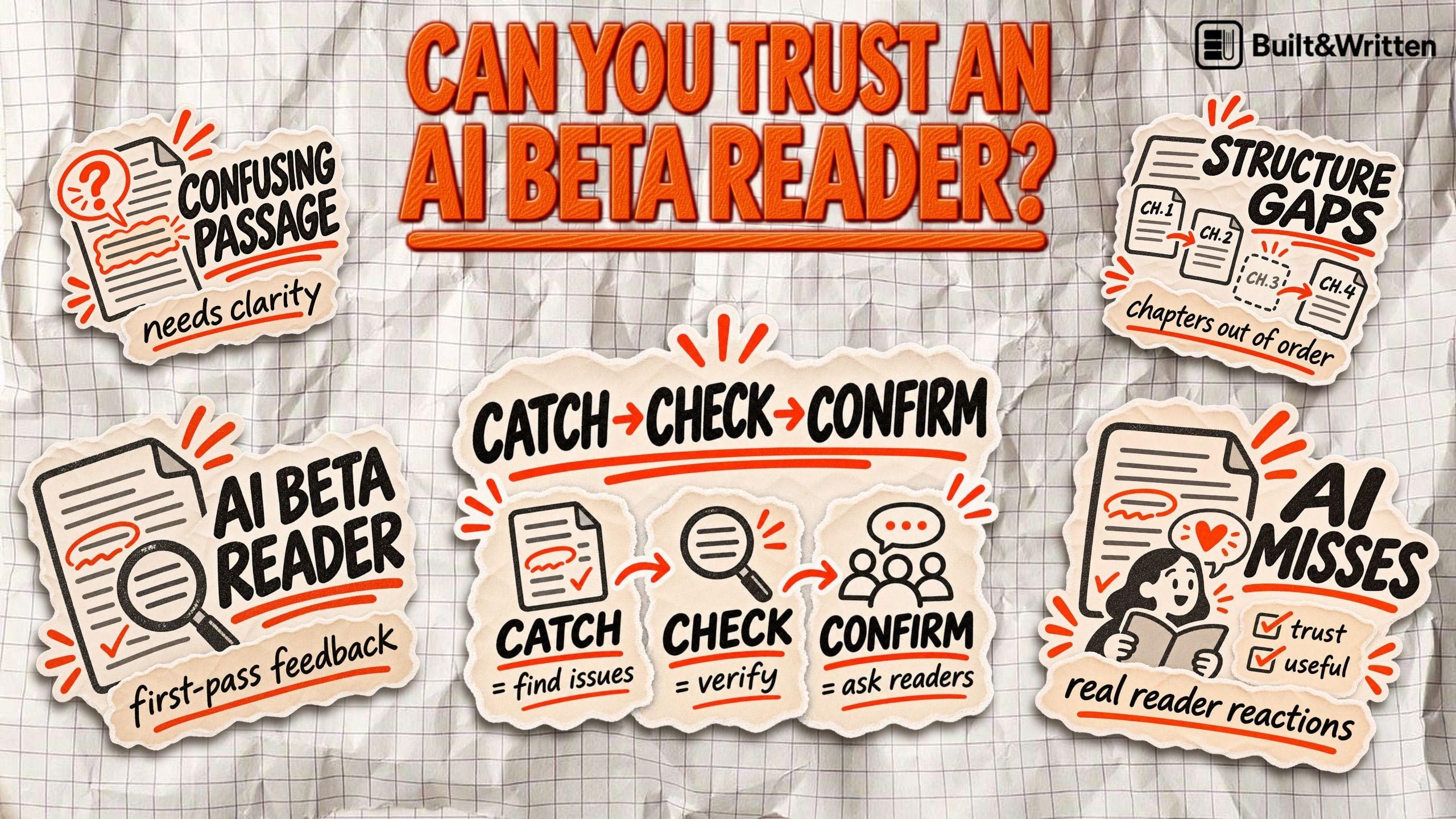

What an AI Beta Reader Catches in Your Manuscript and What It Misses
You've finished a 50,000-word business manuscript. You ask an AI beta reader to review it. Minutes later, you have a neatly organized report covering weak transitions, repetitive arguments, and chapters that need work.
It looks thorough. But does that make it trustworthy?
An AI beta reader can help you spot problems in a nonfiction manuscript before anyone else reads it. It can flag repeated arguments, unclear explanations, missing transitions, and inconsistent terminology. But even a detailed AI review cannot tell you whether your advice works in practice or whether your intended readers find the book convincing.
What is an AI beta reader?
An AI beta reader is an AI tool that reviews a manuscript from a reader's perspective. Instead of checking only grammar or spelling, it looks for problems that could make your book difficult to follow, repetitive, or less useful to its intended audience.
The distinction matters because beta reading is not the same as editing.
A traditional beta reader is a person who reads an unfinished manuscript and reports how the book works from a reader's perspective. An AI beta reader attempts a similar review using language-model analysis. Unlike grammar checkers, which focus on sentence-level problems, AI beta reading asks broader questions: Is the argument understandable? Does the chapter deliver what it promises? Are important ideas missing or repeated?
Developmental editing examines the book's structure, arguments, and overall direction. Proofreading catches surface errors such as typos and punctuation mistakes. Fact-checking verifies claims against reliable sources. AI beta reading focuses on how a reader might experience the manuscript, although its feedback can overlap with these tasks.
The process is straightforward. You provide a chapter or full manuscript, describe your target audience, and ask specific questions. The AI returns observations about clarity, organization, pacing, and potential weaknesses, often with suggested revisions.
But there's an important limitation. AI doesn't experience your book like an actual reader. It predicts where confusion or disengagement might occur based on patterns in the text. That makes its feedback useful for identifying potential problems, not confirming how real readers will respond.
What can an AI beta reader catch in a nonfiction manuscript?
An AI beta reader is particularly useful for spotting problems you might overlook after reading your own manuscript dozens of times. It can examine individual chapters or compare sections to identify patterns that affect clarity and readability.
Here are five areas where its feedback can help.
1. Repetition and redundancy
AI can flag ideas, examples, and explanations that appear repeatedly across chapters. Repetition sometimes helps reinforce a concept, but unnecessary duplication can make a business book feel longer than it needs to be.
2. Structural weaknesses
Does Chapter 4 introduce a framework that readers needed in Chapter 2? Does one section jump to a new topic without explanation? AI can identify questionable chapter sequences, missing transitions, and gaps in the argument.
3. Confusing passages
AI can highlight unexplained terminology, complicated sentences, and arguments that require additional context. This is especially useful when translating specialized knowledge into language your target audience can understand.
4. Inconsistencies
A manuscript might define a concept one way early on and describe it differently later. AI can compare terminology, definitions, and statements to flag potential contradictions, although you'll need to verify each finding.
For example, Chapter 2 might define customer retention as the percentage of existing customers who continue buying over a specified period. Chapter 6 might then use the same term to describe how often customers make repeat purchases. Those measures are related, but they are not identical. An AI beta reader could flag the change in definition and point you toward the relevant passages. You would still need to decide which measure your framework actually uses.
5. Weak examples
Business nonfiction depends on making abstract ideas practical. AI can identify passages where a concept is explained but never demonstrated through a concrete example.
Here's a hypothetical example:
Before: "Businesses should optimize their customer acquisition processes to improve operational efficiency."
AI feedback: The recommendation is vague. What should the reader actually do?
After: "Track how many qualified leads become customers each month. If conversion rates fall, examine where prospects leave your sales process before increasing your marketing budget."
The revision gives readers a specific action instead of another general recommendation.
The important distinction: AI can identify passages worth reconsidering. It cannot guarantee that every suggested change makes your book better.
What does an AI beta reader miss?
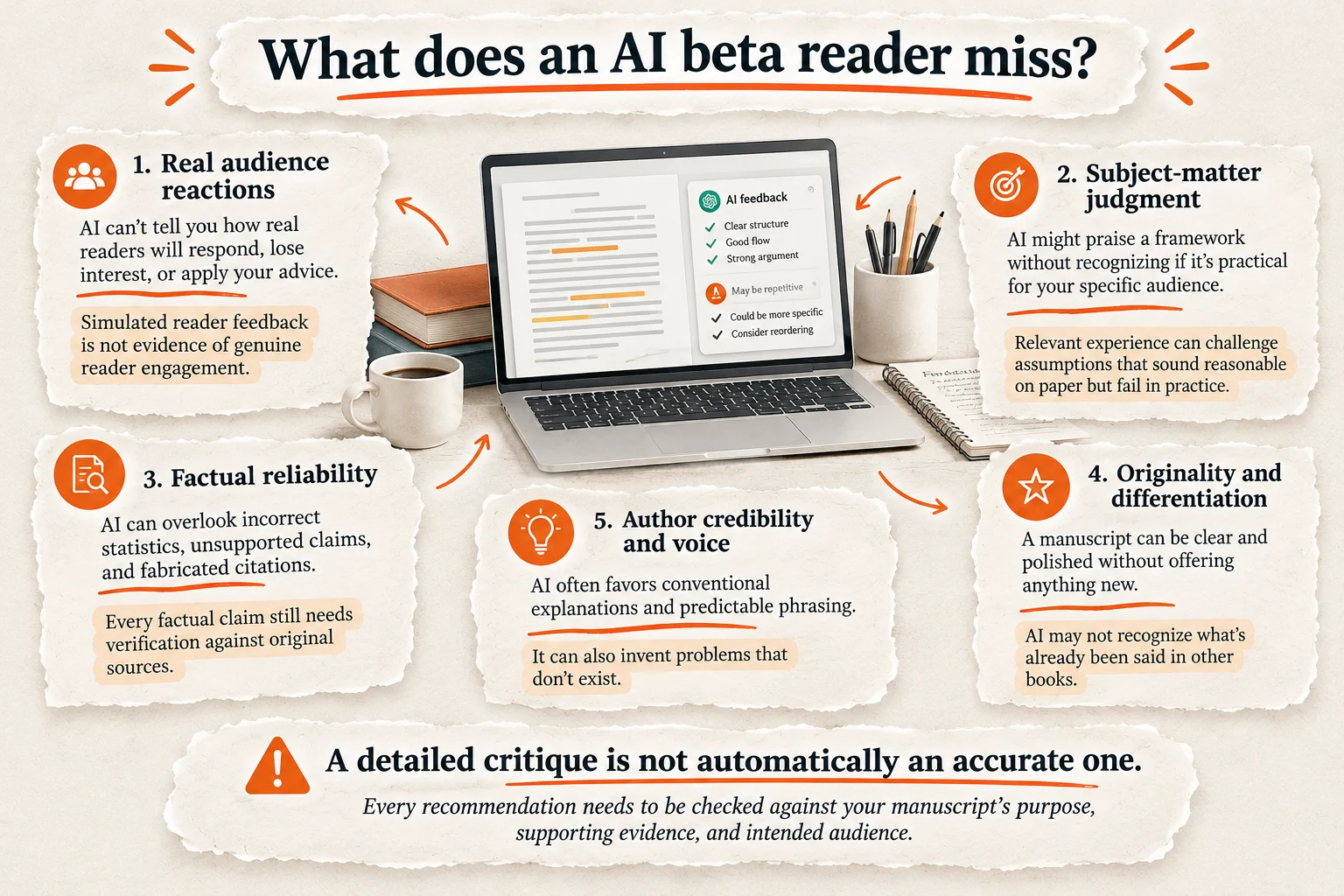
An AI beta reader can produce a convincing critique and still overlook the problems that matter most. It analyzes text, but it cannot fully judge whether your book earns a reader's trust or delivers useful advice.
Here are five limitations worth understanding.
1. Real audience reactions
AI can predict that a chapter might feel repetitive or confusing. It cannot tell you whether an actual business owner finds your argument persuasive, loses interest halfway through, or struggles to apply your advice.
Simulated reader feedback is not evidence of genuine reader engagement.
2. Subject-matter judgment
Suppose your book introduces a framework for improving employee retention. AI might praise its logical structure without recognizing that the recommendations are impractical for a company with ten employees.
Someone with relevant business experience can challenge assumptions that sound reasonable on paper but fail in practice.
3. Factual reliability
AI can overlook incorrect statistics, unsupported claims, and fabricated citations. Worse, it may confidently suggest inaccurate corrections.
Language models can produce answers that sound credible but are factually wrong. OpenAI's 2025 research on hallucinations explains how training and evaluation practices can reward plausible guesses instead of expressions of uncertainty. In manuscript reviews, that risk matters because AI may invent a contradiction, misinterpret an argument, or recommend a correction without checking the evidence.
4. Originality and differentiation
A manuscript can be clear, polished, and logically organized without contributing anything new.
AI might praise a familiar leadership framework without recognizing that your intended audience has encountered the same advice in dozens of other business books.
5. Author credibility and voice
AI often favors conventional explanations and predictable phrasing. Its suggestions can remove distinctive examples, simplify important nuances, or weaken the perspective that makes your expertise valuable.
There's another risk: AI can invent problems. It might flag a contradiction that doesn't exist or recommend reorganizing chapters that already work.
A detailed critique is not automatically an accurate one. Every recommendation needs to be checked against your manuscript's purpose, supporting evidence, and intended audience.
A useful rule is to separate three kinds of AI feedback: observations supported by the manuscript, interpretations that need checking, and claims about reader reactions that only real readers can confirm. A model can correctly quote a confusing paragraph while being wrong about why the paragraph is confusing. Evidence makes its criticism easier to evaluate, but it does not make the conclusion automatically correct.
AI beta readers vs. human beta readers: Which feedback matters more?
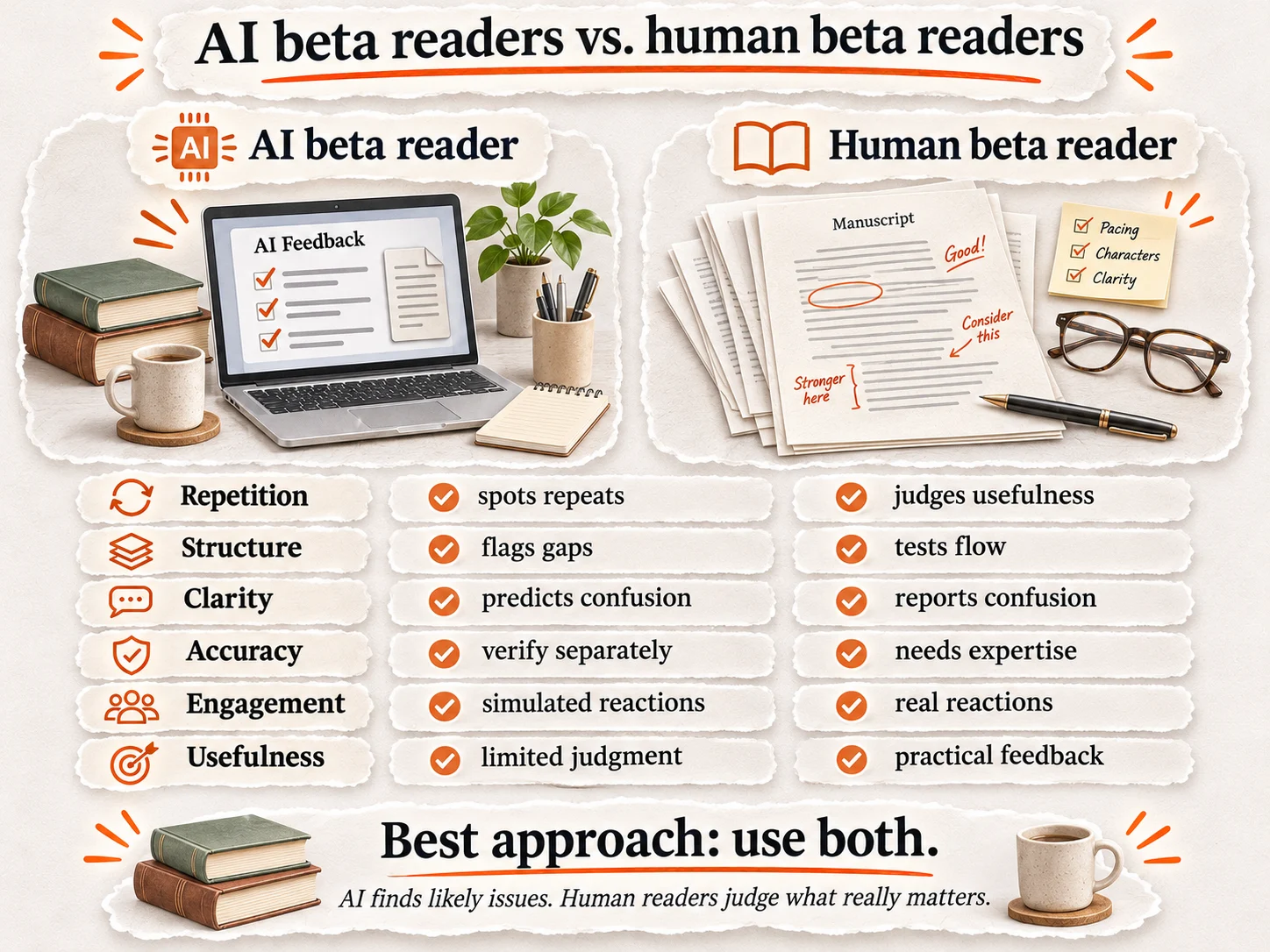
AI and human beta readers serve different purposes. AI is useful for identifying potential problems quickly. Human readers help determine whether those problems actually affect the reading experience.
Here's how their feedback compares:
| Evaluation area | AI beta reader | Human beta reader |
|---|---|---|
| Repetition | Detects repeated ideas | Judges whether repetition helps learning |
| Structure | Flags possible gaps | Evaluates actual reading flow |
| Clarity | Identifies potentially confusing text | Reports genuine confusion |
| Factual accuracy | Requires independent verification | Depends on subject expertise |
| Reader engagement | Simulates reader reactions | Provides firsthand reactions |
| Practical usefulness | Offers limited judgment | Tests relevance and applicability |
Neither approach is perfect.
An AI beta reader might flag a repeated explanation as unnecessary, while a human reader finds it helpful for understanding a difficult concept. Conversely, a human reader might enjoy a chapter without noticing that its central argument contradicts an earlier section.
Use AI when you're preparing your next revision. It can help you identify obvious repetition, unclear explanations, and structural issues before involving other people.
Human feedback becomes essential when you need to know whether your target audience understands your framework, trusts your recommendations, and finds the material useful.
For a business or expert-led nonfiction book, recruit readers who resemble your intended audience. Add subject-matter reviewers when accuracy or practical application requires specialist knowledge.
The strongest approach combines both: AI helps identify what deserves attention. Human readers help determine what genuinely needs changing.
How to use AI as a beta reader for your nonfiction book
Getting useful AI beta reader feedback takes more than uploading your manuscript and asking, "Is this book good?"
A better approach follows three steps: Catch → Check → Confirm.
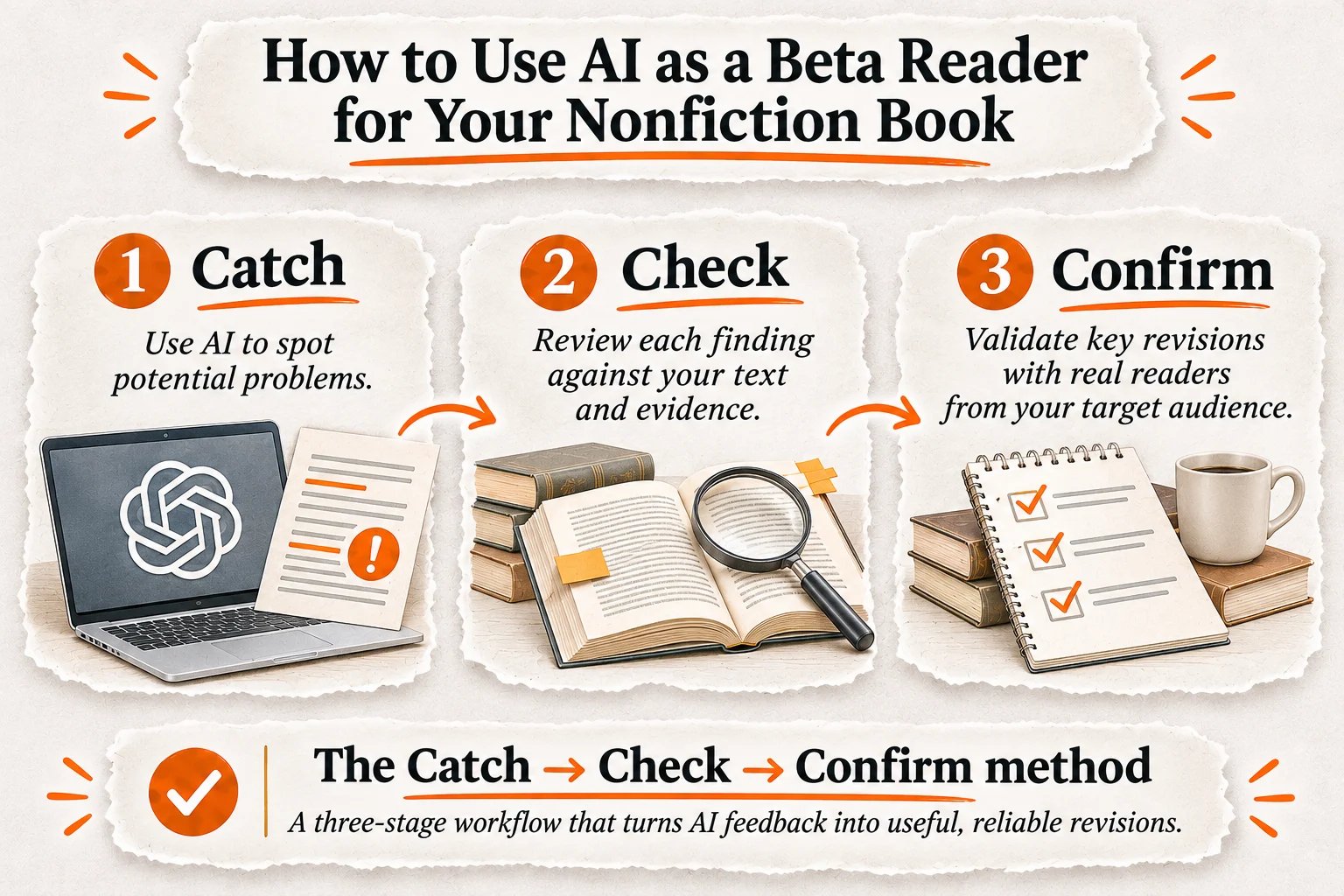
The Catch → Check → Confirm method is a three-stage AI beta reading workflow. First, use AI to catch potential manuscript problems. Next, check each finding against the original text and supporting evidence. Finally, confirm important revisions with readers who resemble your intended audience. This prevents an AI-generated critique from becoming an unquestioned editing checklist.
1. Catch potential problems
Start by giving AI enough context to evaluate your manuscript.
Include your target audience, the book's purpose, chapter outline, and the text you want reviewed. Then ask it to identify specific weaknesses in structure, clarity, repetition, and consistency.
Require evidence for every criticism. Ask AI to quote the relevant passage or identify its chapter and location. This makes the feedback easier to evaluate.
2. Check every recommendation
Don't treat the AI's report as an editing checklist you must complete.
Return to your manuscript and examine each flagged issue. Is the explanation genuinely confusing? Does the supposed contradiction exist? Would the suggested revision improve the argument?
Reject unsupported criticism. If AI questions a statistic, quotation, or factual claim, verify it against the original source rather than accepting its correction.
Tools like Built&Written can help you develop your nonfiction manuscript from source material, organize its chapter structure, and review text in an integrated editor. A dedicated beta reading process remains a separate step.
3. Confirm with real readers
Once you've addressed the strongest findings, share your manuscript with people who represent your intended audience.
Ask where they lost interest, what they struggled to understand, and which recommendations they would actually use. Involve subject experts when technical accuracy matters.
Review chapters individually first, then evaluate the complete book. Chapter reviews help identify local clarity problems and weak explanations. A full-manuscript review can reveal repeated concepts, inconsistent terminology, and structural gaps between chapters.
Neither perspective replaces the other.
The goal isn't to accept every AI recommendation. It's to identify meaningful weaknesses before your readers encounter them.
What should you ask an AI beta reader to look for?
The quality of AI beta reader feedback depends heavily on what you ask it to evaluate. A generic request like "Review my book" often produces broad compliments and predictable suggestions.
Instead, give AI a specific evaluation task, define your audience, and require evidence for every criticism.
Here's a reusable prompt for business and expert-led nonfiction:
AI beta reader prompt:
Act as a critical beta reader for a nonfiction business book. Evaluate the manuscript from the perspective of its intended audience.
Context
- Target audience: [Describe readers]
- Book's central promise: [Explain the result readers expect]
- Chapter purpose: [Explain what this chapter should teach]
Review the manuscript for:
- Repeated ideas, examples, and arguments.
- Confusing terminology or unclear explanations.
- Missing transitions and structural gaps.
- Contradictory definitions or inconsistent statements.
- Advice that lacks practical examples or actionable steps.
- Sections that appear unrelated to the chapter's central promise.
For each finding, provide:
- The exact quotation from the manuscript.
- The problem you identified.
- Why it may affect reader understanding.
- Priority: High, Medium, or Low.
- A specific recommendation.
Separate issues directly supported by the manuscript from possible reader reactions that require human confirmation.
Do not invent quotations, contradictions, statistics, or problems. If you cannot find evidence for a criticism, say so. If a section works well, explain what makes it effective.
Preserve the author's voice, terminology, and intended argument. Do not rewrite the chapter unless explicitly requested.
Manuscript:
[Paste the chapter]
Run separate reviews for clarity, structure, and practical usefulness when necessary. Focused questions make it easier to assess whether AI has identified a genuine weakness or simply generated another plausible-sounding opinion.
Should you trust an AI beta reader before publishing?
Yes, but trust it to identify potential problems, not decide whether your book is ready to publish.
AI beta reading works best as an early review, before you invest time in professional editing or ask people to read your manuscript.
Use a simple decision rule:
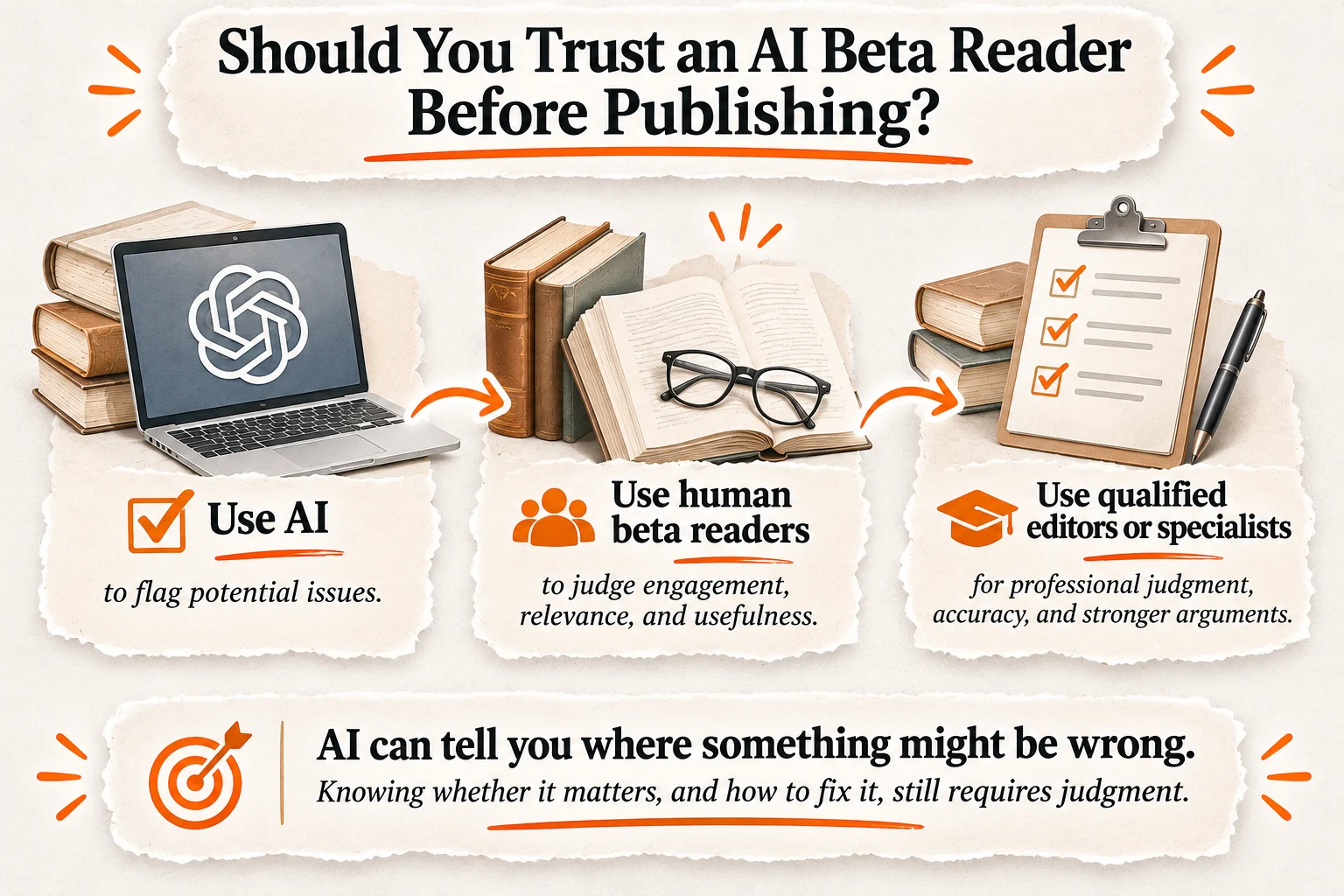
Use AI to flag repetition, unclear explanations, structural gaps, and inconsistent terminology.
Use human beta readers to evaluate whether your book is engaging, relevant, understandable, and genuinely useful to its intended audience.
Use qualified editors or subject specialists when you need professional judgment on structure, technical accuracy, or the strength of your arguments.
Don't skip fact-checking because an AI review found no errors. And don't assume a positive AI assessment means your target audience will respond the same way.
A polished manuscript can still contain weak advice or fail to answer the questions readers actually have.
An AI beta reader can tell you where something might be wrong. Knowing whether it matters, and how to fix it, still requires judgment.
Frequently asked questions
Yes, but the amount of text an AI tool can process depends on its context limits. Some tools accept full manuscripts, while others require smaller sections. Reviewing chapters individually and then examining the complete structure often produces more manageable feedback.
Not for every task. AI can efficiently identify repetition, unclear passages, and potential inconsistencies. Human beta readers provide genuine reactions to your arguments, examples, and advice. Both can miss problems, so combining their feedback is usually more useful.
Yes. You can give ChatGPT your manuscript, describe your intended audience, and request feedback on clarity, structure, and consistency. Ask it to support criticisms with specific passages rather than provide general impressions.
Nonfiction manuscripts don't typically have plot holes, but they can contain logical gaps, contradictory claims, and inconsistent definitions. AI can flag these issues, although you must confirm whether each alleged problem actually exists.
AI can flag questionable claims and suggest what needs verification. However, it may overlook errors or generate incorrect corrections. Verify statistics, quotations, and citations using reliable original sources.
Yes. An initial AI review can help you address obvious structural and clarity problems before professional editing. It won't replace a developmental editor's judgment, but it can help you prepare a stronger draft for review.
It depends on the service's privacy policies, account settings, and how your manuscript is processed or retained. Before uploading a complete book, check whether your content may be used for model training, who can access it, and whether uploaded files can be deleted. Remove confidential or third-party material you are not authorized to share.
Start with individual chapters, giving the AI your target audience and each chapter's purpose. Ask for specific feedback supported by manuscript quotations. Check each suggested correction yourself, then review the complete manuscript for structural consistency. Use human beta readers to confirm whether your explanations and recommendations work for the intended audience.
Sources & References
About the author

Polina Karlashchuk
More in AI Book Tools
Ready to write your book?
Turn your expertise into a professional book with Built&Written.