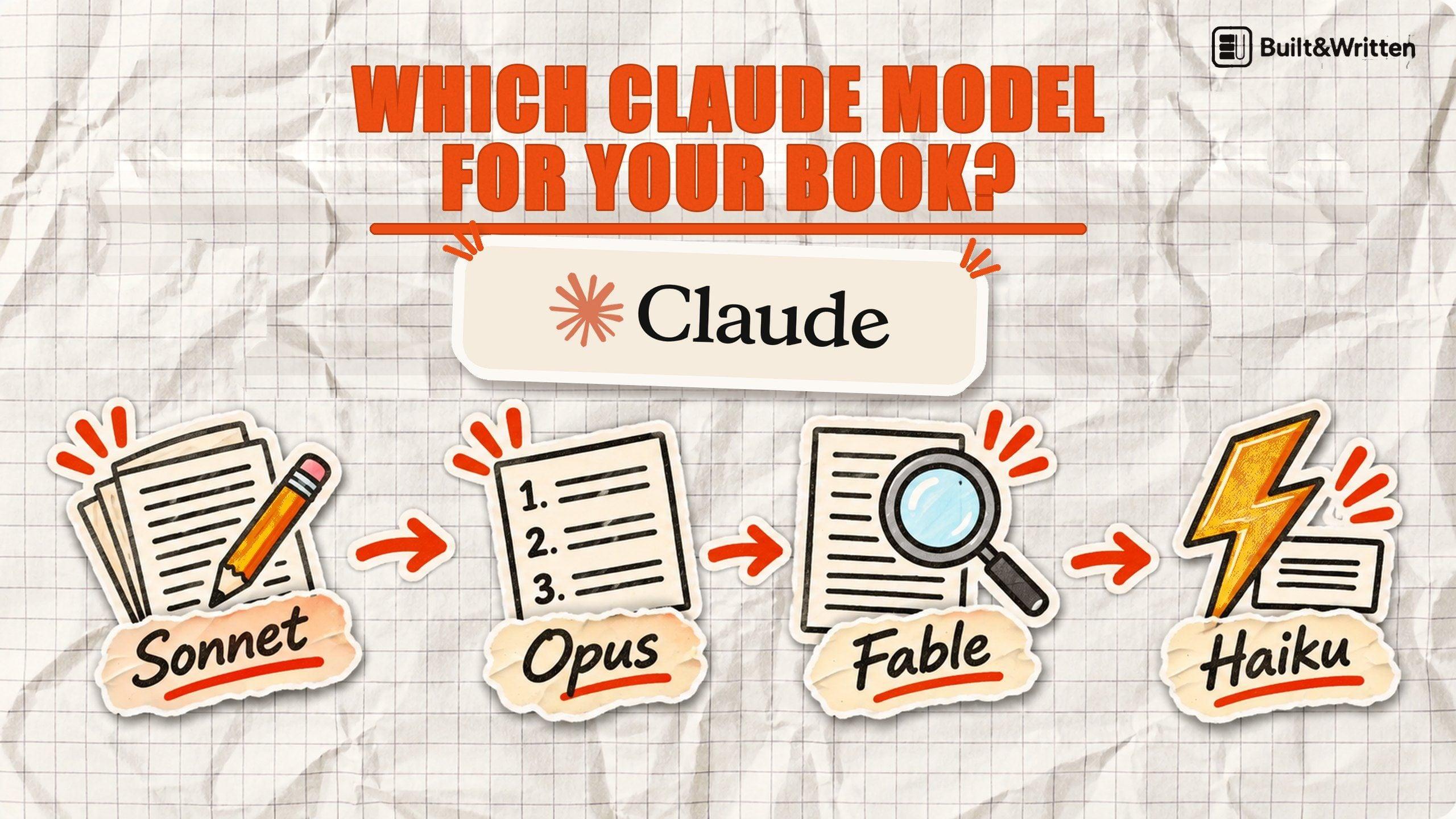
You open Claude to start chapter one. The model menu shows four names: Fable, Opus, Sonnet and Haiku. You want to write a book, and you do not want to pick wrong.
This guide shows which Claude model to use for different parts of writing a book, from drafting chapters to reviewing your manuscript. It also explains what each plan includes, what the models cost through the API, and where Claude needs your help.
Here is the honest part first. Anthropic, the company behind Claude, does not rank its models for book writing. Its guide to choosing a model names content creation once, under Sonnet, and says nothing about the quality of prose.
So we read Anthropic's own pages as they stood on November 25, 2026. We did not run a new writing test. Our last one, in September, used an older model and is described below.
What are the Claude models you can pick today?
Anthropic's models overview lists four current models. The table gives Anthropic's descriptions in plainer words.
| Model | What it is for | Speed |
|---|---|---|
| Claude Fable 5.2 | Hard problems that need careful, step-by-step reasoning, and long tasks Claude can handle on its own | Moderate |
| Claude Opus 5.5 | Long jobs that combine coding and knowledge work. Anthropic suggests starting here for most work | Moderate |
| Claude Sonnet 5.5 | A balance of speed and ability. Anthropic lists content creation among its uses | Fast |
| Claude Haiku 5.5 | Fast, high-volume jobs where speed matters, such as sorting and pulling out details | Fastest |
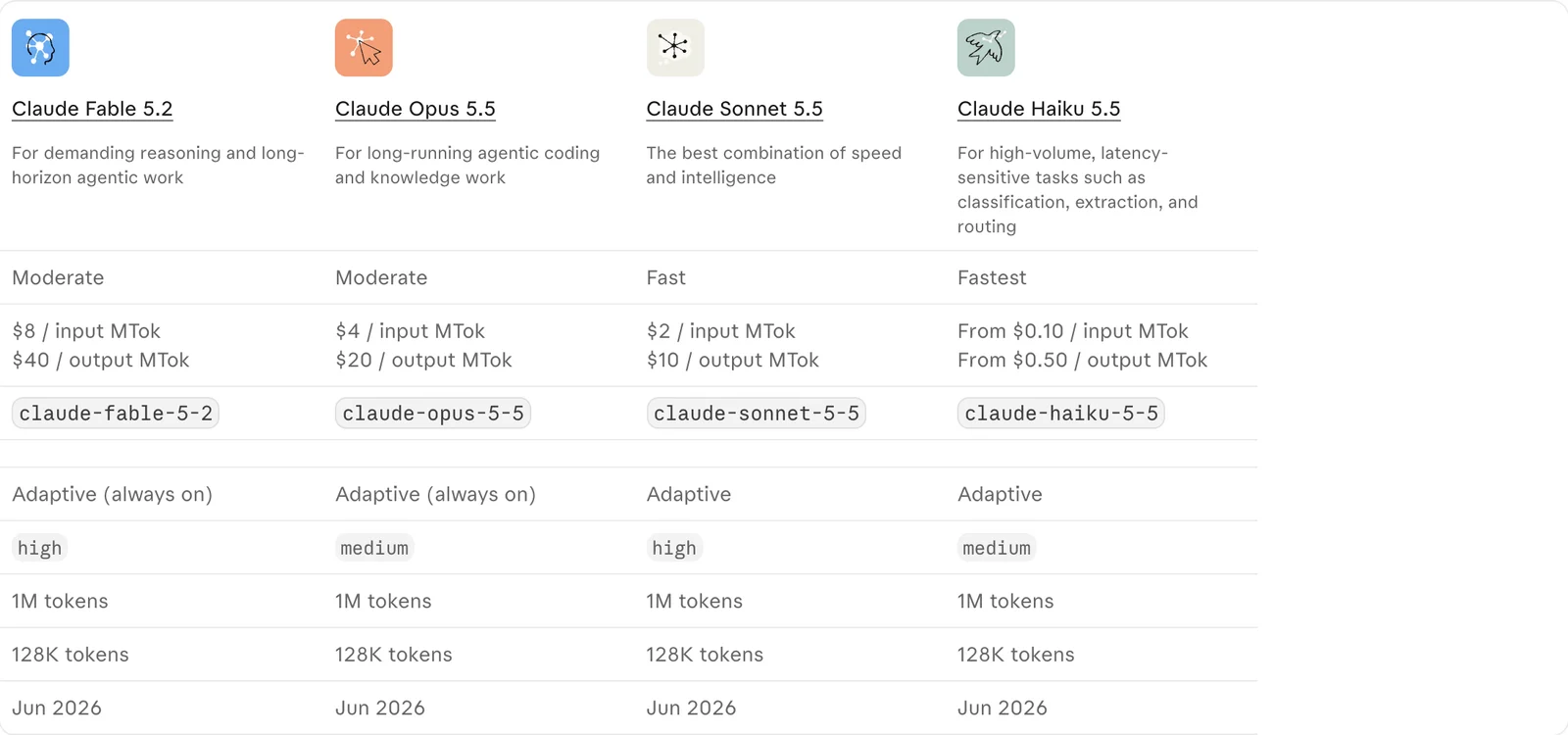
In Anthropic's developer docs, all four list a context window of 1 million tokens. A token is a small piece of a word, and Anthropic says 1 million tokens is roughly 555,000 words. A 60,000-word book is about a tenth of that.
So Claude can work with a large amount of your material at once. That figure is for developers, though. Claude's chat limits are different and depend on your plan and the model, so your own chat may allow less.
All four list a knowledge cutoff of June 2026. They may not know about events after that date unless you tell them.
Which Claude model is best for writing a book?
Anthropic does not name one model as the best for writing a book. Its descriptions give us a starting point for each task. Here is what we would use for each part of the process.
| Job in your book | Pick | Why |
|---|---|---|
| Drafting chapters from your notes | Sonnet 5.5 | It is fast, and Anthropic lists content creation among its uses |
| Planning the book and big edits, such as reordering chapters | Opus 5.5 | It is Anthropic's suggested starting point, built for knowledge work |
| Checking a whole manuscript for contradictions | Fable 5.2 | Its reasoning strength makes it worth trying when you review a manuscript for inconsistencies |
| Quick jobs: title ideas, a tighter paragraph | Haiku 5.5 | It is the fastest and cheapest |
These picks are our reading of Anthropic's descriptions. They do not measure how good the prose is. Only you can judge which model sounds most like you, and the last section shows a quick way to do it.
Which Claude models does each plan include?
The plan you pay for decides which models you see. This is from Claude's pricing page, checked November 25, 2026.
| Plan | Price | Models for writing |
|---|---|---|
| Free | $0 | Sonnet and Haiku, with limited usage |
| Pro | $20 a month, or $17 a month billed yearly ($200 up front) | Sonnet, Haiku and Opus. Fable only with paid usage credits |
| Max | $100 a month | The same models, plus Fable up to half your weekly limit |
| Ultra | $200 a month | The same models, with more usage and no 5-hour limit for verified accounts |
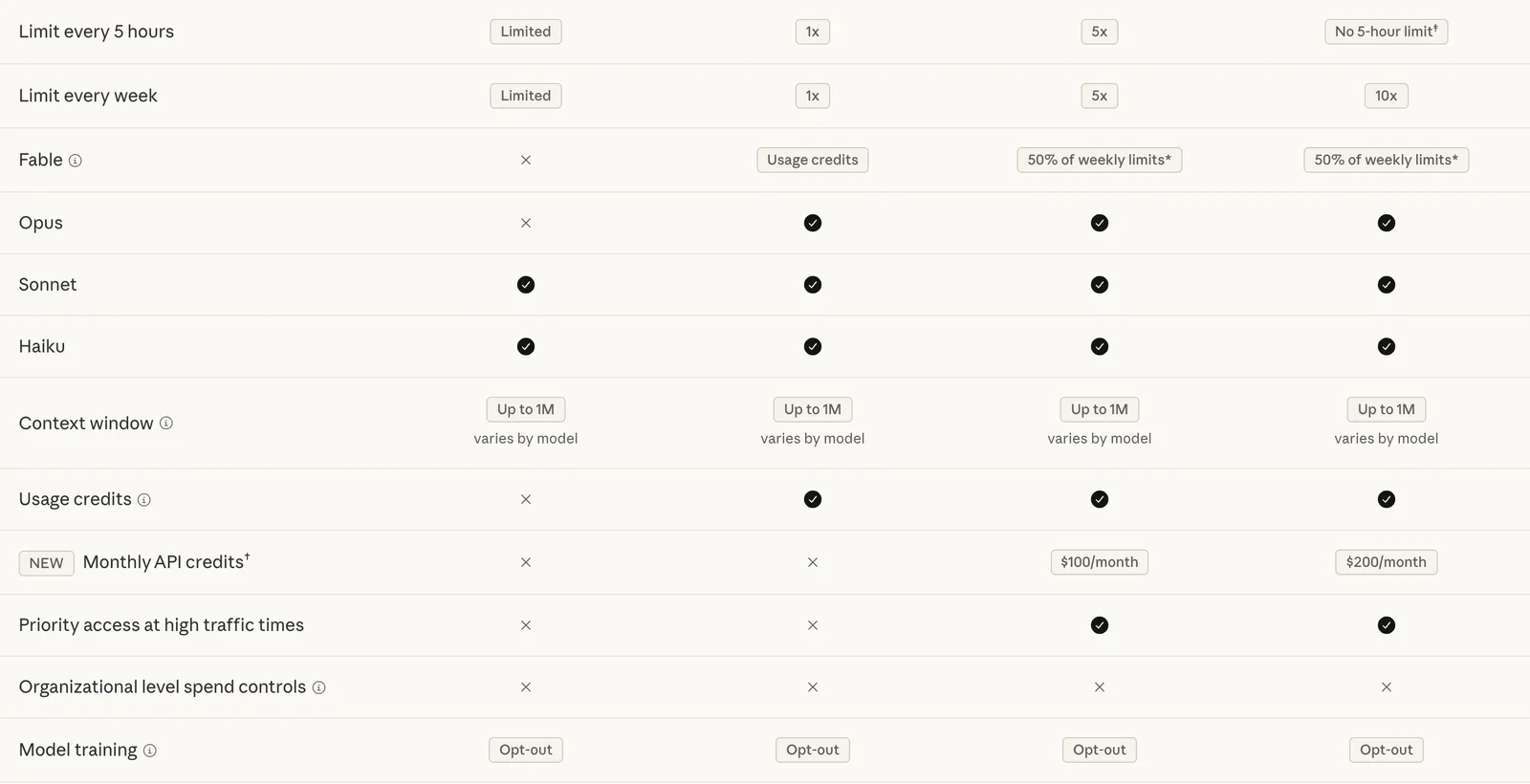
If you are on the Free plan, Sonnet is a good place to start writing your chapters. If you have Pro, you can also try Opus for planning your book or making larger edits. You do not need the most expensive model for every chapter. Start with the one that works for your writing, and switch only when a task needs more.
Anthropic says how fast you reach a limit depends on the model you use, how long your chats are and how large your files are. Check that before a long writing session. Model access and usage limits can change, so look at Claude's pricing page again before you choose a plan.
What does a draft cost at each model's price?
This part is only for authors who use Anthropic's developer service. A chat plan charges a monthly fee, not a price for each word.
These numbers show the cost of generating 60,000 words once, counted as output only. They do not include the notes you send to the model, its thinking or any rewrites. The total cost of writing a book through the API will be higher.
| Model | Output price per million tokens | One 60,000-word draft |
|---|---|---|
| Fable 5.2 | $40 | $4.32 |
| Opus 5.5 | $20 | $2.16 |
| Sonnet 5.5 | $10 | $1.08 |
| Haiku 5.5 | $0.50 (prompts up to 100,000 tokens) | about $0.05 |
The math: 60,000 words at about 1.8 tokens a word is 108,000 tokens. At $40 per million, that is $4.32.
Haiku's price depends on the size of your prompt. The estimate above uses its rate for prompts up to 100,000 tokens. For longer prompts, Anthropic's pricing page lists a higher output rate of $2.50 per million tokens.
Fable costs four times as much as Sonnet, on both input and output. Even so, the gap is a few dollars per draft. For most authors, the plan and its limits matter more than the price per token.
Does the effort setting matter more than the model?
The effort setting controls how much thinking a model puts into a task. A higher setting gives the model more room to think. It can help with complex requests, but it may take longer and use more tokens. Anthropic says adjusting effort is often a better move than switching models.
The defaults differ. Opus 5.5 and Haiku 5.5 start at medium. Fable 5.2 and Sonnet 5.5 start at high.
Anthropic describes this setting in its developer docs. We did not check which Claude chat screens show it, so look in your model menu. If you do not see it, skip this step. If you do, try a higher setting on a hard part of your book before you switch models.
What can't Claude fix for you?
Every model needs a fact check. In our September test of Claude and ChatGPT, Claude Sonnet 5 added 8 details that were not in the notes across two chapters. Some were quotes nobody said.
That was one run on an older model. Treat it as a warning, not a score. We have not tested the newer models the same way.
When Claude writes a chapter from your notes, compare the draft with your original material. Check names, dates, numbers, quotes and any detail that was not in your notes. If Claude adds something you cannot verify, remove it or find a reliable source first. Our guide to writing a nonfiction book with AI without making up facts shows how.
In a long book, consistency is the other job. When chapters are written in separate chats, chapter 7 can end up contradicting chapter 1. So you need to watch the whole book, not only each chapter. Our guide to Claude Projects for writing a book shows one way to reduce that.
Where does Built&Written fit?
Picking a model is half the job. The other half is keeping the book together, because chats end and your outline, chapters and voice live in them.
Built&Written is a platform that works with Claude. You connect it once, as described on our Claude page, and use Claude to plan your book, talk through ideas and edit chapters. The platform's own writing AI drafts the chapters from your material, in your voice. It keeps your outline and chapters in one place, so you can continue across chats without starting over.
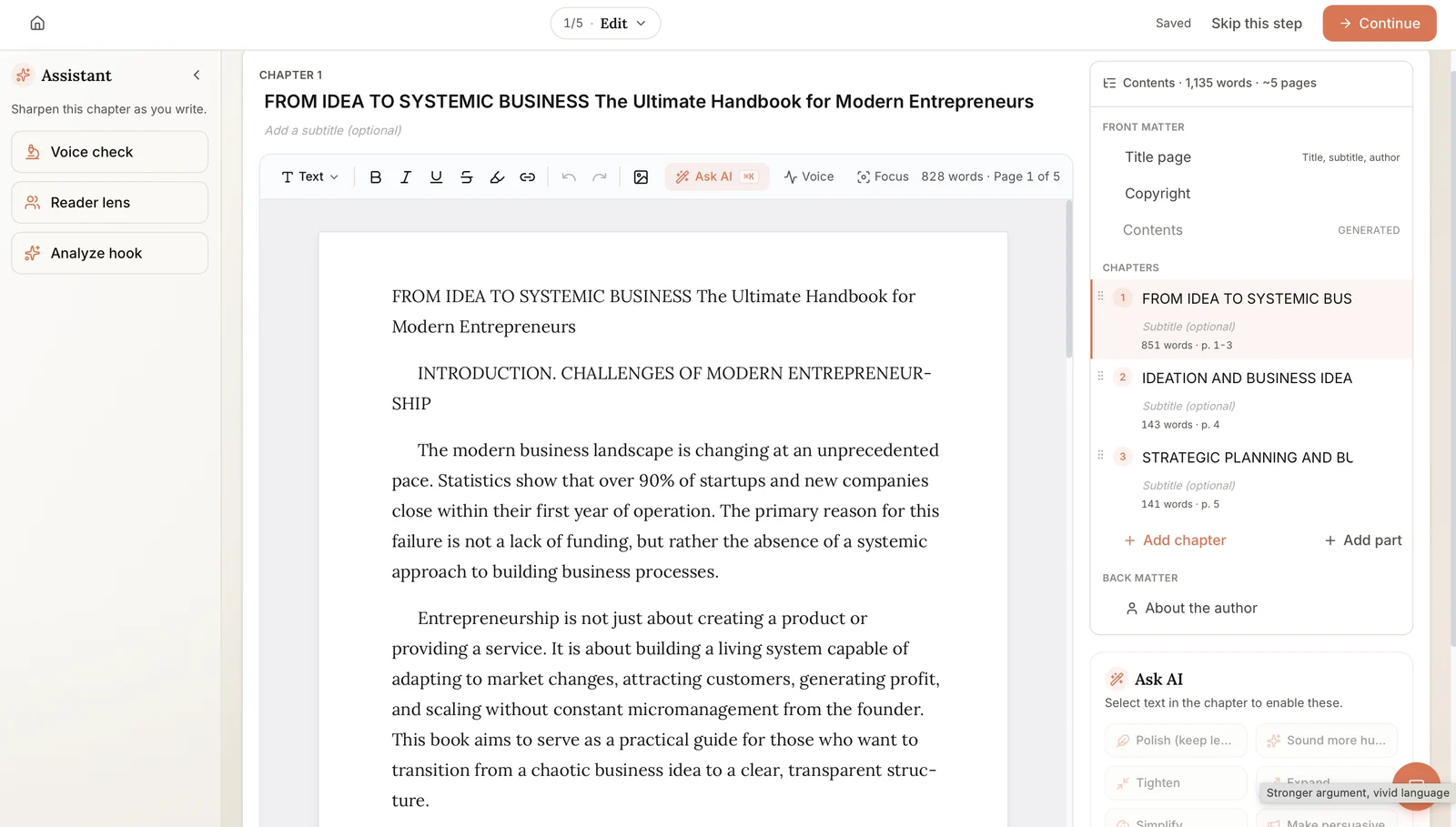
The platform learns your voice through Voice DNA. About 300 to 1,000 words of your writing works best. It reads only the first 1,300 words you give it, so put your strongest pieces first.
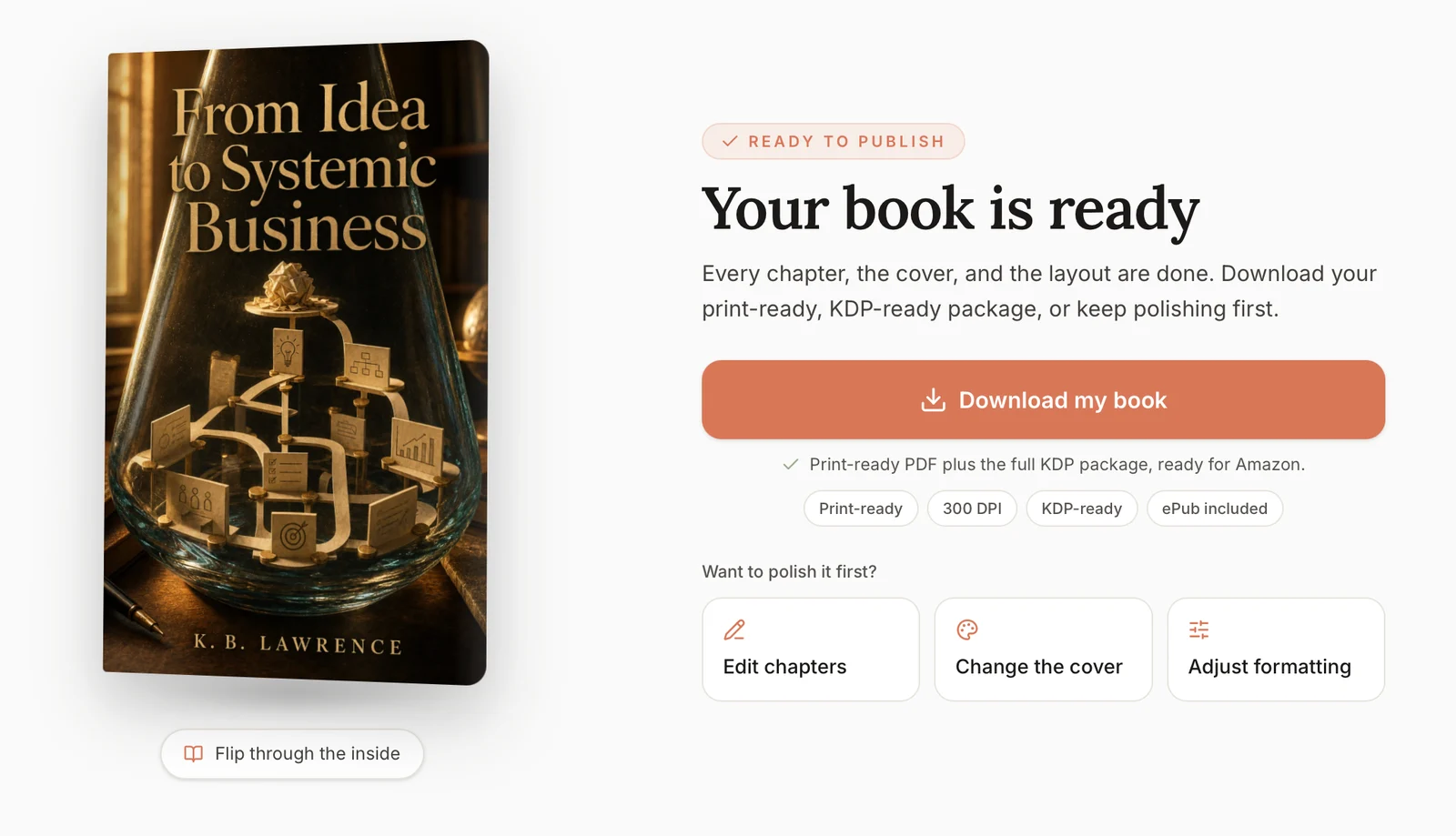
Built&Written prepares the files for your book, but publishing is still your step. You upload the finished files to Amazon KDP yourself, and you review every page before you publish.
The setup steps are in our guide to writing a whole nonfiction book inside Claude. Our page on how a plain Claude chat compares with Built&Written shows the gaps a chat leaves.
How can you pick your model in ten minutes?
Take about 300 words from your notes. Give the same notes and the same instruction to Sonnet 5.5 and Opus 5.5.
Compare the two drafts. Which one keeps your meaning? Which one sounds more like you? Which one adds fewer details you did not give it? Which one would need less editing?
Read both aloud, then check every fact. Keep the model that gives you the better starting point. That is a more useful test than any list, this one included.
Frequently asked questions
Anthropic does not name a best model for creative writing, and its guide to choosing a model says nothing about prose style. For a memoir chapter or a story-like passage, run the same notes through Sonnet 5.5 and Opus 5.5. Read both aloud and keep the one that sounds like you. Then check every name, date and detail against your own records.
Not always. Anthropic describes Fable 5.2 as built for demanding reasoning and long agentic work, and it does not say Fable writes better prose. Fable also costs four times as much per token as Sonnet 5.5 (checked November 25, 2026). For most chapters, start with a faster and cheaper model.
Often enough to recheck before you start a book. Anthropic's overview lists many past models, and some older ones are already retired. Open the overview page on the day you begin to see which models are current. Then check Claude's pricing page for the ones your plan includes.
Anthropic lists a knowledge cutoff of June 2026 for all four current models. Anything newer, such as a price, a rule or a news event, is missing unless you paste it in. Check each fact that can change against the source, and add the date to your manuscript notes so you know when to recheck it.
Sources & References
About the author