
In September 2023, Amazon capped Kindle Direct Publishing at three new titles per author a day. The Authors Guild reported the cap days after Amazon started asking authors to disclose AI-generated content.
Two rules in one month, both about AI. A lot of people read that as "Amazon is banning AI books." That is not what happened. But the story stuck, and so did a handful of others.
I talk to people writing nonfiction books with AI every week. The same eight beliefs come up again and again. Some are wrong, some are half true, and one is mostly right. Here is each one, checked against the people who actually set the rules.
Jump to the eight myths at a glance
Why AI book writing myths matter for a nonfiction author
An AI book writing myth is a belief about writing a book with AI that sounds like a rule but isn't one. Some stop people from starting a book they could finish. Others let them publish something that breaks a real rule.
Both cost you. The first costs you the book. The second can cost you the listing, the copyright claim or the trust of your readers.
So the test for each myth below is simple. What does the source say? Amazon's KDP Content Guidelines, the US Copyright Office, published research and the Authors Guild. Not a forum thread. Not a guess.
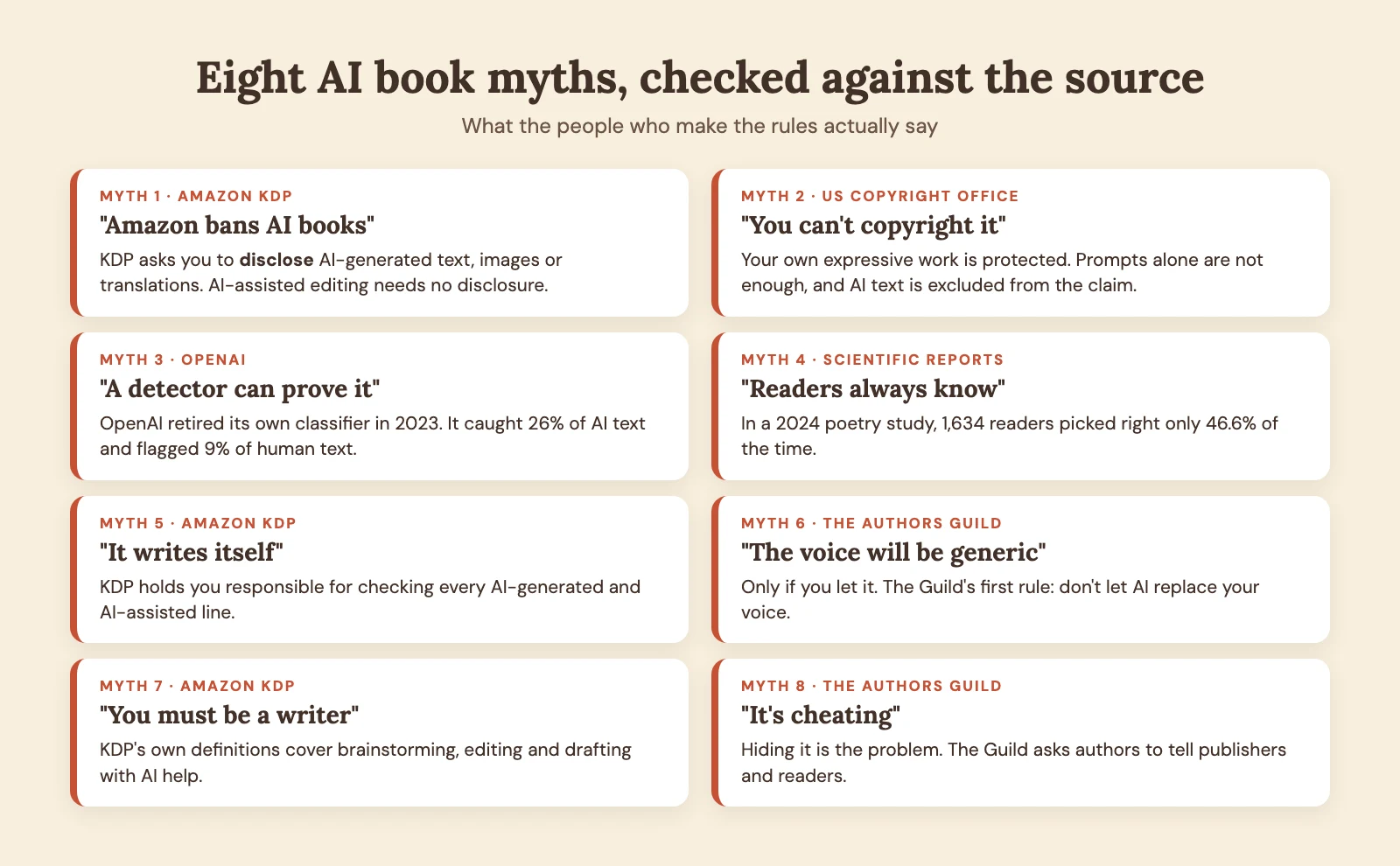
The eight myths at a glance
Myth 1. Amazon bans books written with AI
Amazon does not ban them. It asks you to tell it.
Here is the exact rule. KDP requires you to tell it about AI-generated text, images or translations when you publish a new book. The same section says you are "not required to disclose AI-assisted content."
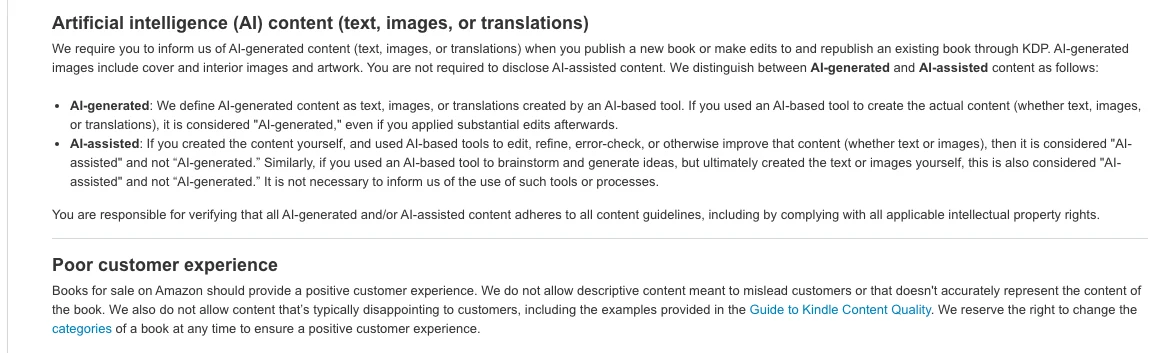
The line between the two matters. AI-generated means an AI tool created the actual text, images or translations. KDP says it still counts as AI-generated "even if you applied substantial edits afterwards." AI-assisted means you wrote it and used AI to edit, refine or error-check it.
What KDP does reject is the same thing it always rejected: content that breaks its guidelines, misleads customers or disappoints them. The three-a-day cap from 2023 limits volume, not AI. Our guide on publishing an AI-written book on KDP walks through the upload, and KDP's disclosure rules explain the checkbox line by line.
Myth 2. You can't copyright anything you wrote with AI
This one is half right, which is why it spreads.
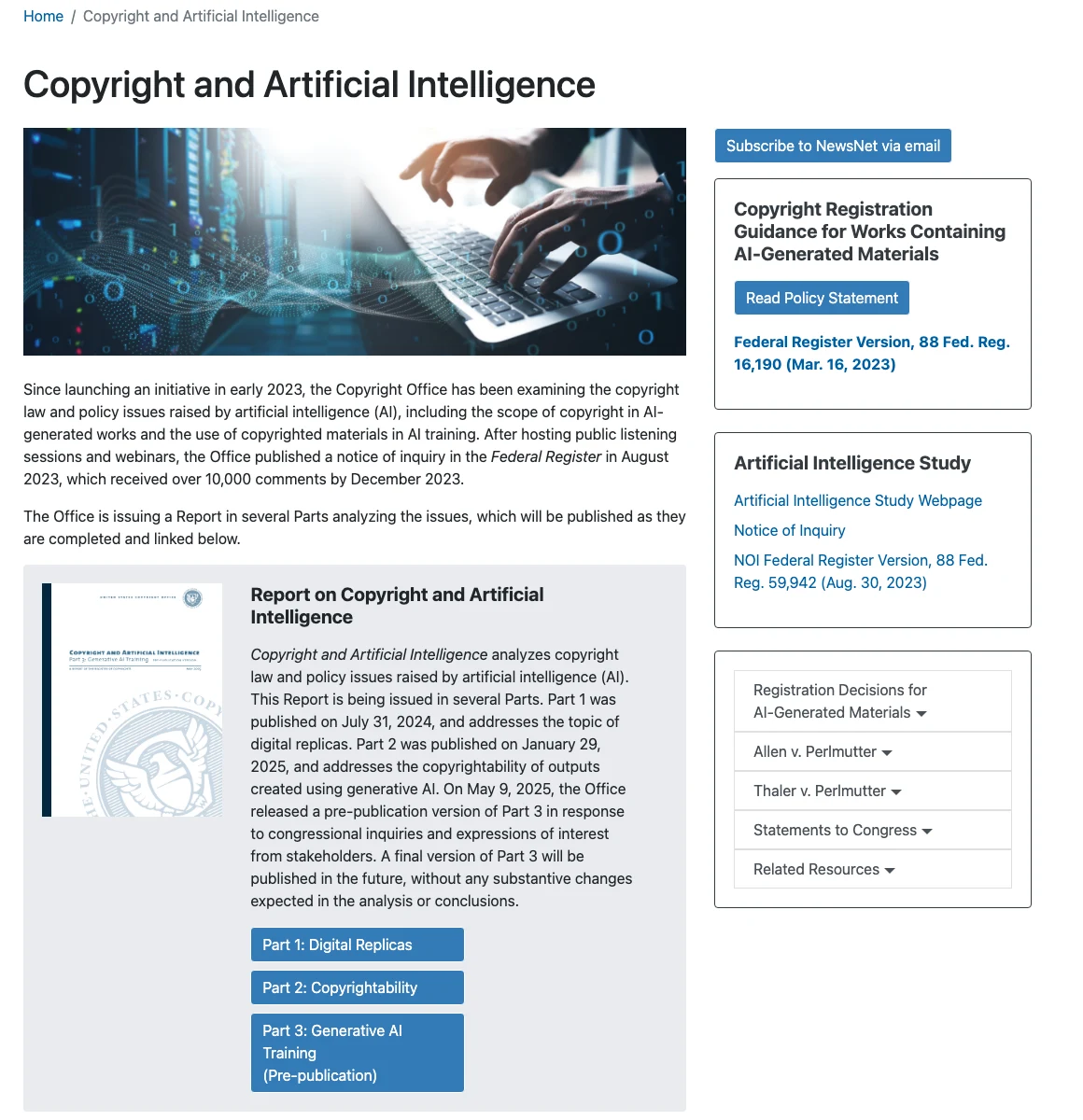
The Copyright Office published Part 2 of its AI report on January 29, 2025. Its conclusion: AI-assisted work is protected "only where a human author has determined sufficient expressive elements." Using AI as a tool "does not bar copyrightability."
So three things are true at once:
- Your own words are protected. The chapters you wrote, the stories you told, the edits you made.
- Prompts alone are not enough. The report says protection needs more than "the mere provision of prompts."
- The AI's raw text is not yours to claim. The Office's March 2023 registration guidance says applicants have "a duty to disclose" AI-generated content, and AI content that is "more than de minimis" (more than a trivial amount) should be excluded from the claim.
The practical answer: the more of the book that is yours, the more of it you own. Our two guides go deeper, on who owns a book you wrote with AI and on what the Copyright Office says in each report.
Myth 3. An AI detector can prove a book was written with AI
No detector can prove it. The company behind ChatGPT gave up on its own.
OpenAI built an AI text classifier for exactly this job. On its own announcement page, it says the tool caught 26% of AI-written text in testing. It also wrongly labeled 9% of human-written text as AI. On July 20, 2023, OpenAI took it down "due to its low rate of accuracy."
That is the maker of the model, testing a detector for its own model.
Other detectors claim better numbers. Some are better. None can tell a publisher, with certainty, who wrote a page. And a detector score is not what KDP's rule asks about. KDP asks whether AI created the content, and it asks you. We looked at what detectors do with book text in how accurate AI detectors are.
Myth 4. Readers can always tell a book was written with AI
The research says otherwise, at least in short pieces.
In a 2024 study in Scientific Reports, Brian Porter and Edouard Machery at the University of Pittsburgh showed 1,634 people ten poems. Some were by famous poets, others by ChatGPT 3.5 writing in those poets' styles. Readers picked the right author 46.6% of the time, which the authors describe as below chance.
Two cautions. That was poetry, not a 200-page nonfiction book. And the same study found a twist: readers told a poem was by AI rated it lower, whether or not it was.
So the honest version of this myth is different. Readers often can't tell. But once they think a book is AI, they like it less. That is a reason to make the book good and true, not a reason to hide anything. We looked at how this plays out in reviews in do readers review AI books differently.
Myth 5. AI will write the book for you with no work
This is the most expensive myth on the list.
KDP is plain about who carries the risk: "You are responsible for verifying that all AI-generated and/or AI-assisted content adheres to all content guidelines." That includes intellectual property rights. Amazon does not check your facts. You do.
And AI gets facts wrong in nonfiction. It invents a statistic, a study, a client, a quote. In my experience the draft is the fast part. Checking every claim, replacing generic examples with your own and cutting what didn't happen is the real work.
How much work? We measured it on a real AI-written book in how much of an AI-written book you still have to fix. If facts worry you most, start with writing nonfiction with AI without making up facts.
Myth 6. The voice will always sound generic
This one is half true, and it is the one I hear most.
Give an AI a topic and nothing else, and you get the average of everything it has read on that topic. That reads generic because it is. The Authors Guild's first recommendation in its AI best practices for authors is "don't let AI replace your unique voice, thinking, and creativity."
The fix is input, not a better prompt. Give the AI a few pages of your own writing, your real stories and your real opinions. Then it has something to sound like. Our explainer on what Voice DNA is shows why a few strong pages of your writing teach voice better than any description of it.
Then read it out loud. Any sentence you would never say, cut or say your way.
Myth 7. You need to be a writer to write a book with AI
You need material. Writing skill helps, but it is not the gate it used to be.
Most nonfiction authors are experts first and writers second. A dentist, a pastor, an accountant, a parent with a story. What they have is knowledge, stories and opinions. What they lack is the habit of turning that into 50,000 clean words.
KDP's own definitions already cover the range of ways people work. Use AI to brainstorm and write the text yourself, and KDP counts it as AI-assisted. Let AI draft from your notes, and it is AI-generated and you disclose it. Both are allowed.
What you can't skip is judgment: what goes in, what is true, what sounds like you. Our guide for people who don't think of themselves as writers covers where to start.
Myth 8. Using AI to write a book is cheating
Cheating means breaking a rule to gain something unfairly. So what are the rules?
Amazon's rule is disclosure. The Copyright Office's rule is that you claim only what you made. The Authors Guild asks authors to tell their agent and publisher "up front" if a manuscript includes AI outputs, and to disclose substantial AI text to readers. It calls passing off generated text as your own, without substantial revision, unethical.
Read those together and a clear line appears. Using AI is not the problem. Hiding it, or claiming words you didn't write, is.
My view: a book built from your own ideas, stories and checked facts, drafted with AI help and disclosed where the rules ask, is your book. The ethics of writing a book with AI gets its own full article if you want the longer argument.
What is actually true about writing a book with AI
Put the eight answers together and you get five rules that hold up:
- Disclose AI-generated content on KDP. AI-assisted editing needs no disclosure.
- Own what you made. Your expression is protected; raw AI text is not.
- Don't trust a detector score, in either direction.
- Check every fact. You carry the responsibility, not the tool.
- Feed it your voice. Generic in, generic out.
None of those say "don't." They say "do it honestly, and do the work."
Where Built&Written fits
If you have the material and want help turning it into a book, that is what we built. Built&Written is set up around the rules above, not around the myths.
Wren, our writing AI, drafts from your own material in your voice. It learns that voice from a few pages of your writing, about 300 to 1,000 words. Our AI nonfiction book writer page shows the flow from notes to chapters. You still check every fact, and you still tick KDP's AI box when you upload, because Wren generated the text.
If you wrote the book yourself and only want help polishing it, our AI book editor rewrites passages you select, and nothing changes until you accept. KDP treats that kind of editing as AI-assisted.
Built&Written builds the print PDF, the ePub and the cover file. You upload them to KDP yourself. It is $49/month for AI-written books ($19/month for your own manuscript). Every plan comes with monthly credits for the AI, and you see what a book will cost before Wren writes it.
Sources & References
- Amazon KDP, Content Guidelines: https://kdp.amazon.com/en_US/help/topic/G200672390
- The Authors Guild, Amazon Adds to KDP Generative AI Policy, Caps Daily Self-Publishing Uploads (September 27, 2023): https://authorsguild.org/news/amazon-adds-to-kdp-generative-ai-policy-caps-daily-self-publishing-uploads/
- US Copyright Office, Copyright and Artificial Intelligence: https://www.copyright.gov/ai/
- US Copyright Office, Copyright Office Releases Part 2 of Artificial Intelligence Report (January 29, 2025): https://www.copyright.gov/newsnet/2025/1060.html
- US Copyright Office, Copyright Registration Guidance for Works Containing Material Generated by Artificial Intelligence (March 16, 2023): https://www.copyright.gov/ai/ai_policy_guidance.pdf
- OpenAI, New AI classifier for indicating AI-written text: https://openai.com/index/new-ai-classifier-for-indicating-ai-written-text/
- Porter and Machery, AI-generated poetry is indistinguishable from human-written poetry and is rated more favorably, Scientific Reports (2024): https://pmc.ncbi.nlm.nih.gov/articles/PMC11564748/
- The Authors Guild, AI Best Practices for Authors: https://authorsguild.org/resource/ai-best-practices-for-authors/
Frequently asked questions
Yes. KDP's Content Guidelines say AI-generated images include cover and interior images and artwork. If an AI tool created your cover art, you tell KDP when you publish, the same way you would for AI-generated text. If you designed the cover yourself and used AI only to touch it up, KDP treats that as AI-assisted, and no disclosure is needed.
Yes. KDP lists translations next to text and images in its definition of AI-generated content. A translation made by an AI tool counts as AI-generated even if you edit it heavily afterwards, so you disclose it when you publish the translated edition. A translation you wrote yourself, with AI used only to check it, counts as AI-assisted.
KDP's guidelines say you inform it of AI-generated content when you publish a new book and when you make edits to and republish an existing book. So if a new edition adds AI-generated chapters or images, answer the AI question again for that version. Fixing typos you wrote yourself, with or without an AI checker, does not change the answer.
The Copyright Office's 2023 guidance says you disclose AI-generated content and briefly explain what the human author contributed. AI content that is more than a trivial amount should be excluded in the Limitation of the Claim section, in the Other field under Material Excluded. Your own text, selection and arrangement stay in the claim.
It has published a report on it. Part 3 of the Office's Copyright and Artificial Intelligence report covers generative AI training. A pre-publication version came out on May 9, 2025, and the Office says the final version will follow without substantive changes. Parts 1 and 2 cover digital replicas and copyrightability.
Sources & References
- Amazon KDP, Content Guidelines
- The Authors Guild, Amazon Adds to KDP Generative AI Policy, Caps Daily Self-Publishing Uploads
- US Copyright Office, Copyright and Artificial Intelligence
- US Copyright Office, Part 2 of the Artificial Intelligence Report
- US Copyright Office, Copyright Registration Guidance for Works Containing AI-Generated Material
- OpenAI, New AI classifier for indicating AI-written text
- Porter and Machery, AI-generated poetry is indistinguishable from human-written poetry, Scientific Reports
- The Authors Guild, AI Best Practices for Authors
About the author