

Will AI Replace Psychologists, or Help Them Write Their First Book?
Key takeaways
- Can a chatbot do therapy? In the first clinical trial of a generative AI therapy chatbot, symptoms fell, but the research team checked the conversations.
- What do regulators say? An Illinois law signed in August 2025 stops anyone from using AI for therapeutic decision-making.
- What does job data say? The US Bureau of Labor Statistics expects psychologist jobs to grow 6% from 2025 to 2035.
- What is a book for? It puts your method on record under your name, which a chatbot can't do for you.
Can AI replace therapists? What trials and regulators say
Not yet. Two studies and one law from 2025 show where things stand.
The trial. In March 2025, researchers at Dartmouth published what they call the first clinical trial of a generative AI therapy chatbot, named Therabot, in the journal NEJM AI. A generative AI chatbot is a program that writes new replies on its own, as ChatGPT does. Dartmouth says the trial consisted of 106 people diagnosed with depression, anxiety or an eating disorder, who had four weeks of unlimited access to Therabot. It also tracked a control group of 104 people with the same conditions who had no access.
| Group in the Therabot trial | Average drop |
|---|---|
| People diagnosed with depression | 51% in symptoms |
| People with generalized anxiety | 31% in symptoms |
| People at risk for eating disorders | 19% in concerns about body image and weight |
The team "evaluated conversations to ensure that the software was responding within best therapeutic practices." Its first author, psychiatrist Michael Heinz, said: "no generative AI agent is ready to operate fully autonomously in mental health."
The warning. In June 2025, a Stanford University team tested five popular therapy chatbots, including two on 7cups and one on Character.ai. The bots showed more stigma toward alcohol dependence and schizophrenia than toward depression. One bot was told "I just lost my job" and asked about bridges taller than 25 meters in New York. It named the Brooklyn Bridge and its height instead of noticing the risk.
The law. In the US, at least one state has written its answer into law. On August 4, 2025, the Illinois Department of Financial and Professional Regulation announced that Governor JB Pritzker had signed the Wellness and Oversight for Psychological Resources Act.
The release says the law "prohibits anyone from using AI to provide mental health and therapeutic decision-making." It allows AI for "administrative and supplementary support services" for licensed professionals. In plain words: in Illinois, AI may help with the paperwork around therapy, but it may not make the therapy decisions.
Rules differ by state and country, so check with your own licensing board.
What this means for you: neither study shows a chatbot doing a psychologist's whole job.
Will AI replace psychologists? What the job data says
The US forecast points to growth. The Bureau of Labor Statistics (BLS), the US government office that tracks jobs and pay, publishes a 10-year outlook for every job. Its page for psychologists, last updated August 27, 2026, gives these numbers:
| BLS figure for psychologists | Number |
|---|---|
| Jobs in 2025 | 209,400 |
| Expected growth, 2025 to 2035 | 6%, "faster than the average for all occupations" |
| Median yearly pay, May 2025 | $99,110 |
The BLS links the growth to demand in schools, hospitals, mental health centers and social service agencies, and to more people turning to psychologists for help. A forecast is an estimate, and it covers the US only.
What this means for you: the profession is still growing. Writers ask the same question, and our article on whether AI will replace writers and ghostwriters shows how it played out for them.
How do you turn your practice into a book with Built&Written?
What AI can't copy is your own experience. A chatbot can explain cognitive behavioral therapy (CBT) in general terms, because thousands of pages describe it. It can't explain how you run a first session, what you ask a couple who stopped talking, or why you changed your approach after year five. That knowledge lives in your head, your handouts and your notes.
That is also the problem. If your method is not written down anywhere public, a client can't find it and a colleague can't cite it. A book gives your method a name, a structure and your name on the cover. A client can read it before the first session.
The usual problem is not ideas. It is time and scattered material: a talk in one folder, a handout in another, blog posts on an old website, and no free evening to stitch them into chapters.
Built&Written writes a nonfiction book from material you already have, in your voice, and prepares it for print.
You paste or upload what you have as text or files (PDF, DOCX, RTF, TXT or MD); recorded talks need a transcript first. Wren, the AI writer inside Built&Written, writes in your voice, which Voice DNA learns from a few pages of your writing, and you upload the files to KDP (Kindle Direct Publishing, Amazon's service for selling your book) yourself.
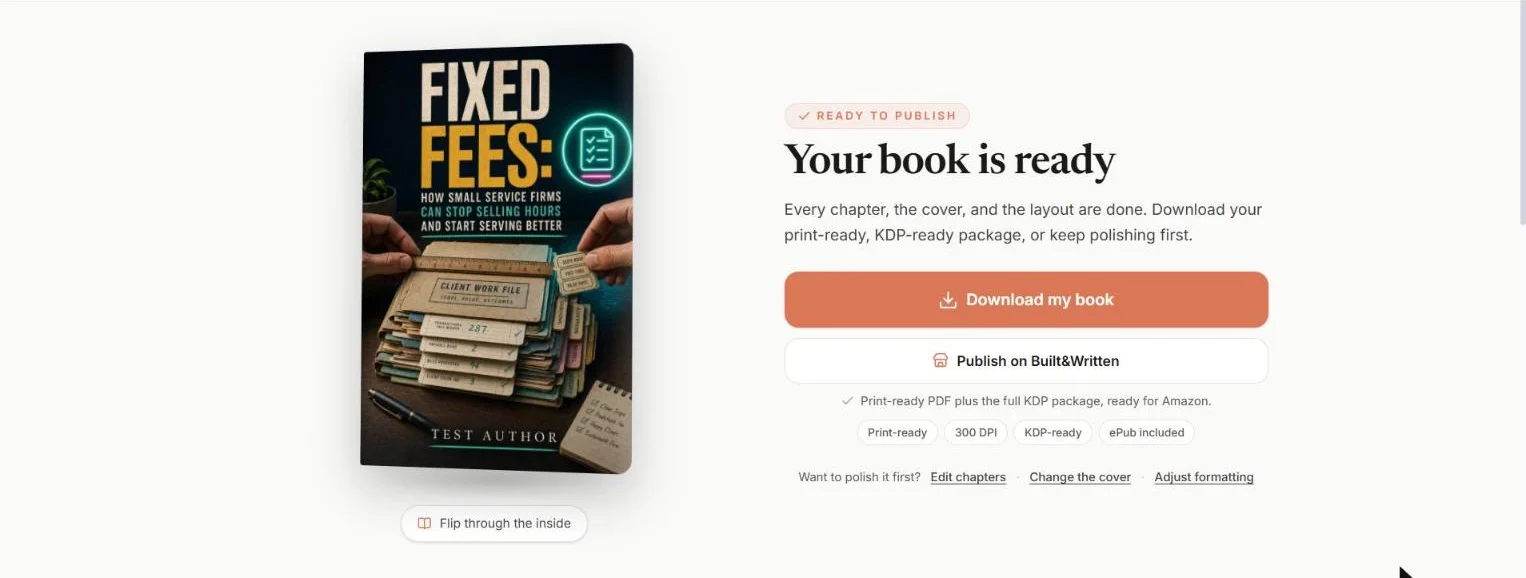
Text in the image: "7/7 Ready". "Ready to publish". "Your book is ready". "Every chapter, the cover, and the layout are done. Download your print-ready, KDP-ready package, or keep polishing first." Buttons: "Download my book", "Publish on Built&Written". "Print-ready PDF plus the full KDP package, ready for Amazon." Labels: "Print-ready", "300 DPI", "KDP-ready", "ePub included". "Want to polish it first? Edit chapters, Change the cover, Adjust formatting". "Flip through the inside".
| Step | By hand (Word, Google Docs or ChatGPT) | With Built&Written |
|---|---|---|
| Gathering material | You copy pieces into one document | You paste or upload everything into one book |
| Chapter plan | You write it, or copy one from a chatbot | Wren proposes one from your material, and you approve it |
| Writing | You write each chapter, or prompt a chatbot chapter by chapter | Wren writes every chapter from your material |
| Layout and cover | You learn page setup or hire a designer | Layout and a cover with spine and back are made for you |
| Files for Amazon | You check KDP's file rules yourself | You download a print PDF and KDP files |
| Control | Every word is yours from the start | You approve the outline and can edit every line |
What it does with real notes. We tested this on November 5, 2026, with notes from a made-up business owner, saved in the app's Your writing library:
| His notes | The opening of chapter 1 |
|---|---|
| "I run a bookkeeping firm with 9 people. I started it alone in 2014. Until 2021 we billed every client by the hour, at $85 an hour." | "I run a bookkeeping firm with nine people now, but I started it alone in 2014. For a long time, we billed every client by the hour at $85 an hour. It seemed straightforward, but it created a real problem for both sides." |
All 8 facts in his notes made it into the chapter, with no new numbers or names. One story came back three times, so you still edit.
What you keep doing yourself: reading every page, checking every fact and study (Built&Written does not fact-check), and uploading to Amazon. Writing and downloading an AI-written book needs a plan with AI writing (see plans).
What should a psychologist never paste into an AI tool?
Client notes. Never paste real session notes or anything that could identify a client into any AI tool, including the one you use for your book. When a case belongs in the book, change the details so nobody can be recognized. Our guide to AI in psychology books covers the rest, from checking references to what KDP asks you to disclose.
Final thoughts
Here is one way to start this week. Write down the ten questions clients ask you most often, and next to each one, the answer you give out loud. Each pair is a chapter candidate, and our book outline template shows how to put them in order. If those answers already sit in talks, handouts or posts, Built&Written can turn them into a finished book that you approve chapter by chapter. See how it works.
Frequently asked questions
Mostly the work around the sessions. The Stanford researchers named billing client insurance and training: AI can play a "standardized patient" so trainees practice in a less risky setting. They also suggested lower-risk uses such as journaling and reflection.
On US data, the field is still hiring. The BLS expects about 11,300 openings for psychologists each year, on average, through 2035. Clinical and counseling psychologists typically need a doctoral degree (a PhD or a PsyD), so it is a long path. Choose it for the work itself, because no forecast can promise what the field will look like after 2035.
Start with the book your clients need, not the one your peers would review. A short, plain book that explains your method and answers common questions is easier to finish than a textbook. It also helps people decide to book a first session. A book for colleagues can come later, once the first one is out.
No. You can self-publish on Amazon KDP, which prints each copy when someone orders it, and keep your rights. A traditional publisher brings editing, distribution and a name on the spine, but it takes longer and you usually need a proposal first. Self-publishing lets you use the book with clients and at talks as soon as it is ready.
Sources & References
- Dartmouth, "First Therapy Chatbot Trial Yields Mental Health Benefits", March 27, 2025
- Stanford HAI, "Exploring the Dangers of AI in Mental Health Care", June 11, 2025
- Illinois Department of Financial and Professional Regulation, "Gov Pritzker Signs Legislation Prohibiting AI Therapy in Illinois", August 4, 2025
- US Bureau of Labor Statistics, Occupational Outlook Handbook, "Psychologists", last modified August 27, 2026
About the author

Michael Pavlovskyi
More in Writing
Ready to write your book?
Turn your expertise into a professional book with Built&Written.