

How Much Can an AI Author Earn on Amazon KDP?
AI has made publishing a book faster than ever. You can organize your expertise, draft a manuscript, and publish it through Amazon KDP without spending months on production. Once it's live, every sale could bring in royalties for years.
But faster publishing doesn't mean faster money.
A book can sell hundreds of copies and still earn little after Amazon's share, production expenses, and marketing costs. And publishing ten AI-generated books won't help if nobody wants to read them.
The real question isn't how quickly AI can produce a book. It's whether that book solves a problem people will pay to solve.
How much money can an AI author actually make on Amazon KDP?
There is no reliable published average for what AI-generated nonfiction books earn on Amazon KDP. An author might make nothing, recover a few expenses, or earn hundreds or thousands of dollars in monthly royalties. The useful question is how many copies a book can sell and how much each sale pays.
Amazon doesn't publish a reliable average income specifically for AI-generated nonfiction books. Broader self-publishing surveys include different genres, experience levels, and publishing strategies, making them unsuitable for predicting what a new AI-assisted business book will earn.
The clearest way to understand the earning potential is to calculate royalties against actual sales.
Assume you publish a Kindle ebook priced at $9.99. Under Amazon's 70% royalty option, a 2 MB file with a $0.30 delivery charge would earn approximately $6.78 per eligible US sale, before any publishing or marketing expenses.
| Monthly ebook sales | Royalty per sale | Monthly royalties |
|---|---|---|
| 10 copies | $6.78 | $67.80 |
| 100 copies | $6.78 | $678.00 |
| 500 copies | $6.78 | $3,390.00 |
These are hypothetical scenarios, not typical earnings or documented results. They assume eligible US sales, no applicable VAT, and unchanged pricing. Amazon's actual royalty calculation depends on eligibility, delivery costs, and the buyer's location.
And royalties aren't profit. Editing, cover design, software, and advertising can reduce what you keep.
For nonfiction experts, the opportunity is real, but the deciding factor isn't how much AI produces. It's how many readers are willing to buy the finished book.
How does Amazon KDP pay authors for AI-generated books?
Amazon KDP pays the same royalty rates whether your book is written entirely by you or developed with AI. There is no separate payment system for AI-generated content.
For Kindle ebooks, Amazon offers two royalty options:
35% royalty: Available across a broader price range, with no delivery fee deducted.
70% royalty: Available for eligible books and sales territories, with delivery costs deducted.
Since July 7, 2026, ebooks priced between $2.99 and $12.99 on Amazon.com can qualify for the 70% option, provided they meet Amazon's other requirements.
Paperback royalties work differently. Amazon pays 50% or 60% of the list price, depending on the price and marketplace, then subtracts printing costs. Expanded Distribution generally pays 40% minus printing costs.
Here's how the numbers compare for US sales:
| Format | List price | Estimated royalty |
|---|---|---|
| Kindle ebook | $9.99 | $6.78 |
| Paperback | $19.99 | $7.39 |
The ebook example assumes a 2 MB file and $0.30 delivery cost. The paperback assumes 300 black-and-white pages, regular trim size, and $4.60 printing cost. Both use eligible sales at the applicable royalty rates, excluding taxes and price adjustments.
Kindle Unlimited works differently. Authors enrolled in KDP Select receive payments based on eligible pages read, funded through Amazon's monthly KDP Select Global Fund, rather than a fixed payment per download.
How many AI book sales do you need to make $1,000 a month?
To earn $1,000 a month on Amazon KDP, you need enough book sales to generate $1,000 in royalties. The number depends on your book's price, format, and royalty rate.
The calculation is simple:
Monthly royalty target ÷ royalty per copy = required sales
Here's what that looks like for different pricing strategies:
| Book format | List price | Royalty per sale | Sales needed for $1,000 |
|---|---|---|---|
| Kindle ebook | $4.99 | $3.28 | 305 |
| Kindle ebook | $9.99 | $6.78 | 148 |
| Paperback | $19.99 | $7.39 | 136 |
A useful way to compare publishing strategies is to separate the royalty target from the profit target. Start with the amount you want to keep, add your expected expenses, then divide by the royalty per sale.
Required monthly sales = (Target profit + Monthly expenses) ÷ Royalty per sale
For example, keeping $1,000 before taxes with $300 in monthly costs requires approximately 192 sales at $6.78 per copy. If sales fluctuate, your actual monthly profit will fluctuate too.
These estimates assume eligible US sales, a 2 MB ebook with a $0.30 delivery charge, and a 300-page black-and-white paperback with $4.60 printing costs. They exclude taxes and price adjustments.
But $1,000 in royalties isn't $1,000 in profit.
If you spend $300 monthly on advertising and software, you need $1,300 in royalties to keep $1,000 before taxes. At $6.78 per ebook, that's approximately 192 sales.
Publishing more titles might spread those sales across several books, but it doesn't guarantee demand. Five books selling ten copies each will earn less than one useful book selling 150 copies.
For nonfiction experts, reaching that target starts with a problem readers are willing to pay to solve, not the number of AI-generated manuscripts published.
What does it cost to publish and sell an AI-written book?
Publishing through Amazon KDP costs nothing upfront. You can upload a Kindle ebook or paperback without paying a listing fee. Amazon prints physical copies on demand and deducts printing costs from your royalties.
But publishing a book and producing one worth buying are different expenses.
Even with AI handling part of the drafting, your budget may include:
AI software: Monthly subscriptions for drafting, research, and editing tools.
Fact-checking and proofreading: Verifying claims, correcting errors, and improving readability.
Cover design and formatting: Creating a professional cover and preparing Kindle and print editions.
Marketing: Amazon Ads, promotional campaigns, and audience outreach.
Review copies: Printing and shipping advance copies to potential reviewers.
Consider a hypothetical nonfiction ebook with $500 in production expenses and a $6.78 royalty per sale.
You would need 74 sales to recover your initial $500 investment, before taxes and ongoing expenses.
If you also spend $150 on advertising, your break-even point rises to 96 sales, assuming those are your only costs.
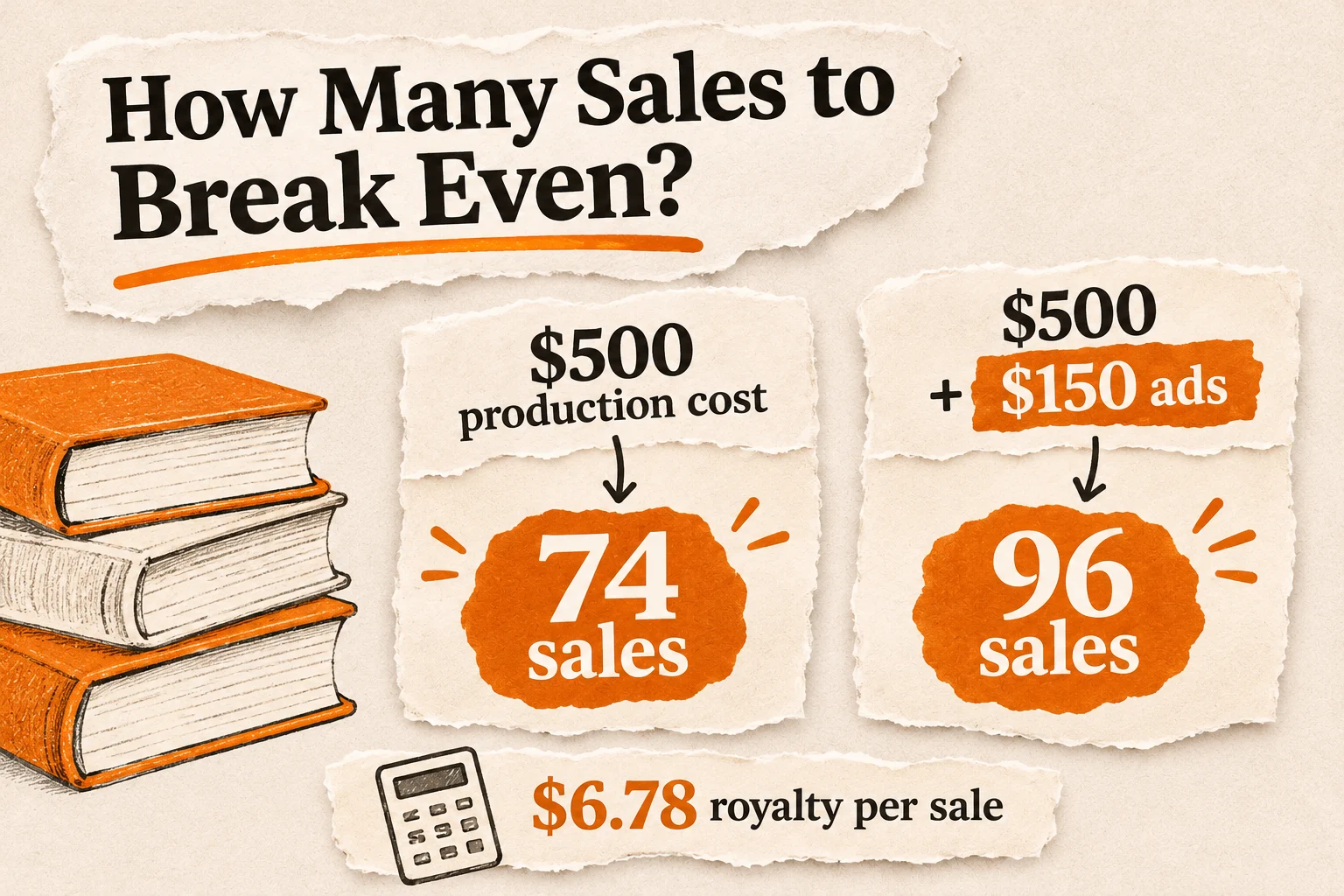
These figures illustrate the calculation, not typical publishing expenses.
AI may reduce what you spend creating a manuscript. It doesn't eliminate the cost of convincing someone to buy it.
For entrepreneurs publishing nonfiction, the real financial challenge isn't getting a book onto Amazon. It's generating enough demand to recover the investment.
Can you legally sell AI-generated books on Amazon KDP in 2026?
Yes. Amazon KDP allows AI-generated books, provided they meet its publishing guidelines. Using AI isn't prohibited, but Amazon requires you to disclose certain AI-created content.
The distinction matters:
AI-generated: Text, illustrations, cover artwork, or translations created by AI. You must disclose this when publishing, even if you substantially edit the output afterward.
AI-assisted: Content you create yourself using AI for brainstorming, proofreading, editing, or refinement. Amazon doesn't require disclosure.
But permission to publish doesn't automatically mean copyright protection.
Under US copyright law, purely AI-generated material generally cannot receive copyright protection. Original human writing, creative editing, and arrangement may qualify, depending on the contribution.
You're also responsible for verifying facts, avoiding plagiarism, and ensuring you have the necessary publishing rights.
Amazon can reject or remove books with misleading descriptions, excessive repetition, inaccurate content, or other quality problems. Mass-producing similar AI books can therefore create compliance risks rather than reliable income.
For entrepreneurs publishing nonfiction, the safest approach is to use AI to support genuine expertise, not replace it. Your research, original frameworks, and editorial judgment give the finished book its value.
What determines whether an AI-published nonfiction book earns money?
Publishing an AI-assisted book is relatively easy. Getting people to buy it is harder.
A nonfiction book's earning potential depends on five factors:
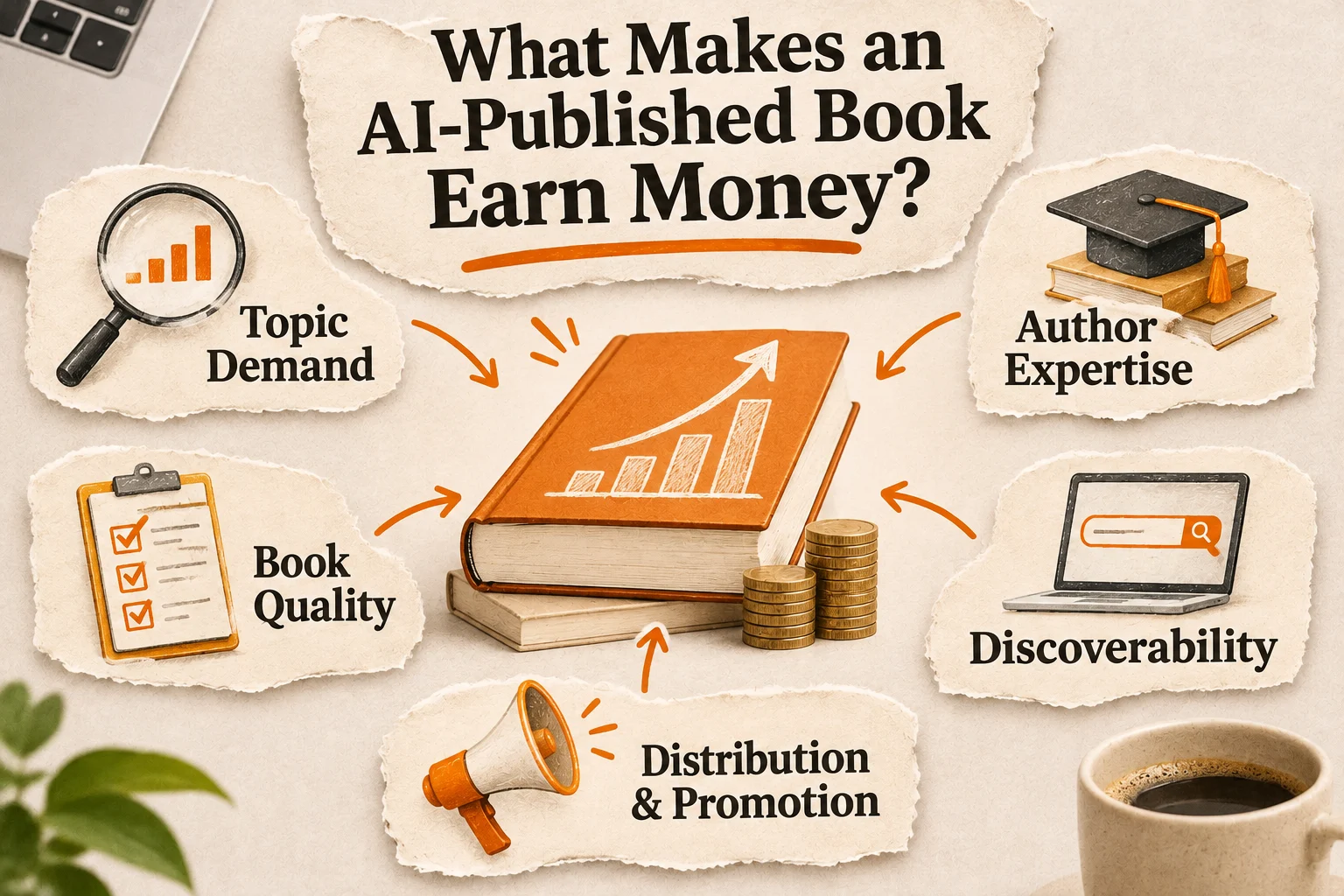
Topic demand. Are people actively searching for solutions to the problem your book addresses? A specific, urgent business problem gives buyers a clearer reason to purchase than a broad topic with no defined audience.
Author expertise. AI can explain familiar concepts, but your experience, case studies, and original frameworks make the content harder to replicate. Readers need a reason to trust your advice.
Book quality. Accurate research, practical examples, useful templates, and professional formatting matter more than how quickly the manuscript was produced.
Discoverability. Your Amazon keywords, categories, cover, title, and product description help potential buyers find and evaluate your book. Visibility matters, but it doesn't guarantee conversions.
Distribution and promotion. An existing audience, email newsletter, professional network, or targeted advertising campaign can bring readers to your Amazon listing.
Amazon recommends relevant keywords and accurate categories to help readers discover books.
A practical book solving one expensive business problem may have a stronger commercial proposition than ten generic AI-generated titles. Specific expertise gives readers a reason to pay.
How can entrepreneurs use AI to publish a book that earns?
AI can speed up nonfiction publishing, but a profitable book still needs a clear audience, credible information, and a reason to buy.
Here's a practical seven-step workflow:
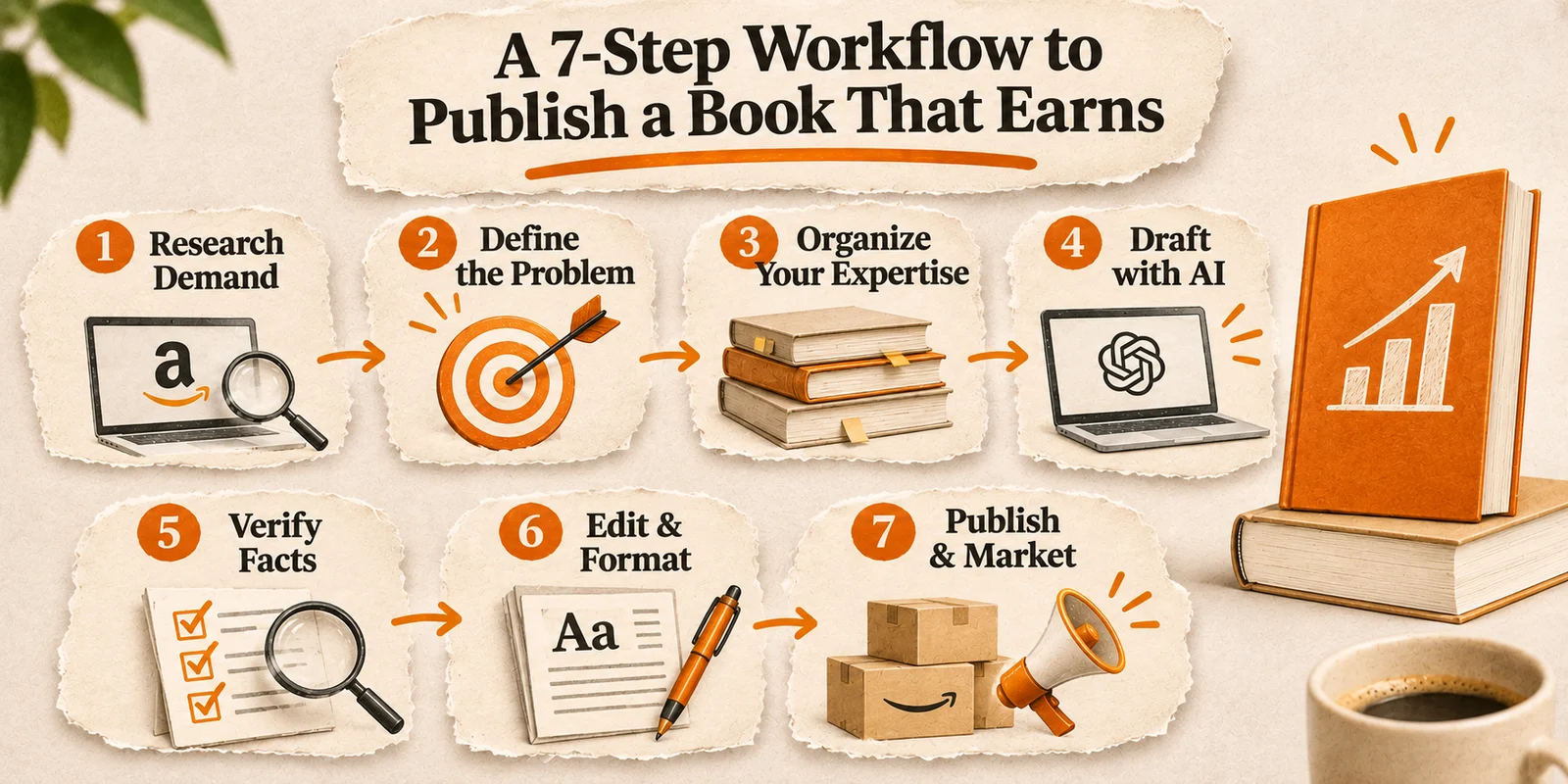
Research demand. Study Amazon categories, competing books, customer reviews, and search queries to identify problems readers already pay to solve.
Define the reader's problem. Choose one specific challenge your book will address. A focused promise is easier to communicate and market.
Organize your expertise. Gather original frameworks, case studies, research, and professional experience before drafting.
Draft with AI. Use AI to structure chapters, develop explanations, and refine your manuscript without surrendering editorial control.
Verify facts. Check statistics, citations, quotations, and technical claims against reliable sources. Never assume AI-generated references are accurate.
Edit and format. Improve clarity, remove repetition, and prepare professional ebook and print layouts.
Publish and market. Upload to KDP, optimize your Amazon listing, and promote the book through relevant channels.
Built&Written can support the manuscript-development stage by helping nonfiction authors organize their source material and work through their drafts. It is not a replacement for checking facts, validating demand, or building a marketing plan. Those decisions remain with the author.
AI can accelerate production. Your expertise determines the book's value, and your marketing determines whether potential buyers discover it.
Frequently asked questions
Yes. Once published, a book can generate royalties without requiring work on every sale. However, maintaining sales may require advertising, listing updates, and ongoing promotion. Passive income is possible, but it isn't guaranteed.
No. Amazon applies the same royalty structure to AI-generated and human-written books. Eligible Kindle ebooks can earn 70% royalties after delivery costs, while other ebooks receive 35%. Paperback royalties depend on pricing and printing expenses.
Yes, but you need sufficient sales. At $6.78 per ebook, approximately 148 monthly purchases generate $1,000 in royalties. This is a hypothetical calculation, not a typical earnings forecast. Advertising and production expenses reduce profit.
It depends on format and price. Selling 100 eligible $9.99 Kindle ebooks with a 2 MB file would generate approximately $678 in royalties, assuming US sales, no applicable VAT, and no price adjustments.
It can be. Profit depends on reader demand, production costs, marketing expenses, and royalties. Books built around credible expertise and practical business problems may offer stronger value than generic AI-produced content.
Yes. Amazon requires disclosure of AI-generated text, images, and translations, including substantially edited AI output. AI assistance with brainstorming, proofreading, or refining human-created content doesn't require disclosure.
Sources & References
About the author

Polina Karlashchuk
More in KDP Publishing
Ready to write your book?
Turn your expertise into a professional book with Built&Written.