
What AI in Publishing Means for Your Nonfiction Book
What is Built&Written? Built&Written is a platform for writing and publishing nonfiction books. Its AI writes a book from material you already have, like posts, notes and talk transcripts, in your voice. If your book is already written, it lays the file out for print without changing a word. On a paid plan, you download a print PDF and KDP files and publish the book yourself. AI-written books download on Entrepreneur and up.
Key takeaways
- Where does Built&Written fit? It writes a book from your own posts and notes, or lays out one you wrote without changing a word, and you publish it.
- Do publishers use AI? Yes. HarperCollins asked authors to license nonfiction titles for AI training, Audible announced AI narration for publishers, and Wiley reported $40 million in AI licensing revenue in fiscal 2025.
- Do publishers run AI detectors on manuscripts? A few do. Penguin Random House uses one as part of its review, according to Jane Friedman's guide. Publishers typically ask you to disclose AI use when it drafts or rewrites your work.
- Can AI-assisted books get copyright? Yes, for the parts you wrote and for your creative selection, arrangement and edits. The US Copyright Office decides this case by case and says prompts alone don't make you the author.
Where does AI in publishing show up today?
AI in publishing is the use of AI tools by publishers, agents and stores at each stage of a book's life. It runs from reading submissions to selling the finished copy. One of those stages is AI licensing: a publisher lets an AI company train its models on books, for a fee.
For an author, the big change is this: depending on your contract, a publisher may be able to translate or narrate your book with AI. For AI training, HarperCollins asked each author first.
Here is where publishers using AI put it today, checked on the source pages on November 4, 2026:
| Stage | What is happening | What it means for you |
|---|---|---|
| Submissions | Business Expert Press refuses manuscripts "generated in whole or in substantial part" by AI | You disclose AI use when you submit |
| Licensing | HarperCollins offered $5,000 per nonfiction title for AI training, $2,500 of it to the author | Your contract may cover AI training |
| Translation | Taylor & Francis plans AI translation for its Routledge and CRC Press books | Check who controls translations of your book |
| Audiobooks | Audible announced more than 100 AI voices for publishers in May 2025 | Your audiobook may be read by an AI voice |
| Retail | Amazon KDP requires you to tell it about AI-generated text, images or translations | You answer the AI question when you publish |
Two stages change the most for authors: translation and audio.
- Translation. Taylor & Francis announced on March 20, 2025 that it will use AI tools to translate nonfiction and academic books into English. Each translation is copyedited, then reviewed by its editors and the book's author before publication.
- Audio. Audible said select publishing partners would be able to make AI-narrated audiobooks, either managed by Audible or on their own. It also announced AI translation of audiobooks as a beta.
If a publisher holds your audio and translation rights, these choices may be theirs to make. If you keep those rights, you make those choices.
Authors use AI too. Of 1,229 authors who answered a BookBub survey, updated November 5, 2025, about 45% said they use generative AI in their work. Most of the authors who answered, 69%, were self-published.
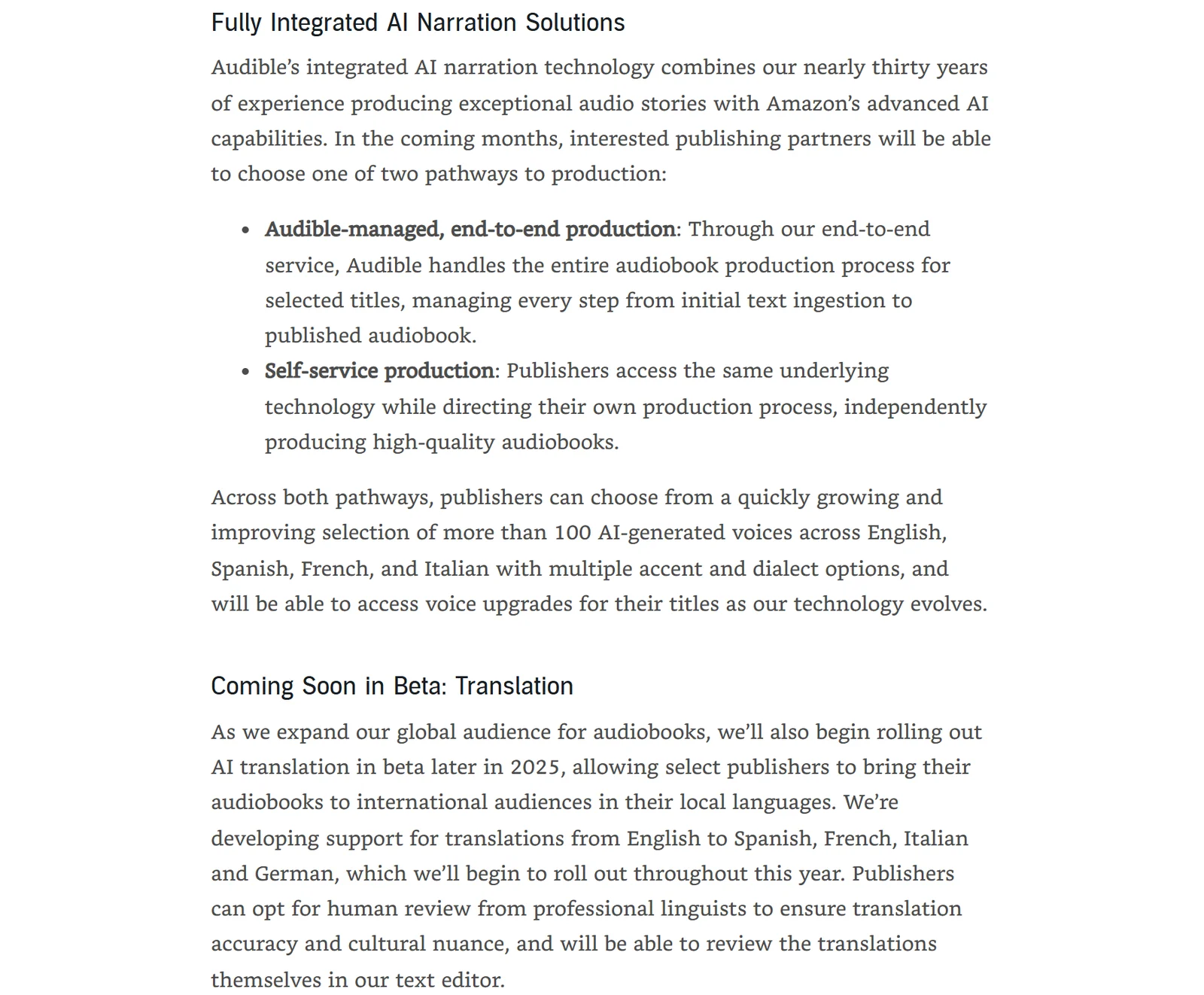
Text in the image: Fully Integrated AI Narration Solutions. Audible-managed, end-to-end production. Self-service production. More than 100 AI-generated voices across English, Spanish, French, and Italian. Coming Soon in Beta: Translation.
Where Built&Written fits
Here is what happens to your book and your rights in Built&Written:
- You keep all rights. The terms give Built&Written only a limited license to process your content to run the service.
- No training on your text. The AI providers that process your text do it under terms with no training on customer data.
- AI works from your material. You paste or upload what you already have, like posts, notes or transcripts. Voice DNA learns your voice from 5 to 50 pages of your writing. The free plan can write one book a month with AI but can't download it. Downloading a book the AI wrote needs Entrepreneur or higher (see pricing).
- No AI, if you prefer. "Format a book you've written" keeps your words exactly and lays the book out for print. If you don't use Ask AI (the editor's menu that rewrites a selected passage), a book made this way can still qualify for the Authors Guild Human Authored mark, explained below.
- You publish it yourself. You download the print PDF and KDP files on a paid plan and upload them to Amazon KDP the same day.
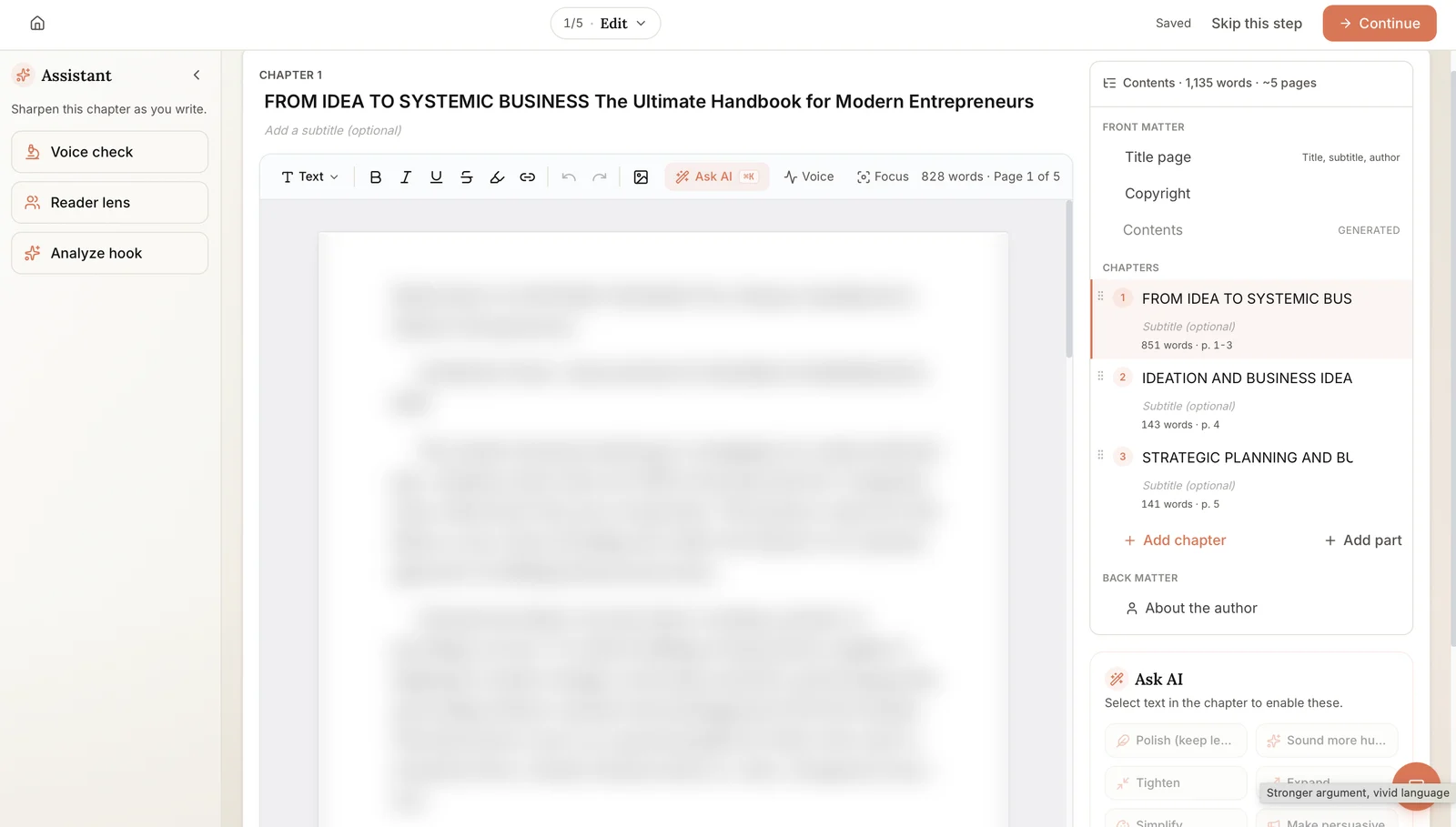
Text in the image: Assistant: Voice check, Reader lens, Analyze hook. Ask AI. Voice. Focus. Contents. Front matter: Title page, Copyright, Contents. Chapters. Add chapter. Add part. Back matter: About the author. Ask AI: Select text in the chapter to enable these. Polish, Sound more human, Tighten, Expand, Simplify, Make persuasive.
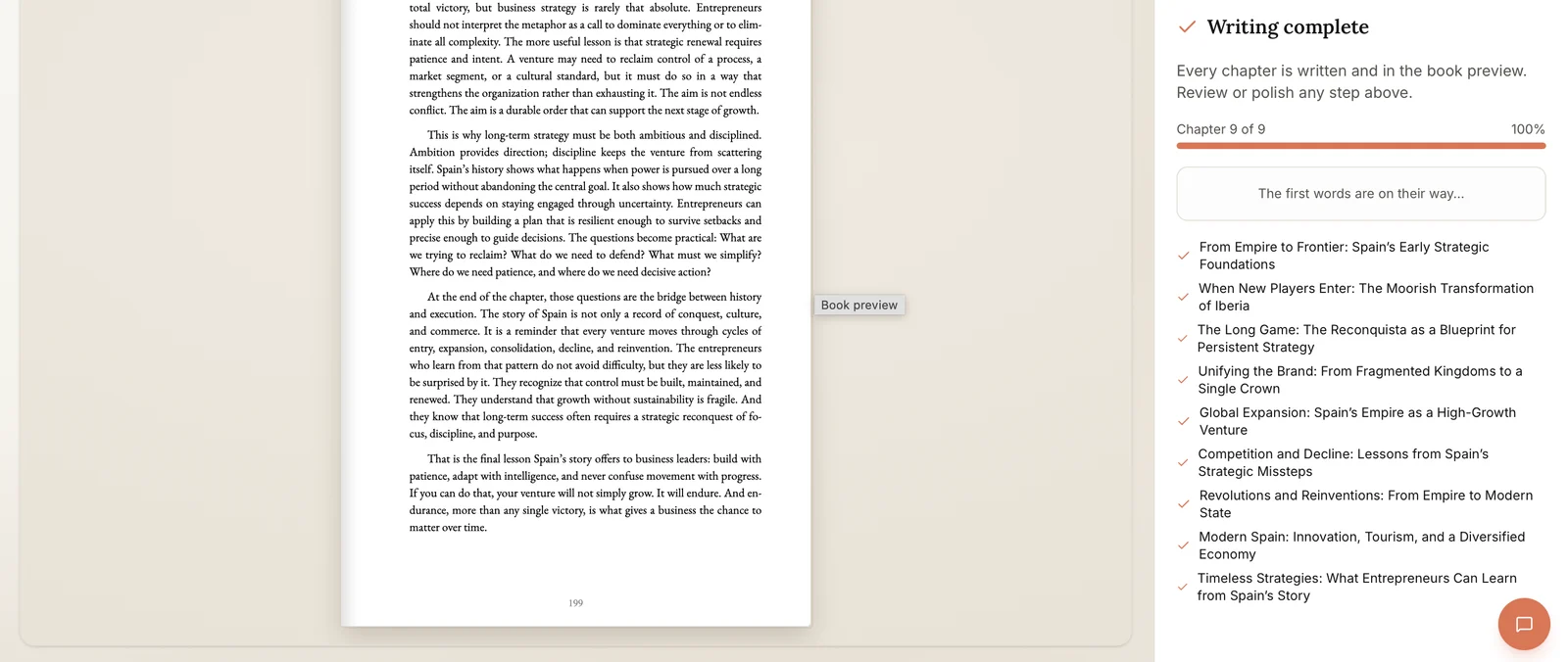
Text in the image: Writing complete. Every chapter is written and in the book preview. Review or polish any step above. Chapter 9 of 9, 100%.
One honest note: if the AI writes your chapters, KDP counts that text as AI-generated, even after you edit it. You tick yes on KDP's AI question. Our guide can you publish an AI-written book on KDP shows that step, and our book disclaimer examples show how to tell readers.
Do publishers use AI detectors?
An AI detector is a tool that guesses whether a text was written by AI. Few publishers say how they check. According to Jane Friedman's AI and publishing guide, Penguin Random House is the only publisher that has said publicly it uses AI detection software, as one part of editorial review. Wiley also screens all submissions with its own tools, which include AI detection. Others count on writers to disclose AI use honestly.
That matters, because detectors make mistakes. In our AI detector accuracy test, ZeroGPT scored a human-written guide from 2011 as 32.7% AI. A publisher who trusted that score could reject an honest author.
Some authors now label their books as written by a human. The Authors Guild runs a "Human Authored" mark. It's for books "not generated by AI." On March 2, 2026, the Guild opened it to all authors published in the US. It's free for members and $10 a title for everyone else. Small fixes from AI spelling and grammar checkers are allowed, and so is AI help with research and outlining.
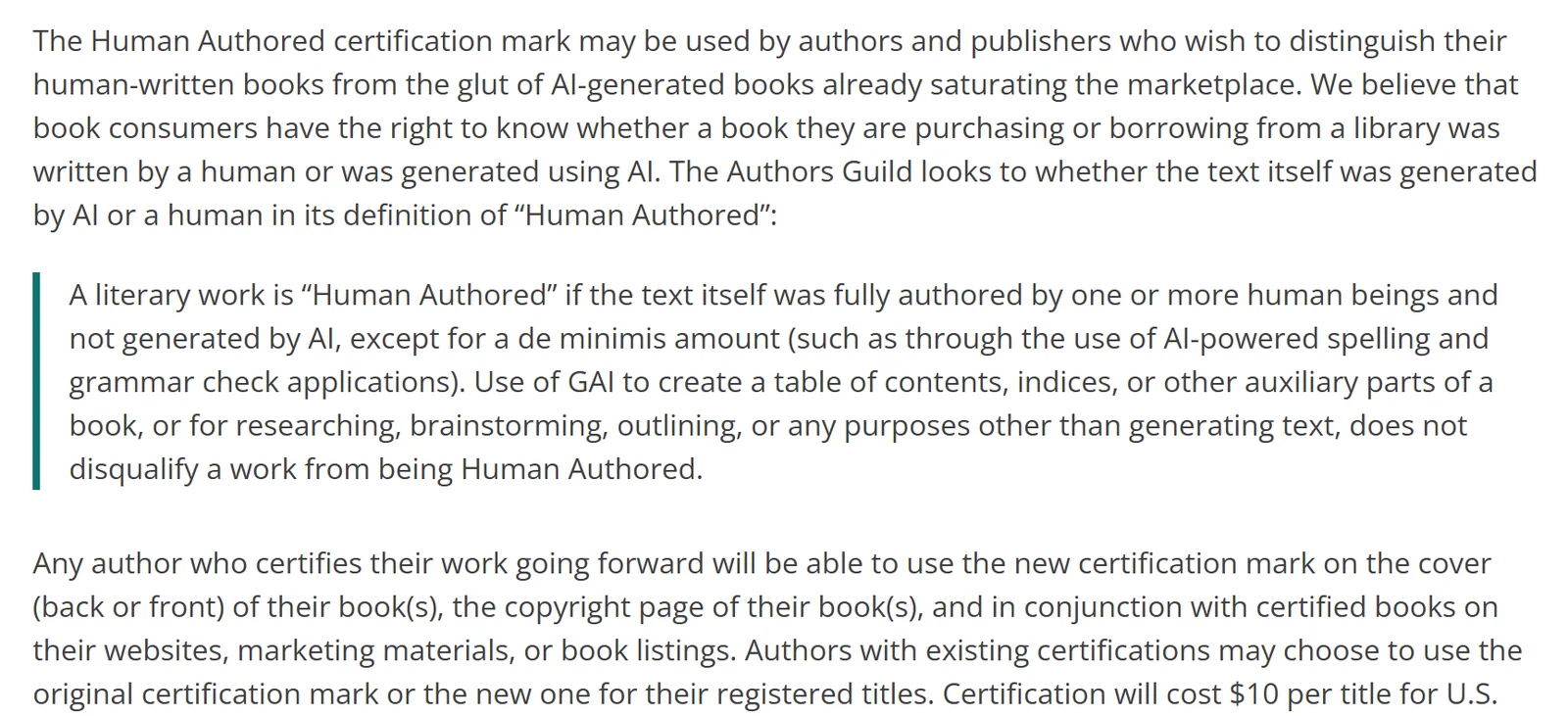
Text in the image: A literary work is "Human Authored" if the text itself was fully authored by one or more human beings and not generated by AI, except for a de minimis amount. Certification will cost $10 per title for U.S.
Will a traditional publisher accept a book written with AI?
Not if AI wrote the chapters, in the policies we found. Business Expert Press bans AI-generated chapter text and allows AI help with grammar and copyediting. It asks you to say what you used. One UK agency, Greyhound Literary, asks that all work submitted to it be "neither generated by nor co-written with AI." If you publish yourself instead, our guide to publishing a book you wrote with AI compares the rules of KDP and other platforms.
The rules sit in two places:
- The submission page. It says what you may use and what you must disclose. Read it before you send anything.
- The contract. Read every clause that mentions AI, including what it asks you to promise about your own AI use.
Getting a deal is hard even without AI, as we covered in our post on falling book deals. For an expert who wants a book for credibility, waiting months for an answer can cost more than it brings.
How is AI in publishing changing book contracts?
AI licensing is a new source of income for publishers, and some of it reaches authors.
- HarperCollins asked authors in November 2024 to opt in to an AI training license for nonfiction titles, for $5,000 per title split 50/50. Publishers Weekly reported a three-year term. It also cited a Bloomberg report, based on an anonymous source, that the buyer is Microsoft.
- Wiley reported $40 million in AI licensing revenue in fiscal 2025 (its business year), up from $23 million the year before.
- Penguin Random House added a line to its copyright pages in October 2024, as Engadget reported: no part of the book may be used to train AI.
Courts have also stepped in. In Bartz v. Anthropic, a court gave final approval on July 20, 2026 to a $1.5 billion settlement. It covers nearly half a million books Anthropic downloaded from pirate sites.
What to check in a publishing contract:
| Clause | Question to ask |
|---|---|
| AI training | Can the publisher license my book for AI training, and do I have to agree first? |
| Payment | What share of any AI fee do I get? |
| Translation | Can my book be translated with AI, and do I approve it? |
| Audio | Can my audiobook use an AI voice? |
| Your promise | What does the contract make me promise about my own AI use? |
Who owns a book you write with AI help?
You do, for the parts that come from you. In its January 2025 report, the US Copyright Office said that "prompts alone" don't make you the author of AI output. It also said that if AI wrote some parts of a larger human work, the parts you wrote can still be protected. Our guide to AI copyright for books covers what you can register and how.
Three habits help you show your own work:
- Keep your source material (posts, notes, talks) with dates.
- Rewrite the chapters in your own words where it matters most.
- Save your versions, so you can show what you changed.
Final thoughts
AI in publishing is already here, mostly in places authors don't see. If you sign with a publisher, read every AI clause. If you publish yourself with Built&Written, AI training, translation and audio stay your call. See how it works.
What Built&Written gives you here:
- Your own cover, if you prefer. Upload a cover you made (PNG, JPG, WebP or PDF) instead of an AI one, so there's no AI image to disclose.
- A no-AI route. Upload a finished manuscript (the full text of your book) and every word stays as you wrote it.
- An outline you approve. You see and edit the outline before any chapter is written, so the structure stays yours.
Frequently asked questions
Some use detection software, and many ask you to disclose AI use. Detectors make mistakes: in our test, ZeroGPT scored a human-written guide from 2011 as 32.7% AI. If a publisher questions your manuscript, show your notes and earlier drafts.
Rarely. The publishers and agents we checked accept AI help with grammar or editing at most, and some accept no AI at all. Amazon KDP accepts AI-generated books if you disclose them. Other platforms set their own rules, and some refuse books made only with AI.
Not so far. Publishers test AI for translation and audio and license books to AI companies. They still choose, edit and sell books.
About the author

Khrystyna Balushka
More to read
Ready to write your book?
Turn your expertise into a professional book with Built&Written.