

Can AI Write Thought Leadership That Still Sounds Like You?
You have real experience and a clear opinion. You ask AI for a LinkedIn post. What comes back is correct and tidy, but it could carry anyone's name. That is the problem this article is about: a text that reads well and still does not sound like the person who publishes it.
On November 11, 2026, we ran one small test to see how far a sample of your writing can fix that. We used the same facts and prompt in two AI chat tools, with and without a sample.
What is Built&Written?
Built&Written is a platform for writing nonfiction books and getting them ready to publish. It writes from notes, posts and talk transcripts (the typed text of a talk) you already have, guided by samples of your writing. It can also format a finished book without changing a word. You get a print PDF and files for KDP (Kindle Direct Publishing, Amazon's service for selling your book), and you upload them yourself.
What is AI thought leadership?
Thought leadership is writing that shares ideas from your own work, so readers start to see you as an expert. A LinkedIn post, a newsletter or a book can all do it. ("AI thought leadership" also means experts who speak about AI. This article is about using AI to write your own.)
Two words matter in the rest of this article. Style means writing habits, such as sentence length and word choice. Voice means style plus your experience, opinions and stories.
How did we test whether AI can sound like you?
We wanted to know one thing. Can AI copy only a person's writing habits, or can it also carry their real voice? Here is the test.
- We made up an author. An operations consultant who writes short, dry, direct posts. We wrote a 490-word sample in that voice. No real person's writing was used.
- We wrote one prompt. It asked for a LinkedIn post of about 300 words on one thesis: forecast meetings fail because nobody owns the number. It gave four facts and said to use only those, with no other facts, names, numbers or stories.
- We ran it in ChatGPT and Claude, once without the sample and once with it. That made four runs.
- We compared the four texts with the sample, and read each one for details that were not in the four facts.
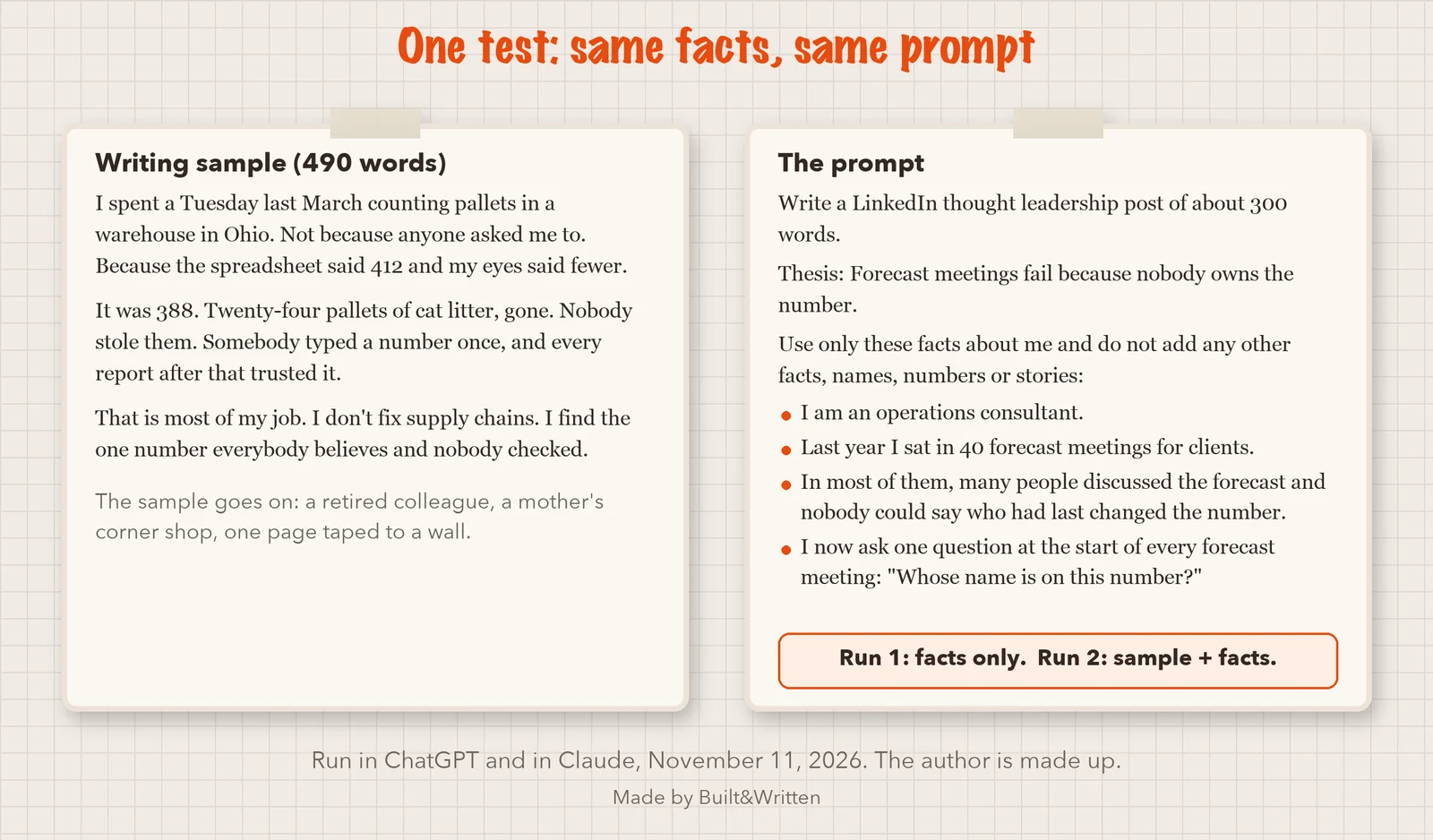
ChatGPT ran in a temporary, "Unpersonalized" chat, so memory could not change the answer. Claude ran in an incognito chat (Opus 5.5, medium effort).
This is one run per setting, one made-up author and one sample. Results change with the prompt wording, the settings and the run itself. Four texts do not prove how AI behaves every time. This test shows what a sample can and cannot change.
Does a writing sample make AI sound more like you?
A little. The sample pulled the rhythm in the right direction in both tools.
| Text | Average sentence (words) | Contractions per 100 words | Sentences of 6 words or fewer |
|---|---|---|---|
| Author's sample | 7.7 | 4.3 | 58% |
| ChatGPT, facts only | 9.8 | 2.0 | 28% |
| ChatGPT, with sample | 8.4 | 2.5 | 56% |
| Claude, facts only | 9.6 | 2.3 | 50% |
| Claude, with sample | 6.6 | 4.6 | 54% |
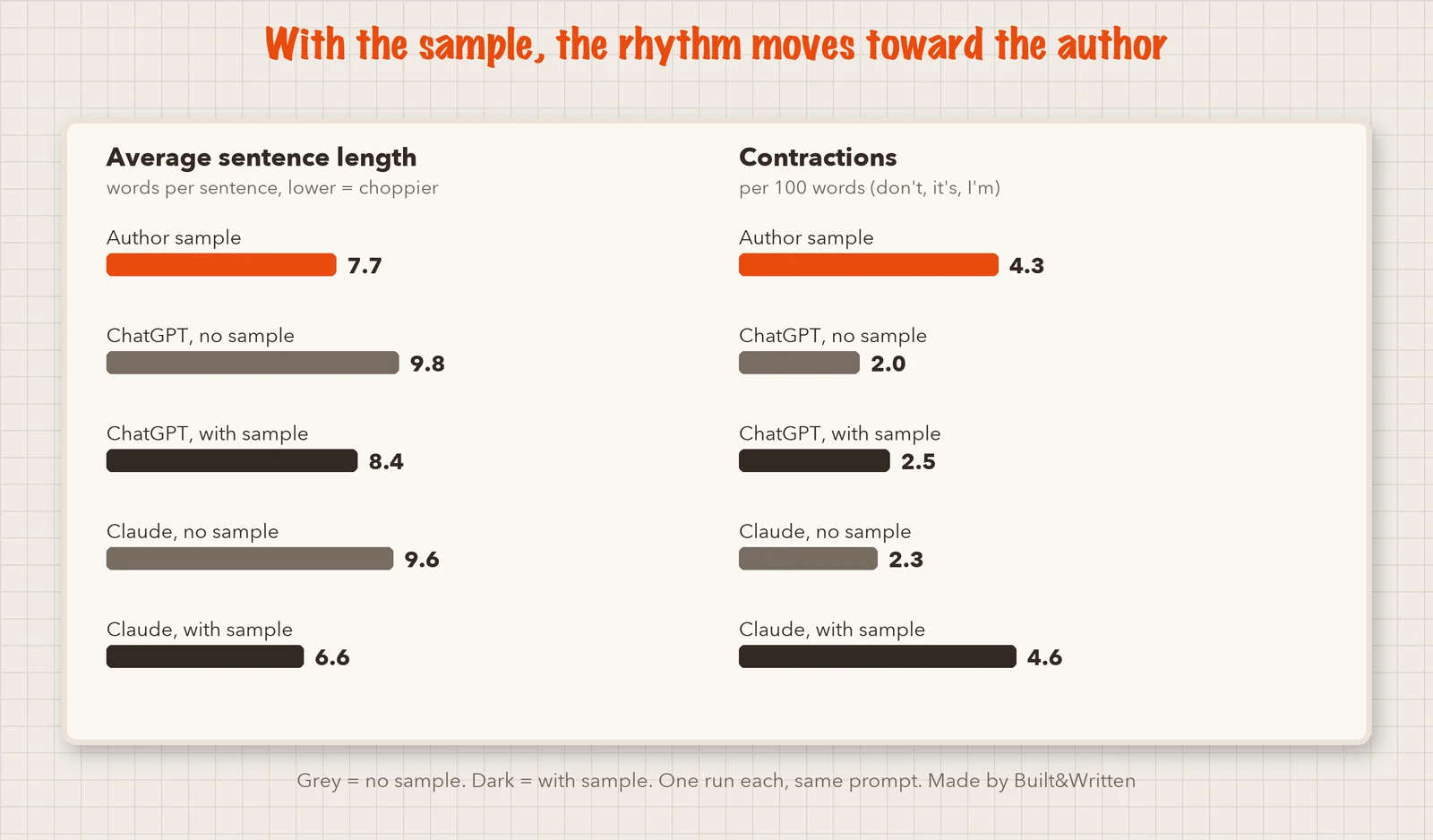
ChatGPT with the sample jumped on short sentences (28% to 56%) but stayed low on contractions. Claude with the sample matched the author's contractions. So a sample shapes rhythm, a big part of why a post sounds spoken.
Read the numbers with care. They measure outside habits only. A shorter average sentence does not mean Claude "learned the voice". It matched one trait of the sample. A voice also includes experience, how a person thinks and what they notice.
What did AI still get wrong?
The habits that are hard to count went wrong. We saw three problems.
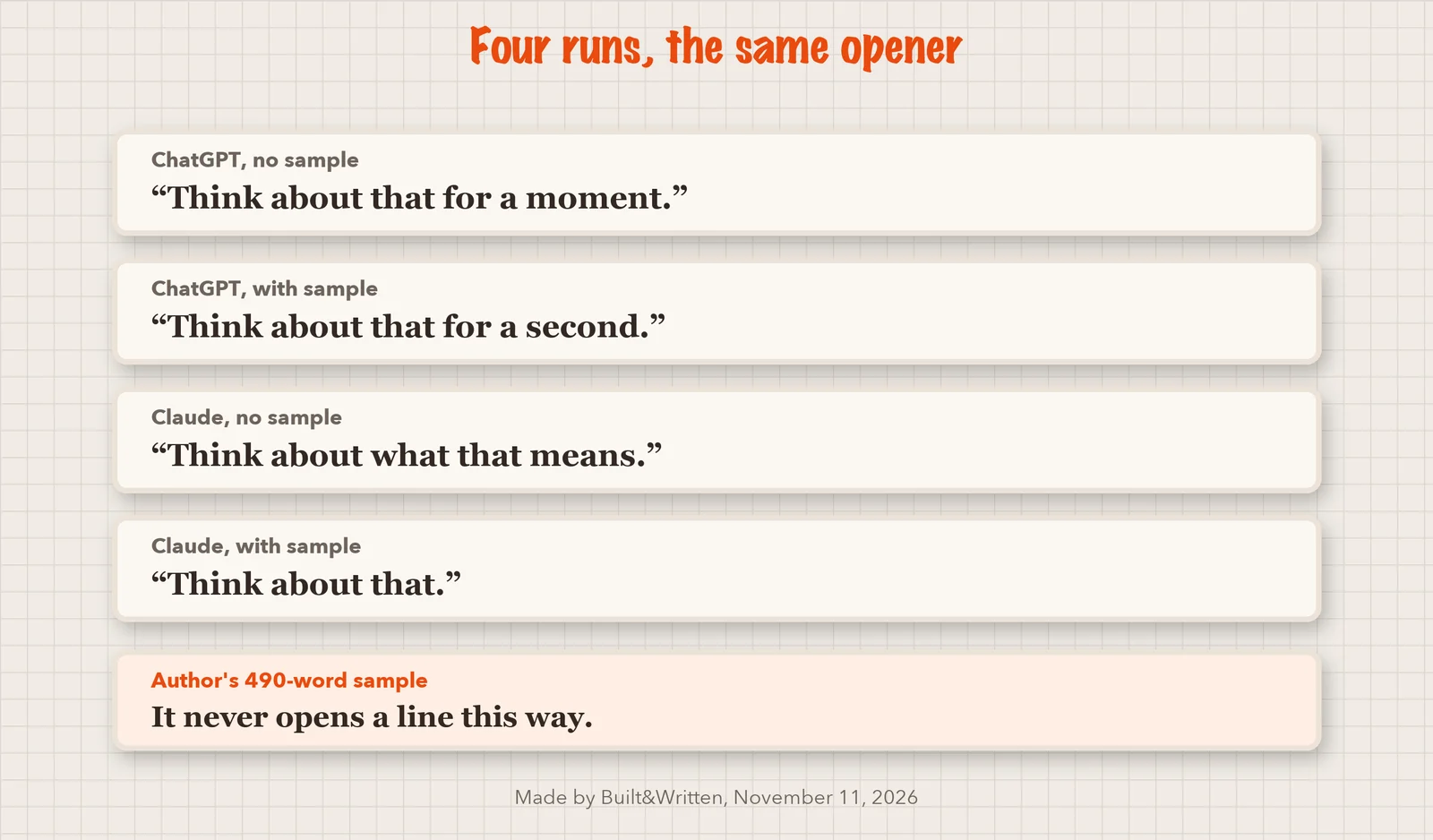
1. The same stock opener, every time. All four runs used a line that begins "Think about that" or "Think about what that means". The author's sample never opens a line like that. The line is grammatically fine, adds no personality and could sit in thousands of LinkedIn posts.
2. Borrowed lines. Both runs with the sample copied the author's joke format. The sample has "That's not a Gary problem. That's a company problem." ChatGPT wrote "That's not a forecasting problem. That's an ownership problem." Claude wrote "That's not a forecast meeting. That's a group chat about the weather." Claude also ended on the sample's word "decoration".
A model can spot a trait in a sample and move it into new text without knowing why the author used it there. Your best line works once. Repeated, it becomes a tic.
3. Invented scenes. We said not to add facts. Here is what happened.
| Run | What it added that was not in the four facts |
|---|---|
| ChatGPT, facts only | Nothing we could find. No new number, name or scene. |
| ChatGPT, with sample | "Twelve people" in the room, a forecast about why "sales were up", and "There is usually a pause". |
| Claude, facts only | A room where sales, finance and operations each "had a view", and meetings that were "sometimes heated". |
| Claude, with sample | The author asking "who changed the number last" before, which changes the order of events, plus "Too high. Too low." and "Sometimes the answer comes right away". |
We judged this by reading each text against the four facts.
None of these is a big lie, but you publish the post under your name. A reader may take "I sat in a room where..." as your real experience, and a reader who was in that room will notice. That makes this a question of trust, which matters more than style.
AI should not invent professional situations, conversations, meetings or personal stories that you did not give it. A tool can help you phrase your story. It should not write your biography.
The author's sample has real stories: 24 missing pallets, a retired colleague, a mother's corner shop. The AI posts have none, because we gave it none.
AI can learn how you write. It cannot know why you write that way. Your experiences, your decisions and your stories still have to come from you.
How does Built&Written help you keep your voice?
A good book needs four things: your own material, a clear structure, your voice, and pages that meet printing and KDP rules. Many professionals already have the first, scattered across LinkedIn posts, notes, slides and the typed text of talks. Built&Written helps with the other three.
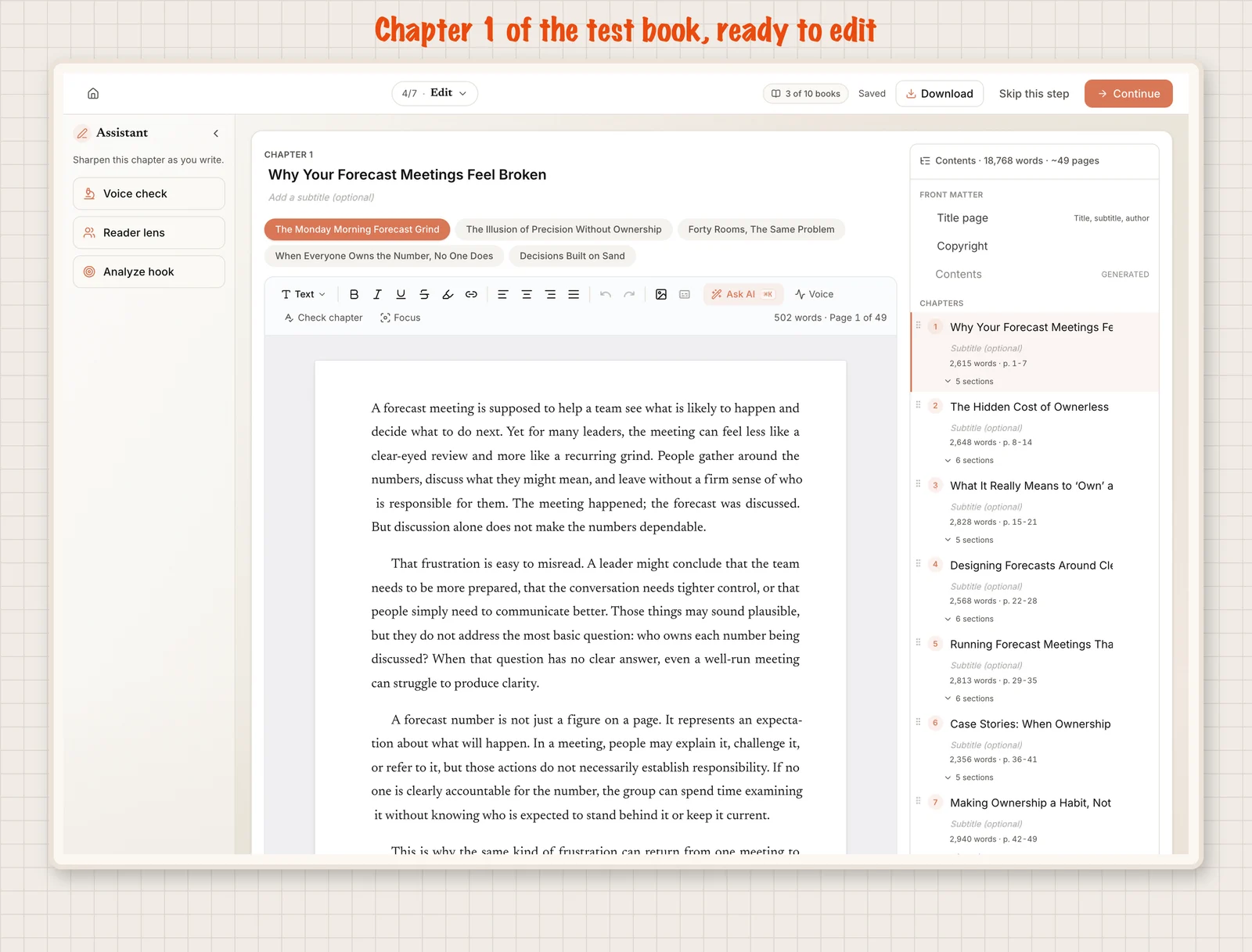
We also put the same facts and the same sample through it. This is a different task from a post: the platform writes a book. From four facts it built a plan and seven chapters, and a first draft is a starting point. With so little material, the platform has little to build on. Your own notes, posts and transcripts, and your edits, are what make the book yours.
You have loose material. Picture a consultant who has posted on LinkedIn for years, kept client notes and has the typed text of a few talks.
- Bring the material. Paste in posts, notes and transcripts. (You paste text. The platform does not turn audio into text.)
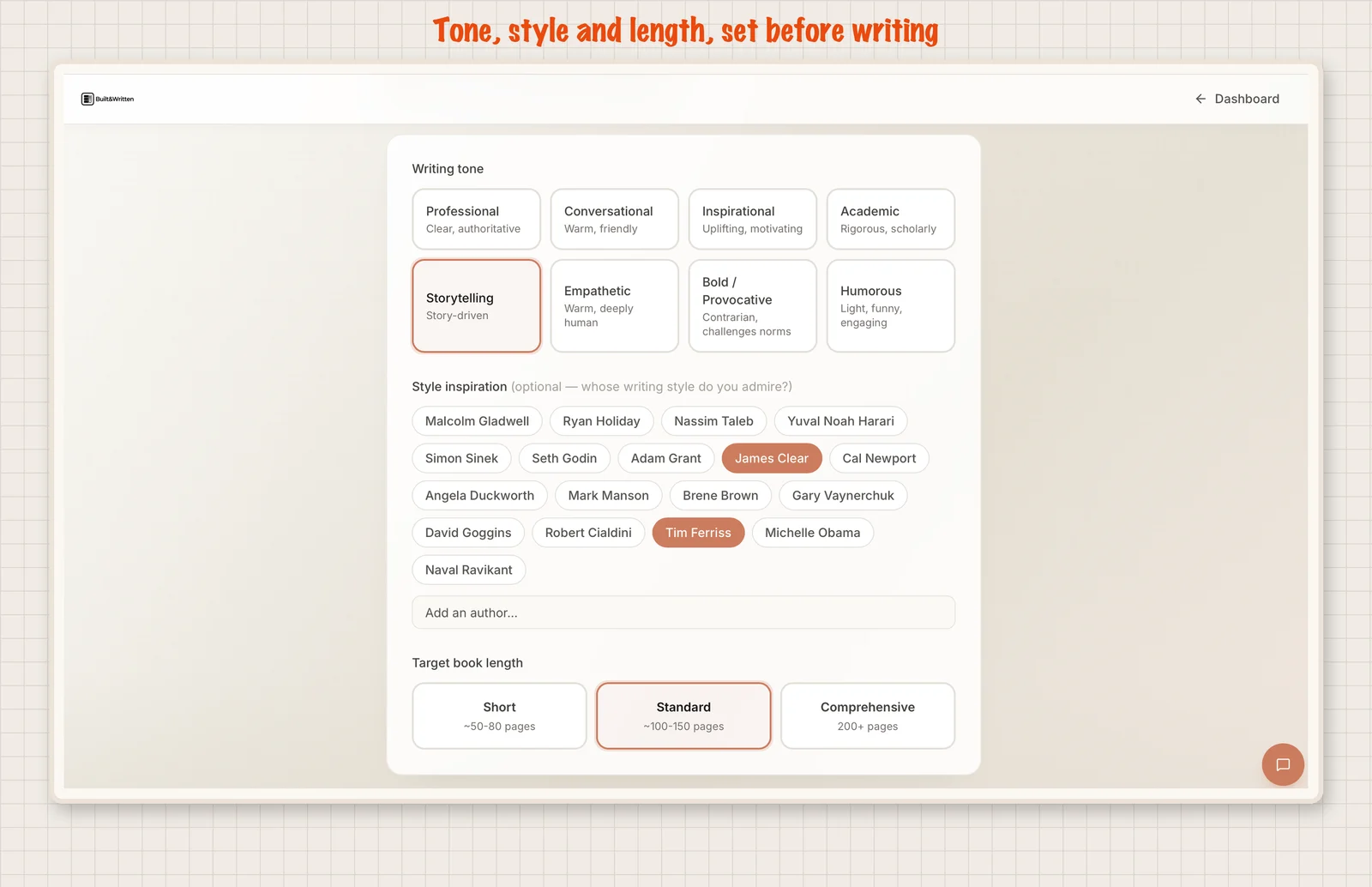
- Choose tone and add samples. Pick a writing tone. Voice DNA (more in what is Voice DNA) uses samples of your own writing as a guide to your style. A few pages of your best work is enough.
- Approve the outline, then edit. You change the outline before any chapter is written, and you can edit any chapter. The Ask AI menu has options such as "Sound more human" for selected text. Review each suggestion before you accept it, as you would a chat draft.
- Download and upload. You download print-ready files for KDP and upload them yourself. Downloads of an AI-written book need the Entrepreneur plan or higher, and so does EPUB (the standard ebook file).
You already wrote the book. Upload the finished manuscript (your complete text) as a .docx, .txt or .md file. The platform lays it out for print and prepares KDP files without changing a word. Downloading print files for a book you uploaded works on any paid plan, from $19/month. You can still edit chapters, change the cover and adjust the formatting.
| Step | By hand | With Built&Written |
|---|---|---|
| Collect material | Search old posts and files | Paste it into one place |
| Keep your voice | Check every line yourself | Voice DNA plus your edits |
| Plan chapters | Outline in a document | Outline you approve first |
| Layout and cover | Set up pages and a cover | Layout and cover made for you |
| KDP files | Export and check sizes | Files made for KDP, you upload them |
The checks help you meet KDP's requirements, but they do not guarantee that Amazon accepts a book. You download the files and upload them to KDP yourself. We promise no sales. See pricing for plans. Free tools help too: the book title generator and the book blurb generator.
What does research say about AI writing and readers?
Our test is small, but the problem is wider than our test. Two published studies add context.
Note: Both studies tested creative writing, such as short stories. They did not test LinkedIn posts or thought leadership. Treat them as hints, not proof of our findings.
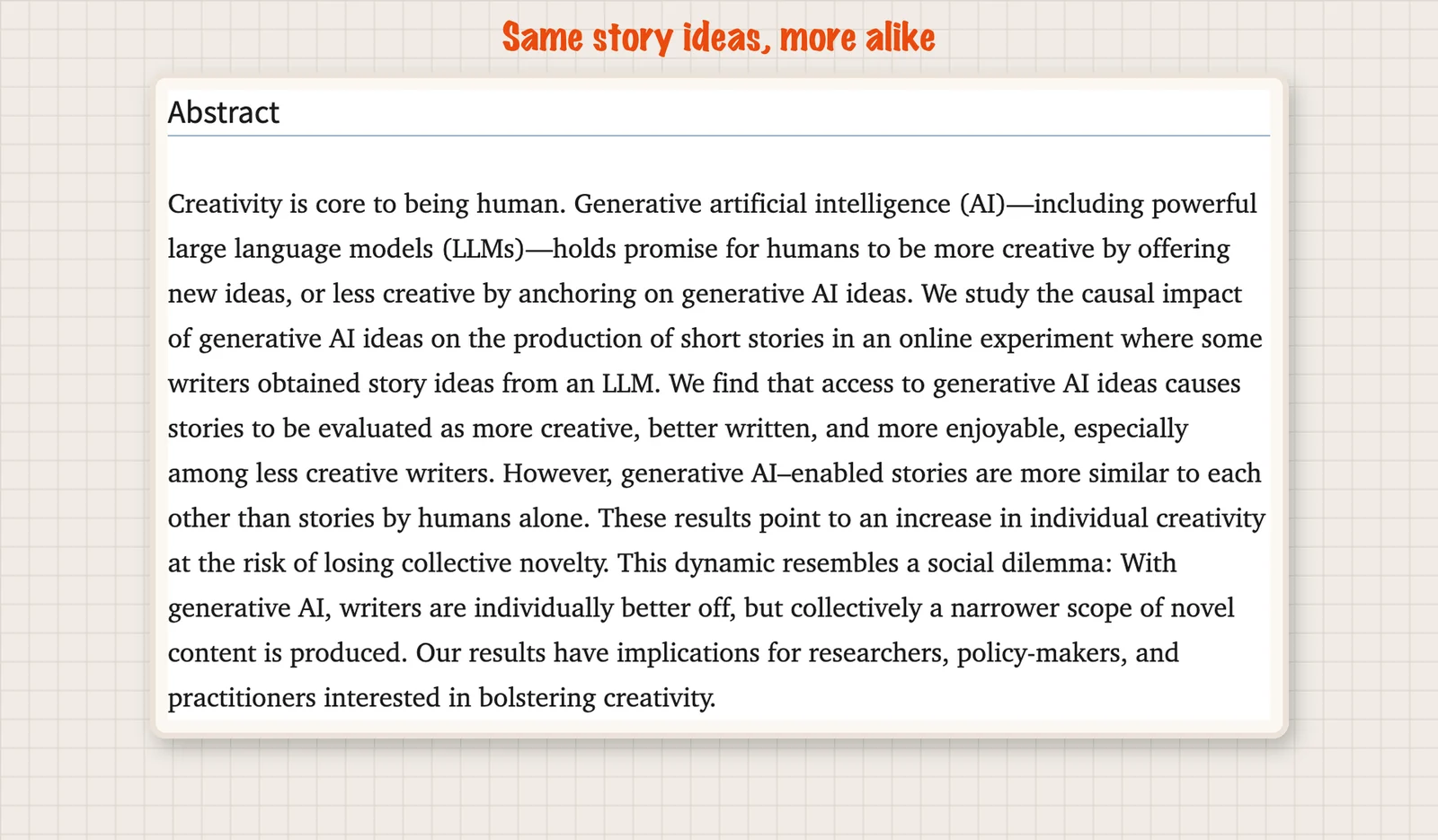
AI makes writing more alike. In a 2024 experiment in Science Advances by Anil Doshi and Oliver Hauser, some writers got story ideas from an AI. Their stories were rated as more creative, but the stories were "more similar to each other than stories by humans alone". (PubMed page, checked November 11, 2026.)
Readers mark writing down when they think AI wrote it. A 2026 paper in the Journal of Experimental Psychology: General by Manav Raj, Justin Berg and Rob Seamans ran 16 preregistered experiments with 27,491 people. (Preregistered means the plan was published first.) Ratings dropped when people believed AI wrote or helped. The effect ran through perceived authenticity and persisted across many tests. (PubMed page, checked November 11, 2026.)
Both studies show a risk: AI makes writing more alike, and readers rate it lower when they think AI helped. Our test shows what you can control: your own stories and facts.
LinkedIn's User Agreement (effective November 3, 2025) says to review and edit content made with LinkedIn's own AI features before you share it. We did not check its other policies. This is not legal advice.
How can you write thought leadership with AI and still sound like you?
Here is one way to work, from start to finish, with a plain AI chat tool.
- Write your facts first. List what happened, with real numbers and names you may use. AI cannot know them.
- Add one story only you could tell. A consultant writing about client work should give the AI a real situation, the problem, the fix, the result and their own takeaway. A topic alone gets a general text.
- Pick a sample. Paste two or three pieces you wrote. About 500 words is a rough guide, not a magic number, because quality and variety matter as much as length. Include a text where you explain a hard idea in your natural way.
- Ask for a draft with a hard limit. Say "use only these facts", name them and set the length. This cuts down invented scenes.
- Cut the stock and borrowed lines. Delete openers like "Think about that" and any line you would never say.
- Check every added scene. If the draft names an event, conversation, number or personal case, you must be able to say where it came from. If you cannot, remove it or use the real story.
- Read it aloud. If you stumble, rewrite the line.
AI does the shaping. You supply the substance.
Final thoughts
Can AI write thought leadership that still sounds like you? It can copy some of your habits if you show it a sample. It cannot copy your life. Good writing in your name starts with your real experience, and no clever prompt replaces that.
Your posts, notes and ideas may already hold the base of a book. Built&Written helps you bring them together and shape them into chapters, and you stay involved at every step. In short:
- You start from your own material.
- You approve the outline and edit any chapter, the cover or the formatting.
- Layout, cover and KDP readiness checks are done for you.
- You download files for KDP and upload them to your own account.
Frequently asked questions
It can write a draft. In our test, it matched some of an author's habits when given a sample, and it also added scenes that never happened. Give it your facts and stories, and treat its draft as a first version you edit. On the ethics, see whether it is ethical to use AI to write when the ideas are yours.
We can only tell you part of the answer. LinkedIn's User Agreement (checked November 11, 2026) says to review and edit content created with LinkedIn's own AI features before you share it. We did not check LinkedIn's other policies, so read them before you rely on this.
We know of no way to tell from the words alone that works every time, and we did not test AI detectors. What research shows is how readers react when they believe AI helped: they rate creative writing lower, because it feels less authentic. Your own stories and numbers are what you can control, but the study found the penalty hard to remove.
There is no magic number. We used 490 words and saw some change. We did not test other sizes. Choose pieces that sound like you, and expect to edit.
No. A ghostwriter is a person. AI writes from what you give it. See what an AI ghostwriter can and cannot write.
Yes, if you start from your own material. Built&Written builds a book from notes, posts and transcripts, you approve the outline, and you publish it yourself on KDP.
Sources & References
- Doshi and Hauser, Generative AI enhances individual creativity but reduces the collective diversity of novel content, Science Advances, 2024
- Raj, Berg and Seamans, The artificial intelligence disclosure penalty, Journal of Experimental Psychology: General, 2026
- Doshi and Hauser, full text in PubMed Central
- LinkedIn User Agreement, effective November 3, 2025
- Amazon Kindle Direct Publishing
About the author

Khrystyna Balushka
More in AI Book Tools
Ready to write your book?
Turn your expertise into a professional book with Built&Written.