
You know the chapter. Every fact is right. Every point from your outline is there. And reading it feels like reading a manual for a dishwasher.
The instinct is to rewrite it from the top. Don't. A flat chapter almost never needs new content. It needs a handful of small, targeted edits in the right places.
This guide gives you seven of them. Each one has a before and after, the prompt to paste into ChatGPT or Claude, and the editor action to use if you work in a book editor. Do them one paragraph at a time and the chapter you have becomes the chapter you meant.
What makes a chapter flat?
A flat chapter is one where every sentence is correct and nothing pulls the reader to the next one. It is not wrong. It is just even: the same sentence length, the same safe claims, the same summary at the end of every section.
It usually comes from one of three places. A first draft written to get the ideas down. An AI draft with no stories of yours in it. Or a chapter you have revised so many times that every edge got sanded off.
If you are not sure your chapter is flat or sounds like AI, run the checklist in our six signs your writing sounds like AI first. This guide starts where that one ends: you know it is flat, and you want the fastest fix.
How to make a targeted edit without breaking the chapter
A targeted edit changes one thing in one passage and leaves the rest alone. That is the whole difference from a rewrite.
When you ask an AI to "make this chapter better," it changes everything at once. Your facts move. Your phrasing goes. You spend an hour checking what it touched. When you ask it for one change on one paragraph, you can see the result in ten seconds and keep it or throw it away.
Three rules keep it safe:
- One paragraph, one edit. Select a passage, not the chapter.
- Say what must not change. End every prompt with "Keep every fact. Change nothing else."
- Compare before you accept. Read the new version against the old one. If a fact, name or number moved, reject it.
In a book editor with built-in rewrite actions, the third rule is built in when nothing changes until you accept. In ChatGPT or Claude, paste the paragraph and the prompt, then paste the result back yourself.
The seven edits, one at a time
Every example below is written for this guide to show the shape of the edit. None of them is a real author's text.
1. Open in the middle
Most flat chapters warm up before they start. The first paragraph explains what the chapter is about, and the real opening sits in paragraph three.
Before: "Communication is something we all do every day, at home and at work. In this chapter, we will look at why listening matters so much."
After: "My manager listened to my whole pitch, nodded, and asked one question. It was the only question that mattered."
Find your first concrete sentence, a moment, a number or a claim, and start there. The "after" above only works if the moment is yours, so take it from your notes, never from the AI.
Prompt: "Delete every sentence before the first concrete one: a scene, a number or a specific claim. Do not add anything. Keep every fact."
Editor action: Tighten on the opening paragraph, then paste your own first line by hand.
2. Replace the abstract claim with your own example
Flat writing tells. "Many clients struggle with delegation." Readers nod and forget it. One real case does the work of a page of claims.
Before: "Many business owners find it difficult to delegate, which can limit their growth."
After: "One client signed every invoice herself for six years. The week she stopped, she got back nine hours."
The danger is obvious. Ask an AI for "an example" and it will invent one, with a name and a number that never existed. So give it yours.
Prompt: "Here is a real case from my notes: [paste the case]. Rewrite this paragraph around it. Use only facts that are in the case."
Editor action: Add example, then replace whatever it invents with your real case.
3. Move the payoff up
In a flat section, the best sentence is often the last one. The reader has to wade through the setup to reach it, and many stop before they do.
Before: three sentences of background, then "So raise the price before you add the feature."
After: "Raise the price before you add the feature." Then the three sentences of background, now as the reason.
Prompt: "Which sentence in this section is the main point? Move it to the first line and keep the rest in order. Change no other words."
Editor action: None needed. This is a cut-and-paste, so do it by hand. It takes ten seconds and no AI is safer.
4. Vary the rhythm
When every sentence runs about 18 words, the page hums at one note. Readers feel it before they can name it.
Before: "The first step is to track your spending for a month. The second step is to sort each expense into a category. The third step is to decide which category to cut first."
After: "Track every dollar for a month. Then sort it. Housing, food, the subscriptions you forgot. Now pick one category to cut, and only one."
Prompt: "Rewrite this paragraph so the sentence lengths vary: some very short, one longer. Keep every fact and every number. Do not add examples."
Editor action: Polish. On our editor page it is labelled "Polish (keep length)," so the paragraph does not grow.
5. Commit to the claim
Hedges flatten a chapter faster than anything. "It may be helpful for some readers to consider" tells the reader you are not sure. If you are sure, say so.
Before: "It may be helpful for some people to consider possibly setting aside a little time each week for review."
After: "Block 30 minutes every Friday for review. Put it in your calendar now."
The US government's plain language guide makes the same point about voice: "Active voice makes it clear who should do what." A reader who knows what to do keeps reading.
Prompt: "Remove every hedge (may, might, possibly, some people) where the claim is something I am sure of. Use active voice and talk to the reader as you. Keep every fact."
Editor action: Make persuasive. Check the result: it can overstate a claim you meant as a maybe.
6. Swap jargon for plain words
Jargon is flat because it is abstract. "Stakeholder alignment" has no picture in it. The same guide warns about hidden verbs, the nouns that bury an action, because they make writing "weak and longer than necessary."
Before: "Facilitate stakeholder alignment through the implementation of iterative feedback loops."
After: "Ask your team what they think every Friday. Then change one thing."
Prompt: "Rewrite this in plain words a smart 14-year-old would understand. Turn nouns that hide an action back into verbs. Keep every fact and the technical terms my reader needs."
Editor action: Simplify. Keep the words your reader will meet elsewhere, like "ISBN" or "trim size," and explain them once instead.
7. Cut the recap ending
Flat chapters end each section by telling the reader what they just read. AI drafts do it almost every time. The reader already knows. The recap only slows them down on the way to the next idea.
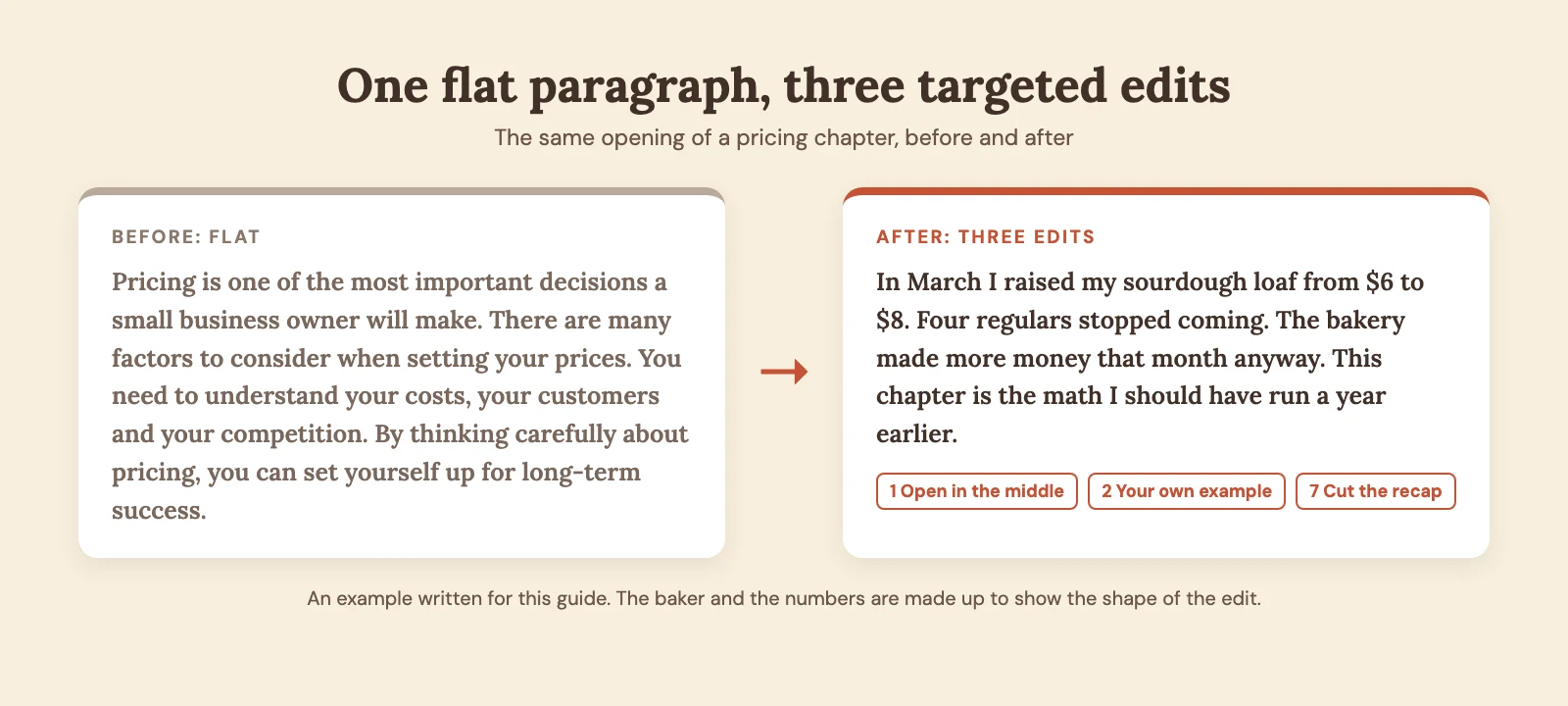
Before: "To wrap up, we have seen that pricing affects revenue, customer trust and growth. By keeping these ideas in mind, you will be ready for the next step."
After: delete it. End the section on its strongest sentence, or on the question the next section answers.
Prompt: "Does the last paragraph of this section only repeat earlier points? If yes, delete it and tell me what you deleted. Change nothing else."
Editor action: Tighten on the last paragraph, or Sound more human if you want to keep a closing line but lose the stock phrasing.
Which edit should you try first?
Match the symptom to the edit. You rarely need all seven on one chapter.
| What you notice | Try this edit first |
|---|---|
| Nothing happens in the first page | 1. Open in the middle |
| You agree with every line and remember none | 2. Your own example |
| The best line is at the bottom | 3. Move the payoff up |
| It reads like a list, even in paragraphs | 4. Vary the rhythm |
| It sounds unsure of itself | 5. Commit to the claim |
| A smart friend would ask "meaning what?" | 6. Plain words |
| Every section ends the same way | 7. Cut the recap |
| One section is three sentences long | Expand, with your own notes pasted in |
Work in that order inside a chapter too. Openings and examples change how the reader feels about everything after them. Rhythm and recaps are the polish.
What these edits can't fix
Targeted edits fix how a chapter reads. They can't fix what it says.
If the chapter makes two arguments that belong in two chapters, no edit will save it. Go back to the plan. Our book outline template helps you split it. If the chapter has facts you have not checked, polishing them makes the mistakes more convincing, not less.
Check every number, name and example the AI touched. Rewrite tools can add a detail that was not in your text, especially when you ask for an example. Keep only what you can stand behind.
Checking a whole AI-written draft is a bigger job. Our guide on how much of an AI-written book you still have to fix covers facts, repetition and voice drift. And if you want to compare tools before you pick one, we gave four AI book editors the same chapter.
Do you have to disclose AI edits on KDP?
Not for edits to your own writing. Amazon's KDP Content Guidelines call it "AI-assisted" when you wrote the content yourself and used AI tools to "edit, refine, error-check, or otherwise improve" it. The page says it is not necessary to inform Amazon about that.
The line moves when the AI writes the text. If an AI tool created the actual content, KDP counts it as AI-generated even after heavy edits, and you disclose it. So the seven edits above, run on your own draft, stay on the assisted side. Asking an AI to write a new section from nothing does not. Our article on KDP's AI disclosure rules covers the checkbox in full.
Making these edits in Built&Written
If your manuscript lives in Built&Written, the rewrite actions above are built into the editor. Our AI book editor lets you select a passage and pick Polish, Tighten, Simplify, Expand, Make persuasive, Sound more human or Add example. It shows the new version, and nothing changes until you accept.
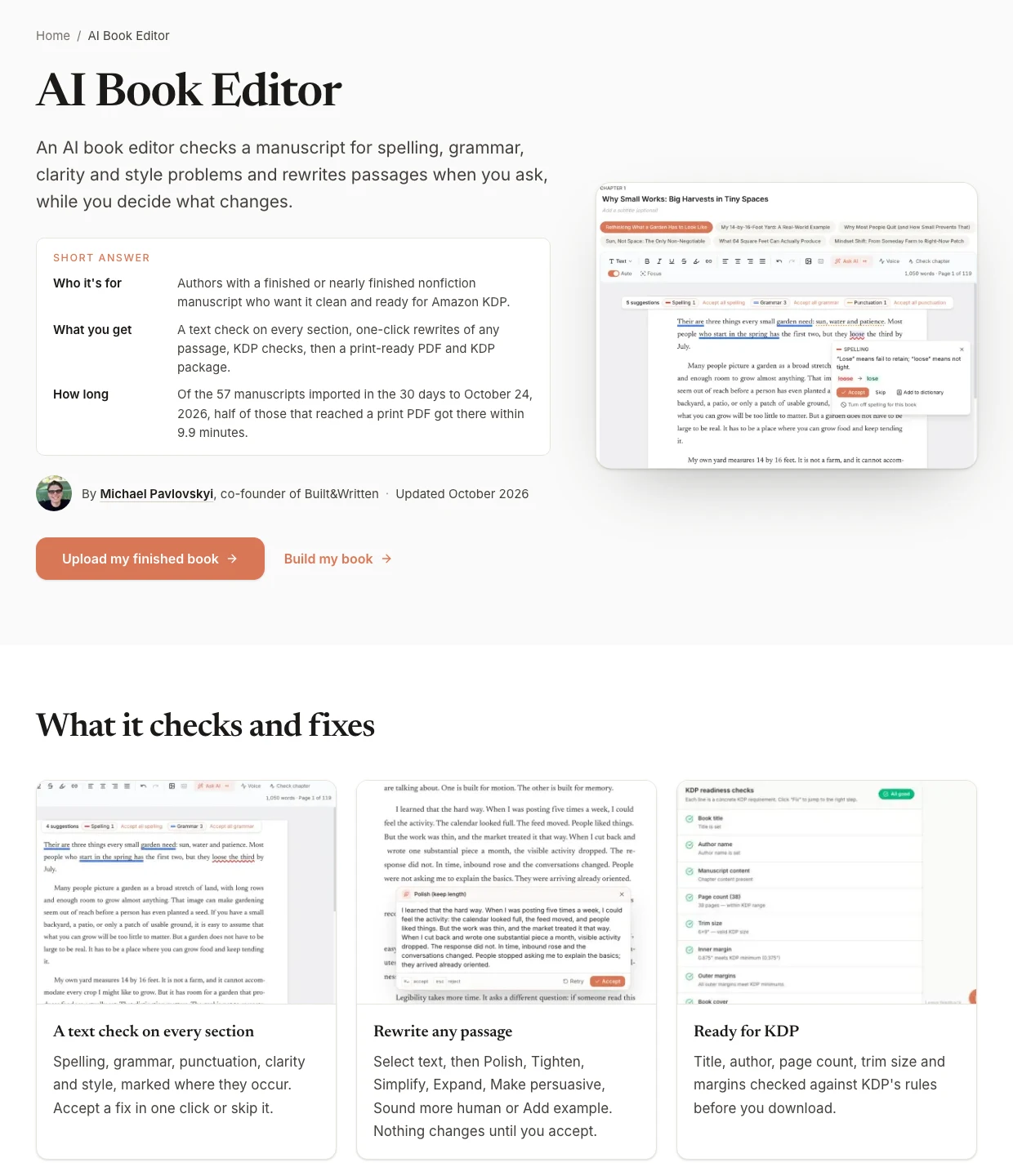
The editor also runs a text check on each section for spelling, grammar, clarity and style, which you accept or skip one fix at a time. The one edit it can't do for you is the one that matters most: putting your own stories in. That part is yours.
If your chapter was written by Wren, our writing AI, a few pages of your own writing teach it your voice before it drafts. That is the point of Voice DNA, and it means fewer flat chapters to fix later.
It is $49/month for AI-written books ($19/month for your own manuscript). Every plan comes with monthly credits for the AI, and you see what a book will cost before Wren writes it.
Sources & References
- Amazon KDP, Content Guidelines: https://kdp.amazon.com/en_US/help/topic/G200672390
- Digital.gov, Writing for understanding (plain language guide): https://digital.gov/guides/plain-language/writing
- Built&Written, AI Book Editor: https://www.builtwritten.com/ai-book-editor
Frequently asked questions
No. KDP's Content Guidelines say that if you used an AI tool to brainstorm and generate ideas but created the text yourself, the content counts as AI-assisted, not AI-generated. KDP says it is not necessary to inform it about AI-assisted content. The disclosure applies when an AI tool created the actual text, images or translations.
Using an AI tool to error-check writing you created yourself falls under what KDP calls AI-assisted content. KDP's guidelines name editing, refining and error-checking as AI-assisted uses, and say you are not required to disclose them. You are still responsible for making sure the final text follows KDP's content guidelines.
In active voice the subject does the action: "We proposed new regulations." In passive voice the action happens to the subject, and the doer can disappear: "New regulations were proposed." The US government's plain language guide recommends active voice because it makes clear who should do what, which also makes a chapter easier to follow.
A hidden verb is an action buried inside a noun. "We conduct an analysis of the data" hides the verb "analyze" in "analysis"; "We analyze data" brings it back. The Digital.gov plain language guide says hidden verbs make writing weak and longer than necessary, and fixing them often removes other wordy phrases and passive verbs at the same time.
Yes, with limits. Our AI Book Editor page says the free plan lets you use Ask AI and run the text check on a limited number of sections. Downloading the finished files needs a paid plan. Editing your own manuscript and exporting it is the Author plan, $19/month for your own manuscript.
Sources & References
About the author