

Can You Write a Memoir with AI and Still Make It Your Own?
Key takeaways
- What can AI do in a memoir? Sort memories into chapters, draft from text you already wrote and tighten sentences. Tools like Built&Written work from the material you paste in.
- What stays yours? The memories, what they meant to you, and the facts: names, dates, places and what people said.
- What is the real risk? Invented details that sound true. Check every one against a journal, photo, letter or witness.
- Who owns it? The US Copyright Office protects what you wrote, selected, arranged or changed. Text the AI wrote alone has no copyright.
What happens when memoir AI fills in the gaps?
AI is good at ordering memories, drafting from your words and tightening sentences. It is bad at the one thing a memoir can't fake: knowing what really happened.
An experiment from 2021 shows why. In August 2021, the journalist Vauhini Vara published "Ghosts" in The Believer, an essay about her sister, who died of a bone cancer called Ewing sarcoma. Vara wrote the first sentences of each part. GPT-3, an early AI model from OpenAI, wrote the rest, and she barely edited it.
The AI invented. In one version, the narrator says she ran across America in 1978. In another, her sister takes her hand at a red light on the way home from the beach. Both lines came from the machine, not from Vara's life.
An AI hallucination is a detail a model states with confidence that never happened. In a memoir, it's a false statement about your own life, and maybe about someone else's. The AI writes what sounds true. Only you know what is true.
Which parts of an AI memoir should still be yours?
Hand AI the jobs that need patience, whether you use a chat tool or a book app. Keep the jobs that need your life.
| Part of the work | Who does it | Why |
|---|---|---|
| Remembering what happened | You | Only you were there |
| Deciding what it meant | You | The meaning is the reason for the book |
| Names, dates, places, quotes | You | AI fills gaps with guesses |
| The hardest scenes | You first | They need your exact words |
| Sorting memories into chapters | AI can help | A long list is easier to order with help |
| First draft from your notes | AI can help | It starts from your sentences |
| Tightening a slow passage | AI can help | You compare before and after |
| Checking the final text | You | Only you can say "that didn't happen" |
If you haven't planned your memoir yet, start with our guide on how to write a memoir, then come back for the AI part.
The Authors Guild, a US organization for professional writers, says the same in its May 2026 best practices. If you claim authorship, "don't let AI replace your unique voice, thinking, and creativity." It also tells authors to fact-check every AI output.
How does your voice survive an AI draft?
Your voice is how you sound on the page: your words, your sentence length, what you notice. AI drafts lose it when they start from a short prompt and smooth every line into the same polite tone.
Five habits keep it:
- Start from your own text. Journal entries, letters, emails and old posts. A draft built from your sentences keeps many of them.
- Show the tool how you write. Give it a few pages of your best writing. A letter to a friend beats a work report, because it sounds like you talking.
- Pick the tone first. A memoir usually wants a storytelling tone. An inspirational tone can make a sad chapter sound like a pep talk.
- Keep what people really said. Use dialogue only from memory you trust or from writing you have.
- Read every line out loud. If you would never say it, rewrite it.
Many published authors use AI this way: for research and language help, while the sentences stay theirs.
How do you catch details an AI memoir generator made up?
Check every specific detail against something other than the AI. Do it after each chapter, while the memory is fresh.
- Highlight every specific. Names, dates, places, numbers, quotes, the weather, a song on the radio.
- Trace each one to a source. A journal entry, a dated photo, a letter, an old calendar, or a sibling who was there.
- Cut what you can't trace. Or say it plainly: "as I remember it".
- Distrust the perfect scene. In "Ghosts", the most moving line, the sister's hand at the red light, was invented.
- Check every quote twice. Quotes are where AI errors hide best.
That last step isn't theory. Steven Rosenbaum used AI to organize research and refine language for his 2026 book The Future of Truth. After it came out, two fact-checkers at his publisher, BenBella Books, found 26 quotes that didn't hold up. He wrote about it in Fortune on October 6, 2026.
We saw the same in our own test. Given a real life story for our AI biography generator article, ChatGPT kept every fact and still added details we never wrote.
How to write a memoir with AI in Built&Written
The hard part of a memoir is often the gathering. Your memories sit in ten places: old journals, letters, emails, posts and phone notes. A blank chat window knows none of them.
Built&Written starts from that pile. It works from text, so it only uses what you give it:
- Add your material. Paste or upload journal entries, letters, posts or a rough draft (PDF, DOCX, TXT and more), up to 50,000 words. Transcribe voice memos first.
- Show it how you sound. Add writing samples so Voice DNA, the feature that learns your style, can match it. A few pages of your best writing is enough. Then pick the tone.
- Approve the chapter plan. Rename, move or delete chapters before a word is written.
- Edit every chapter. Each is drafted from your material. Change any line by hand, or select a passage and use Ask AI buttons such as Tighten or Simplify.
- Download your book. Layout and cover are done in the app. You download the files and upload them to Amazon KDP (Kindle Direct Publishing, Amazon's free service for selling books) yourself.
What it does with real notes. We tested this on November 5, 2026, with notes from a made-up business owner, saved in the app's Your writing library. The facts came back in the first person:
| His notes | The opening of chapter 1 |
|---|---|
| "I run a bookkeeping firm with 9 people. I started it alone in 2014. Until 2021 we billed every client by the hour, at $85 an hour." | "I run a bookkeeping firm with nine people now, but I started it alone in 2014. For a long time, we billed every client by the hour at $85 an hour. It seemed straightforward, but it created a real problem for both sides." |
All 8 facts in his notes made it into the chapter, and no new numbers or names were added. One story came back three times, so you still edit.
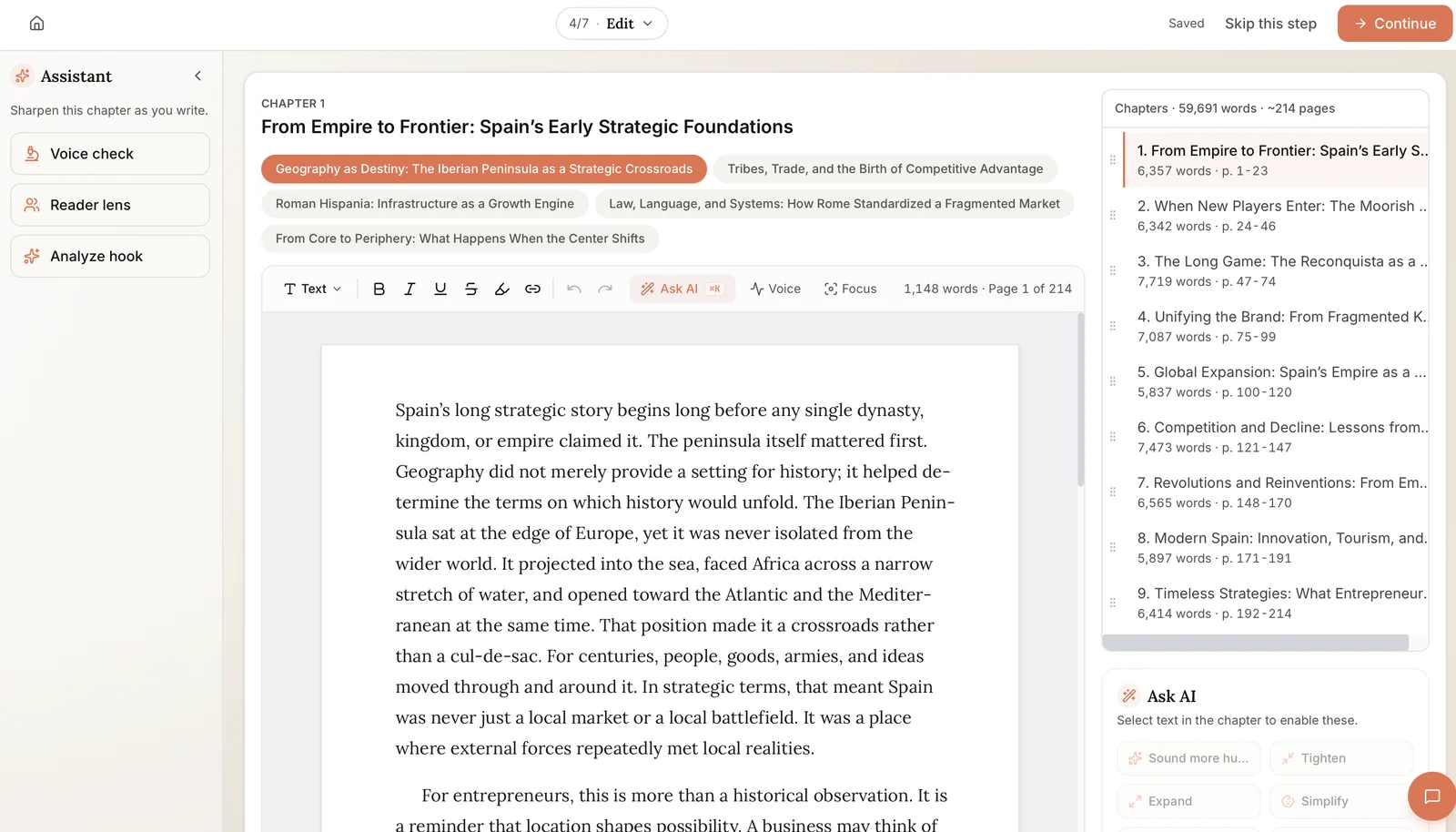
Text in the image: Left: "Voice check", "Reader lens", "Analyze hook". Toolbar: "Ask AI", "Voice", "Focus". Right: "Chapters, 59,691 words, ~214 pages"; "Ask AI": "Select text in the chapter to enable these.", "Sound more human", "Tighten", "Expand", "Simplify".
| Step | On your own | With Built&Written |
|---|---|---|
| Gather your memories | Copy them into one file by hand | Paste or upload them as they are |
| Order them into chapters | Sort a list or index cards | A chapter plan you approve first |
| Draft in your voice | Write every chapter | Drafted from your material and samples |
| Layout and cover | Learn formatting software | Made in the app, and you can change both |
| Upload to Amazon | You | You, with the files you download |
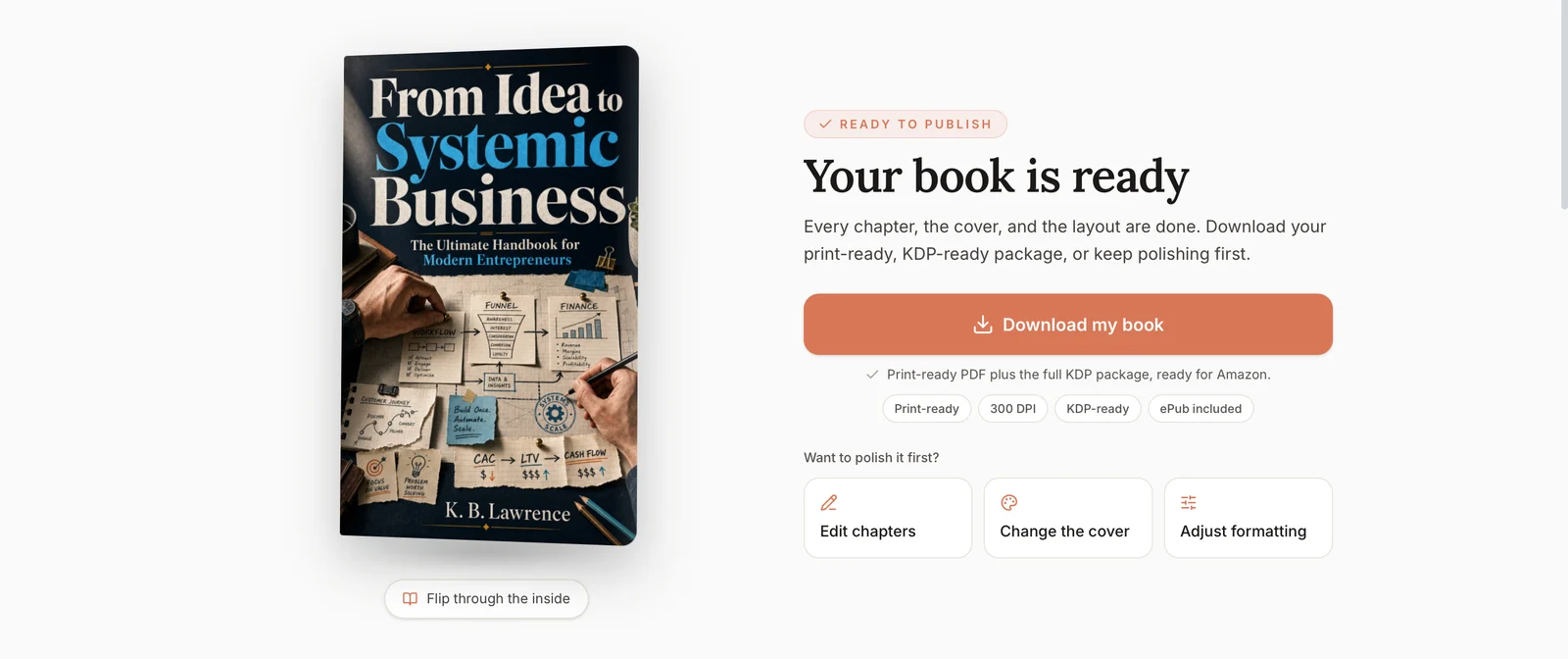
Text in the image: "Ready to publish". "Your book is ready". "Every chapter, the cover, and the layout are done. Download your print-ready, KDP-ready package, or keep polishing first." Button: "Download my book". "Print-ready PDF plus the full KDP package, ready for Amazon." Labels: "Print-ready", "300 DPI", "KDP-ready", "ePub included". "Want to polish it first?" Buttons: "Edit chapters", "Change the cover", "Adjust formatting".
Writing and downloading an AI-drafted book needs a plan with AI writing (see plans).
Your rights stay yours: under Built&Written's terms, you keep all rights to your book.
Would you rather write every word yourself? Built&Written also formats your finished manuscript, the complete text of your book, without changing a word. Then there is no AI-generated text to disclose.
Who owns a memoir you wrote with AI?
You own what you wrote, selected, arranged or changed. In the US, text an AI wrote on its own has no copyright, and prompts alone don't make you its author, as the US Copyright Office explained in 2023 and 2025. Keep your notes and drafts, because they show your part. Our guide on who owns a book written with AI explains registration step by step; this is general information, not legal advice.
Do you have to tell Amazon KDP your memoir used AI?
Yes, if AI wrote text that ended up in the book. Amazon KDP's content guidelines ask you to disclose AI-generated text, and it stays AI-generated "even if you applied substantial edits afterwards". Text you wrote and only improved with AI tools doesn't need disclosing. Our guide on KDP's AI disclosure shows the exact question and how to answer it.
Final thoughts
Let AI carry the sorting, the first drafts and the tightening, and keep the last read for yourself, one chapter at a time. If your stories already sit in journals, letters and posts, Built&Written turns them into a chapter plan you approve and chapters you edit in your own voice. See how it works.
Frequently asked questions
No, as long as the life, the choices and the final words are yours and you're honest about how the book was made. Using AI to sort notes or tighten sentences is closer to working with an editor than to handing someone your life.
The best one is the one that writes from your own text and lets you edit every line. A book tool such as Built&Written fits when you want your journals and letters turned into chapters, a layout and files for Amazon. General chat tools such as ChatGPT or Claude help you question your memories, brainstorm scenes and tighten a passage, but you assemble the book yourself.
It depends on the tool, so read its privacy policy before you paste anything personal. Look for two things: whether your text is used to train AI models, and who the tool shares it with. Built&Written's privacy policy names its AI providers, OpenAI, Anthropic and Google, and says they work under terms with no training on customer data.
It's optional, but many authors add one to the copyright page or the acknowledgments, such as "I used AI tools to help organize and draft this book from my own journals, and I checked every event and detail." It sets honest expectations, and the Authors Guild recommends disclosing substantial AI use.
Sources & References
- Vauhini Vara, "Ghosts", The Believer, August 9, 2021
- Authors Guild, "AI Best Practices for Authors", May 11, 2026
- Steven Rosenbaum, commentary in Fortune on The Future of Truth, October 6, 2026
- US Copyright Office, "Copyright Registration Guidance: Works Containing Material Generated by Artificial Intelligence", 88 Federal Register 16190, March 16, 2023
- US Copyright Office, "Copyright and Artificial Intelligence, Part 2: Copyrightability", January 29, 2025
- Amazon KDP, Content Guidelines, artificial intelligence (AI) content
- Built&Written, Privacy Policy (last updated November 2026)
About the author

Michael Pavlovskyi
More in Writing
Ready to write your book?
Turn your expertise into a professional book with Built&Written.