
In April 2026, Kobo's chief executive, Michael Tamblyn, gave a keynote at the CONTEC conference in Buenos Aires. He said Kobo Writing Life had rejected 45% of the titles submitted to it in 2025. He put more than 80% of those rejections down to books he judged to be AI-generated and of very poor quality (The Next Web, June 26, 2026).
That number frightens a lot of authors who used AI honestly. It should not. Most stores do take books made with AI. What changes from store to store is the line they draw, and what they ask you to tell them.
So if your nonfiction book is finished and AI helped write it, this is the map. We checked the rules of eight stores on their own pages on November 23, 2026. The table below shows where each one stands.
Skip to the store-by-store table
Do stores accept AI-written books?
Yes, most of them do, on terms. An AI-written book is one where an AI tool produced some or all of the text. Stores use two other words for the difference that matters to them: AI-generated (the AI wrote it) and AI-assisted (you wrote it and used AI to edit, check or brainstorm).
Every store we checked handles AI in one of three ways:
- Disclose it. The store accepts AI-generated books, but you must say so at upload. Amazon KDP, Apple Books and Barnes & Noble Press work this way.
- Refuse books made only by AI. The store accepts AI help, but turns away books an AI produced with little human work. IngramSpark, Draft2Digital and Kobo work this way.
- Judge the quality. The store has no AI rule at all, only rules against spam and poor books. Google Play Books works this way.
None of the eight bans a book just because AI touched it.
Which stores accept AI books, side by side
Here is what each store says, in its own terms. The sections below link to the page we read for each one.
| Store | Accepts AI-generated books? | What you must do | Checked |
|---|---|---|---|
| Amazon KDP | Yes | Tell KDP about AI-generated text, images or translations when you publish. AI-assisted needs no notice. | Nov 23, 2026 |
| IngramSpark | Only with significant human editing | Declare AI use at title setup and credit it in the contributor fields | Nov 23, 2026 |
| Barnes & Noble Press | Yes, on its content policy | Answer the AI questions in Build-a-Book; it is required before publishing | Nov 23, 2026 |
| Apple Books | Yes | Add the "AI Generated by" role and say so in the description | Nov 23, 2026 |
| Kobo Writing Life | Wholly or partly AI-generated books can be declined | No disclosure field described; quality is reviewed | Nov 23, 2026 |
| Draft2Digital | Only after extensive human editing | Nonfiction authors may need to show subject expertise | Nov 23, 2026 |
| Google Play Books | No AI rule published | Meet the spam and content-quality rules | Nov 23, 2026 |
| Built&Written Marketplace | Yes | Pick the true label for how the book was written | Nov 23, 2026 |
The table is a summary. Read each store's own wording below before you upload, because the words "AI-generated" do not mean the same thing everywhere.
Amazon KDP: disclose AI-generated, not AI-assisted
Amazon KDP accepts books made with AI. Its Content Guidelines ask you to tell KDP about AI-generated content when you publish a new book, or edit and republish one.
KDP defines AI-generated content as "text, images, or translations created by an AI-based tool." AI-assisted content is work you created yourself and then used AI to edit, refine or error-check. KDP says you do not need to tell it about AI-assisted work.
Two details catch people. First, images count: KDP says AI-generated images include cover and interior images. Second, KDP says content an AI tool created is still AI-generated "even if you applied substantial edits afterwards."
Our full guide to disclosing AI on KDP walks through the publishing form.
IngramSpark: AI help is fine, AI-only books are not
IngramSpark sells to bookstores and libraries. Its content guidelines list what it accepts and what it refuses.
It accepts three kinds of AI use. AI used "only in an assistive way" is fine. So is a book where most of the work is human. So is AI work that had "significant and material human editorial review." It refuses "works created solely using generative AI."
At title setup, IngramSpark asks about AI use. Its help article on AI disclosure and attribution also asks you to credit AI in the contributor fields. Its example is the role "Assisted By" with the name "Generative AI," placed right after the person it helped. IngramSpark says it is not passing this disclosure to the market.
One more warning on that page: your titles "may not be accepted by every channel." Each store IngramSpark sends to can apply its own rules. Our article on the IngramSpark AI policy covers the setup screens.
Barnes & Noble Press: say which parts AI made
Barnes & Noble Press asks about AI while you build the book. Its help article on generative AI in your project lists four parts it asks about: the cover or artwork, the manuscript, images and translations.
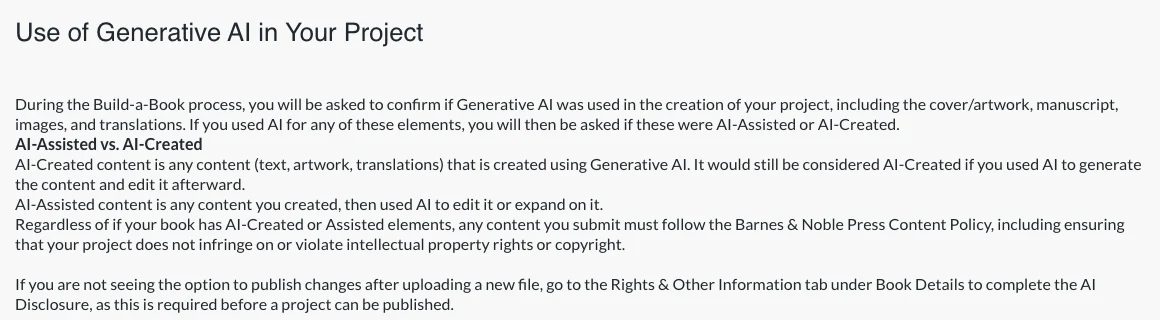
If you used AI for any part, B&N asks whether it was AI-Assisted or AI-Created. Like KDP, it counts an AI draft that you edited afterward as AI-Created. Either way, the book must follow the B&N Press Content Policy.
The disclosure is required. If the publish option does not appear after a new upload, B&N says to finish the AI Disclosure under Rights & Other Information. Our article on whether Barnes & Noble accepts AI books explains how that differs from getting into stores.
Apple Books: label the book and the description
Apple Books puts its rule in section 1.13 of its Formatting and Content Guidelines.
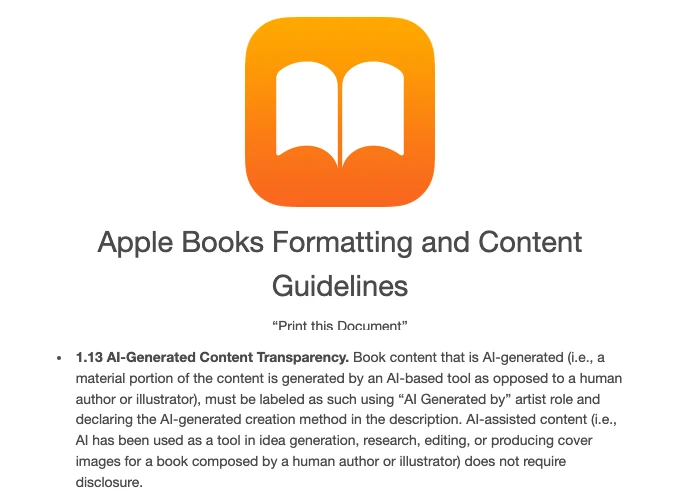
Apple calls a book AI-generated when a material portion of it came from an AI tool. That book needs the "AI Generated by" artist role in its metadata. The description must also state it, "to avoid customer confusion."
AI-assisted books need no disclosure. Apple's list of AI-assisted uses is wider than KDP's: idea generation, research, editing and producing cover images for a book a human wrote.
So the same cover can be disclosed on KDP and not on Apple. Read each store on its own terms.
Kobo Writing Life: quality decides
Kobo Writing Life has no disclosure question that we could find. Instead, its help page on why a book was rejected or blocked lists "wholly or partially AI generated" books among those that give readers "an unsatisfactory or incomplete experience."
That is the rule behind Tamblyn's rejection numbers. The Next Web notes two caveats: the 45% is the share of submissions rejected, not the share of AI books. Tamblyn also said Kobo's detection software sometimes mistakes human writing for machine output.
Kobo's FAQ also says it does not feed books into anyone's large language model or use them to train one.
Draft2Digital: extensive human editing, and a list of crowded topics
Draft2Digital sends ebooks to many stores at once. Its content guidelines, last updated October 27, 2025, support AI-assisted content. They refuse content "generated entirely by AI/LLMs that has not gone through extensive editing from a human."
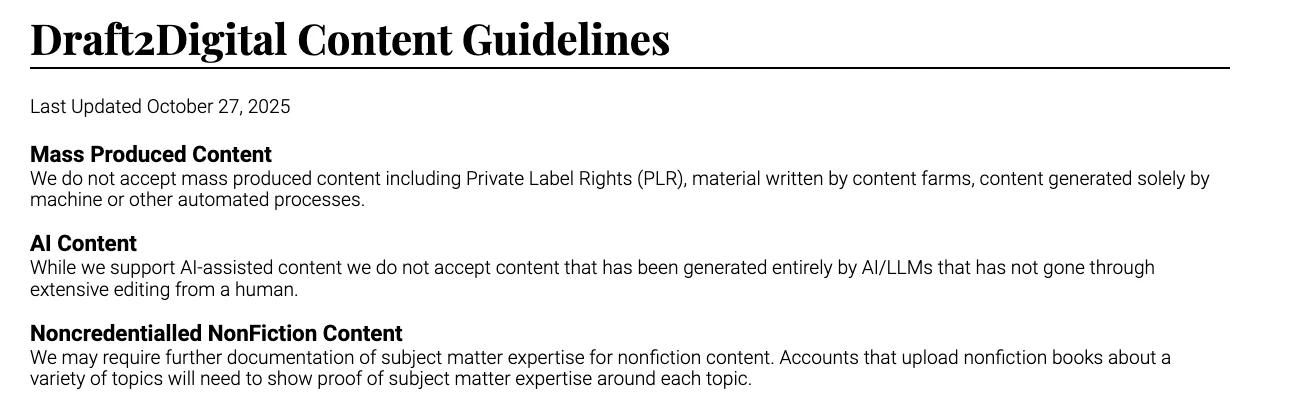
Two other rules on that page matter more for nonfiction authors. Draft2Digital may ask for proof of subject expertise, especially from accounts that publish on many topics. It also refuses topics its partners call oversaturated.
That list includes cookbooks, diet books, meditation, mindfulness, intermittent fasting, generic marketing advice and generic how-to books. It applies to every book on those topics, AI or not. Our Draft2Digital review covers its fees and what each store paid in our test.
Google Play Books: no AI rule, strict quality rules
The Publisher Content Policies for Google Play Books do not mention AI-written books. We read the whole page on November 23, 2026.
What the page does ban could still catch a weak AI book. Google prohibits "gibberish, nonsensical, or repetitive text." It also bars content "easily found online at no charge." Books that lack "depth and curation" fail too. It reviews books with a mix of automated and human checks.
What counts as AI-generated changes from store to store
This is the part most guides skip. Take one example book, written to show the difference: you gave an AI your notes, it drafted every chapter, and you rewrote a third of each one.
The safe habit is simple. Answer each store's question honestly, in that store's own words, and keep notes on what the AI did and what you did. If the AI wrote most of a chapter, say so.
Disclosure also belongs inside the book for some topics. For health or money books, our page of AI book disclaimer examples has wording you can adapt.
Where Built&Written fits
Built&Written writes and formats books; it does not upload them anywhere. You download the print PDF and ebook files and upload them to each store yourself. Our ebook generator page shows the files you get, and our guide to choosing a self-publishing platform helps you pick the first store.
If Wren, our writing AI, wrote your chapters, treat the book as AI-generated on KDP and AI-Created on B&N Press. Check Apple's "material portion" test and IngramSpark's editing test against what you actually changed.
The Built&Written Marketplace is the eighth store in the table. Every book listed there states how it was written: written by the author, written with AI assistance, or generated with AI and edited by the author. The label appears in the book's details, a person reviews each listing, and a false label breaks the policy.
The Marketplace sells ebooks only. Authors keep 80% of the net amount of each sale after tax and the card fee, under the Seller Terms. One catch: a book shown there cannot be enrolled in KDP Select, because every book page carries a free sample. See how selling your book on Built&Written works.
Writing a book with Wren is $49/month for AI-written books ($19/month for your own manuscript). Every plan comes with monthly credits for the AI, and you see what a book will cost before Wren writes it.
Sources & References
- The Next Web, Kobo rejects 45% of self-published books, citing AI (June 26, 2026): https://thenextweb.com/news/kobo-rejects-45-percent-self-published-books-ai
- Amazon KDP, Content Guidelines: https://kdp.amazon.com/en_US/help/topic/G200672390
- IngramSpark, Content Guidelines: https://www.ingramspark.com/content-guidelines
- IngramSpark Support, AI Disclosure and Attribution: https://help.ingramspark.com/hc/en-us/articles/46042242163597-AI-Disclosure-and-Attribution
- B&N Press Help, Use of Generative AI in Your Project: https://help-press.barnesandnoble.com/hc/en-us/articles/28267750176923-Use-of-Generative-AI-in-Your-Project
- Apple, Apple Books Formatting and Content Guidelines: https://help.apple.com/itc/applebooksstoreformatting/en.lproj/static.html
- Kobo Writing Life Help, Why was my book rejected or blocked: https://kobowritinglife.zendesk.com/hc/en-us/articles/360058975712-Why-was-my-Book-Rejected-or-Blocked
- Kobo Writing Life Help, FAQ: https://kobowritinglife.zendesk.com/hc/en-us/articles/37446931721883-FAQ
- Draft2Digital, Content Guidelines (updated October 27, 2025): https://draft2digital.com/content-guidelines
- Google Play Books Partner Center Help, Publisher Content Policies for Google Play Books: https://support.google.com/books/partner/answer/1067634?hl=en
- Built&Written, Content Policy and Seller Terms: https://www.builtwritten.com/legal/seller-terms
Frequently asked questions
Yes. Amazon KDP's Content Guidelines ask you to tell KDP about AI-generated text, images or translations when you publish or republish a book. AI-assisted work, where you wrote the content and used AI to edit or check it, needs no notice. KDP counts AI content as AI-generated even if you applied substantial edits afterwards.
It depends on the store. Apple Books requires the AI Generated by role in the metadata and a statement in the description, which customers can see. IngramSpark says it collects AI disclosures but is not passing them to the market. On the Built&Written Marketplace, the label for how the book was written appears in the book's details.
Both turn away books an AI produced with little human work. Kobo's help page lists wholly or partially AI-generated books among those that give readers an unsatisfactory experience. Draft2Digital refuses content generated entirely by AI without extensive human editing, may ask nonfiction authors for proof of expertise, and refuses some crowded topics such as cookbooks and diet books.
On Amazon KDP, yes: its guidelines say AI-generated images include cover and interior images, so an AI cover is disclosed. Apple Books treats producing cover images with AI, for a book a human wrote, as AI-assisted, which needs no disclosure. Barnes & Noble Press asks separately about the cover or artwork during Build-a-Book.
Sources & References
- The Next Web, Kobo rejects 45% of self-published books, citing AI
- Amazon KDP, Content Guidelines
- IngramSpark, Content Guidelines
- IngramSpark Support, AI Disclosure and Attribution
- B&N Press Help, Use of Generative AI in Your Project
- Apple Books Formatting and Content Guidelines
- Kobo Writing Life Help, Why was my book rejected or blocked
- Kobo Writing Life Help, FAQ
- Draft2Digital, Content Guidelines
- Google Play Books, Publisher Content Policies
- Built&Written, Seller Terms
About the author