

What an AI Memoir Generator Actually Does With Your Life Story
Key takeaways
- How do your stories get in? As typed answers, pasted notes and files, or speech that a service turns into text.
- Who decides the chapters? The tool proposes them; the better ones show you the plan before writing.
- What goes wrong most? Added details, softened people and a voice that sounds like everyone else's.
- What should you check before you start? Which AI companies see your stories, and whether they train on them.
An AI memoir generator is software that turns your memories into book chapters with a language model, the kind of AI behind ChatGPT. A memoir is one slice of your life told by you: a business you built, a move, an illness, a decade. A whole life story is a different job, covered in our guide to the AI biography generator.
Step 1: How does your life story get into the tool?
Every service needs your stories as text before it can write. There are three ways in.
You type answers to prompts. Squibler starts with one box: "Describe your story. Summarize key moments, time period, people, and emotions."
You talk, and the service writes it down. Storii calls the storyteller up to 3 times a week with a question from its library; they answer by pressing 1 on the phone's keypad. Storii "records and transcribes the calls".
You paste notes or upload files. Journals, letters, emails and old posts go in as they are, with the scenes already in your words.
A transcript is the first place errors enter: a misheard name or date travels into every chapter after it. Read it before anything gets written from it.
Step 2: How are memories sorted into themes and chapters?
Next, the tool proposes a structure. A chapter plan (an outline) is the list of chapters in order, with a line on what each one covers.
BookFoundry shows how this can work. You pick a format, an era and up to six themes. The tool then pulls out the events it found in your text and shows you the list. The page says: "Nothing is written from a fact you did not confirm."
Storii keeps it simpler: you can remove, reorder or add questions before they are asked, so you choose which stories it collects and when.
This is the cheapest moment to fix a memoir: moving a chapter in a plan takes seconds. Our article on the AI outline generator shows how to judge a chapter plan before you approve it.
Step 3: How does the AI write the draft, and in whose voice?
Then the model writes. It reads your material plus instructions (tone, reader, length) and produces the sentences most likely to fit them. It only knows what you gave it.
Squibler describes two clicks: "Generate" makes an opening draft, then "Generate Full-Length Book" turns it into a memoir "with chapters and flow". BookFoundry says your answers become "a voice directive and a reader profile that travel with every chapter".
Voice is the hard part. A model copies your voice from samples of your writing; with none, it falls back to a smooth, neutral style. Our guide to an AI writing style that sounds like you shows what a good sample looks like. Our test of AI chapter generators shows how far drafts drift.
Step 4: What does an AI memoir generator give you at the end?
What comes out depends on the service.
- Your words as told. Storii lets you download an audiobook or a transcribed ebook PDF at any time.
- Editable files. Squibler exports "a PDF, Word document, or Kindle file". BookFoundry exports DOCX (a Word file), EPUB (the standard ebook file) and a PDF "built to the specifications Amazon KDP expects". KDP (Kindle Direct Publishing) is Amazon's service for selling your book in print and as an ebook.
Editable files give you the most control: you fix any line, then print copies or sell the book.
How does Built&Written turn your stories into a memoir?
The usual problem with a memoir is that the stories sit in ten places: a journal, old emails, posts, things you only ever said out loud. Built&Written starts from that pile and gives you a say at each stage above.
| Stage | What to check in any generator | In Built&Written |
|---|---|---|
| Stories go in | Which formats it takes, and how much | Paste text or upload PDF, DOCX, RTF, TXT or MD, up to 50,000 words of source material; the microphone button types what you say, in browsers that support dictation |
| Chapters get planned | Whether you see the plan before writing | Wren, the AI writer inside Built&Written, proposes an outline; you rename, reorder or cut chapters first |
| The draft gets written | Whose voice it uses | Voice DNA learns your voice from a few pages of your writing; you change any line by hand or select a passage to tighten or simplify |
| The book comes out | What files you get | A cover, the layout, a print PDF and KDP files you upload to Amazon KDP yourself; Built&Written doesn't print books or publish for you |
Writing and downloading an AI-drafted book needs a plan with AI writing (see plans). On data: Built&Written's privacy policy names OpenAI, Anthropic and Google as its model providers, with no training on customer data.
What it does with real notes. We tested this on November 5, 2026, with notes from a made-up business owner, saved in the app's Your writing library:
| His notes | The opening of chapter 1 |
|---|---|
| "I run a bookkeeping firm with 9 people. I started it alone in 2014. Until 2021 we billed every client by the hour, at $85 an hour." | "I run a bookkeeping firm with nine people now, but I started it alone in 2014. For a long time, we billed every client by the hour at $85 an hour. It seemed straightforward, but it created a real problem for both sides." |
All 8 facts in his notes made it into the chapter, with no new numbers or names. One story came back three times, so you still edit.
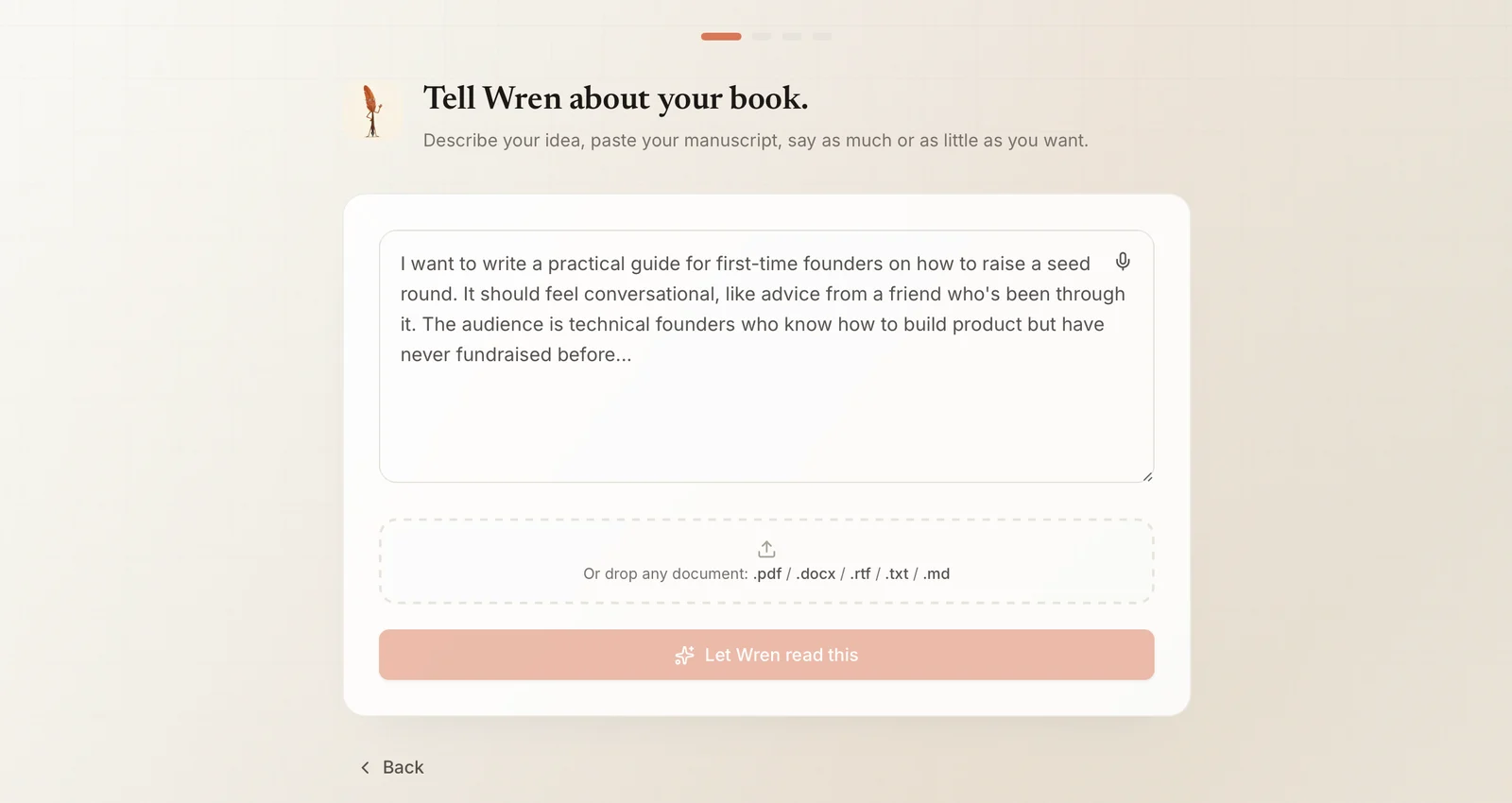
Text in the image: "Tell Wren about your book." "Describe your idea, paste your manuscript, say as much or as little as you want." "Or drop any document: .pdf / .docx / .rtf / .txt / .md". "Let Wren read this". "Back".
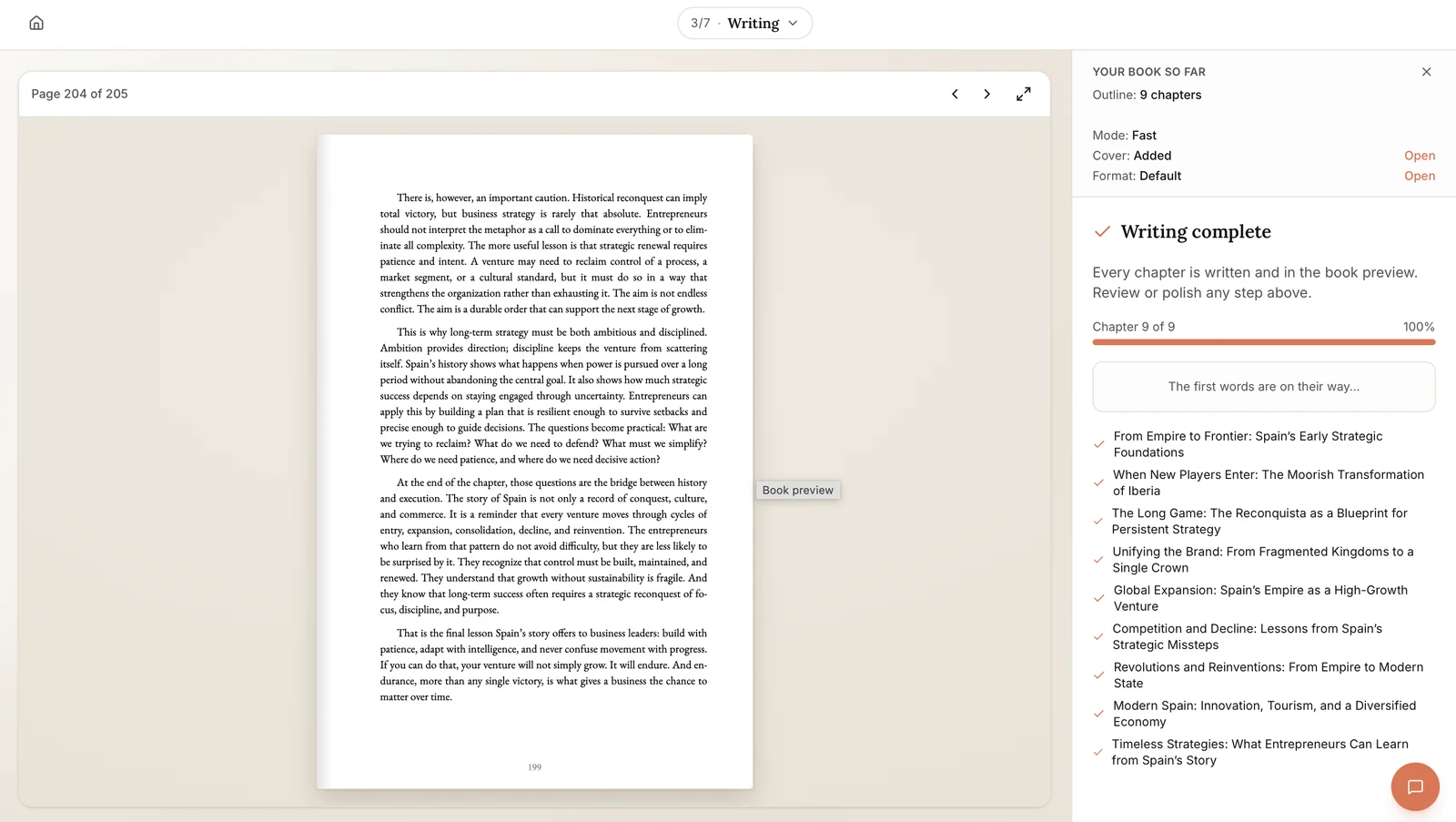
Text in the image: "Your book so far." "Outline: 9 chapters." "Writing complete." "Every chapter is written and in the book preview. Review or polish any step above." "Chapter 9 of 9, 100%."
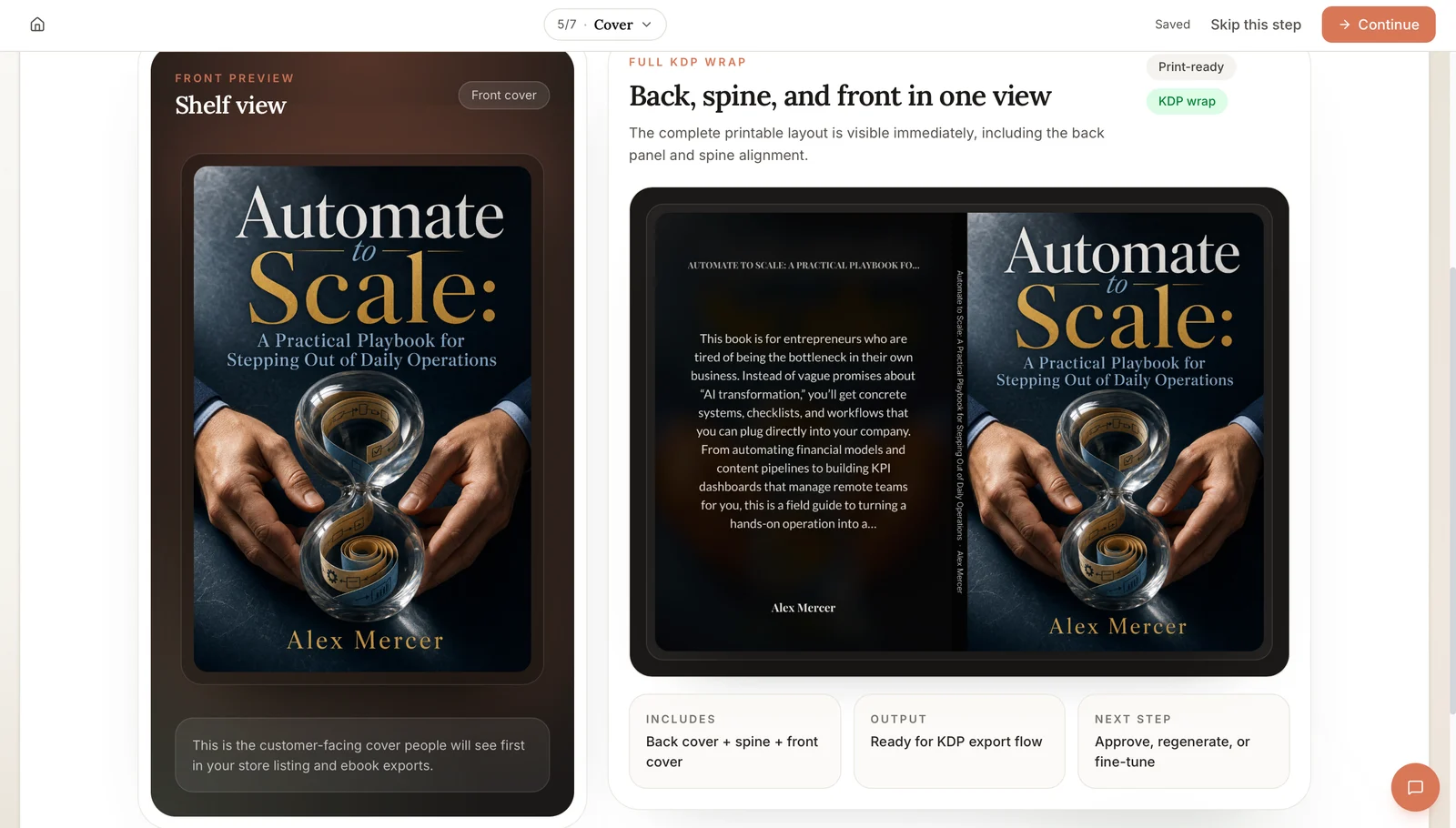
Text in the image: "Shelf view." "Full KDP wrap. Back, spine, and front in one view." "Print-ready." "Output: Ready for KDP export flow." "Next step: Approve, regenerate, or fine-tune."
If you've already written your memoir, Built&Written can also format the finished manuscript (the full text of your book) for print without changing a word.
Where does an AI memoir generator go wrong?
Watch for three problems.
| What goes wrong | What it looks like | How to catch it |
|---|---|---|
| Invented details | A rainy night, a smell, a line of dialogue you never mentioned | Mark every detail you can't find in your own notes |
| Smoothed people | Your difficult father becomes "a man of few words" | Compare each person in the draft with how you described them |
| Flattened voice | Your short, blunt sentences turn into long polished ones | Read a page out loud; stop where you would never say it that way |
Start with invented details. When we gave ChatGPT 150 words of notes with 12 facts for our AI biography test, it kept all 12 and added 3 of its own, and 1 of them was wrong. Some vendors promise otherwise: Squibler's page says its tool "does not invent facts or fill in memories you did not share". Check anyway.
Smoothed people matter most in a memoir, because real people will read it. Run each passage about a real person through the checklist in our guide on how to write a memoir.
What happens to your stories and data?
A memoir holds private things: health, money, family fights. Before you paste them anywhere, find four answers in the privacy policy.
- Who stores it? Storii says answers are "recorded, transcribed and stored to the Storyteller's online profile".
- Which AI companies see it? If a tool sends your text to an outside model provider, such as OpenAI or Google, a good policy names it.
- Does anyone train on it? Look for a plain sentence that your content is not used to train AI models.
- Can you delete it? Find out how, and how long deleted text is kept.
BookFoundry's page says "Nothing is published or shared unless you choose to share it", but it doesn't say whether your text trains a model. When a page doesn't say, ask the company before you upload.
Final thoughts
Before you upload anything, split your stories into two files: the ones you'd tell a stranger and the ones you wouldn't. Start with the first file, read one finished chapter, and only then decide what else the book needs. If that first file is already long, Built&Written can start from it today: you approve the plan before a chapter is written, and every line stays yours to change. See how it works.
Frequently asked questions
Less than a book, but more than a paragraph. Limits vary: BookFoundry's description box takes 40 to 6,000 characters, while other tools accept long files. The more scenes you write yourself, the less the AI has to guess. Ten memories of a few paragraphs each, with names, places and years, is a good start.
Edit it, or ask for a new one. Most tools let you change every line by hand. In Built&Written, you can rewrite any line by hand as often as you like, and the chapter plan can be rebuilt before writing starts. If only one passage is off, select it and pick an option such as Simplify or Sound more human.
Yes. Once a draft exists, each chapter is ordinary text you can replace by hand, so you can paste in a chapter you wrote years ago. Use your own chapters as the voice sample too, so the drafted ones sound closer to them. Read the joins between chapters twice: that is where a change of voice shows.
It depends on the tool, so check before you start. Built&Written writes in 30 languages and picks the book's language from your text; you can change it before writing. It doesn't translate a finished book into another language, so if you want two versions, start each one from material in that language.
Sources & References
- Squibler, "AI Memoir Writer" product page
- BookFoundry, "AI Memoir Writer" product page
- Storii, homepage (how the calls, transcripts and downloads work)
- Built&Written, "How to Write Your Life Story With an AI Biography Generator" (ChatGPT test: 12 facts kept, 3 added, 1 wrong), November 3, 2026
- Built&Written, Privacy Policy (model providers and training), updated November 2026
About the author

Michael Pavlovskyi
More in Writing
Ready to write your book?
Turn your expertise into a professional book with Built&Written.