

How to Write a Book About Your Life That People Want to Read
Key takeaways
- What comes first? The form of the book, before a single chapter.
- Who is it for? Family readers want names and dates; strangers want a story that goes somewhere.
- Where does the material come from? From what you already have, typed up as text.
- How does it become a real book? Print a handful of copies, or publish on Amazon KDP, Amazon's own publishing service, and order copies at print cost.
What kind of book about your life should you write?
Writing a book about your life starts with its form. The form decides what goes in, how long the book gets and who will enjoy it. A book about your life usually takes one of four forms.
| Form | What it covers | Pick it when |
|---|---|---|
| Memoir | One stretch or theme of your life, told as a story | One period changed you, and others could learn from it |
| Autobiography | Your whole life in order, from childhood to now | You want a full record, often for your family |
| Family or legacy book | Your life plus your family's roots, photos, recipes and sayings | The book is a gift to children and grandchildren |
| Collection of stories | Short stories from your life, each complete on its own | You tell great stories at dinner but don't see one big arc |
A legacy book is a book written to pass your story, values and family history to the next generation. It often mixes text with photos, letters and documents.
The steps for how to write an autobiography are the same; an autobiography simply covers your whole life in order. If one stretch of your life is the whole point, you're writing a memoir, and our step-by-step guide on how to write a memoir covers that form.
Who is your life story for?
Decide who will read the book before you choose what goes in. There are two very different readers.
Your family. They already know the people, the town and the jokes. They want details: names, dates, where the house stood, what your first job paid. A book for them can be short and loose. It can include family trees, recipes and photo pages that strangers would skip.
Readers who don't know you. They don't care about your cousin's name. They read for a problem, a change or a question that gets answered, and they stop when nothing happens. A book for them needs a clear shape and fewer side stories.
A quick test: picture handing the book to your grandchild, then to a stranger on a train. Write for one of them.
How to write your life story from material you already have
You have more material than you think. Find it, put it in one place and turn it into text.
- Make one box and one folder. The box holds paper: letters, cards, diaries, certificates and photos. The folder on your computer holds everything digital.
- Search what you've already written. Old emails, social posts, blog posts, speeches, holiday letters and journals often hold whole scenes. Copy the best ones into one document.
- Use photos as prompts. Write a few lines under each photo: who, where, when, and what happened just before it was taken.
- Talk it through. Many people tell their story better than they write it. Ask a family member to interview you and record the talk on your phone. StoryCorps publishes free lists of questions for grandparents and parents. One example: "Where did you grow up?" Some apps and AI tools do the asking for you; our guide to AI biography generators compares them.
- Turn recordings into text. A book is made of text, so type up or transcribe what you record. Google Docs has voice typing that turns your speech into text as you talk, in recent versions of Chrome, Edge and Safari. Read the result once and fix names and places.
- Sort everything into piles. Make one pile per period, person or theme. Each pile can become a chapter, and our book outline template shows how to turn piles into a chapter plan.
How to write a book about your life with Built&Written
The hard part is turning a box of letters, old posts and hours of transcripts into chapters that read in order.
Built&Written starts from that pile and turns it into a nonfiction book in your voice. You paste text or upload files (PDF, Word, RTF, TXT or Markdown), up to 50,000 words; it works from text, so transcribe recordings first or dictate into the box in browsers that allow it. You choose the tone and length, approve the chapter plan, and edit every chapter it drafts, while Voice DNA learns how you sound from a few pages of your own writing.
What it does with real notes. We tested this on November 5, 2026, with notes from a made-up business owner, saved in the app's Your writing library. Three sentences of notes became the first lines of chapter 1, in his own first person:
| His notes | The opening of chapter 1 |
|---|---|
| "I run a bookkeeping firm with 9 people. I started it alone in 2014. Until 2021 we billed every client by the hour, at $85 an hour." | "I run a bookkeeping firm with nine people now, but I started it alone in 2014. For a long time, we billed every client by the hour at $85 an hour. It seemed straightforward, but it created a real problem for both sides." |
All 8 facts in his notes made it into the chapter, with no new numbers or names. One story came back three times, so you still edit.
Here is what changes compared with doing it yourself:
| Step | By hand (Word, Google Docs or ChatGPT) | With Built&Written |
|---|---|---|
| Getting everything in one place | Copy letters and transcripts into one document | Paste text or upload the files as they are |
| Putting the chapters in order | Sort your piles into a plan yourself | A chapter plan you approve before writing |
| Writing the chapters | Type every chapter, or paste pieces into ChatGPT one at a time | Each chapter drafted from your material, in your voice |
| Layout and cover | Learn page setup and design a cover | Done in the app, and you can change both |
| Files for printing | Export them and check them yourself | A print-ready PDF and the KDP files to download |
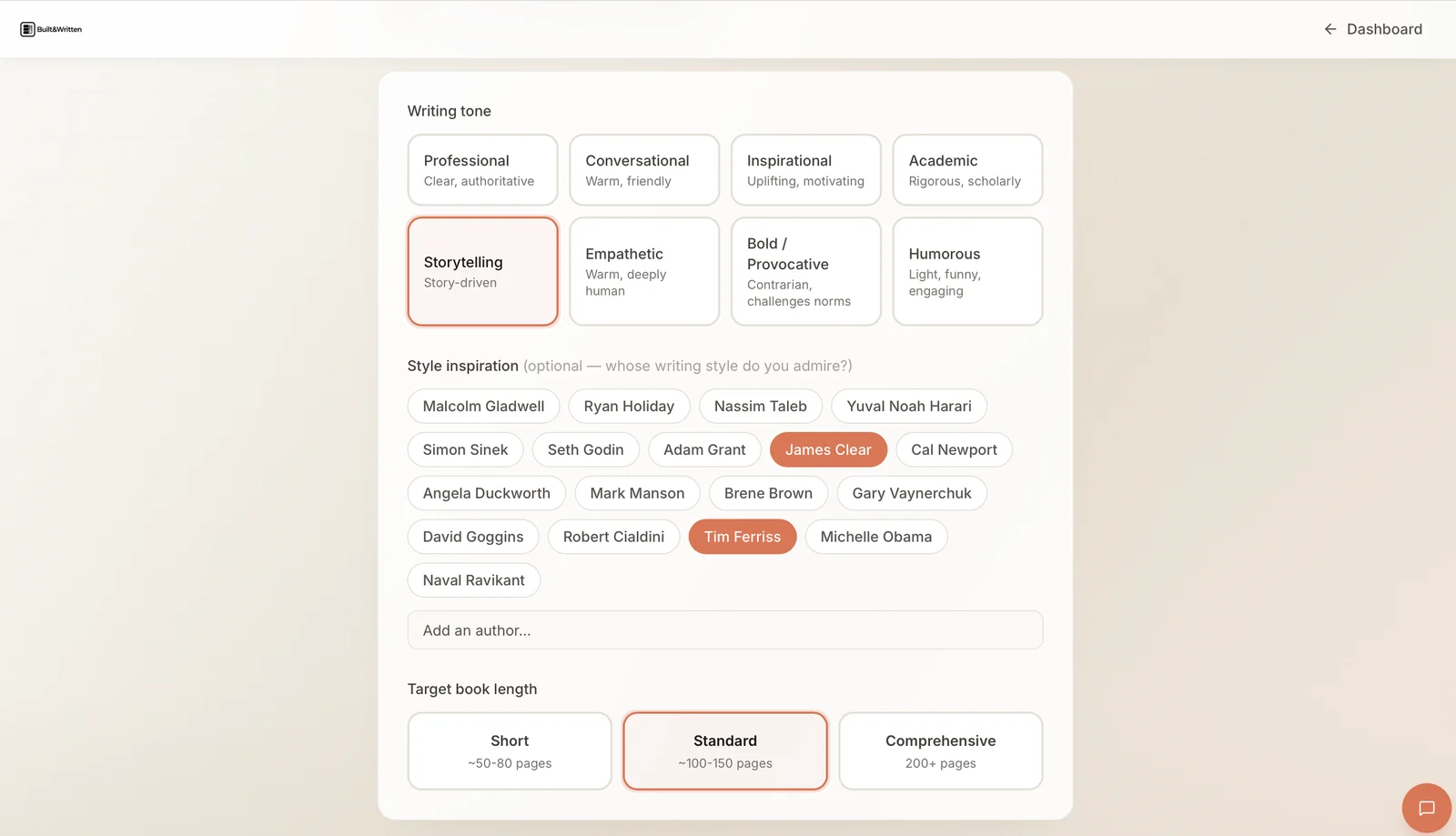
Text in the image: "Writing tone": "Professional", "Conversational", "Inspirational", "Academic", "Storytelling, Story-driven" (selected), "Empathetic", "Bold / Provocative", "Humorous". "Style inspiration (optional, whose writing style do you admire?)" with names such as "Michelle Obama", "James Clear" and "Tim Ferriss". "Target book length": "Short ~50-80 pages", "Standard ~100-150 pages" (selected), "Comprehensive 200+ pages".
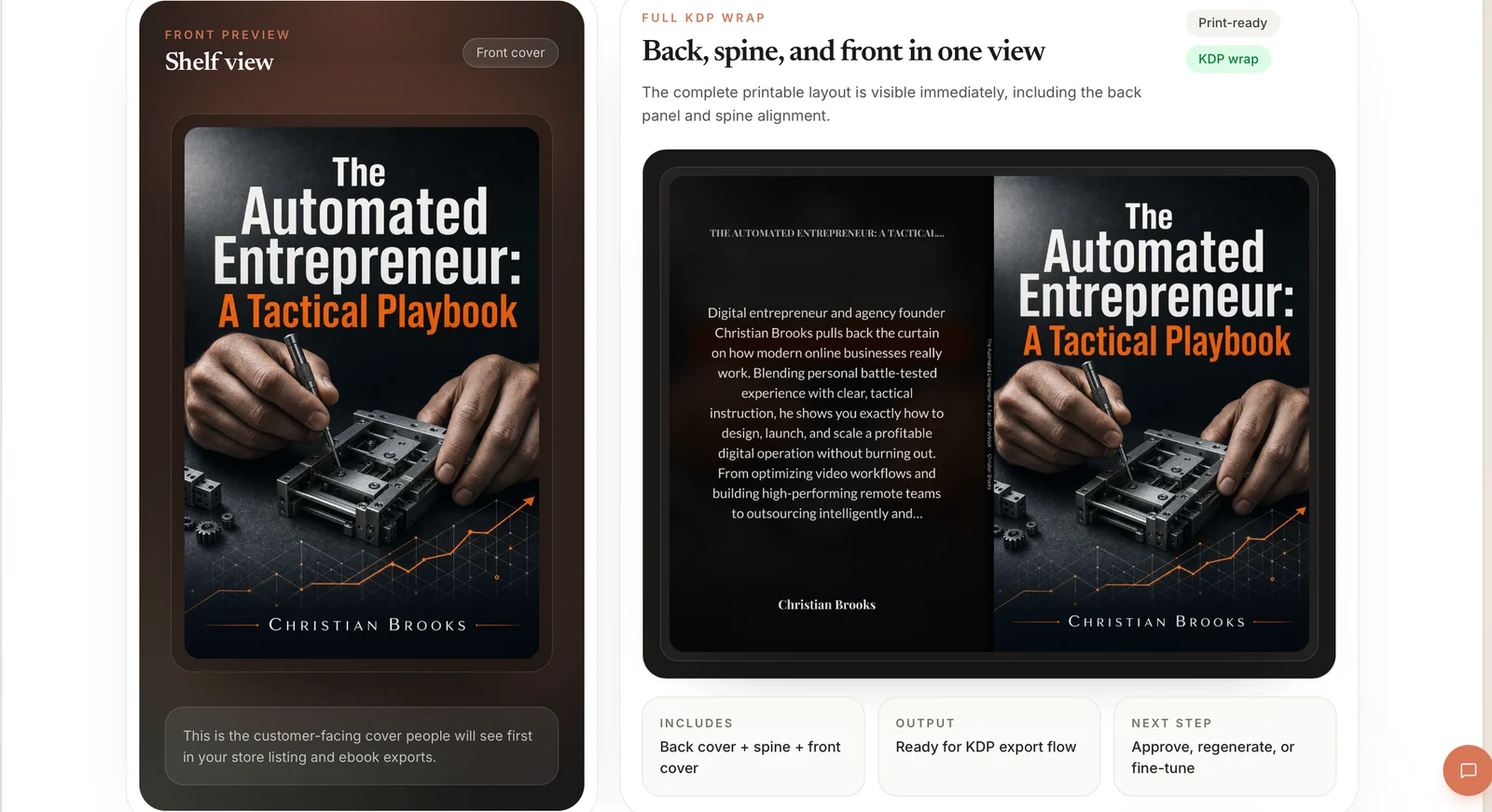
Text in the image: "Front preview", "Shelf view", "Front cover". "Full KDP wrap": "Back, spine, and front in one view." "The complete printable layout is visible immediately, including the back panel and spine alignment." Labels: "Print-ready", "KDP wrap". "Includes: Back cover + spine + front cover". "Output: Ready for KDP export flow". "Next step: Approve, regenerate, or fine-tune".
Writing and downloading an AI-drafted book needs a plan with AI writing (see plans).
What you end up with is a finished, laid-out book with a cover, as files you keep. You stay the publisher: you choose the printer and the number of copies, as the section on printing below shows. If you'd rather type every word yourself, Built&Written also formats your finished manuscript (the full text of your book) without changing a word.
What should you put in a book about your life, and what should you leave out?
Put in what your reader can't get anywhere else. Leave out what only matters to you, or what could hurt someone who never agreed to be in the book.
Put in:
- Turning points: a move, a marriage, a lost job, a business started, a child born.
- Everyday details that are gone now: prices, streets, how a kitchen looked, what people did on a Sunday.
- The lessons you'd tell a grandchild, told through the moment you learned them.
- For a family book: full names, dates and places, so later generations can trace them.
Leave out:
- A chapter for every year. Skip the years where nothing changed.
- Old scores to settle. A book is a poor place to win an argument.
- Private or unchecked details about living people. Run every passage about a real person through the checklist in our memoir guide.
How long does a book about your life need to be?
There's no required length. A book about your life needs to be long enough to tell its stories, and no longer.
- Family book or story collection: often short. Twenty stories of 1,000 words each make a 20,000-word book, and that's a real book.
- Memoir or autobiography for strangers: much longer, because it has to hold a reader who has never met you. The memoir guide gives the usual range.
- The floor: a paperback on Amazon KDP needs at least 24 pages. KDP (Kindle Direct Publishing) is Amazon's service for publishing and printing your book.
Font, line spacing and trim size (the final size of the printed page, such as 6 x 9 inches) all change the page count, as our article on how many pages 50,000 words makes shows. To check your own number, use the word count to pages calculator.
Should you print a few copies or publish on Amazon?
Pick the way out that matches the reader you chose earlier.
A few copies for family. Lulu, a print-on-demand service, prints each copy when you order it, so you can order just a few. On Amazon KDP, you can also order up to 5 proof copies of a book that is still a draft, without publishing it. Proof copies carry a "Not for Resale" watermark and have no ISBN, the number that identifies a book in shops and libraries. They work better as a test print than as a gift.
Publish on Amazon. Publishing a paperback on Amazon KDP puts it on Amazon, where anyone can buy it. Once the book is live, you can order up to 999 author copies per order, offered at print cost. Shipping is extra, because these orders don't qualify for free or Prime shipping.
| A few copies for family | Publish on Amazon KDP | |
|---|---|---|
| Who gets the book | The people you give it to | Anyone who finds it on Amazon |
| How many copies | As few as you order on Lulu; up to 5 KDP proofs per order | Up to 999 author copies per order |
| What the copy looks like | KDP proofs carry a "Not for Resale" watermark | A normal paperback with an ISBN |
| Good for | Family book, legacy book, story collection | Memoir or autobiography for readers who don't know you |
You can also do both: publish on Amazon, then order author copies for the family. Our comparison of self-publishing platforms covers other routes.
Final thoughts
Start with the stories you already tell at dinner and the box you already kept; twenty of them make a real family book. If that material sits in folders, posts and transcripts, Built&Written turns it into a chapter plan you approve and a book you can print. See how it works.
Frequently asked questions
Yes, as long as the memories come from you. AI tools can interview you, sort your notes and draft chapters from what you give them, but they can't know what happened in your life. Read every chapter against your notes, letters and photos, and fix any detail the AI added or got wrong. The stories, and the final word on what's true, stay yours.
Yes. A ghostwriter is a professional writer who writes a book in your name, usually after many hours of interviews with you. A family member can do a simpler version: interview you, record the talks and type them up. Either way, you supply the stories and check the draft.
Yes. Photos are often the heart of a family book. Scan them, give each one a short caption with who, where and when, and place it next to the story it belongs to. In Built&Written you can add PNG, JPG or WebP images inside chapters, up to 15 MB each, and they carry into the PDF you download.
Only if you sell it in stores. Lulu says a book needs one to be sold on sites other than its own bookstore. A paperback on KDP needs one, and KDP gives you a free ISBN for paperbacks that works only on KDP. Ebooks on KDP don't need one.
Sources & References
- Amazon KDP, "How do I order a proof or author copy?"
- Amazon KDP, "Proof and Author Copies"
- Amazon KDP, "Paperback Submission Guidelines" (minimum page count and trim sizes)
- Amazon KDP, "What is an ISBN and Imprint?"
- Lulu, "Create & Custom Print a Book Online"
- Lulu Help Center, "ISBN FAQ"
- StoryCorps, "Great Questions"
- Google Docs Editors Help, "Type & edit with your voice"
About the author

Michael Pavlovskyi
More in Writing
Ready to write your book?
Turn your expertise into a professional book with Built&Written.